
(7% discount is applied at checkout)
Cart is empty
Your go-to destination for cutting-edge server products
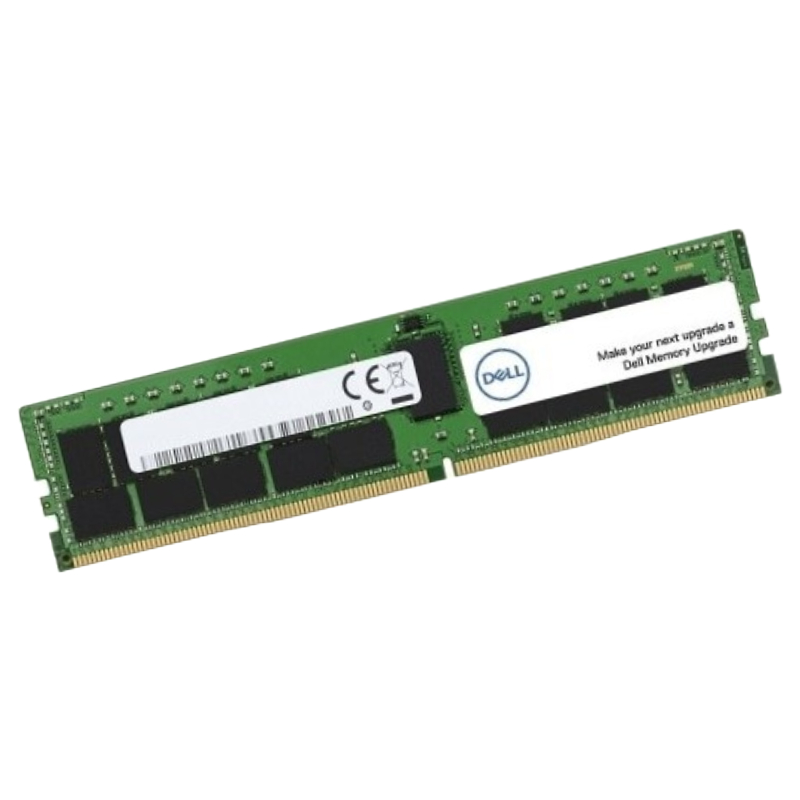
Dell 370-AHJR 8GB DDR4-3200MT/S ECC Registered RDIMM Server Memory Module. New Sealed in Box (NIB) - Samsung Version
The Dell 370-AHJR 8GB 3200MT/s PC4-25600 ECC CL22 Registered Single Rank X8 1.2v DDR4 SDRAM 288-Pin RDIMM memory module is designed for environments where stability, data integrity, and predictable performance matter above all else. This module combines the high transfer rate of 3200MT/s DDR4 technology with ECC (Error Correcting Code) and registered buffering to deliver a balanced mix of throughput and reliability necessary in modern enterprise servers. As a memory component built to the RDIMM form factor standard, it targets server-class motherboards and chipset implementations that require 288-pin DDR4 registered modules, supporting mission-critical workloads such as virtualization, database processing, large-scale web serving, and analytics where memory errors cannot be tolerated.
The headline specification, 3200MT/s, denotes the theoretical maximum data transfer rate for the memory bus under standard DDR4 tuning — a figure that translates into meaningful bandwidth improvements over lower-frequency DDR4 parts. PC4-25600 is another way to express the same bandwidth in terms of bytes per second, indicating the module’s peak theoretical throughput. ECC functionality actively detects and corrects single-bit errors and detects multi-bit errors, thereby reducing silent data corruption risks. Registered memory (RDIMM) includes a register between the memory controller and DRAM chips, which reduces electrical load on the memory bus when multiple modules are installed, enabling higher capacity configurations and improved signal integrity in multi-socket or multi-module server setups. The CL22 timing reflects the CAS latency characteristic and is a tradeoff that balances stable operation at higher speed with latency; CL22 is common at the 3200MT/s point for many server-oriented modules where absolute lowest latency is less important than throughput and reliability. The X8 designation describes the internal organization of DRAM chips (eight data bits per chip), a common layout for ECC RDIMMs that influences compatibility with server memory controllers. The 1.2v operating voltage conforms to DDR4 standards and helps reduce power consumption compared with older memory generations, while the 288-pin physical interface is the industry-standard connector for DDR4 RDIMMs in server DIMM slots.
ECC memory is not simply a feature for marketing — it is a foundational technology for preserving data integrity in systems that run continuously and process sensitive or high-volume information. Single-bit errors occur naturally in semiconductor devices and can be induced by cosmic rays, voltage fluctuations, thermal stress, or aging components. ECC detects those single-bit errors and automatically corrects them before they propagate through the system. For workloads such as in-memory databases, virtualization hosts with many VMs, and error-sensitive computations, this correction capability prevents data corruption and reduces the need for reactive recovery procedures. Registered buffering, on the other hand, alleviates the electrical loading on the memory bus, which is crucial when a server's memory configuration scales to large capacities across multiple DIMM slots per channel. Together, ECC and registered design enable servers to operate with large memory footprints while maintaining predictable behavior under heavy concurrent access.
Physically, the RDIMM adheres to the 288-pin DIMM layout used by DDR4 server modules, with component placement and module height engineered for the space constraints common to rackmount and tower servers. The memory module’s PCB and heat spreader (if present) are designed to endure steady airflow from server chassis fans; passive thermal dissipation through the module’s surface area becomes important in multi-module configurations where airflow restrictions can raise operating temperatures. While modules designed for servers typically operate within strict thermal ranges, proper server layout, adequate airflow, and manufacturer-recommended placement across channels are essential for sustained performance and longevity. Low-voltage operation at 1.2 volts reduces heat generation relative to earlier generations of memory and contributes to lower overall server power draw — a meaningful benefit in data center racks where power and cooling costs scale with deployment size.
The raw throughput of an 8GB 3200MT/s RDIMM can materially increase data movement rates between system memory and the CPU, particularly when workloads are memory-bandwidth bound. Memory-intensive tasks such as in-memory caching, scientific computation, and large-scale analytics see a direct benefit from higher MT/s ratings. Latency, indicated in part by CAS latency (CL22), represents the delay in cycles between a memory command and the availability of data; while CL22 indicates more cycles than lower-latency desktop modules, server workloads typically prioritize bandwidth and stability over single-digit cycle reductions in latency. For many enterprise applications, the increase in bandwidth at 3200MT/s outweighs the marginal penalty of a higher CAS cycle count. Moreover, ECC correction mechanisms add a minute processing overhead that is negligible compared to the risk they mitigate in long-running mission-critical systems.
Compatibility hinges on three major factors: the server’s CPU/memory controller support for DDR4 3200MT/s RDIMMs, the motherboard’s acceptance of registered ECC modules, and the BIOS/firmware support for specific module SPD timing profiles. Most modern enterprise server platforms accept a range of DDR4 RDIMM speeds, but actual supported speeds often depend on whether modules are populated across all memory channels and whether the CPU or chipset enforces speed downclocking for stability. This module is typically deployed in enterprise-class servers, blade systems, and high-density rack servers where Dell-certified or compatible RDIMMs are preferred to ensure tested interoperability. System administrators configuring memory should consult server vendor documentation or platform compatibility lists when mixing module capacities or ranks in the same system to avoid unexpected downclocking or channel asymmetry that can affect memory throughput and performance behavior.
Eight-gigabyte modules remain a common building block in server memory architectures because they provide a practical density that balances cost, channel population, and scaling flexibility. Using 8GB RDIMMs allows architects to provision modest memory footprints while retaining the ability to scale up by adding modules across multiple channels or sockets. In virtualization hosts that run many small virtual machines, fine-grained capacity increments let operators avoid wasted memory while retaining the option to increase capacity in future cycles without replacing existing modules. For database caching tiers or application servers with predictable per-instance memory needs, 8GB increments are often appropriate for achieving a desired ratio of memory-to-core, especially in mixed-generation server fleets where maximum supported per-slot density varies across platform revisions.
In development and staging clusters that mirror production environments, matching memory specifications reduces the risk of environment drift. Additionally, small-scale high-availability clusters and edge data centers that aim for low power draw while maintaining ECC protection find the 1.2v footprint advantageous when aggregated across large numbers of nodes. In short, any deployment where long uptimes, error resilience, and certified vendor compatibility matter will find the combination of RDIMM, ECC, and 3200MT/s attractive.
Understanding the differences between RDIMM, LRDIMM, and UDIMM helps architects make informed choices. Unbuffered DIMMs (UDIMM) are common in desktop and workstation environments but are not recommended for high-density multi-module server configurations because they increase electrical loading on the memory bus. Load-Reduced DIMMs (LRDIMM) take a different approach by placing a buffer that reduces the electrical load and allows higher densities per channel. LRDIMMs can sometimes enable higher per-slot capacity than RDIMMs, but they also have different performance characteristics and may introduce additional latency due to their buffering approach. RDIMMs strike a middle ground: they provide improved signal integrity for multi-module population without the potentially higher latency or platform-specific tradeoffs that LRDIMMs bring. Choosing RDIMM over LRDIMM or vice versa depends on the server platform’s compatibility matrix, the desired maximum capacity per socket, and whether the marginal performance or density benefits align with cost and power budgets.
Operating memory modules at lower voltage reduces cumulative power consumption, which is a non-trivial factor in data center economics. At 1.2v, DDR4 modules consume less power than earlier DDR generations, and when multiplied across dozens or hundreds of nodes, the savings can be measurable. Memory power also has a secondary effect on cooling requirements; less heat generated by DIMMs can reduce rack-level thermal load and enable quieter or less energy-intensive cooling strategies. For constrained edge deployments where power budget is limited, low-voltage ECC RDIMMs offer a practical compromise between enterprise-class features and conservative energy use.


 Contact Us
 Information
 Catalog
 Solid State Drives (SSD)
 Network Switches
 Hard Disk Drives
 HBA & Controllers
 PC & Servers
 PC & Server Memory
 CPU & Processors
 Network Routers
 Power Supplies
 Tape Drives & Libraries
 Network Devices
 Computer & Network Cables