(7% discount is applied at checkout)
Cart is empty
Your go-to destination for cutting-edge server products
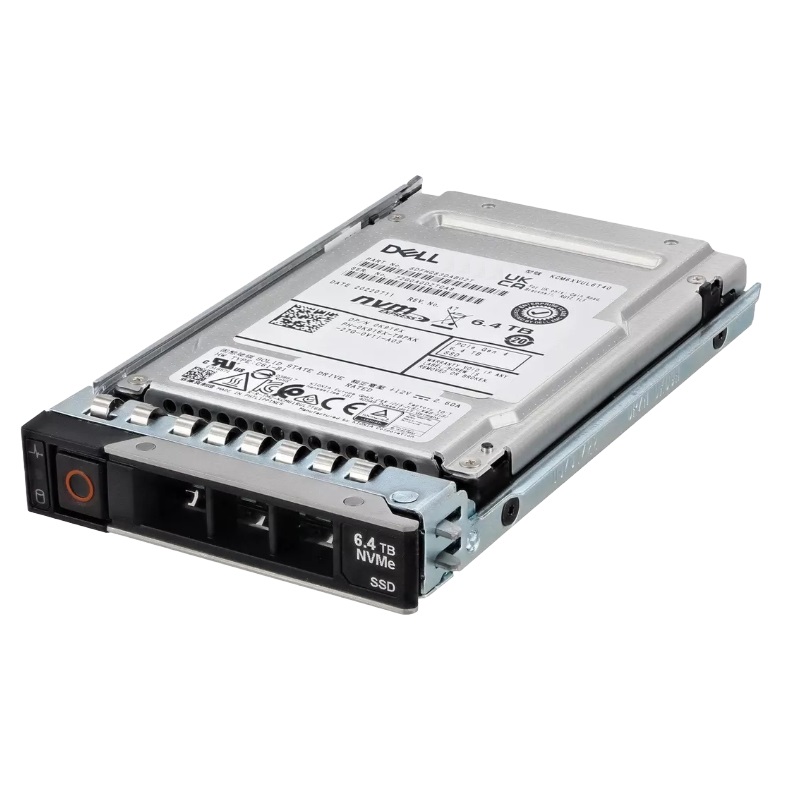


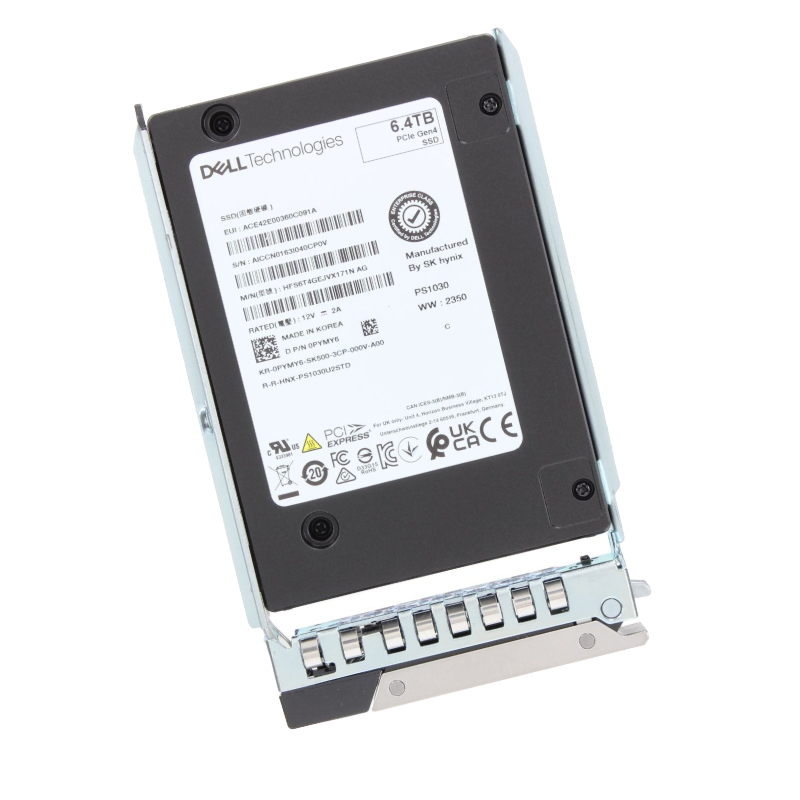
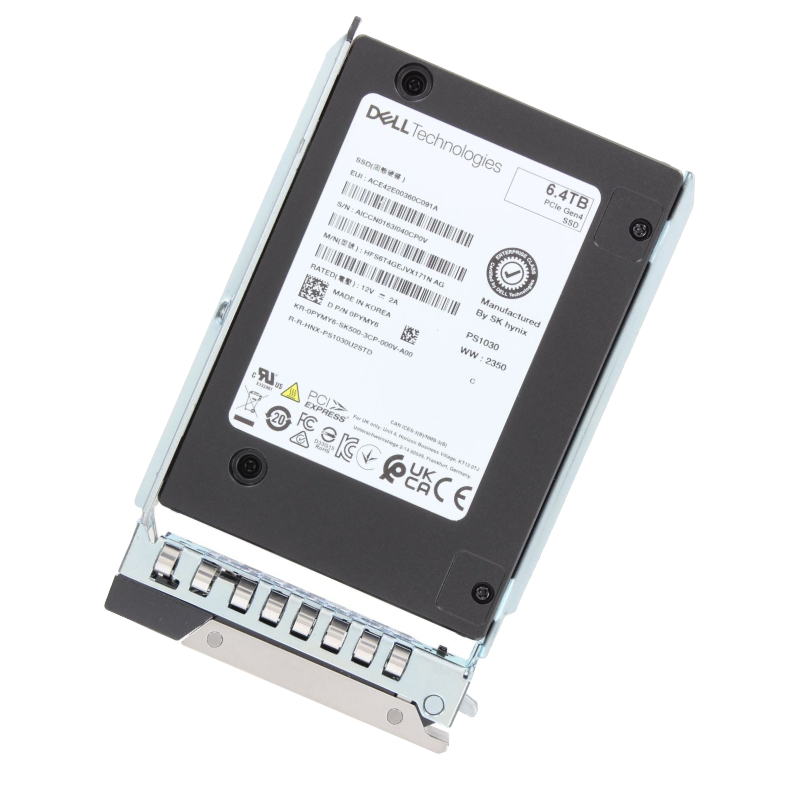
Dell 9F6Y3 6.4TB U.2 Mixed Use 3dwpd PCI-Express 4.0 Nvme SFF 3D TLC for 14G Poweredge Server Solid State Drive. New Sealed with 1 year replacement warranty.
| SKU/MPN | Warranty | Price | Condition | You save |
|---|---|---|---|---|
| 9F6Y3 | 1 Year Warranty | $1,798.00 | Excellent Refurbished | You save: $629.30 (26%) |
| 9F6Y3 | 1 Year Warranty | $2,580.00 | New Sealed in Box (NIB) | You save: $903.00 (26%) |
Designed to handle diverse data operations, the Dell 9F6Y3 SSD excels in environments requiring consistent performance and reliability. Its mixed-use endurance profile makes it ideal for read/write-intensive applications.
The U.2 small form factor enables a hot-swapable, enterprise-friendly physical interface that maps directly to server drive bays and backplanes designed for 2.5-inch devices. Unlike M.2 modules that plug into motherboard sockets, U.2 drives use standardized cabling and backplane interconnects familiar to system administrators, enabling straightforward replacements, firmware updates, and field serviceability. The NVMe protocol running over PCI-Express 4.0 delivers higher bandwidth and lower latency than legacy SATA or SAS interfaces, allowing database engines, virtualized I/O stacks, and distributed storage layers to extract maximum IOPS and throughput. PCIe 4.0 doubles per-lane bandwidth compared to PCIe 3.0, allowing enterprise-class controllers and NAND arrays to scale performance without saturating the bus; this is particularly relevant for multi-queue NVMe I/O patterns and for consolidating multiple virtual disks on a single physical drive without performance cliffs. For application architects, the combination of NVMe and U.2 presents a balance between raw performance and operational simplicity within 14th generation PowerEdge server ecosystems that expect U.2 compatibility in their drive trays and firmware stacks.
3D Triple-Level Cell NAND flash is currently a preferred media for enterprise mixed-use SSDs because it provides favorable density and cost per TB while delivering predictable endurance under enterprise firmware. The three-bit-per-cell architecture stores 3 bits in each flash cell, enabling higher capacities such as 6.4TB in a 2.5-inch U.2 package while still enabling robust error correction, wear leveling, and background management routines. Robust drive firmware implements advanced ECC (error-correcting code) algorithms, dynamic read voltage adjustment, and per-block bad-block management to maintain data integrity across the drive’s operational life. In addition to ECC, enterprise SSDs commonly include features such as end-to-end data path protection that ensures data written by the host is checked at every stage of the drive’s internal path, and built-in power loss protection buffers that reduce the risk of data corruption during sudden power events. These combined layers of protection make 3D TLC drives well-suited for mixed transactional workloads where both read consistency and write durability are important.
Endurance expressed as 3DWPD means the drive is designed to sustain writing an amount equal to three times its raw capacity each day over the warranted lifetime without exceeding expected wear rates. For a 6.4TB unit, that equates to a daily write budget of 19.2TB. Translating endurance specifications into operational practices requires mapping application-level write amplification and host behavior to physical media wear. Database systems that perform frequent small writes, log-heavy architectures, or poorly tuned virtual machine swappings will consume write budget faster than read-dominant analytics workloads. Conversely, content delivery, caching, and read-optimized OLAP engines will generally preserve more drive life. When planning capacity and lifecycle replacement windows for a fleet of 6.4TB mixed-use NVMe SSDs, administrators should factor in RAID or erasure coding overhead, periodic rebuild workloads, background scrubbing, and snapshot retention policies because all of these add to background write activity and affect real-world DWPD.
Performance in a mixed-use enterprise SSD category is twofold: high sequential throughput for bulk reads and writes, and high random IOPS for transactional responsiveness. PCI-Express 4.0 NVMe drives in this category are engineered to sustain several gigabytes per second of sequential throughput across large contiguous transfers and to provide tens to hundreds of thousands of IOPS for random small-block operations at low latency. Quality of Service, or QoS, is a critical dimension for enterprise deployments because predictable latency under sustained load matters as much as peak throughput. Drives in the Dell 9F6Y3 class typically include firmware-level QoS management where internal parallelism, host command throttling, and background garbage collection are orchestrated to avoid latency spikes. For virtualization hosts supporting dozens of VMs, QoS behavior directly impacts perceived performance at the guest level and the ability to meet service-level objectives for latency-sensitive applications such as OLTP databases or real-time analytics.
High-density NVMe SSDs produce heat under heavy sustained I/O; therefore thermal management is integral to maintaining performance and reliability. The flattened power envelope of modern enterprise SSDs reflects firmware strategies that modulate internal parallelism and refresh rates when certain temperature thresholds are reached to avoid thermal throttling events that might degrade throughput. In rack-scale deployments, airflow design, drive sled heat sinks, and server chassis ventilation patterns must be considered when populating multiple 6.4TB U.2 drives. Power consumption is another consideration: while these drives are more energy efficient than equivalent HDD arrays for throughput per watt, the instantaneous power draw during peak activity and during drive initialization or secure erase procedures can be significant. Data center operators should plan rack-level power budgets and monitor SMART telemetry for temperature and power metrics to ensure drives operate within manufacturer-recommended envelopes.
These U.2 NVMe SSDs are engineered for compatibility with modern PowerEdge server platforms that present U.2 bays and NVMe-aware firmware and drivers. Compatibility extends beyond physical fit; firmware interaction with server management stacks like iDRAC, RAID controllers that can present NVMe drives directly to the OS, and hypervisor ecosystems is essential. System administrators deploying Dell-branded 6.4TB U.2 drives in PowerEdge servers should verify platform firmware and BIOS updates that may improve NVMe handling, NVMe hot-plug support, and reporting of SMART attributes. When used with hardware RAID or software-defined storage systems, it is important to configure the stack to expose the drive’s native NVMe capabilities rather than forcing SATA emulation modes. The result is lower CPU overhead for I/O, more efficient queue depth utilization, and improved end-to-end performance for latency-sensitive applications.
Because individual SSDs, while reliable, remain subject to hardware failure and rare media wear phenomena, redundancy strategies such as RAID, erasure coding, and replication remain central to data protection. Deployments that use Dell 9F6Y3 6.4TB NVMe drives must balance redundancy overhead with capacity and performance goals. For example, RAID configurations that stripe across multiple NVMe devices can achieve exceptional throughput but may yield higher rebuild write amplification during a failed-drive replacement; erasure coding introduces computational overhead but reduces storage overhead for comparable fault tolerance when applied at scale. Application-level replication, such as database clustering or distributed object storage replication, can complement lower-level redundancy and provide geographic resilience. The choice of redundancy must align with the organization’s recovery time objectives and available compute to absorb rebuild operations without compromising active workloads.
Mixed-use NVMe U.2 SSDs shine in environments with a mixture of read and write activity where predictable latency, moderate to high IOPS, and multi-terabyte capacities are required. Examples include virtual desktop infrastructure where many small random writes coexist with heavy reads, transactional databases that perform frequent commit operations alongside large analytical scans, containerized microservice clusters that host numerous database instances, and cache or tiering layers that accelerate access to frequently used datasets. Analytics pipelines that intermittently ingest large volumes of data also benefit from the combination of sequential throughput and responsive random access that these drives provide. Because the endurance rating is tuned for mixed workloads, they are particularly apt for enterprises seeking to consolidate multiple workloads onto fewer drives without incurring the higher cost-per-GB of purpose-built write-intensive media.


 Contact Us
 Information
 Catalog
 Solid State Drives (SSD)
 Network Switches
 Hard Disk Drives
 HBA & Controllers
 PC & Servers
 PC & Server Memory
 CPU & Processors
 Network Routers
 Power Supplies
 Tape Drives & Libraries
 Network Devices
 Computer & Network Cables