(7% discount is applied at checkout)
Cart is empty
Your go-to destination for cutting-edge server products
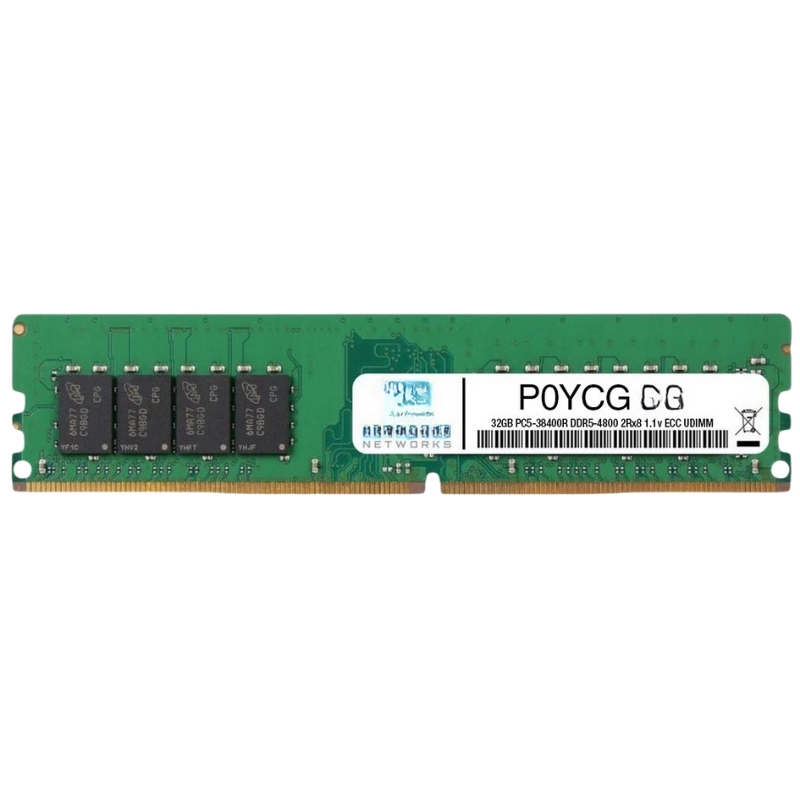


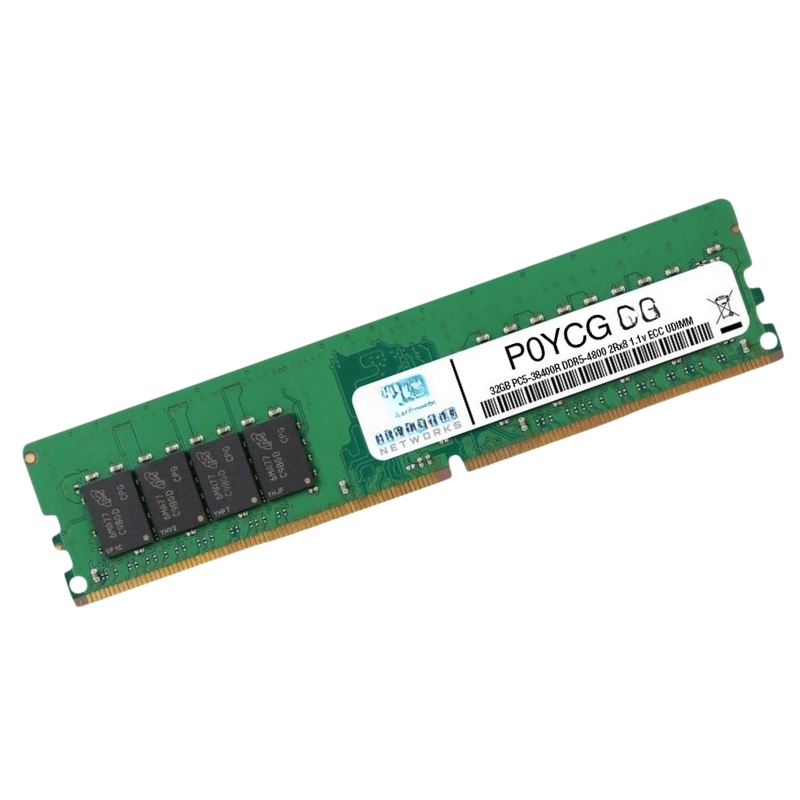
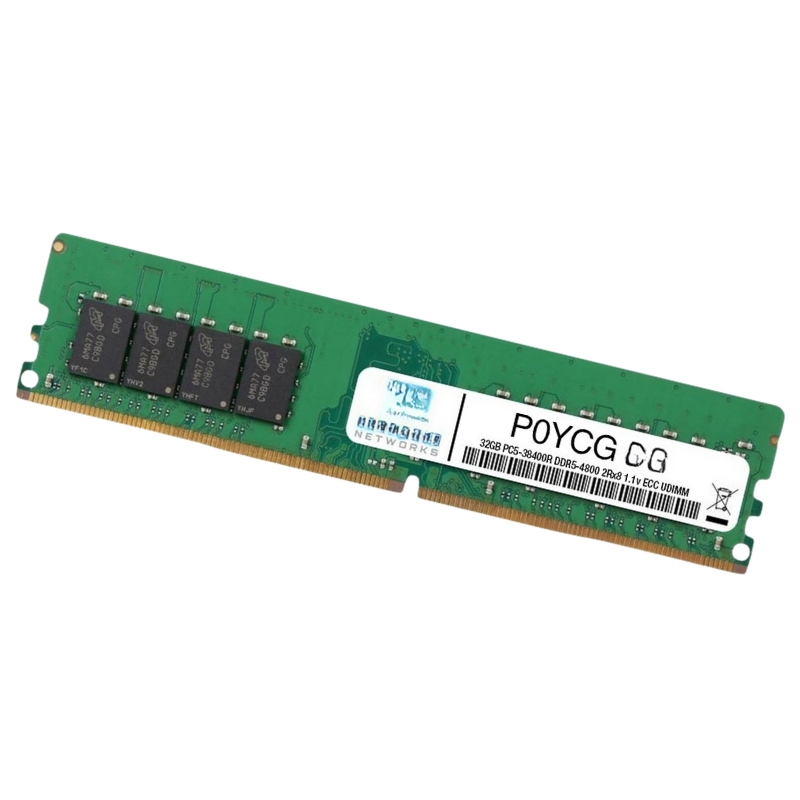
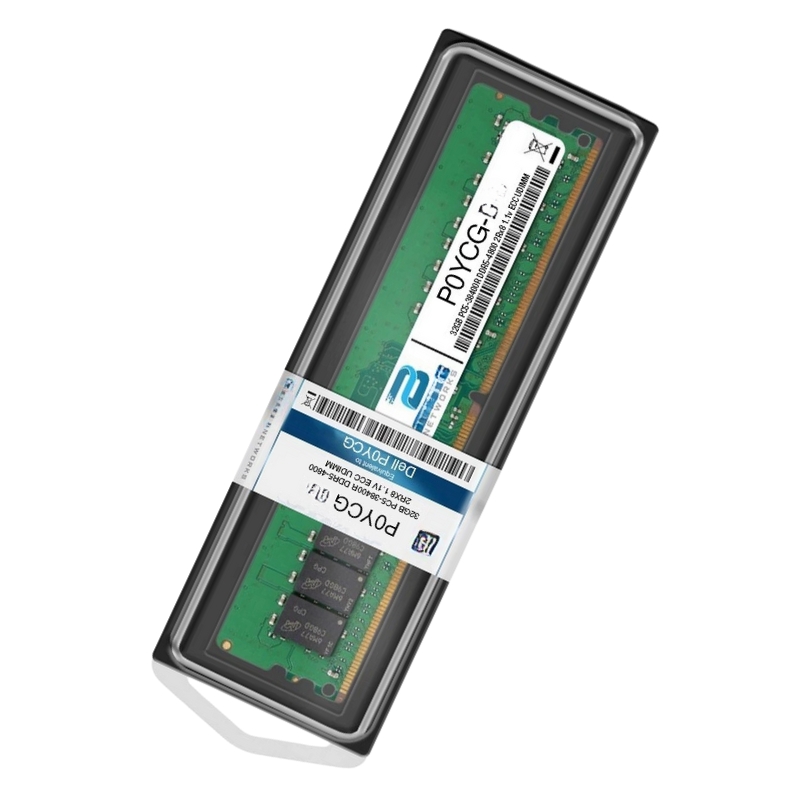
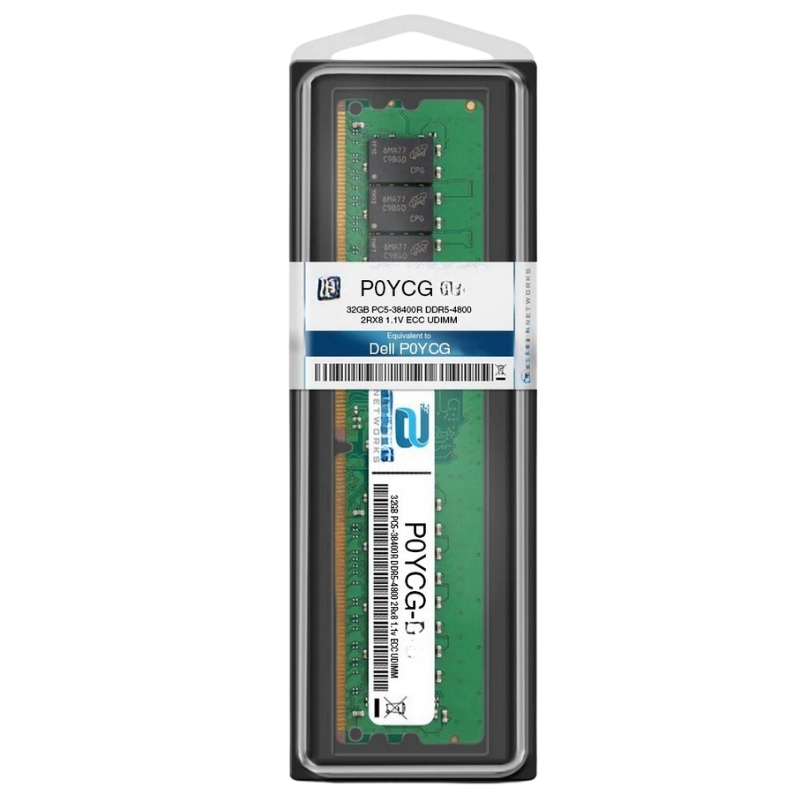
Dell P0YCG 32GB PC5-38400 4800MTs ECC Dual Rank X8 DDR5 SDRAM 288 Pin Memory Module. New Sealed in Box (NIB) with 1 year replacement warranty
Dell P0YCG 32GB PC5-38400 4800MT/s DDR5 SDRAM is a high-performance registered memory module engineered for server, storage, and workstation applications where reliability, error correction, and consistent throughput are essential. Built to the DDR5 JEDEC standard, this 288-pin DIMM delivers 4800 mega-transfers per second (MT/s) and a nominal bandwidth of PC5-38400, providing a substantial uplift over previous DDR4 generations. The module’s ECC (Error Correcting Code) capabilities and Dual Rank X8 chip organization make it ideal for mission-critical systems that require data integrity and predictable performance under load.
Dual Rank modules contain two sets of memory chips that the memory controller can access independently. In practice, Dual Rank 32GB modules can present performance advantages over single-rank equivalents in systems and workloads that benefit from rank interleaving. The “X8” chip organization indicates each memory chip provides an 8-bit data path. This configuration balances density and electrical loading while maintaining broad compatibility with enterprise-class memory controllers. When combined with ECC, the Dual Rank X8 architecture contributes to both throughput optimization and a robust error-correction environment.
Rank interleaving allows a memory controller to alternate access between ranks, reducing idle cycles and improving effective bandwidth for certain multi-threaded and I/O-heavy workloads. Enterprise database servers, virtualization hosts, and memory-bound scientific computations frequently benefit from Dual Rank modules, particularly when the platform supports interleaving across multiple DIMMs per channel. The result is smoother sustained performance during peak load periods and improved responsiveness for I/O-bound tasks.
Core Memory Attributes
The module is equipped with a substantial 32GB capacity, structured as a single module. This configuration is designed to facilitate substantial multitasking and data handling.
Leveraging the latest DDR5 Synchronous Dynamic Random-Access Memory technology, this component provides a significant leap in bandwidth and efficiency over previous generations.
Operates at a swift 4800 Megatransfers per second (MT/s), aligning with the PC5-38400 (DDR5-4800) standard to ensure rapid data access and execution.
Features an Unbuffered (UDIMM) design, which minimizes latency between the memory controller and the DRAM chips, resulting in more direct and faster communication.
The dual rank architecture with an x8 setup enhances signal integrity and allows for efficient loading, boosting overall system stability and performance potential.
Incorporates ECC functionality to automatically detect and correct common types of internal data corruption, a critical feature for mission-critical applications and data integrity.
Housed in a standard 288-pin UDIMM form factor, ensuring correct physical compatibility and secure installation within the appropriate motherboard memory slots.
This memory module is validated and certified for seamless integration and optimal performance within the following Dell computing platforms:
• Alienware Aurora R13 Desktop
• Alienware Aurora R15 (Intel variant) Desktop
• XPS 8950 Tower
• OptiPlex 7000 Tower
• OptiPlex XE4 Tower
• Precision 3660 Tower
• Precision 3660 XE Tower
Some motherboard and server platforms have specific rules about rank population and maximum supported ranks per channel. Always verify the platform’s memory population guide to ensure optimal configuration, especially when mixing ranks or capacities.
ECC (Error-Correcting Code) memory detects and corrects single-bit errors and detects multi-bit errors, drastically reducing the probability of silent data corruption. In enterprise and critical computing environments—such as financial services, healthcare systems, and cloud infrastructure—ECC is a baseline requirement. The Dell P0YCG module’s ECC support ensures that transient errors caused by electrical interference, cosmic rays, or manufacturing variations are corrected automatically, maintaining data integrity over prolonged operation.
With an effective data rate of 4800MT/s, the PC5-38400 classification corresponds to roughly 38.4 GB/s of theoretical bandwidth per module under ideal conditions. DDR5 improves not just peak transfer rates but also overall efficiency through architectural changes including improved bank grouping, higher prefetch, and internal power-management enhancements. The real-world benefit is especially notable in memory-bound loads where sustained throughput and concurrency matter more than peak single-thread latency.
While DDR5 focuses on increasing transfer rates and bandwidth, latency characteristics may differ from DDR4. The absolute cycle latency can be higher due to increased prefetch and internal timing, but effective latency in multi-threaded or pipelined workloads often improves because higher bandwidth prevents queuing delays. Systems tuned for DDR5 (BIOS/firmware, memory timings, and memory channel utilization) will typically demonstrate the best balance of latency and throughput.
The Dell P0YCG memory module is designed to align with Dell’s server and workstation platforms that support DDR5 ECC memory. Compatibility is influenced by platform memory controllers, BIOS/UEFI versions, and supported DIMM population rules. Enterprise platforms often release compatibility matrices and Qualified Vendor Lists (QVLs) indicating validated DIMMs and configurations. It’s recommended to reference the system vendor’s official documentation and apply the latest BIOS updates to ensure full support for 4800MT/s operation, advanced power features, and ECC behavior.
DDR5 modules typically default to JEDEC-standard timings and speeds. Some server-class modules can support higher profiles through vendor-specific configuration or platform-level optimizations. In production environments, stability and validated operation at JEDEC settings are preferred. When tuning memory speeds, always validate for sustained stability under synthetic and real-world workloads before committing changes to production.
These modules are optimized for scenarios that demand both capacity and reliability. Typical use cases include:
In-memory databases and analytics platforms enjoy lower query times and faster batch processing when backed by high-speed, high-capacity DDR5 memory. Dual Rank modules increase effective parallelism for memory access and can improve throughput for large-scale, parallel query execution and caching layers.
Safe installation practices reduce the risk of damage to the modules and the host platform. Follow ESD-safe procedures, handle DIMMs by the edges, and avoid bending or touching gold fingers and chips. Insert modules fully into the DIMM slot until latches lock, and ensure the system is powered down and unplugged before making changes. After installation, run memory validation and stress tests to confirm all channels and ranks are detected correctly and that ECC is functioning as expected.
Enterprise memory routinely undergoes thorough testing including thermal cycling, voltage margining, error injection testing for ECC verification, and long-duration burn-in to surface early-life failures. System integrators and data center operators commonly perform in-house validation to match their specific workloads and environmental conditions. If a module fails diagnostics or shows recurring correctable errors, it should be flagged for replacement to avoid potential future uncorrectable errors.
Use vendor-supplied diagnostics when available, as these tools understand platform-specific nuances and can interpret ECC logs. Third-party tools and stress-testing frameworks are also useful for cross-checking results and ensuring that modules behave consistently across different test suites.
ECC memory supports organizational policies for data integrity and compliance by reducing the risk of silent data corruption. For regulated industries—such as finance, healthcare, and public sector deployments—ECC is frequently a requirement in technical controls frameworks because it protects data at the hardware level. Integrating ECC memory into a larger defense-in-depth strategy helps preserve system state, logs, and transaction consistency across unexpected hardware anomalies.
When evaluating memory options, consider not only raw specifications but also ecosystem fit: platform validation, firmware support, vendor warranty, and long-term availability. Compared to earlier DDR4 modules, DDR5 PC5-38400 delivers significantly higher bandwidth and improved power architecture. Compared to other DDR5 SKUs, differences often come down to rank, chip organization, vendor validation, and firmware-level features. For enterprise buyers, verified operation on target platforms is frequently more valuable than marginal speed gains.
Continuous monitoring of ECC events, memory temperature, and platform telemetry enables proactive maintenance and reduces unplanned downtime. Automated alerting that correlates memory error rates with workload patterns can indicate failing hardware before it causes uncorrectable errors. Regular audits of firmware and BIOS updates ensure compatibility with evolving memory standards and platform fixes.
When planning deployments that rely on high-capacity DDR5 memory, consider the trade-offs between maximizing per-node memory capacity and achieving the desired compute-to-memory ratio. Dense memory configurations may require additional cooling and power budget adjustments. Use vendor sizing tools to model thermal envelopes and power draw at scale.
Scale-out architectures favor many nodes with modest memory per node, whereas scale-up strategies concentrate memory and compute in fewer, larger systems. The Dell P0YCG 32GB modules provide a granular capacity option that supports both strategies depending on population rules and target workloads.
Enterprise-grade memory typically conforms to relevant safety and environmental standards. Verify that modules meet RoHS, REACH, and other regional regulations as required by your organization. Proper disposal and recycling protocols for electronic components should be part of lifecycle planning.
Plan for regular refresh cycles based on vendor support windows, warranty periods, and evolving workload needs. Maintain a record of EOL notifications from the supplier to schedule orderly upgrades and minimize operational disruption.


 Contact Us
 Information
 Catalog
 Solid State Drives (SSD)
 Network Switches
 Hard Disk Drives
 HBA & Controllers
 PC & Servers
 PC & Server Memory
 CPU & Processors
 Network Routers
 Power Supplies
 Tape Drives & Libraries
 Network Devices
 Computer & Network Cables