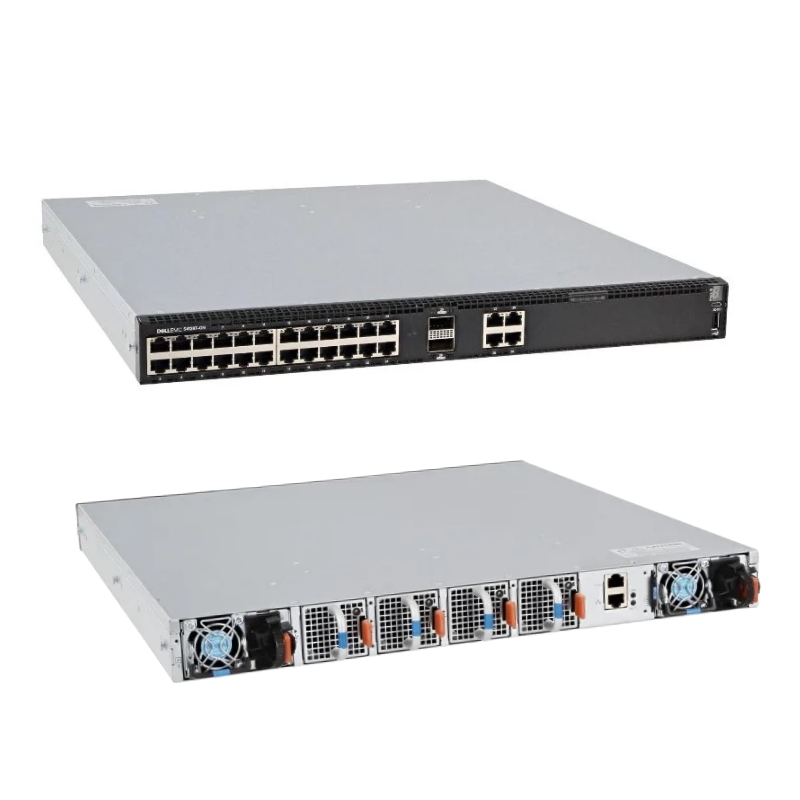
Dell R5W3X EMC Networking S4128T-ON 28-Port 10GbE Switch Overview
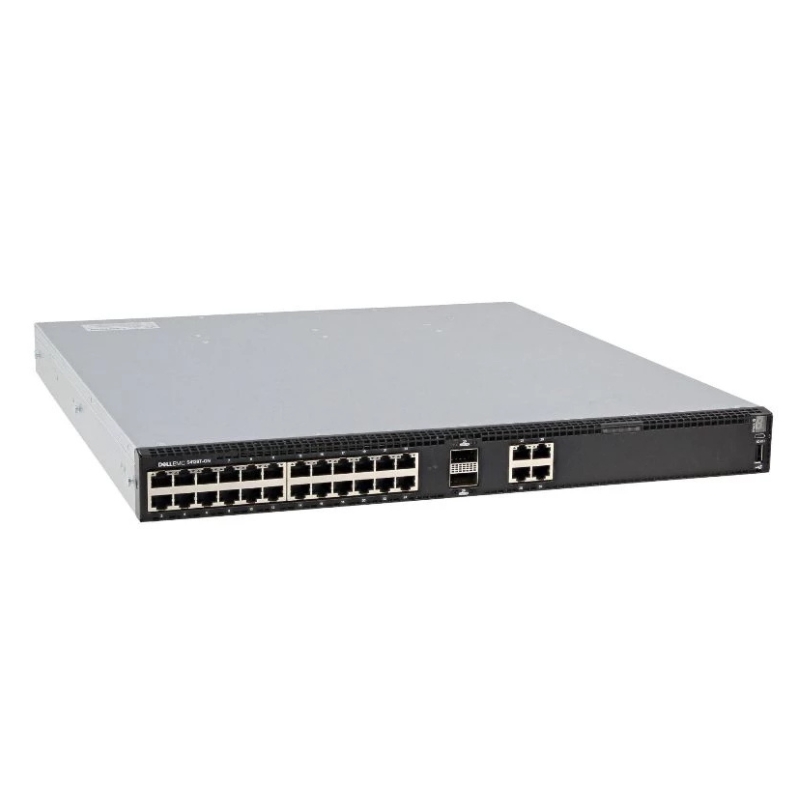
The Dell R5W3X EMC Networking S4128T-ON delivers a high-performance switching solution tailored for data centers, enterprise networks, and demanding IT infrastructures. Designed with flexibility, scalability, and redundancy in mind, this advanced 10 Gigabit Ethernet switch supports 28 auto-sensing RJ-45 ports alongside 2 QSFP28 uplink ports, enabling seamless connectivity and powerful data throughput.
Key Specifications of Dell R5W3X
- Manufacturer: Dell
- Part Number: R5W3X
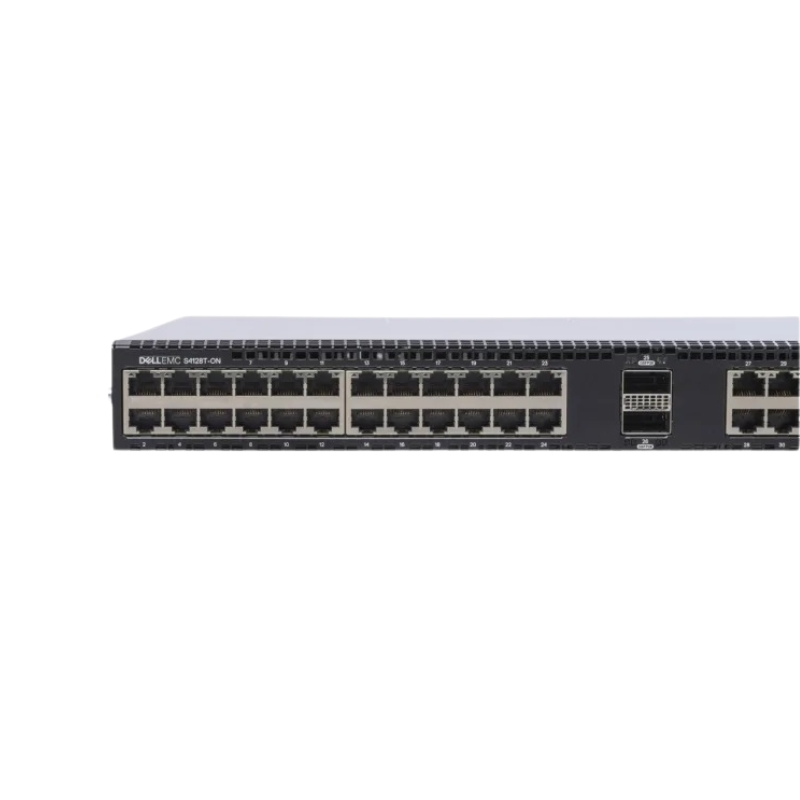
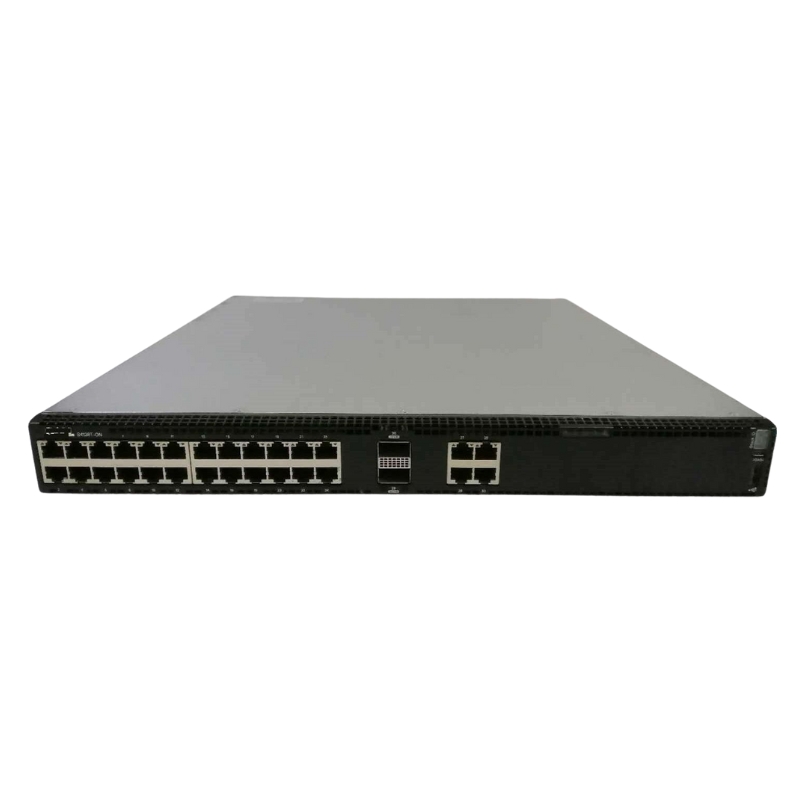
- Access Ports: 28 fixed 1/10GbE RJ-45 auto-sensing ports
- Uplink Ports: 2 fixed 100GbE QSFP28 ports
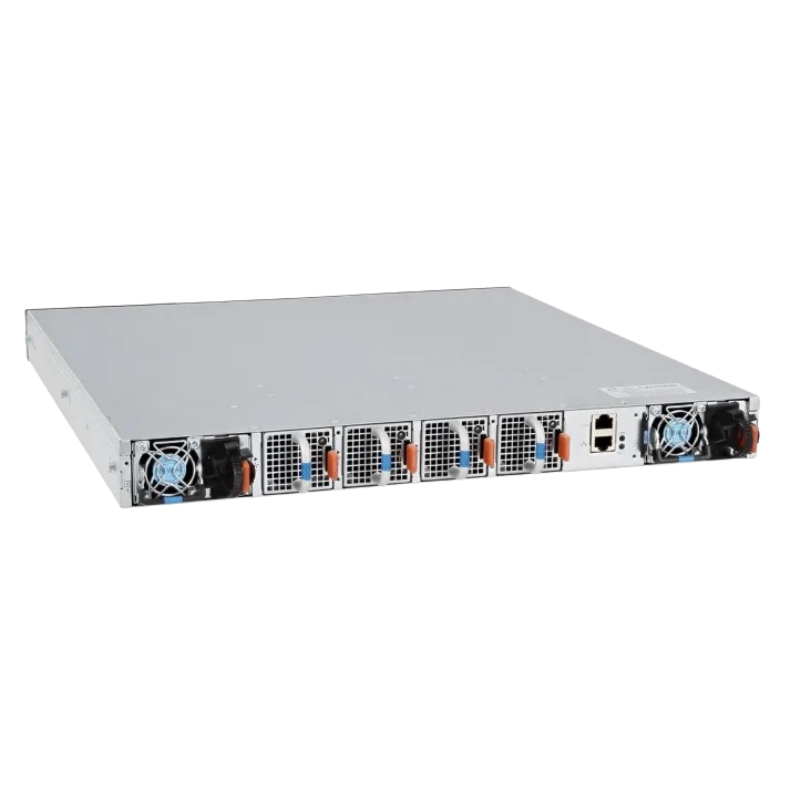
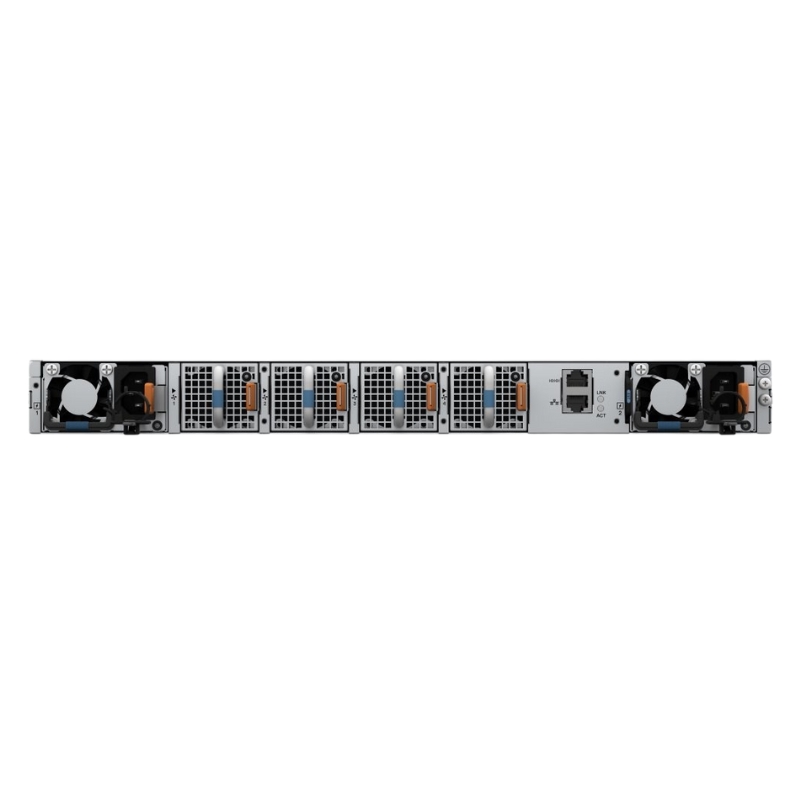
- Power Supplies: Dual hot-swappable 550W AC redundant PSUs
- Network OS: Dell OS10 pre-installed
- Airflow Options: Standard I/O to PSU, or reverse (PSU to I/O)
- PoE Support: Not applicable
- Transceivers: Sold separately
Advanced Connectivity and Port Density
With 28 copper RJ-45 interfaces supporting both 1GbE and 10GbE speeds, the Dell R5W3X switch ensures versatile connections for servers, storage devices, and high-performance workstations. The addition of 2 QSFP28 uplink ports provides lightning-fast 100GbE backbone connectivity, making it suitable for aggregation layers and demanding east-west traffic within data centers.
Flexible Uplink Options
The dual 100GbE QSFP28 uplinks are engineered for ultra-fast data transfer, enabling reliable connections to core switches or network fabrics. They ensure scalability as business requirements expand, offering enterprises the freedom to upgrade without replacing the existing switching hardware.
Redundant Power Supply Design
High availability is critical for mission-critical applications. The Dell R5W3X features two hot-swappable 550W AC power supplies designed to minimize downtime and guarantee continuous operation. Redundancy ensures that even if one PSU fails, the switch continues operating smoothly with the backup unit.
Cooling and Airflow Options
The model supports both standard airflow (I/O to PSU) and reverse airflow (PSU to I/O), accommodating different rack setups and cooling strategies. This flexibility provides optimal temperature control in dense data center environments.
Operating System and Open Networking
Out of the box, the switch runs on Dell Networking OS10, a modern, flexible, and modular network operating system. It is engineered to support automation, programmability, and open standards, giving IT administrators the power to configure and manage networks efficiently.
Software-Defined Networking (SDN) Support
By leveraging OS10, businesses can benefit from advanced Layer 2 and Layer 3 features, automation scripts, and network virtualization tools, making this switch a future-ready investment for evolving IT infrastructures.
Ideal Use Cases
- High-density enterprise switching
- Data center edge and aggregation layers
- Campus networks requiring 10GbE access
- Cloud and virtualization environments
- Scalable IT infrastructures needing 100GbE uplinks
Enterprise Benefits
Organizations deploying the Dell R5W3X gain cost efficiency, reliability, and flexibility. Its high bandwidth, redundant design, and modular OS simplify deployment while ensuring maximum uptime.
Performance Highlights
- 28 ports of 1/10GbE for versatile connectivity
- 2x 100GbE uplinks for next-generation data speeds
- Dual power supplies for redundancy
- Open networking with OS10 capabilities
- Energy-efficient cooling with airflow direction options
Overview of the Dell R5W3X S4128T-ON 28-Port 10G RJ45 Switch with QSFP28 Uplinks
The Dell R5W3X S4128T-ON is a compact, high-density 10 Gigabit Ethernet top-of-rack switch designed for modern server rooms, enterprise wiring closets, and edge aggregation zones that demand low latency, simplified management, and flexible uplink options. With twenty-eight auto-negotiating 100M/1G/2.5G/5G/10G RJ45 ports for copper connectivity and high-bandwidth QSFP28 uplinks for 40/100GbE aggregation, this platform enables seamless migration from legacy copper to multi-gig and 10G infrastructure while preserving investment in existing CAT6A/CAT7 cabling. Dual hot-swappable PSUs, hot-swap fans, and data-center-grade features such as advanced Layer 2/Layer 3, VXLAN, EVPN-ready design principles, and automation hooks make the S4128T-ON a robust, future-focused choice for converged networks.
Key Positioning in the 10G Copper Switch Category
This model sits in the sweet spot for organizations standardizing on copper-based server NICs or multi-gig access devices that need true wire-rate switching without the transceiver cost overhead of SFP+ at the edge. It bridges the gap between access and aggregation by pairing 10GBase-T density with two QSFP28 cages capable of breakout for 4×25G or native 100G uplinks (depending on optics/cables), supporting spine-leaf, collapsed core, and campus distribution topologies. As part of Dell’s Open Networking (ON) portfolio, it aligns with environments that value OS flexibility, streamlined automation, and standards-first interoperability.
Hardware Architecture and Build Quality
The S4128T-ON hardware centers on reliable forwarding silicon tuned for low latency, deep buffers, and precise QoS enforcement. A fixed 1U chassis houses the RJ45 ports on the data plane, dual QSFP28 cages for uplink expansion, and modular power supplies/fan trays for serviceability. Thoughtful airflow options (front-to-back or reverse, depending on SKU) ensure flexibility for both hot and cold aisle data-center layouts. Tool-less PSU replacement and visually identifiable fan modules accelerate maintenance while minimizing downtime.
Port Composition and Performance Characteristics
- Access ports: 28 × 10GBase-T RJ45, typically supporting auto-negotiation across 100M/1G/2.5G/5G/10G to accommodate diverse client capabilities.
- High-speed uplinks: 2 × QSFP28 for 40/100G aggregation; often supports breakout to 4 × 25G with appropriate cables, easing aggregation to spine or core.
- Throughput and latency: Wire-rate forwarding across all ports with microsecond-level latency suitable for virtualized workloads and iSCSI/NFS traffic.
- MAC/route scale: Hardware tables sized for dense campus or data center use, with room for thousands of VLANs, routes, and access control entries.
- Buffers and QoS: Dynamic and static allocation options allow lossless or near-lossless behavior for storage and bursty east-west traffic.
Power Delivery and Thermal Design
Dual, hot-swappable PSUs provide redundancy and load sharing. The switch monitors power draw relative to port speed and link utilization, enabling energy-efficient Ethernet modes when negotiated with compliant NICs. Fan trays are hot-swappable and speed-controlled, optimizing acoustics in wiring closet deployments while maintaining adequate cooling in high-density racks. Clear status LEDs on PSUs and fan units offer at-a-glance diagnostics for quick field service.
Mounting and Cabling Considerations
- Rack integration: Standard 19-inch rack mounting with included rails or brackets ensures fast installation in 1U slots.
- Cabling best practices: For sustained 10GBase-T performance, CAT6A or better is recommended; keep patch leads within length guidelines.
- Uplink media: Choose QSFP28 DAC for short-reach, AOC for intermediate distances, and 100G optical modules for long-reach aggregation.
Software Capabilities and Feature Set
As an Open Networking platform, the S4128T-ON typically ships with a modern, capable network operating system engineered for both traditional CLI workflows and API-driven automation. Its L2/L3 feature stack addresses enterprise, campus distribution, and data center leaf use cases. Focus areas include robust VLAN segmentation, advanced routing (static and dynamic), virtualization overlays, and extensive security and visibility controls.
Layer 2 Essentials for Segmentation and Access Control
- VLANs and Trunking: IEEE 802.1Q VLAN tagging, QinQ (where supported), and flexible trunk/access port profiles for server, AP, and user device on-ramping.
- Spanning Tree Options: RPVST+/MSTP alternatives to ensure loop-free topologies while optimizing convergence times.
- Link Aggregation: IEEE 802.3ad LACP for bonded interfaces to servers, storage arrays, or upstream switches—supporting multipathing and resilience.
- Multicast Control: IGMP snooping/querier functions to efficiently deliver media streams and reduce broadcast noise across VLANs.
Layer 3 for Scalable Routing
- Static and Policy-Based Routing: Straightforward forwarding paths with route-maps for traffic engineering and segmentation enforcement.
- Dynamic Protocols: OSPF and BGP options for multi-area or multi-AS designs in campus cores or spine-leaf fabrics, including ECMP load-sharing.
- VRF-Lite: Virtual routing instances to separate tenant or departmental traffic without the complexity of full MPLS.
- IPv6 Readiness: Dual-stack operation, RA guard options, and neighbor discovery protections to accommodate modern addressing schemes.
Overlay and Fabric Readiness
While the S4128T-ON excels as a traditional L2/L3 switch, many deployments leverage it as a leaf in VXLAN-based fabrics. Hardware support for large MAC/ARP and routing tables, coupled with EVPN-ready design patterns and high-bandwidth QSFP28 uplinks, ensures a smooth path to overlay architectures that unify campus and data center segmentation. Whether the controller is proprietary or open, the platform’s automation hooks and standards compliance simplify fabric onboarding.
Security and Compliance Features
- Port Security: MAC limiting, sticky MACs, and storm control for granular edge protection.
- Network Access Control: 802.1X supplicant and authenticator roles, MAB fallback, and RADIUS/TACACS+ integration for identity-driven permissions.
- ACLs and Micro-Segmentation: IPv4/IPv6 ACLs applied at ingress/egress with L4 matches for application-aware policy enforcement.
- DHCP Protections: Snooping, option-82, and guard functions to block rogue servers and prevent address spoofing.
- Management Plane Hardening: Role-based access, encrypted management sessions, and secure API endpoints to meet organizational compliance.
Observability and Automation
- Streaming Telemetry: Model-driven data export to analytics platforms for real-time insight into utilization, errors, and latency.
- Syslog and SNMP: Standards-based integrations enable centralized monitoring tools to alert on thresholds and events.
- CLI, REST, and Ansible: Multiple control options accommodate both traditional network engineers and DevNetOps workflows.
- Boot and Provisioning: Zero-touch provisioning (ZTP) and profile-driven day-0 configs accelerate fleet rollouts and golden-image governance.
Use Cases for the S4128T-ON Category
Organizations adopt the Dell R5W3X S4128T-ON family to unify copper 10G access with agile, high-speed uplinks. From virtualized server racks to high-density wireless backhaul, the platform’s combination of port types and software breadth makes it a practical, long-lived choice. Below are common scenarios and design notes to guide planning.
Top-of-Rack for Virtualization and HCI
In converged and hyperconverged infrastructures, each node often provides multiple 10GBase-T ports for data, vMotion/Live Migration, and storage. The S4128T-ON consolidates these links within a single 1U ToR switch, minimizing cable runs and simplifying latency-sensitive east-west traffic. Use LACP for bonded host uplinks and apply VLANs for clean separation of compute, storage, and management planes. QSFP28 uplinks aggregate to spine switches at 100G for non-blocking north-south traffic.
Design Tips for HCI Racks
- Reserve dedicated VLANs for storage and keep QoS policies consistent across hosts and the switch to avoid buffer misalignments.
- Enable flow control or priority queuing only where appropriate—avoid blanket enablement that can hide congestion elsewhere.
- Use 100G uplinks to the spine for future HCI node growth, ensuring oversubscription stays within acceptable design targets.
Edge Aggregation for Wi-Fi 6/6E/7 and Multi-Gig Access
Many enterprises deploy multi-gigabit APs that negotiate 2.5G/5G on copper runs. Aggregating these devices on the S4128T-ON provides headroom for bursty traffic and backhauls via 40/100G uplinks to distribution/core. Policy is applied via ACLs and 802.1X, while multicast snooping optimizes streaming services. For surveillance or IoT zones using 1G or 2.5G NICs, the same chassis centralizes control without additional media converters.
Campus Distribution with Collapsed Core
In mid-sized campuses, a pair of S4128T-ON units can serve as a collapsed core with redundant 100G interconnects. Access switches connect over 10G copper or via 25G fiber (through breakout on the QSFP28 uplinks on upstream gear). Utilize VRF-Lite to carve out guest, corporate, and IoT routing domains, and enforce east-west policy using ACLs at distribution. The compact footprint keeps wiring closets cool and simple.
IP Storage and Backup Networks
Many NAS/iSCSI arrays use copper 10G interfaces. The S4128T-ON offers the right buffer profile and QoS toolkit to reduce drops on micro-bursts during backups or VM snapshots. Route storage subnets separately from user VLANs and dedicate 100G uplinks toward backup repositories or replication targets. When needed, LACP across multiple copper ports on the array can increase throughput and improve fault tolerance.
Media Production and Content Delivery
Creative suites, render farms, and editing bays commonly rely on 10GBase-T workstations. Centralizing those endpoints on an S4128T-ON gives editors wire-rate access to shared storage while QSFP28 uplinks deliver fast transit to render nodes and transcoding clusters. IGMP features help manage multicast review streams, and ACLs prevent cross-department snooping on pre-release content.
Planning and Sizing Guidance
Proper planning ensures the switch meets performance expectations over time. Consider client mix, uplink oversubscription, resilience goals, and growth trajectories. Below are practical tips for designing around the S4128T-ON platform.
Client Mix and Port Speed Profiles
- 10G-heavy racks: For servers and HCI nodes, assume close to 1:1 utilization of 10G ports during peak windows and plan uplinks accordingly.
- Mixed multi-gig access: Expect many clients to negotiate 2.5G/5G; peak concurrency is typically lower, but plan for bursts during OS updates or backups.
- Legacy 1G devices: Group by VLAN and apply policing/shaping where necessary to protect 10G workloads.
Uplink Strategy: 40G vs 100G
If upstream switches support 100G, prefer QSFP28 100G optics or DAC for headroom and simpler link design. For legacy cores or incremental upgrades, QSFP28 can interoperate in 40G modes (with appropriate optics/cables) or break out to multiple 25G lanes toward distribution devices. Balance the number of 100G uplinks with projected east-west and north-south flows, targeting an oversubscription ratio aligned with your service level objectives.
Resiliency Considerations
- Dual-homing servers: Team NICs across different switch ASICs or chassis if possible; use LACP for fast failover and load distribution.
- Redundant uplinks: Deploy at least two 100G uplinks to diverse upstream devices, with ECMP in routed designs.
- Power redundancy: Use two PSUs connected to independent PDUs on separate circuits to avoid single points of failure.
Configuration Patterns and Best Practices
Adopting consistent, templatized configurations reduces errors and accelerates mean time to resolution. The following patterns map well to the S4128T-ON’s capabilities and typical roles.
Access Edge Template for 10G Hosts
- Define port-profiles for servers (LACP trunk), APs (access port with voice/data VLANs if needed), and management devices (restricted ACLs).
- Apply storm control and broadcast suppression on access ports to protect the control plane.
- Enable LLDP to advertise VLAN assignments and negotiate capabilities with intelligent endpoints.
Routed Leaf with ECMP Uplinks
For data center leaf deployments, run the switch as a Layer 3 boundary. Assign SVI interfaces or routed subinterfaces per VLAN and advertise summaries upstream via OSPF or BGP. Use ECMP across dual 100G links to the spine. Where overlays are used, integrate with the controller for VNI/VTEP lifecycle; otherwise, maintain simplified VLAN-to-VRF mappings for deterministic routing.
QoS and Traffic Engineering
- Classify storage, voice/video, and control traffic; map to priority queues with explicit minimum guarantees.
- Use DSCP remarking at the access edge to normalize inconsistent markings from endpoints.
- Monitor queue depth and tail drops via telemetry to calibrate buffer allocations over time.
Security Baseline Checklist
- Enforce 802.1X where possible; fall back to MAB for non-supplicant devices with tight MAC ACLs.
- Apply DHCP snooping and ARP inspection on user VLANs to prevent spoofing and man-in-the-middle attempts.
- Restrict management access to out-of-band networks; disable legacy ciphers and mandate strong authentication.
- Deploy control-plane policing to protect routing protocols and switch CPU resources.
Physical Layer Insights for 10GBase-T and QSFP28
Understanding the physical layer helps prevent intermittent faults. Copper and optical media behave differently under noise, temperature, and length constraints, so aligning media to the environment is key.
10G Copper Best Practices
- Distance: Use CAT6A or better for 10G up to 100 meters under standard conditions; shorter runs reduce latency and power draw per link.
- EMI/RFI: Avoid pathway parallelism with high-voltage lines; use shielded cabling (CAT7) in noisy industrial spaces.
- Thermal effects: Elevated temperatures can increase bit error rates; ensure adequate rack ventilation.
QSFP28 Optics and Cabling
- DAC (Direct-Attach Copper): Excellent for short interconnects (typically up to 3 meters) with minimal latency and cost.
- AOC (Active Optical Cable): Useful for 5–30 meter ranges with simple handling and lower bend sensitivity than discrete fiber.
- Optical Modules: Choose SR/LR/ER variants according to reach; ensure fiber type and patch panel terminations match the optic specifications.
- Breakout: Leverage 100G-to-4×25G or 40G-to-4×10G breakouts to fan uplink capacity into aggregation devices that require lane-level distribution.
Labeling and Documentation
Maintain consistent labeling from patch panel to switch port, including speed and VLAN/VRF assignments. Accurate documentation accelerates incident response and simplifies audits.
Comparison Within the S4100-Series 10G Copper Category
When evaluating the S4128T-ON against adjacent models, focus on port density, uplink flexibility, and power/thermal profiles. Devices with more 10GBase-T ports may increase rack density but at the cost of higher thermal loads; conversely, fewer ports with the same uplink capability can simplify cabling in smaller sites. The S4128T-ON strikes a balanced profile: enough 10GBase-T density for meaningful consolidation, paired with QSFP28 for high-speed aggregation without forcing a chassis solution.
Trade-Offs to Consider
- Power per 10GBase-T link is inherently higher than SFP+ fiber; weigh energy budgets against transceiver savings.
- Cabling bulk can be greater with copper; plan cable management and tray capacity accordingly.
- Noise/acoustics in small closets may necessitate attention to fan profiles and rack placement.
Troubleshooting Playbook
Rapid incident triage keeps SLAs healthy. The following playbook targets common edge and aggregation issues seen with 10G copper and high-speed uplinks.
Intermittent Link Flaps on 10GBase-T
- Check cable certification reports for marginal performance; replace suspect runs with CAT6A/7 factory-terminated assemblies.
- Reduce link speed temporarily (e.g., to 5G) to isolate physical layer faults without losing connectivity.
- Inspect patch panels for poor punch-downs or excessive bend radius causing crosstalk.
High Error Counters on Uplink Interfaces
- Swap DAC/AOC or optics to rule out component failure; clean fiber ends and verify polarity.
- Confirm both ends agree on breakout configuration and lane assignments.
- Verify that optical budget meets the site’s patching and distance profile.
Slow Application Performance Despite Clean Links
- Examine QoS queues for tail drops; re-allocate buffers for storage or latency-sensitive traffic.
- Review CPU usage on hosts during peak windows; NIC offloads and driver versions can materially affect throughput.
- Audit ACLs and firewall rules for asymmetric paths or unintended packet inspections.
Security Hardening Patterns for Compliance-Sensitive Environments
Enterprises in finance, healthcare, and public sector must align network devices with rigorous control frameworks. The S4128T-ON supports a hardened posture without sacrificing manageability.
Identity-Driven Edge
- Use 802.1X with per-user VLAN assignment from RADIUS to segment users dynamically.
- Employ downloadable ACLs for fine-grained policy scoped to identity, device type, or posture results.
- Leverage MACSec (if available in your NOS) on sensitive uplinks to protect data in motion.
Management Plane Controls
- Restrict management to an out-of-band interface in a dedicated VRF; block in-band management from user VLANs.
- Mandate multi-factor authentication for administrative access and enforce per-role command authorization.
- Enable configuration signing and maintain an audit trail using a central configuration management system.
Data Plane Policy and Telemetry
- Apply CoPP/CP-policing to limit protocol floods; monitor drops to detect anomalies early.
- Export NetFlow/IPFIX and streaming telemetry to SIEM/NDR platforms for behavior analytics.
- Automate config drift detection and restore baselines on deviation to counter insider threats or misconfigurations.
Deployment Recipes
Recipe 1: Small Data Center Leaf Pair
- Two S4128T-ON switches as leafs, each with 2×100G uplinks to dual spines.
- Servers connect via dual 10GBase-T LACP bonds to both leafs for redundancy.
- Routing via eBGP with ECMP; VLANs mapped to VRFs as needed.
- Telemetry exported to a central collector; Ansible automates port-profiles and ACLs.
Recipe 2: Campus Distribution Node
- Aggregate access switches and multi-gig APs at 10G/5G; trunk VLANs upstream.
- Use OSPF areas between distribution and core; summarize routes to reduce LSDB churn.
- Apply downloadable ACLs from RADIUS for role-based access in sensitive departments.
Recipe 3: Storage and Backup Fabric
- Dedicated VLANs/SVIs for iSCSI/NFS; QoS priority queues for storage traffic.
- LACP bundles toward storage arrays; per-VLAN ACLs restrict management traffic.
- 100G uplinks to backup targets; monitor queue depths during backup windows to size buffers.
Cabling, Optics, and Accessories
Choosing the right media and accessories streamlines operations and extends service life.
Recommended Copper Accessories
- Factory-terminated CAT6A trunks with labeling to minimize field terminations.
- Low-profile angled patch panels for tidy high-density racks.
- Velcro ties and cable managers to prevent over-tightening that can impair performance.
QSFP28 Optics Matrix Considerations
- 100G SR for short-range MMF; LR for long-range SMF connectivity between rooms or buildings.
- DAC for intra-rack; consider AOC for inter-rack runs where fiber termination is undesirable.
- Breakout cables for 4×25G distribution to legacy aggregation equipment or server NICs with QSFP28 splitters.
Spare Parts and Field Replaceable Units (FRUs)
- Maintain at least one spare PSU per site; ensure airflow direction matches installed units.
- Hold spare fan trays; schedule periodic dusting and filter cleaning in dusty environments.
- Stock a minimum kit of optics/DAC lengths aligned to your most common patch routes.
Management Integrations and Tooling
The S4128T-ON integrates smoothly with a range of management ecosystems, from legacy SNMP-driven tools to modern, API-first orchestrators.
Northbound Interfaces
- SNMPv2c/v3 for inventory, interface counters, and trap reception in established NMS platforms.
- Streaming telemetry for low-latency metrics and eventing into observability stacks.
- REST and gNMI (as supported) to enable intent-based configuration and closed-loop automation.
Configuration Governance
- Use Git to version configurations; require peer review via pull requests before production pushes.
- Define standardized templates for port-profiles, QoS, ACLs, and routing to reduce drift.
- Automate pre-check and post-check tasks to validate changes and roll back on failure conditions.
Event Response and RCA
- Correlate syslog/telemetry with application metrics to determine whether congestion or CPU limits are the root cause.
- Capture packet traces at problem ports; maintain a rotating buffer of SPAN captures for quick diagnostics.
- Document incident timelines with exact timestamps and affected VLANs/VRFs for repeatable RCA.
Scalability and Future-Proofing
An enduring value of the S4128T-ON category is how well it adapts to new speed standards and overlay architectures. Even as workloads shift to containers and microservices, the need for dependable, low-latency 10G access persists—particularly for storage, media, and virtualization clusters. QSFP28 uplinks give you runway to adopt higher-speed cores without touching the edge.
Pathways to 25/50/100G Ecosystems
- Leverage 100G uplinks now to simplify future spine upgrades; ECMP lets you scale horizontally.
- Use 4×25G breakouts to interoperate with servers or TORs that have 25G NICs during phased migrations.
- Stage upgrades by replacing only uplink media while keeping edge copper intact.
Cloud and Edge Convergence
As workloads oscillate between on-prem and cloud, the switch serves as a stable anchor for edge compute and secure interconnects. Role-based policy, VRFs, and overlay gateways support hybrid patterns, while telemetry feeds AIOps platforms that predict capacity issues before they impact users.
Investing in Skills and Process
Maximize the platform’s value by training teams on automation frameworks and observability tooling. Process maturity around change control, incident response, and capacity planning often delivers a larger performance gain than any single hardware upgrade.
Hardware and Optics
- Confirm RJ45 port count meets near-term and 24-month projections.
- Select QSFP28 optics/DAC/AOC based on distance, patching depth, and redundancy plans.
- Order PSUs with the correct airflow direction; verify inlet temperatures and rack orientation.
Software and Licensing
- Validate NOS version for required features (BGP, VRF-Lite, VXLAN/EVPN readiness, telemetry).
- Align support contracts with change windows and expected upgrade cadence.
- Plan for API access and automation workflows; test with a lab chassis or virtual twin.
Operations Readiness
- Document ZTP, golden images, and rollback playbooks.
- Integrate with monitoring/SIEM prior to production use.
- Train staff on FRU replacement and ESD procedures; stage spare kits locally.
Technical Highlights at a Glance
- 28 × auto-negotiating RJ45 ports for 10GBase-T with multi-gig fallback.
- 2 × QSFP28 uplinks designed for 100G aggregation and 25G/40G compatibility via optics/cables.
- Dual, hot-swappable PSUs and hot-swap fan trays with directional airflow options.
- Comprehensive L2/L3 feature set including VLANs, LACP, OSPF/BGP, VRF-Lite, and robust ACLs.
- Open Networking approach with automation-friendly management interfaces and telemetry.
Real-World Example Architectures
High-Density Virtual Desktop Infrastructure (VDI)
VDI clusters benefit from plentiful 10G copper ports for hypervisors and profile management servers. Placing an S4128T-ON as the rack’s ToR switch allows each host to bond dual 10G links for redundancy and headroom. Uplinks at 100G ensure steady performance even when multiple pools recompose simultaneously. QoS separates real-time display protocols from storage replication, minimizing jank for end users.
Analytics and Data Engineering Pods
Data pipelines often run across mixed compute and storage tiers with both 1G and 10G endpoints. The switch segments ingestion, processing, and serving tiers via VLANs and VRFs, while ACLs lock down east-west flows. IGMP ensures efficient broadcast of metadata in service-discovery layers, and telemetry captures queue health during batch windows.
Hybrid Media/Dev Environments
Studios that combine editing suites with build servers can make use of 10GBase-T for workstations and 100G uplinks for rapid artifact distribution to CI/CD runners. Throttling policies prevent a single transcode job from saturating links, and breakout options let teams integrate 25G-capable appliances incrementally.
Migration Path from Legacy 1G Switching
Stepping up from 1G to multi-gig and 10G does not require a disruptive overhaul. Start by upgrading critical hosts and storage to 10G NICs, connect them to RJ45 ports on the S4128T-ON, and migrate VLANs progressively. Maintain 1G devices on the same chassis while using ACLs and QoS to prioritize business-critical traffic. As the share of 10G hosts increases, scale northbound bandwidth by lighting the second QSFP28 uplink or upgrading optics to 100G.
Staged Rollout Tactics
- Begin with non-production or DR racks to validate templates and automation.
- Migrate storage first for the biggest performance gains, then expand to virtualization and analytics nodes.
- Monitor 95th percentile and p99 latency counters to validate that SLOs are improving release by release.
Risk Mitigation
- Keep legacy interconnects in place during parallel runs; use routing metrics to prefer the new path.
- Implement precise rollback scripts and capture pre-change state for fast recovery.
- Communicate maintenance windows with application owners; test failover paths under load.
Summary of Value for the Category
The Dell R5W3X S4128T-ON 28-Port 10G RJ45 switch category offers a pragmatic blend of high-density copper, flexible QSFP28 uplinks, and enterprise-class L2/L3 capabilities. It simplifies the march to higher speeds without abandoning existing cabling, all while preserving options for modern fabrics and automation. Whether you are scaling a virtualization footprint, consolidating multi-gig access, or building a lean yet powerful distribution layer, this platform delivers balanced performance, resilience, and operational clarity in a 1U form factor.





 Contact Us
 Information
 Catalog
 Solid State Drives (SSD)
 Network Switches
 Hard Disk Drives
 HBA & Controllers
 PC & Servers
 PC & Server Memory
 CPU & Processors
 Network Routers
 Power Supplies
 Tape Drives & Libraries
 Network Devices
 Computer & Network Cables