
(7% discount is applied at checkout)
Cart is empty
Your go-to destination for cutting-edge server products
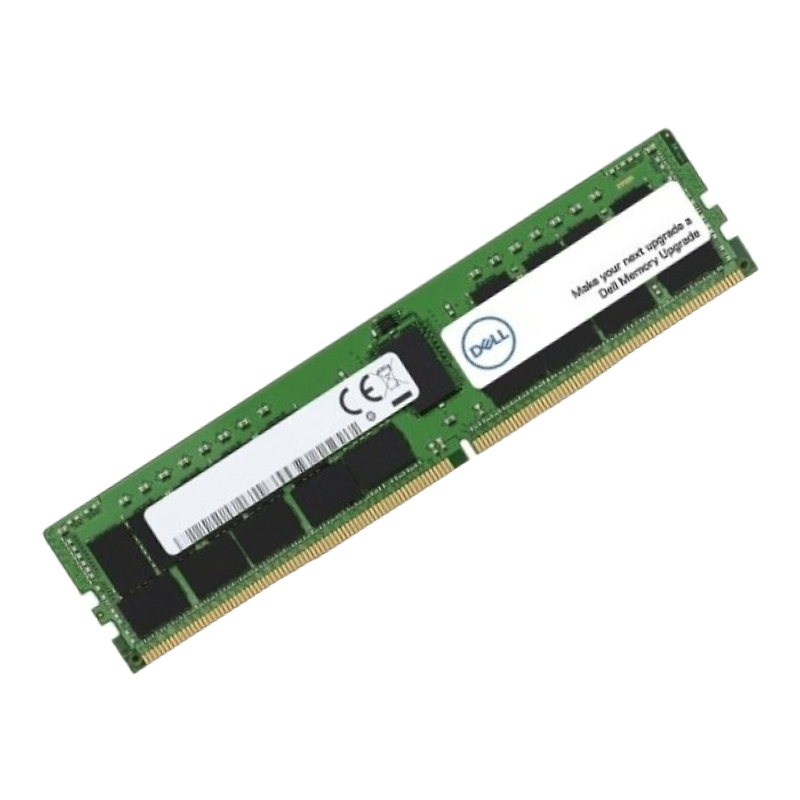
Dell 370-AHIB 64GB DDR5-4800MHz ECC Registered Server Memory Module. New (System) Pull with 1 year replacement warranty - Samsung Version
| SKU/MPN | Warranty | Price | Condition | You save |
|---|---|---|---|---|
| 370-AHIB | 1 Year Warranty | $2,245.00 | New (System) Pull | You save: $785.75 (26%) |
| 370-AHIB | 1 Year Warranty | $3,792.00 | New Sealed in Box (NIB) | You save: $1,327.20 (26%) |
The Dell 370-AHIB 64GB DDR5 4800MHz PC5-38400 1Rx8 ECC Registered 1.1V CL40 DDR5 SDRAM 288-pin RDIMM memory module is positioned in the server memory category as a high-density, high-stability solution designed specifically for enterprise and data center deployments. The aim is to clarify why this class of RDIMM is chosen for memory-heavy workloads, virtualization farms, and fault-intolerant production services while also describing the surrounding technical ecosystem and operational implications.
The 64GB capacity places this module in the high-density tier of server memory modules where density per DIMM reduces the number of populated slots required to reach large system memory configurations. The part’s designation as DDR5 4800MHz identifies its data rate as PC5-38400 — the industry shorthand linking raw MT/s performance to theoretical bandwidth. DDR5’s increased transfer rates relative to DDR4 enable higher aggregate memory bandwidth per channel, which benefits multi-threaded, memory-bound workloads such as in-memory databases, large-scale virtualization, analytics, and high-performance computing tasks. Architecturally, the 1Rx8 notation refers to the module’s organization as single-rank with x8 wide DRAM chips. Single-rank modules typically present a single set of device banks to the memory controller and are often easier to populate for optimal channel interleaving, though the precise effects on performance depend on the server platform’s memory topology and the number of channels available. The 288-pin RDIMM form factor is the standard physical footprint for DDR5 server memory, ensuring mechanical compatibility with modern server DIMM slots designed for DDR5 modules.
Registered DIMMs incorporate a register or buffer between the memory controller and the DRAM chips to stabilize command and address signals when many devices are attached, which improves signal integrity in multi-DIMM configurations. The ECC capability refers to the module’s ability to participate in system-level error-correcting code operations: single-bit errors can be detected and corrected, while multi-bit errors can be detected, which significantly increases data integrity. For mission-critical servers, RDIMM with ECC is a baseline requirement: it reduces the risk of silent data corruption and protects long-running processes and databases from transient faults induced by radiation, marginal voltages, or aging silicon. In modern DDR5 modules, additional reliability improvements are often implemented. DDR5 introduced on-die features that enhance internal error handling and power management; however, on-die ECC is not a replacement for system ECC. On-die mechanisms protect the internal DRAM organization, while registered ECC RDIMM preserves system-level memory correctness across the entire memory bus and is required for most server-class error correction strategies.
CAS latency of CL40 describes the number of clock cycles between issuing a column read command and the moment data begins to be available. At higher data rates like 4800MT/s, cycle counts have different real-time implications than at lower speeds. In general, higher frequency DDR5 modules offset larger cycle counts with faster cycle times, yielding comparable or improved real-time latency compared with older generation modules. For bandwidth-sensitive server applications — large dataset streaming, back-end caching layers, and inter-process memory transfers — the aggregate bandwidth increase at 4800MT/s often outweighs the raw cycle count. System-level latency, however, is a function of many factors including memory channel configuration, rank and bank interleaving, and the workload’s memory access pattern. Designers should understand that CL40 is a characteristic to balance against throughput and ECC behavior. In mixed environments, matching similar latency and speed modules yields the most predictable results; heterogeneous memory populations can force the memory controller to operate at the slowest common speed or suboptimal timings, which is why category-level guidance recommends standardization of module speed and timing across populated slots for production servers.
The operating voltage of 1.1V aligns with JEDEC DDR5 specifications and reflects one of the power-efficiency advances over prior generations. DDR5 often integrates a power management IC (PMIC) on-module, which allows finer-grained power regulation at the DIMM level and can improve stability across voltage rails. PMICs permit more consistent behavior in large-scale installations by regulating voltages closer to the silicon and reducing board-level power routing complexity. From a thermal standpoint, higher density and higher transfer rates increase thermal output. Server administrators should pair RDIMMs with appropriate chassis airflow, heatsinks where applicable, and system-level monitoring. Many DDR5 RDIMMs expose SPD/EEPROM data and sensor information that firmware can read to monitor operating parameters; integrating that telemetry into existing management tools helps to preempt thermal throttling or margin erosion in heavily loaded systems.
Compatibility is a principal concern when purchasing RDIMM server memory. The Dell 370-AHIB module will be compatible with systems that explicitly support DDR5 RDIMM PC5-38400 288-pin modules and ECC Registered memory. Modern enterprise platforms from both major vendor families support DDR5, but firmware, BIOS, and system board trace layouts impose constraints. It is critical to consult server vendor qualified parts lists and, when possible, select memory validated by the server OEM. Using vendor-validated parts ensures optimal BIOS timing tables, validated SPD information, and streamlined technical support. For custom or whitebox servers, cross-referencing the server board’s QVL (Qualified Vendor List) and validating memory density and rank combinations with the board manufacturer is indispensable. Memory population rules vary significantly between single-socket and multi-socket server motherboards. The number of channels and slots per channel dictates which combinations yield full channel bandwidth and optimal interleaving. For example, filling all channels with identical RDIMMs typically delivers maximum sustained bandwidth, while asymmetric populations can impose latency and throughput penalties. Admins should plan memory expansion with rank, capacity, and speed parity in mind to preserve expected performance characteristics through the system lifecycle.
This category of RDIMM targets a range of enterprise use cases where capacity and reliability are prioritized together with improved bandwidth. Virtualized server hosts that consolidate multiple guest VMs, container orchestration nodes running heavy memory workloads, and in-memory data stores benefit from the large 64GB per-DIMM capacity. Analytics and machine learning inference servers that require large memory working sets also see direct benefits: higher bandwidth reduces memory-induced bottlenecks and the ECC registered nature secures long-running data integrity. Database servers, particularly those running columnar or in-memory databases, will favor large RDIMM configurations to minimize disk IO and improve query response. Similarly, mission-critical application servers where data corruption risk is unacceptable typically mandate ECC Registered modules. For HPC clusters where raw bandwidth is crucial, DDR5-4800 RDIMMs supply the per-channel throughput needed to feed multi-core CPUs and accelerator interconnects.
Understanding rank interaction is essential for extracting predictable performance from 1Rx8 modules. Single-rank modules typically present fewer parallel banks to the controller than multi-rank modules, which can affect channel-level parallelism. Server motherboards with multi-channel memory controllers may achieve better bank-level concurrency when ranks are distributed evenly across channels. This category description emphasizes planning populations in multiples that align with the motherboard’s channel count: for systems with eight memory channels, population in channel-friendly multiples ensures optimal interleaving and bandwidth scaling. When upgrading existing servers, matching the new modules to existing ones in capacity, speed and ECC/registered type is imperative. Mixing registered and unregistered modules is typically unsupported. Mixing ranks and capacities can be supported by some platforms but often reduces performance or disables features such as higher-order interleaving. For predictable scaling, design a target memory footprint and populate all channels with matched RDIMMs of the same speed and timing class.


 Contact Us
 Information
 Catalog
 Solid State Drives (SSD)
 Network Switches
 Hard Disk Drives
 HBA & Controllers
 PC & Servers
 PC & Server Memory
 CPU & Processors
 Network Routers
 Power Supplies
 Tape Drives & Libraries
 Network Devices
 Computer & Network Cables