(7% discount is applied at checkout)
Cart is empty
Your go-to destination for cutting-edge server products
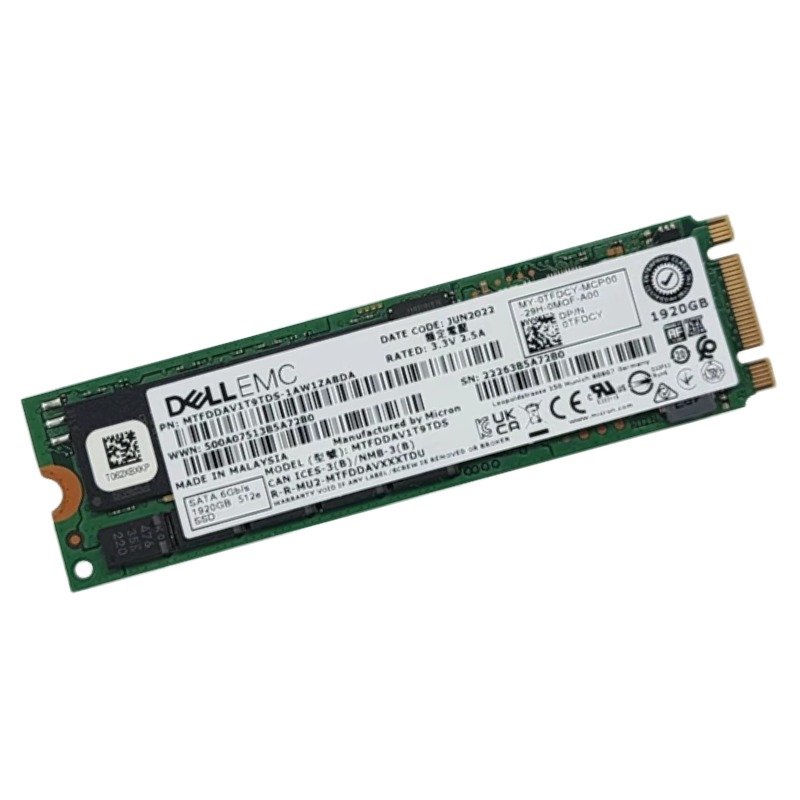


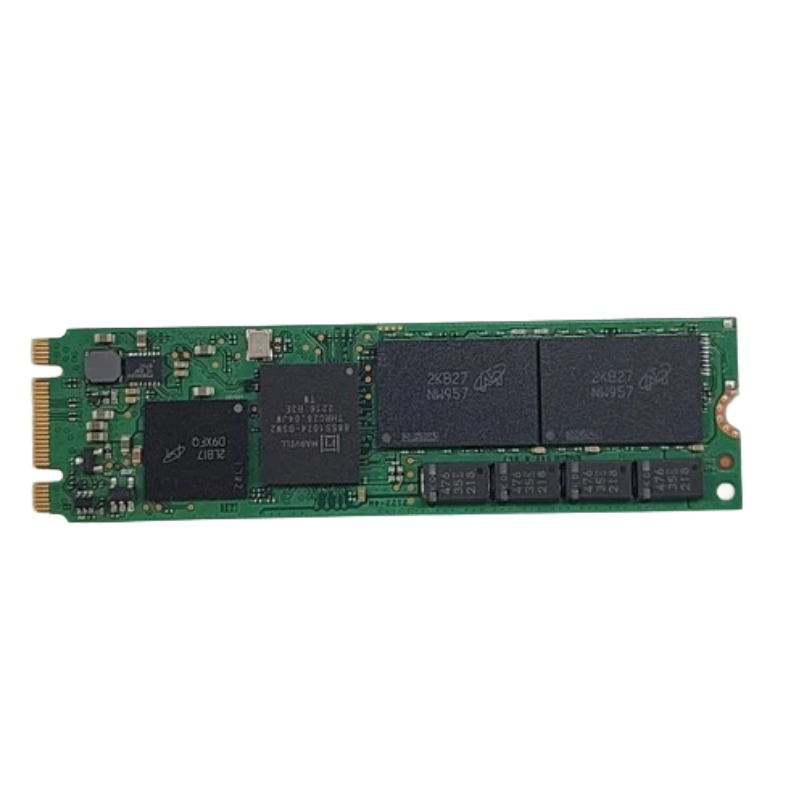
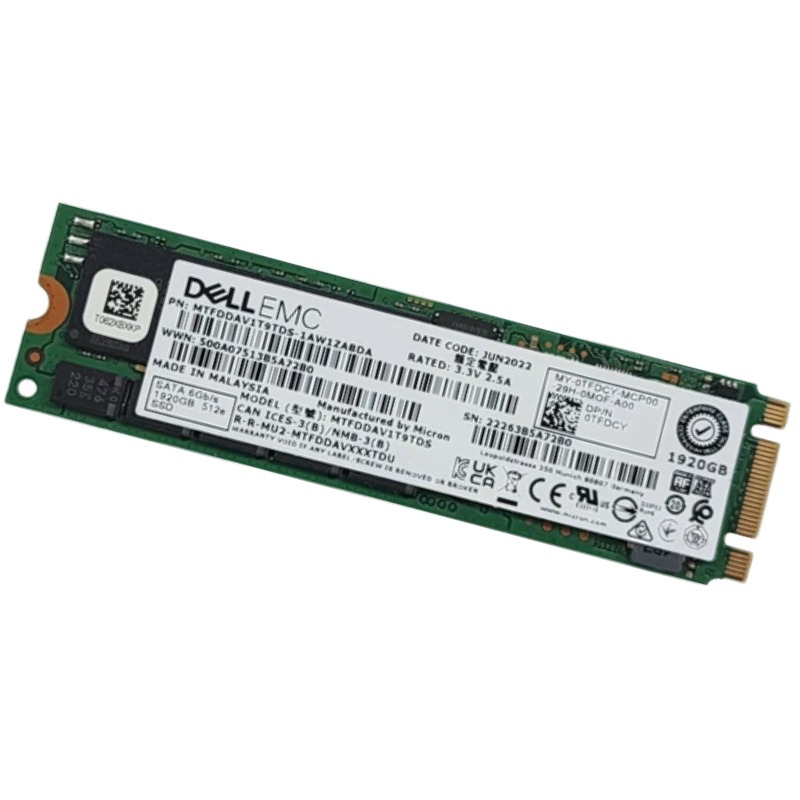
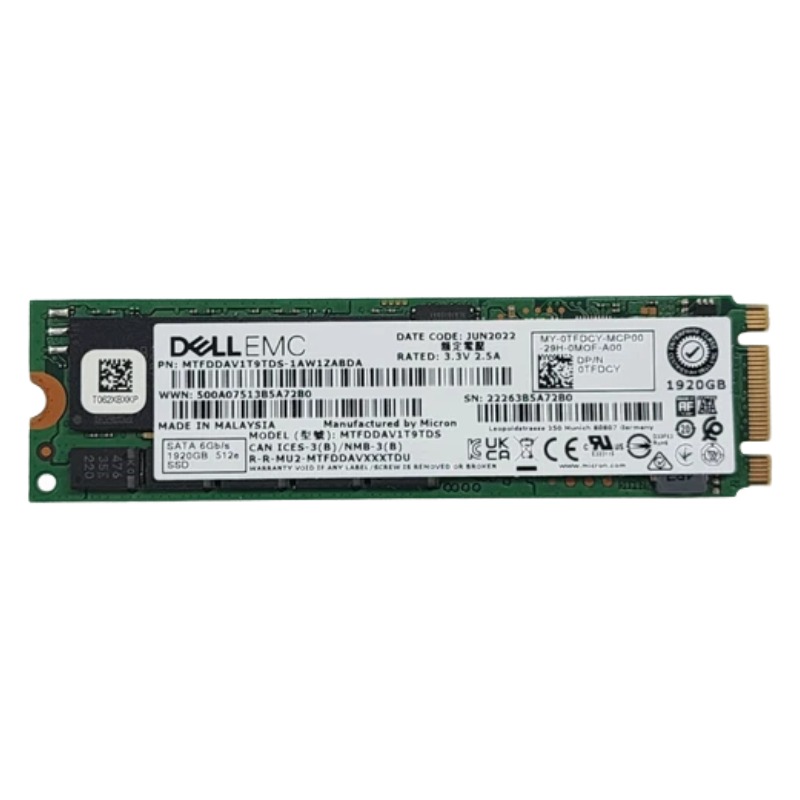
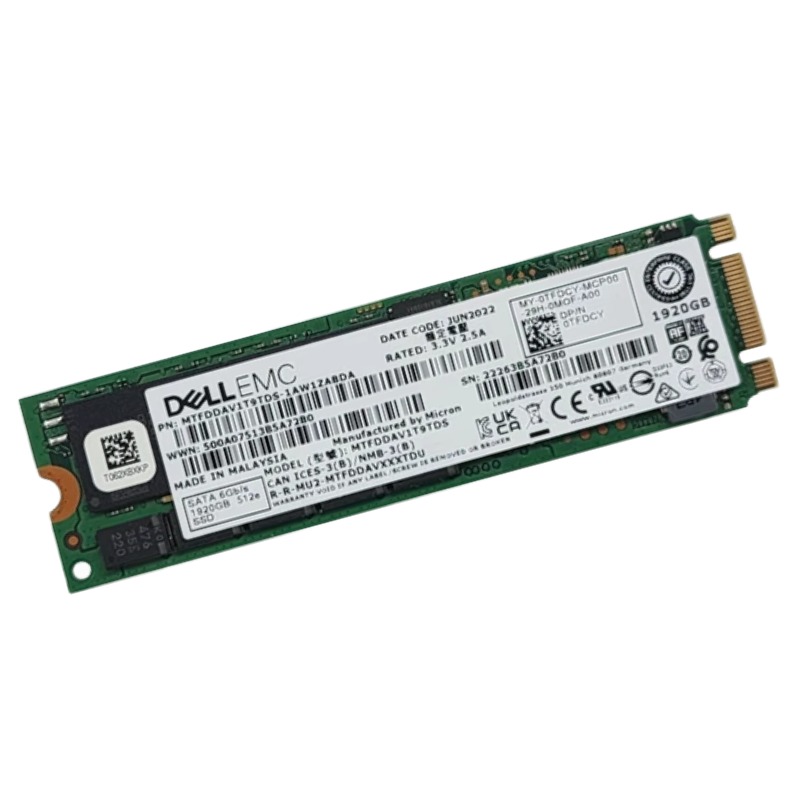
Dell TFDCY 1.92TB SATA M.2 2280 Enterprise SSD. Excellent Refurbished with 1 year Replacement Warranty
Overview of the Solid State Drive
Enterprise server environments demand storage solutions that balance reliability, endurance, predictable performance, and ease of deployment. Within this category, SATA-based M.2 solid-state drives integrated through purpose-built controller cards have become a practical choice for operating system boot, hypervisor placement, and lightweight application workloads. The Dell TFDCY 1.92TB SATA M.2 2280 Enterprise SSD BOSS Card for PowerEdge Servers represents a specialized implementation of this approach, combining enterprise-grade flash storage with a dedicated Boot Optimized Storage Solution architecture designed specifically for Dell PowerEdge platforms.
This category focuses on server-optimized SATA M.2 storage rather than consumer-grade M.2 devices. Enterprise SSDs differ significantly in firmware tuning, endurance ratings, error correction, and power-loss protection. When these drives are paired with a dedicated BOSS card, they become isolated from primary data storage pools, ensuring that critical system partitions remain stable even under heavy I/O loads elsewhere in the server. The 1.92TB capacity addresses modern server requirements where operating systems, container images, monitoring tools, and local caches can occupy significant space.
Unlike traditional 2.5-inch SATA SSDs mounted in front-accessible bays, M.2 2280 drives on a BOSS card conserve valuable drive bays for high-capacity or high-performance data disks. This category therefore appeals to administrators seeking to maximize storage flexibility while maintaining a clean separation between boot volumes and application data. The Dell TFDCY BOSS configuration also aligns with standardized enterprise serviceability, offering predictable lifecycle management and vendor-certified compatibility.
Enterprise SATA M.2 solutions emphasize consistency over peak throughput. While NVMe dominates performance-sensitive workloads, SATA remains relevant for boot and infrastructure roles due to its maturity, broad support, and lower power consumption. Within this category, firmware stability, error handling, and thermal behavior are prioritized, ensuring that the storage subsystem behaves reliably across years of continuous operation.
By focusing on server-certified components, this category eliminates many of the risks associated with adapting consumer M.2 drives for enterprise use. The Dell TFDCY 1.92TB SATA M.2 2280 Enterprise SSD BOSS Card belongs squarely in this segment, providing a purpose-built solution that integrates seamlessly into PowerEdge servers without compromise.
The Boot Optimized Storage Solution, commonly known as the BOSS card, is a defining element of this product category. Rather than connecting M.2 drives directly to a motherboard slot, the BOSS card acts as an intermediary controller that manages one or more M.2 SATA SSDs in a configuration optimized for server boot operations. The Dell TFDCY 1.92TB SATA M.2 2280 Enterprise SSD BOSS Card exemplifies this design philosophy by integrating enterprise flash storage with a dedicated, low-profile PCIe-based controller card.
This architecture provides several advantages over direct-attached storage. First, it standardizes boot device placement across multiple PowerEdge server models, simplifying deployment and maintenance. Second, it allows the system BIOS and management firmware to treat the boot device as a managed storage resource, enabling features such as mirrored boot volumes, health monitoring, and predictable enumeration during startup.
The BOSS card is engineered for minimal overhead. It does not attempt to replace high-performance RAID controllers or NVMe adapters; instead, it focuses on stability and efficiency. SATA connectivity ensures compatibility with mature driver stacks, while the PCIe interface provides sufficient bandwidth for boot-related tasks without consuming excessive system resources. The M.2 2280 form factor is widely supported, allowing for standardized thermal and mechanical design within the server chassis.
Dell’s implementation emphasizes enterprise serviceability. The card and SSD combination is validated as a unit, reducing the risk of firmware mismatches or unsupported configurations. This category benefits organizations that value vendor-backed support and predictable behavior over experimental flexibility. By selecting a BOSS-based solution, administrators gain confidence that firmware updates, diagnostics, and lifecycle management tools will recognize and manage the boot storage consistently.
In addition, the design isolates boot storage from front-facing drive bays and backplane complexities. This reduces cabling, improves airflow, and simplifies internal layouts. The Dell TFDCY BOSS card approach reflects a broader trend in server design, where dedicated subsystems handle specific roles with clarity and efficiency.
Within this category, performance is evaluated through the lens of consistency and reliability rather than raw throughput. The Dell TFDCY 1.92TB SATA M.2 2280 Enterprise SSD is optimized for steady-state operation, delivering predictable latency and sustained performance under typical server boot and management workloads. SATA bandwidth is more than sufficient for operating systems, hypervisors, and administrative tools, ensuring fast boot times and responsive system management.
Enterprise SSDs incorporate advanced error correction, wear leveling, and firmware algorithms that prioritize data integrity. This is especially important for boot volumes, where corruption or unexpected latency can affect overall system availability. Power-loss protection mechanisms help safeguard in-flight data, reducing the risk of file system inconsistencies during unexpected outages or reboots.
The 1.92TB capacity offers ample space for modern infrastructure demands. Virtualization platforms, container runtimes, and orchestration frameworks often store logs, images, and metadata locally. Having sufficient boot storage capacity reduces the need for external dependencies and allows for more flexible system configurations. This category addresses the reality that boot drives are no longer minimalistic components but integral parts of the server software stack.
Thermal stability is another critical factor. M.2 drives can be sensitive to sustained heat, particularly in densely packed server environments. The BOSS card design accounts for airflow patterns within PowerEdge chassis, helping maintain consistent operating temperatures. This contributes to predictable performance and longevity, aligning with enterprise expectations for continuous operation.
Reliability metrics such as endurance ratings and mean time between failures are central to this category. The Dell TFDCY enterprise SSD is designed for write-intensive boot and management workloads over extended periods, supporting long service lifecycles. Administrators benefit from reduced maintenance windows and fewer unexpected failures, reinforcing the value proposition of enterprise-certified storage.
Compatibility is a defining attribute of this category. The Dell TFDCY 1.92TB SATA M.2 2280 Enterprise SSD BOSS Card is validated for use with a wide range of PowerEdge server models, ensuring seamless integration at both hardware and firmware levels. This validation simplifies procurement and deployment, as administrators can standardize on a single boot storage solution across multiple server generations.
Deployment flexibility is enhanced by the card-based approach. The BOSS card occupies a dedicated slot, freeing front-accessible drive bays for application data, archival storage, or high-performance NVMe arrays. This separation allows for clearer storage tiering and simplifies troubleshooting. In environments where uptime is critical, the ability to service or replace data drives without disturbing the boot volume is a significant operational advantage.
The standardized M.2 2280 form factor ensures mechanical compatibility and predictable installation procedures. Technicians benefit from consistent mounting and replacement processes, reducing the likelihood of errors during maintenance. Firmware-level integration ensures that the boot device is recognized uniformly across BIOS updates and management utilities.
This category also supports flexible configuration options. Depending on the server model and BOSS card variant, administrators may implement mirrored boot volumes for redundancy. This enhances availability and aligns with best practices for enterprise deployments. Even in single-drive configurations, the enterprise-grade nature of the SSD minimizes risk.
By focusing on certified compatibility, this category reduces the uncertainty often associated with third-party or consumer-grade alternatives. The Dell TFDCY BOSS card approach ensures that system updates, diagnostics, and support processes function as intended, contributing to a smoother operational experience.
The Dell TFDCY 1.92TB SATA M.2 2280 Enterprise SSD BOSS Card category addresses a broad range of use cases within modern IT environments. In virtualization platforms, dedicated boot storage ensures that hypervisors remain isolated from guest workload I/O, improving stability and simplifying performance tuning. The generous capacity accommodates multiple hypervisor images, logs, and management tools without constraint.
In private cloud and hybrid cloud infrastructures, reliable boot storage underpins automation and orchestration. Nodes must start consistently and predictably to support scaling and failover operations. Enterprise SATA M.2 solutions provide the stability required for such environments, ensuring that boot-related processes do not become a bottleneck.
Edge computing deployments also benefit from this category. Remote or space-constrained locations often rely on compact server configurations with limited service windows. A robust, low-maintenance boot storage solution reduces the need for on-site intervention. The BOSS card’s internal placement and enterprise durability make it well suited for such scenarios.
Development and testing environments similarly gain value. Consistent boot behavior across multiple servers enables reproducible testing and streamlined provisioning. The 1.92TB capacity allows for local storage of test images, snapshots, and tools, enhancing productivity without impacting primary data storage.
Across these use cases, the common thread is the need for dependable, vendor-supported boot storage. This category delivers a balance of capacity, reliability, and integration that aligns with diverse operational requirements.
Effective management is essential for enterprise storage categories, and the Dell TFDCY 1.92TB SATA M.2 2280 Enterprise SSD BOSS Card is designed with this in mind. Integration with PowerEdge management frameworks allows administrators to monitor drive health, firmware versions, and error conditions through familiar interfaces. This visibility supports proactive maintenance and informed decision-making.
Security considerations extend beyond data encryption to include firmware integrity and controlled update processes. Enterprise SSDs are subject to rigorous validation, reducing the risk of vulnerabilities or unpredictable behavior. Boot storage, in particular, plays a critical role in system security, as it forms the foundation of the operating environment.
Lifecycle management is simplified by vendor certification. Replacement cycles, firmware updates, and compatibility planning can be aligned with server refresh strategies. This category supports long-term planning, enabling organizations to standardize on a known-good configuration and reduce operational complexity.
From an operational perspective, the separation of boot storage via a BOSS card reduces the impact of changes to primary storage arrays. Administrators can upgrade, reconfigure, or replace data drives without affecting the boot environment. This modularity contributes to improved uptime and more efficient maintenance workflows.
Overall, this category emphasizes control, predictability, and supportability. The Dell TFDCY enterprise BOSS card solution embodies these principles, offering a storage foundation that aligns with the expectations of modern enterprise IT operations.


 Contact Us
 Information
 Catalog
 Solid State Drives (SSD)
 Network Switches
 Hard Disk Drives
 HBA & Controllers
 PC & Servers
 PC & Server Memory
 CPU & Processors
 Network Routers
 Power Supplies
 Tape Drives & Libraries
 Network Devices
 Computer & Network Cables