
(7% discount is applied at checkout)
Cart is empty
Your go-to destination for cutting-edge server products
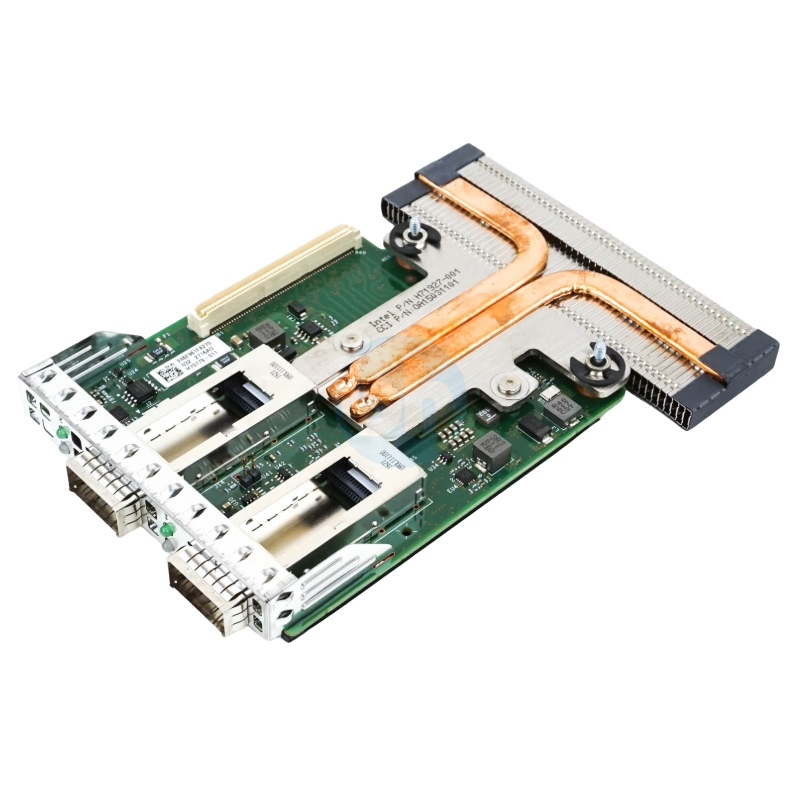
Dell XD56X Xl710 PCIE3.0 40GBE QSFP+ NIC Mezzanine Card. Excellent Refurbished with 1-Year Replacement Warranty
Introducing the Dell XD56X PCIE 3.0 40GBE QSFP+ NIC Mezzanine, a high-performance network adapter engineered for optimal data transmission and efficiency. Designed to meet the needs of modern data centers and networking environments, this product ensures seamless connectivity with its cutting-edge features and robust performance capabilities.
The Dell XD56X Intel Dual-Ports 40Gbps PCIe 3.0 x8 Ethernet Converged Network Adapter is engineered as an enterprise-grade converged network interface solution designed to unify high-speed Ethernet connectivity, storage traffic processing, and virtualization acceleration within a single hardware platform. Built for modern data centers that demand high throughput, low latency, and maximum reliability, this adapter integrates advanced Intel networking controller architecture optimized for 40Gbps dual-port communication across PCI Express 3.0 x8 lanes.
In large-scale server environments, network bottlenecks can significantly impact workload efficiency. This adapter mitigates such challenges by combining hardware offload capabilities with scalable bandwidth delivery. Its converged design ensures that traditional network traffic and storage protocols can be processed simultaneously without overwhelming CPU resources, making it ideal for cloud infrastructures, virtualization clusters, and high-performance computing nodes.
The PCI Express 3.0 x8 interface serves as the backbone of the adapter’s internal data movement capabilities. With each lane delivering approximately 8 GT/s signaling rate, the aggregated throughput ensures that the dual 40Gbps ports operate without internal congestion. This architecture is optimized for balanced data distribution, enabling sustained performance even under heavy multi-session workloads.
Unlike legacy network adapters constrained by lower PCIe generations, this design eliminates upstream bottlenecks between the adapter and the server CPU. As a result, packet processing, virtualization offloads, and storage encapsulation tasks are executed with minimal latency overhead, significantly improving end-to-end network responsiveness.
By leveraging PCIe 3.0 x8 bandwidth efficiency, the adapter reduces dependency on host CPU cycles. This allows server processors to dedicate more resources to application-level workloads such as database processing, virtualization management, or analytics computation. The reduction in CPU interrupt load is particularly beneficial in environments where multiple virtual machines or containers operate concurrently.
The dual-port 40Gbps configuration is one of the defining characteristics of this converged adapter. Each port is capable of handling high-volume data streams independently, allowing for both redundancy and load balancing across multiple network paths. This configuration is critical in data centers where uninterrupted service availability is a requirement.
The aggregated bandwidth supports a wide range of enterprise applications including real-time analytics, virtualization migration traffic, and large-scale distributed storage synchronization. With two independent high-speed interfaces, administrators can configure network segmentation strategies that enhance performance isolation and fault tolerance.
The adapter incorporates advanced packet processing engines that operate at hardware level, significantly reducing the latency associated with traditional software-based networking stacks. These engines are designed to handle segmentation, checksum calculations, and packet classification directly within the adapter firmware layer.
This results in more consistent latency performance, which is essential for latency-sensitive workloads such as financial trading systems, real-time communication platforms, and distributed AI inference clusters.
Traffic prioritization mechanisms embedded in the adapter ensure that critical data flows are processed with higher priority compared to non-essential background traffic. This adaptive intelligence allows enterprise administrators to maintain predictable service quality even under peak load conditions.
The converged design of the adapter enables simultaneous handling of traditional Ethernet traffic alongside storage protocols such as iSCSI and Fibre Channel over Ethernet (FCoE). This integration eliminates the need for separate network interface cards for storage and data traffic, simplifying infrastructure design and reducing hardware overhead.
Storage traffic acceleration is achieved through dedicated hardware offload engines that manage protocol encapsulation and de-encapsulation processes. This ensures consistent throughput for storage replication, backup operations, and distributed file system synchronization.
By converging multiple networking functions into a single adapter, data center architects can reduce cabling complexity, switch port consumption, and power usage. This consolidation improves operational efficiency while maintaining enterprise-grade performance standards.
RDMA support allows direct memory-to-memory data transfers between servers without involving the CPU in packet processing. This dramatically reduces latency and increases throughput for inter-server communication tasks.
In clustered computing environments, RDMA enables near real-time data synchronization, which is critical for high-performance distributed applications such as in-memory databases and AI training workloads.
The deterministic performance characteristics of RDMA-enabled communication ensure that jitter is minimized across network sessions. This consistency is essential for applications requiring strict timing accuracy and predictable data delivery patterns.
The adapter is optimized for seamless integration with major virtualization platforms, enabling efficient virtual machine networking through hardware-assisted virtualization technologies. It supports features such as Single Root I/O Virtualization (SR-IOV), which allows multiple virtual functions to share a single physical adapter while maintaining isolation.
This capability is critical in multi-tenant cloud environments where secure and efficient network partitioning is required to prevent interference between workloads.
In containerized environments, the adapter ensures low-latency communication between microservices by minimizing packet processing overhead. This improves the responsiveness of distributed applications that rely on rapid inter-service communication.
The adapter supports dynamic scaling scenarios commonly found in Kubernetes and similar orchestration platforms. As workloads increase or decrease, network performance remains stable due to hardware-based traffic handling and efficient queue management systems.
The Dell XD56X Intel Dual-Ports 40Gbps PCIe 3.0 x8 Ethernet Converged Network Adapter is designed for seamless compatibility with Dell PowerEdge server architectures, ensuring optimized firmware interaction, driver support, and system-level performance tuning. This integration ensures that enterprise deployments benefit from fully validated hardware and software interoperability.
Within PowerEdge environments, the adapter contributes to balanced workload distribution across CPU cores and memory subsystems, reducing contention and improving overall system efficiency.
The firmware architecture embedded within the adapter provides fine-grained control over traffic routing, queue management, and error correction processes. This ensures stable operation under variable workload conditions.
The adapter supports a wide range of enterprise operating systems, ensuring consistent performance across Linux distributions, Windows Server environments, and virtualization hypervisors. Optimized driver stacks enhance communication between the operating system kernel and hardware acceleration engines.
In cloud computing environments, the adapter plays a critical role in managing distributed workloads that require high-speed interconnectivity. Its dual-port design enables efficient traffic segmentation between public-facing services and internal control planes.
This separation enhances both performance and security by isolating different traffic classes while maintaining high throughput capabilities across the infrastructure.
HPC environments benefit significantly from the adapter’s low-latency communication capabilities. Parallel computing tasks often require rapid synchronization between nodes, and this adapter ensures that data exchange occurs with minimal delay.
Scientific computing workloads such as simulation modeling, genomic analysis, and large-scale data processing rely heavily on fast network interconnects. The adapter provides the necessary bandwidth and latency characteristics to support these demanding applications.
The dual-port architecture of the adapter ensures continuous network availability through automatic failover mechanisms. If one port experiences degradation or failure, traffic is seamlessly rerouted through the secondary interface without disrupting ongoing operations.
This redundancy is essential in mission-critical environments where downtime can lead to significant operational and financial impact.
The adapter is designed with optimized thermal characteristics that ensure stable operation even under sustained high-load conditions. Efficient heat dissipation mechanisms help maintain consistent performance without thermal throttling.
Energy-efficient design principles reduce overall power consumption while maintaining high throughput performance. This is particularly important in large-scale data centers where energy efficiency directly impacts operational costs.
Security features integrated into the adapter include hardware-based packet filtering and traffic segmentation mechanisms that help protect against unauthorized access and malicious traffic patterns. These features operate at line speed, ensuring that security enforcement does not introduce latency.
In virtualized environments, the adapter ensures secure separation between virtual machine traffic streams. This isolation prevents cross-VM interference and enhances overall system security posture.


 Contact Us
 Information
 Catalog
 Solid State Drives (SSD)
 Network Switches
 Hard Disk Drives
 HBA & Controllers
 PC & Servers
 PC & Server Memory
 CPU & Processors
 Network Routers
 Power Supplies
 Tape Drives & Libraries
 Network Devices
 Computer & Network Cables