(7% discount is applied at checkout)
Cart is empty
Your go-to destination for cutting-edge server products
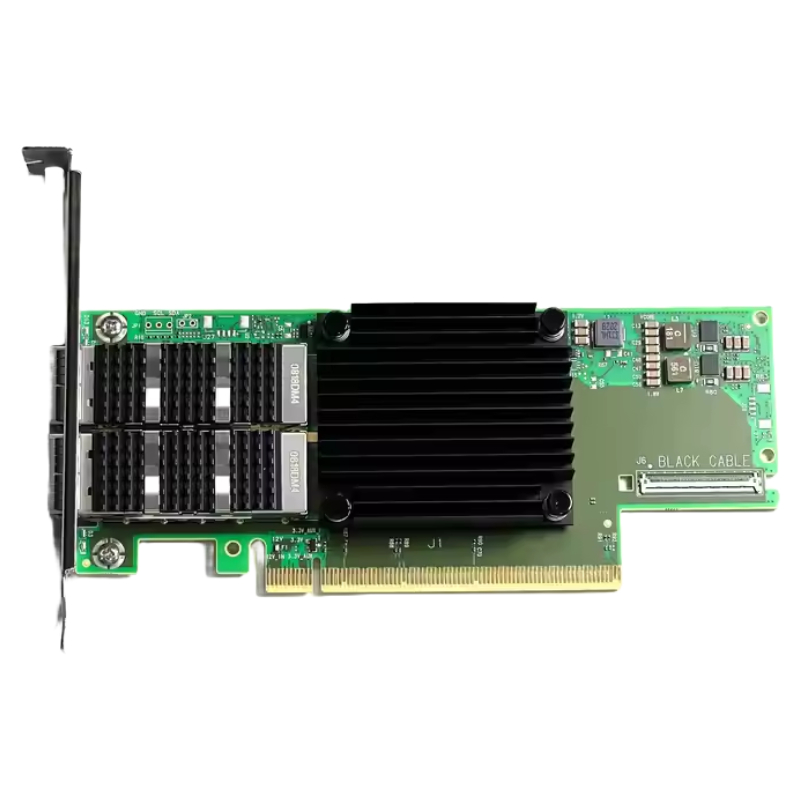


Dell Y30W9 Intel E810 Dual Port Adapter 100GBPS QSFP28 PCIe Low Profile. New Sealed in Box (NIB)
The Dell Y30W9 Intel E810 Dual-Port Adapter is an ultra-high-speed enterprise networking solution designed for modern data centers, cloud infrastructures, and high-performance computing environments. With 100 Gigabit Ethernet capability per port, it delivers exceptional bandwidth, advanced offload technologies, and scalable connectivity for mission-critical workloads.
The Dell Y30W9 Intel E810 Dual Port Adapter 100Gbps QSFP28 PCIe Low Profile represents a high-end enterprise networking category engineered for hyperscale data centers, cloud service providers, and performance-critical computing environments. This category is defined by ultra-high bandwidth connectivity, low latency packet processing, and advanced hardware acceleration features that support next-generation distributed workloads. Built around the Intel Ethernet E810 architecture, this adapter class is designed to deliver deterministic performance in environments where network throughput and efficiency directly impact application scalability and responsiveness.
At the core of the Dell Y30W9 adapter category is the Intel Ethernet E810 controller, which is engineered to support ultra-high-speed Ethernet interfaces up to 100Gbps per port using QSFP28 optical modules. This controller integrates advanced packet processing engines capable of handling massive data streams with minimal CPU intervention. By offloading critical networking functions such as checksum computation, segmentation, encryption acceleration, and traffic classification, the controller significantly improves system efficiency.
The architecture is designed to support deterministic latency under heavy load conditions, making it suitable for workloads that require consistent network performance such as high-frequency trading systems, real-time analytics platforms, and distributed machine learning clusters.
The dual port configuration in this category enables two independent 100Gbps channels, providing an aggregate bandwidth potential of up to 200Gbps under optimal conditions. Each port operates using QSFP28 transceivers, which support high-density optical fiber connections optimized for data center environments. This design ensures redundancy, load balancing, and high availability across critical networking infrastructures.
The dual channel architecture allows organizations to implement failover strategies where traffic is automatically rerouted in the event of port failure, ensuring continuous network availability for mission-critical applications.
QSFP28 (Quad Small Form-factor Pluggable 28) is a high-speed optical interface standard designed for 100Gbps Ethernet transmission. It supports both short-range and long-range fiber optic connectivity, enabling flexible deployment across different data center topologies. The Dell Y30W9 adapter leverages this interface to provide scalable bandwidth options while maintaining low power consumption and high signal integrity.
The QSFP28 ecosystem also enables breakout configurations, allowing a single 100Gbps port to be divided into multiple lower-speed connections when required, offering additional deployment flexibility in complex networking environments.
Latency reduction is a fundamental requirement in this category of networking adapters. The Intel E810 architecture incorporates hardware-based acceleration engines that minimize packet processing delays by handling critical network functions directly within silicon. This eliminates unnecessary software stack traversal, resulting in significantly faster data transmission and reception.
This optimization is particularly important in environments where microsecond-level latency differences can impact system performance, such as algorithmic trading platforms, real-time data analytics engines, and high-performance computing clusters.
The adapter supports intelligent traffic steering mechanisms that dynamically distribute network loads across both 100Gbps ports. This ensures that no single port becomes a performance bottleneck during peak traffic conditions. The system continuously analyzes packet flow patterns and adjusts routing decisions in real time to maintain optimal throughput efficiency.
Hardware offload engines integrated within the Intel E810 controller handle computationally intensive networking tasks such as TCP segmentation offload, receive-side scaling, and checksum validation. By offloading these tasks from the CPU, the system achieves higher throughput while reducing processor utilization, enabling more resources to be allocated to application workloads.
The adapter utilizes intelligent interrupt moderation techniques to reduce CPU overhead during high traffic events. Instead of generating an interrupt for every packet, the system aggregates network events and processes them in optimized batches. This improves CPU efficiency and ensures stable system performance under sustained high-load conditions.
Single Root I/O Virtualization (SR-IOV) is a key feature of this adapter category, enabling the partitioning of a single physical network interface into multiple virtual interfaces. These virtual interfaces can be assigned directly to virtual machines, bypassing hypervisor overhead and delivering near-native network performance.
This capability is essential in cloud environments where high-density virtual machine deployment requires efficient and isolated network performance across multiple tenants.
The Data Plane Development Kit (DPDK) support allows user-space packet processing, enabling applications to bypass traditional kernel networking stacks. This significantly reduces latency and increases packet throughput, making it ideal for telecom infrastructure, network function virtualization, and software-defined networking deployments.
Modern cloud-native architectures rely heavily on container orchestration platforms and microservices-based applications. This adapter category ensures consistent network performance across dynamically scaling workloads, enabling efficient communication between containerized services in distributed environments.
The low-profile PCIe form factor of this adapter category is specifically designed for high-density server environments, including blade servers and compact rack systems. This enables organizations to maximize network interface density without compromising airflow or thermal efficiency.
Redundancy is a critical requirement in enterprise networking architectures. The dual-port design enables multiple failover paths, ensuring continuous connectivity even in the event of hardware failure. This enhances system resilience and supports zero-downtime operational requirements.
This adapter category is widely used in NVMe-over-Fabrics environments where ultra-low latency and high throughput are required for storage communication between compute nodes and storage arrays. The 100Gbps bandwidth ensures rapid data transfer, reducing bottlenecks in high-performance storage systems.
By leveraging hardware acceleration, the adapter improves input/output efficiency for distributed storage architectures, enabling faster database operations and large-scale analytics processing.
In distributed file system deployments, the dual 100Gbps ports enable parallel data transfer across multiple nodes, significantly improving read and write performance for large datasets. This is particularly beneficial for big data analytics, artificial intelligence training, and scientific computing applications.
Security is a fundamental requirement for enterprise networking environments. This adapter category includes hardware-based encryption acceleration capabilities that enable secure data transmission without imposing additional CPU overhead. This ensures high-performance encryption for sensitive workloads such as financial transactions and healthcare data processing.
Encryption processes are handled directly within the network controller, ensuring both speed and compliance with enterprise-grade security standards.
Secure boot mechanisms ensure that only authenticated firmware is executed on the adapter, preventing unauthorized modifications and protecting against low-level attacks. Firmware integrity validation ensures system reliability and compliance with enterprise security frameworks.
Operating at 100Gbps generates significant heat output, requiring advanced thermal management solutions. The adapter incorporates optimized heat dissipation pathways to ensure stable operation under sustained high-load conditions in dense server environments.
Power management systems dynamically adjust energy consumption based on real-time traffic loads. During periods of low network activity, power usage is reduced to improve efficiency, while full performance mode is activated during peak demand periods.
The adapter provides detailed telemetry data including bandwidth utilization, error rates, and packet distribution metrics. This visibility allows administrators to monitor network health and proactively address performance issues before they impact operations.
This adapter category is engineered for hyperscale environments where massive compute and storage clusters require ultra-high bandwidth networking. The 100Gbps dual-port design ensures that infrastructure can scale efficiently without introducing network bottlenecks.
The Dell Y30W9 Intel E810 category is designed with future scalability in mind, ensuring compatibility with evolving Ethernet standards and next-generation data center architectures. This makes it suitable for long-term enterprise IT investment strategies focused on performance and adaptability.
Hardware-level workload isolation ensures that network performance remains consistent across multiple applications and tenants. This prevents performance interference and guarantees predictable network behavior in multi-tenant environments.


 Contact Us
 Information
 Catalog
 Solid State Drives (SSD)
 Network Switches
 Hard Disk Drives
 HBA & Controllers
 PC & Servers
 PC & Server Memory
 CPU & Processors
 Network Routers
 Power Supplies
 Tape Drives & Libraries
 Network Devices
 Computer & Network Cables