
(7% discount is applied at checkout)
Cart is empty
Your go-to destination for cutting-edge server products
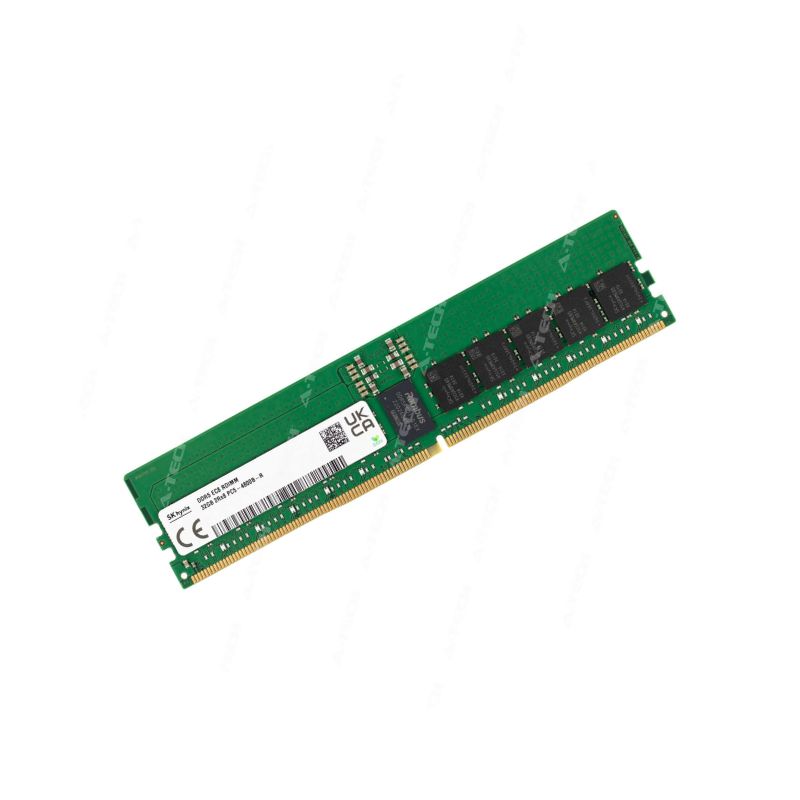
Hynix HMCG88AEBRA 32GB (1x32gb) 2rx8 Pc5-38400 4800MHz Ecc Registered Cl40 1.1v Ddr5 Sdram 288-pin Rdimm Memory Module For Server. New (System) Pull with 1 year replacement warranty
| SKU/MPN | Warranty | Price | Condition | You save |
|---|---|---|---|---|
| HMCG88AEBRA | 1 Year Warranty | Contact us for a price | New Sealed in Box (NIB) | |
| HMCG88AEBRA | 1 Year Warranty | $1,377.00 | New (System) Pull | You save: $481.95 (26%) |
The Hynix HMCG88AEBRA 32GB (1x32GB) DDR5 ECC Registered server-grade memory module delivers outstanding reliability and high-speed performance for enterprise environments. This advanced PC5-38400 RDIMM is engineered to enhance data processing efficiency, system stability, and multitasking capabilities.
The product nomenclature itself is a detailed blueprint of the module's capabilities. Understanding each segment is key to appreciating its design intent.
The "32GB (1x32GB)" denotes a single module with a total capacity of 32 Gigabytes. This high-density package allows for substantial total system memory capacities without exhausting DIMM slot availability, a crucial factor for memory-intensive applications like virtualization, in-memory databases (e.g., SAP HANA, Redis), and large-scale data analytics.
The "2Rx8" refers to its internal organization: it is a Dual Rank (2R) module with an x8 data interface. A rank is an independent set of DRAM chips addressed by the memory controller. A dual-rank module effectively interleaves accesses between two ranks, often improving performance over a single-rank module by better utilizing the memory bus. The x8 configuration refers to the bit width of each individual DRAM chip and is a common, optimized design for server memory, offering a balance of performance, capacity, and reliability.
In practical terms, a dual-rank module like this one can often deliver higher sustained bandwidth than a single-rank module of the same speed because the memory controller can issue commands to one rank while another is preparing data. This reduces idle cycles on the data bus. For servers running sustained, high-throughput workloads, this architectural nuance translates to tangible gains in application responsiveness and data processing rates.
The terms "PC5-38400" and "4800MHz" define the module's performance tier. "PC5-38400" is the industry-standard module designation, where "PC5" indicates DDR5 and "38400" refers to the theoretical peak transfer rate in megabytes per second (MB/s). A single module can thus achieve up to 38,400 MB/s of bandwidth.
The "4800MHz" figure is the data rate, measured in Megatransfers per second (MT/s). Since DDR (Double Data Rate) transfers data on both the rising and falling clock edges, the effective speed is twice the base clock. This 4800 MT/s speed represents a significant uplift from mainstream DDR4 speeds (commonly 2666-3200 MT/s), directly feeding CPUs with data faster and reducing latency in bandwidth-bound tasks.
When planning a server configuration, total system memory bandwidth is a key metric. For a dual-processor (2P) server platform with 12 memory channels per socket (a common modern server CPU architecture), populated with 24 modules of this type, the aggregate theoretical bandwidth becomes staggering. This scalability is essential for multi-threaded applications in scientific computing, financial modeling, and video rendering farms.
The "ECC Registered" descriptor highlights the two most critical technologies that differentiate server memory from standard desktop (UDIMM) memory. These features are non-negotiable for any mission-critical computing environment.
ECC is a fundamental requirement for server stability. It enables the memory module to detect and correct the most common types of internal data corruption—single-bit errors—on the fly, without any operating system or application involvement. It can also detect, though not correct, multi-bit errors.
In a server environment running 24/7, cosmic rays, electrical noise, and other factors can cause soft errors in memory cells. Uncorrected, these errors can lead to silent data corruption, application crashes, or system instability. ECC provides a protective layer that ensures the data read from memory is identical to the data written, which is paramount for database accuracy, financial transaction integrity, and scientific computation validity.
The Hynix HMCG88AEBRA module includes extra DRAM bits (typically 8 bits for every 64-bit word, creating a 72-bit bus) to store a cryptographic code. When data is written, a code is calculated and stored alongside it. Upon read, the code is recalculated and compared. A mismatch triggers correction logic, fixing the error transparently. Many server operating systems can log these corrected events, allowing IT staff to monitor memory health and predict potential hardware failure before it causes downtime.
The "Registered" or "RDIMM" aspect is equally crucial for scalable server configurations. A registered DIMM places a register (or buffer) on the module between the memory controller and the DRAM chips. This register buffers the command, address, and clock signals, reducing the electrical load on the memory controller.
This buffering allows a system to support a much greater number of memory modules per channel (often 2 or more RDIMMs vs. typically 1 UDIMM) and higher total memory capacities without signal degradation. It enhances signal integrity and system stability, especially at high speeds and in fully-populated memory configurations.
The register introduces a minimal, fixed latency of one clock cycle. However, this is a negligible penalty compared to the overwhelming benefits of capacity, stability, and scalability. For any server deployment beyond a basic entry-level tower, RDIMMs are the standard and recommended choice. The Hynix HMCG88AEBRA is built to this enterprise specification, ensuring compatibility and reliability in multi-DIMM per channel environments.
This module is not merely a faster DDR4; it embodies several architectural shifts inherent to the DDR5 standard that deliver generational improvements.
DDR5 modules decentralize power management by moving the Voltage Regulator Module (VRM) from the motherboard to the DIMM itself, via an onboard PMIC. The "1.1V" specification is the nominal operating voltage for the data buffer and core, representing improved power efficiency over DDR4. The PMIC provides more stable and cleaner power delivery to the DRAM chips, improving signal integrity and overclocking margin, and allows for finer-grained power control and monitoring.
DDR5 introduces doubled bank groups compared to DDR4. This increases parallelism within the memory chip, allowing more simultaneous accesses and improving effective bandwidth, particularly in multi-threaded workloads that access memory randomly. The burst length is also doubled to 16, which optimizes sequential data transfers, benefiting streaming and large block operations.
Beyond the module-level ECC, DDR5 chips often incorporate On-Die ECC. This is an internal, additional layer of error correction that happens within the DRAM die itself, correcting minor internal errors before data is sent to the module's ECC logic. This further enhances data reliability and can contribute to higher manufacturing yields and chip longevity.
The Hynix HMCG88AEBRA 32GB RDIMM is designed for specific server platforms.
This module is built for servers powered by Intel Xeon Scalable Processors (Sapphire Rapids, Emerald Rapids, and later generations) and AMD EPYC 7004 "Genoa" and 8005 "Siena" series processors (and beyond) that support DDR5 memory. It is critical to verify compatibility with the specific server OEM's (Dell, HPE, Lenovo, Supermicro, etc.) qualified vendor list (QVL) for the intended motherboard or system model.
Server memory compatibility is stringent. Using a module from the QVL guarantees it has been tested for timing, voltage, thermal, and interoperability specifics with that platform, ensuring boot-up and long-term stable operation. The Hynix HMCG88AEBRA, being a module from a premier manufacturer (SK Hynix), is widely qualified across major OEM platforms.
This category of memory is optimal for numerous demanding enterprise workloads:
High-density modules allow a single physical server to host a greater number of virtual machines (VMs), improving consolidation ratios and reducing data center footprint, power, and cooling costs. The ECC protection is vital for the mixed workloads running on a hypervisor.
Databases like SAP HANA, Oracle Database In-Memory, and Microsoft SQL Server Hekaton demand massive, fast, and ultra-reliable memory pools. The 32GB density, high bandwidth, and ECC/RDIMM stability of this module make it a fundamental building block for such deployments.
While GPUs handle core model training, large CPU memory pools are essential for data pre-processing, feature extraction, and running inference on larger models or datasets. The bandwidth of DDR5 accelerates these ancillary but critical tasks in the AI/ML pipeline.
Applications in computational fluid dynamics, finite element analysis, and genomic sequencing are often memory-bandwidth bound. The PC5-38400 bandwidth, scalable across multiple channels and sockets, directly reduces time-to-solution for complex simulations.


 Contact Us
 Information
 Catalog
 Solid State Drives (SSD)
 Network Switches
 Hard Disk Drives
 HBA & Controllers
 PC & Servers
 PC & Server Memory
 CPU & Processors
 Network Routers
 Power Supplies
 Tape Drives & Libraries
 Network Devices
 Computer & Network Cables