
(7% discount is applied at checkout)
Cart is empty
Your go-to destination for cutting-edge server products
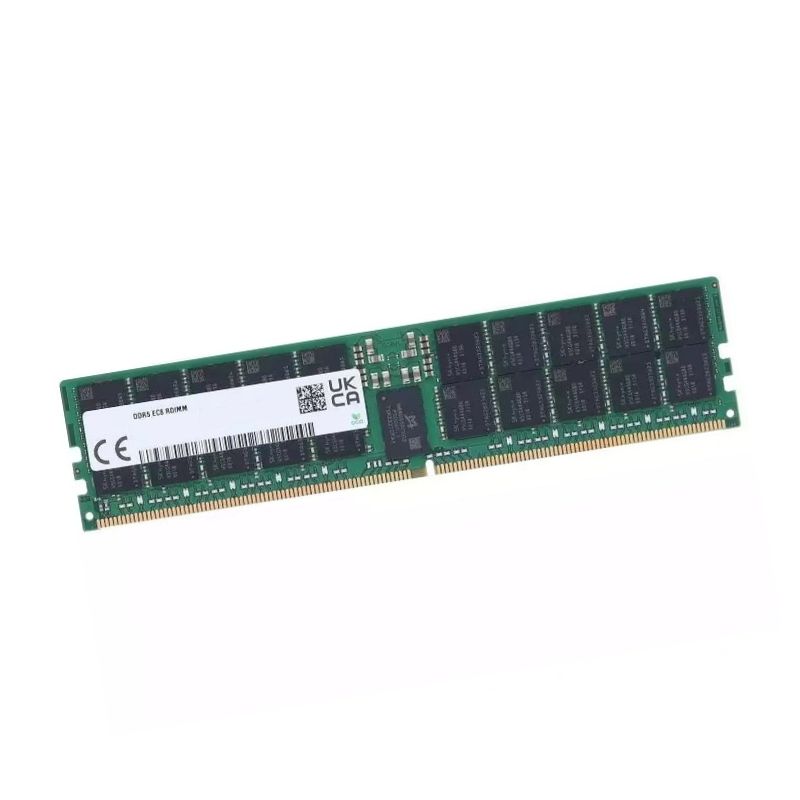
Hynix HMCG88AGBRA188N 32GB (1x32gb) 5600MHz Pc5-44800 Dual Rank X8 Ecc Registered 1.1v Cl46 Ddr5 Sdram 288-pin Rdimm Memory Module For Server. New Sealed in Box (NIB) with 3 Year Warranty
| SKU/MPN | Warranty | Price | Condition | You save |
|---|---|---|---|---|
| HMCG88AGBRA188N | 1 Year Warranty | $1,862.00 | New Sealed in Box (NIB) | You save: $651.70 (26%) |
| HMCG88AGBRA188N | 1 Year Warranty | $1,468.00 | New (System) Pull | You save: $513.80 (26%) |
The Hynix HMCG88AGBRA188N 32GB DDR5 RDIMM is a high-performance, enterprise-grade memory module engineered for speed, reliability, and data accuracy. Designed for modern servers, this 32GB (1x32GB) ECC Registered DDR5 module delivers exceptional bandwidth and enhanced stability for mission-critical applications.
This module supports a wide range of Dell PowerEdge servers, ensuring dependable operation across intensive workloads, virtualization, cloud platforms, and advanced data processing.
Every segment of this complex part number holds a key to its capability. Understanding this lexicon is essential for IT professionals, system integrators, and procurement specialists.
The 32GB capacity per module offers a substantial memory footprint, allowing for higher-density configurations in multi-channel server platforms. Fewer modules can achieve the same total memory, reducing power draw and potential points of failure. The Dual Rank designation indicates the module's internal organization. A dual-rank module essentially splits the memory chips into two groups (ranks) that the memory controller can address separately. While not doubling the channels, this architecture allows for slight efficiency gains through interleaving, often providing better performance in server applications compared to single-rank modules at the same frequency, especially in heavily loaded scenarios.
The 5600MHz figure refers to the data rate, meaning the module can perform 5.6 billion data transfers per second per pin. The correlated PC5-44800 designation is the module's theoretical peak bandwidth in megabytes per second (MB/s). Calculated as (5600 * 64-bit / 8), it yields approximately 44,800 MB/s of bandwidth for a single module in a single channel. In a modern server platform utilizing an 8-channel memory controller, the aggregate bandwidth becomes staggering, eliminating bottlenecks for CPU-intensive tasks like in-memory databases, scientific simulations, and virtualization.
This is where enterprise memory truly diverges from consumer-grade DDR5.
ECC is a non-negotiable feature for any mission-critical system. It goes beyond simple parity checking. ECC memory includes extra bits (e.g., 8 bits for a 64-bit word) that store an encrypted code. When data is written, a code is calculated and stored. Upon reading, the code is recalculated and compared. If a single-bit error is detected (a flipped 0 to 1 or vice-versa due to cosmic rays, electrical noise, or other interference), the ECC circuitry identifies and corrects it on the fly, preventing silent data corruption, application crashes, or system instability. The Hynix HMCG88AGBRA188N provides this essential protection.
The "Registered" in RDIMM stands for a register or buffer placed on the module. This buffer sits between the memory controller and the DRAM chips. It handles the electrical load of the command and address signals, refreshing and stabilizing them before they reach the memory chips. This allows a system's memory controller to support a much larger number of memory modules and higher total capacities without suffering from signal degradation. While it adds a slight latency (typically one clock cycle), this trade-off is essential for achieving the massive, stable memory configurations required in servers and workstations. It is a key differentiator from Unbuffered (UDIMM) memory used in desktops.
DDR5 introduces a more advanced power management architecture. The 1.1V operating voltage is lower than previous generations, contributing to significant power savings at scale—a critical factor for data center power budgets and thermal design. The CL46 (CAS Latency 46) timing is a measure of the delay between a command and data availability. While higher in number than DDR4 timings due to the vastly increased clock speeds, the actual latency in nanoseconds is often comparable or improved. The 288-pin design is the physical standard for DDR5 modules, but the keyhole notch position differs from UDIMMs, preventing accidental installation in an incompatible motherboard slot.
The Hynix HMCG88AGBRA188N is not designed for gaming PCs or standard home computers. Its value is unlocked in specific, demanding environments.
This is the primary domain. From cloud infrastructure servers running hundreds of virtual machines to database servers (SQL, NoSQL like Cassandra or MongoDB) handling terabytes of transactional data, the combination of high bandwidth, large capacity, and ECC reliability is paramount. It ensures data integrity for financial records, customer information, and operational logs.
In computational fluid dynamics, genomic sequencing, climate modeling, and AI/ML training, workloads are often memory-bound. The high bandwidth of 5600MHz DDR5 RDIMMs accelerates data movement between the CPU and RAM, reducing compute time for complex algorithms. ECC safeguards the integrity of long-running, multi-day calculations where an uncorrected error could invalidate the entire result.
Workstations for CAD/CAM engineering, 3D animation and rendering, and 4K/8K video editing benefit immensely. Applications like Siemens NX, SOLIDWORKS, Autodesk Maya, and DaVinci Resolve can leverage large amounts of fast, reliable memory to handle massive assemblies, complex scenes, and high-resolution video frames without crashing or corrupting project files.
Advanced network switches, routers, and all-flash storage arrays (NAS/SAN) often use RDIMMs for their control plane memory. This memory manages routing tables, metadata, deduplication engines, and storage protocols, where uptime and data correctness are essential for network and storage integrity.
DDR5 is not merely an incremental speed bump over DDR4; it represents an architectural shift with benefits that compound in server and workstation environments.
Beyond the module-level ECC, DDR5 chips incorporate On-Die ECC. This is an additional, internal error correction layer that operates within the DRAM chip itself, correcting bit errors before they even leave the chip. This improves chip yield, longevity, and overall data reliability at the most fundamental level, working in concert with the traditional ECC on the module.
Each DDR5 DIMM is organized into two independent 32-bit sub-channels. While a single 64-bit channel in DDR4 could only handle one access command at a time, the two sub-channels in DDR5 allow the memory controller to perform two simultaneous 32-bit operations (to different banks), increasing concurrency and efficiency, especially for smaller, random-access workloads common in server applications.
DDR5 moves the Power Management IC (PMIC) from the motherboard onto the memory module itself. This gives the Hynix module greater control over its own power delivery, allowing for more stable voltage regulation, better signal integrity, and the potential for more granular power state optimization. This is crucial for data centers focused on Power Usage Effectiveness (PUE).


 Contact Us
 Information
 Catalog
 Solid State Drives (SSD)
 Network Switches
 Hard Disk Drives
 HBA & Controllers
 PC & Servers
 PC & Server Memory
 CPU & Processors
 Network Routers
 Power Supplies
 Tape Drives & Libraries
 Network Devices
 Computer & Network Cables