
(7% discount is applied at checkout)
Cart is empty
Your go-to destination for cutting-edge server products
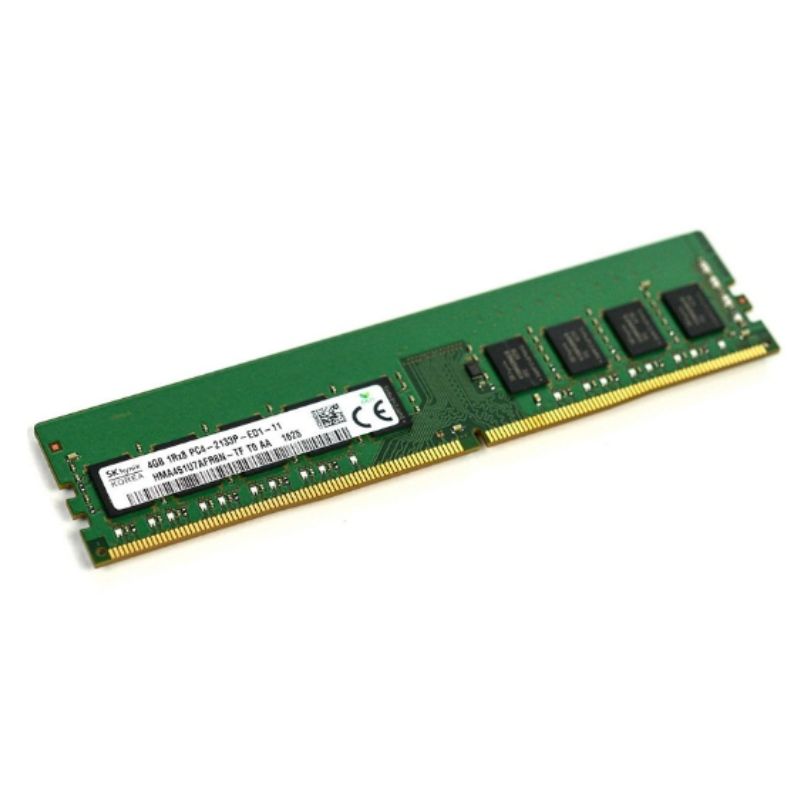
Hynix HMCG88AGBRA191N 32GB 5600MHz Pc5-44800 Dual Rank X8 Ecc Registered 1.1v Cl46 Ddr5 Sdram 288-pin Rdimm Memory Module For Server. New (System) Pull with 1 year replacement warranty
| SKU/MPN | Warranty | Price | Condition | You save |
|---|---|---|---|---|
| HMCG88AGBRA191N | 1 Year Warranty | $1,862.00 | New Sealed in Box (NIB) | You save: $651.70 (26%) |
| HMCG88AGBRA191N | 1 Year Warranty | $1,468.00 | New (System) Pull | You save: $513.80 (26%) |
The Hynix HMCG88AGBRA191N is a high-performance 32GB DDR5 RDIMM module engineered for exceptional stability, rapid data throughput, and enterprise-level reliability. Designed for next-generation servers, this memory module ensures optimized multitasking and smooth operation in demanding data-center environments.
This DDR5 RDIMM module is suitable for a wide range of enterprise-level Dell PowerEdge servers. Below is a list of compatible systems:
Every character in this SKU denotes a critical specification, defining its place in the server ecosystem. Let's break down the Hynix HMCG88AGBRA191N to understand its capabilities:
The "5600MHz" and "PC5-44800" designations are intrinsically linked. The module operates at a data rate of 5600 megatransfers per second (MT/s). The PC5-44800 refers to the peak theoretical bandwidth per module, calculated as 5600 MT/s * 8 bytes (64-bit channel) = 44,800 MB/s or 44.8 GB/s. This substantial bandwidth is crucial for overcoming data bottlenecks in multi-core processors and I/O-intensive applications.
With a substantial 32GB capacity and configured as a Dual Rank (2R) module, this RDIMM offers an optimal balance of performance and density. Dual-rank modules allow the memory controller to interleave accesses between the two ranks, improving efficiency and throughput compared to single-rank modules at the same capacity. This makes it a versatile building block for populating servers with high total memory capacities (e.g., 512GB, 1TB+) without sacrificing performance.
The "ECC Registered" feature is the cornerstone of server memory reliability. Error-Correcting Code (ECC) detects and corrects single-bit errors on-the-fly and detects multi-bit errors, preventing silent data corruption that could lead to application crashes or corrupted datasets—a non-negotiable requirement for data integrity. The "Registered" (or buffered) aspect incorporates a register (or buffer) on the module to manage electrical loads. This register buffers the address and command signals, reducing the strain on the system's memory controller and enabling the support of a much larger number of DIMMs per channel, which is essential for scaling memory capacity in multi-socket servers.
Operating at a low 1.1V, this DDR5 module continues the trend of improved performance-per-watt, a vital consideration for dense data center deployments where power and cooling are significant operational costs. The "CL46" denotes the CAS Latency, a primary timing. While numerically higher than some DDR4 latencies, it must be evaluated in the context of the much higher clock speed. The actual latency in nanoseconds (ns) is often comparable or better, calculated as (CL / (MT/s / 2)) * 1000. In this case, (46 / (5600 / 2)) * 1000 ≈ 16.43 ns, delivering robust performance.
The 288-pin RDIMM form factor is the standard for DDR5 server memory. The pin count and notch position are physically different from DDR4, preventing accidental insertion into incompatible motherboards. RDIMM specifically denotes "Registered DIMM," confirming its buffered design for enterprise systems.
The Hynix HMCG88AGBRA191N is not a consumer gaming component; it is a precision instrument for demanding infrastructure.
This module is designed for next-generation server platforms from Intel (Xeon Scalable "Sapphire Rapids," "Emerald Rapids," and beyond) and AMD (EPYC "Genoa," "Bergamo," and "Turin"). These platforms feature memory controllers explicitly architected for DDR5's new features, including dual sub-channels and on-DIMM PMICs (Power Management Integrated Circuits).
Virtualization Hosts: High memory capacity and reliability are paramount for running numerous virtual machines. ECC ensures guest OS stability, while high bandwidth supports consolidated workloads.
In-Memory Databases: Solutions like SAP HANA, Redis, and others thrive on vast, fast, and error-free memory pools to deliver real-time analytics and transaction processing.
High-Performance Computing (HPC): Scientific simulations, financial modeling, and rendering farms require consistent, reliable performance under continuous load, which ECC RDIMMs provide.
Understanding the landscape clarifies this module's position.
Beyond the obvious speed increase (e.g., 3200 MT/s vs. 5600 MT/s), DDR5 introduces a revolutionary architecture. Each DDR5 DIMM has two independent 32-bit sub-channels (vs. one 64-bit channel in DDR4), improving concurrency and efficiency. The voltage regulation moves from the motherboard to an on-DIMM PMIC, allowing for finer-grained power control and stability. These architectural gains, combined with higher densities, make DDR5 the clear choice for new server deployments.
UDIMMs are standard for desktops and some workstations. They lack the register and full ECC (some support ECC without registering). They offer lower latency at small capacities but are electrically limited in how many can be populated per channel, making them unsuitable for high-capacity, multi-socket servers.
LRDIMMs use a memory buffer (iMB) that buffers both data and address/command lines, further reducing electrical load compared to RDIMMs. This allows for the highest possible capacity and rank configurations (e.g., quad-rank) in fully populated systems. While LRDIMMs offer maximum capacity, they can have slightly higher latency and cost than RDIMMs. The Hynix 32GB RDIMM sits in the performance-optimized mainstream for capacity scaling.
To appreciate the engineering behind this module, one must look at the key innovations of DDR5.
A paradigm shift in DDR5 is the relocation of voltage regulation from the motherboard to the Power Management Integrated Circuit (PMIC) on each memory module. This offers superior power delivery, reduces noise, and improves signal integrity. It allows for module-level power optimization, which is crucial for data center telemetry and fine-tuning power consumption. The 1.1V operating voltage is managed with high precision by this integrated PMIC.
Internally, the 72-bit wide (64 data + 8 ECC) DDR5 RDIMM is split into two independent 32-bit (40-bit with ECC) sub-channels. This allows the memory controller to issue two separate 32-bit commands per cycle, improving overall command efficiency and bank group utilization. For applications with scattered memory access patterns, this can lead to tangible performance improvements over DDR4's single 64-bit channel.
DDR5 specifications include improved training algorithms and decision feedback equalization (DFE) at the PHY level to maintain signal clarity at very high data rates. When combined with the robust construction and rigorous testing of a manufacturer like Hynix—a leader in memory die production—modules like the HMCG88AGBRA191N are validated for 24/7 operation under elevated temperatures and constant load, ensuring long-term reliability in server racks.
SK hynix is a fundamental innovator and volume manufacturer in the DRAM industry. Choosing an OEM module like this Hynix-branded RDIMM offers distinct benefits.
Hynix designs and manufactures its own memory silicon (dies), packages the modules, and tests them end-to-end. This vertical integration allows for stringent quality control, from wafer to finished product. Modules are subjected to extensive testing under thermal and electrical stress to meet enterprise-grade standards.
As a primary supplier to major server OEMs (Dell, HPE, Lenovo, Cisco, etc.), Hynix memory firmware and compatibility are deeply integrated into platform design. This often translates to seamless out-of-the-box functionality, reliable performance profiling, and comprehensive support within the server's management console (like iDRAC, iLO, or XCC).
For businesses planning multi-year hardware lifecycles, consistency in memory supply is key. Hynix's role as a core supplier ensures long-term availability of compatible modules for future expansion, helping to protect IT investments and simplify maintenance and upgrade paths.


 Contact Us
 Information
 Catalog
 Solid State Drives (SSD)
 Network Switches
 Hard Disk Drives
 HBA & Controllers
 PC & Servers
 PC & Server Memory
 CPU & Processors
 Network Routers
 Power Supplies
 Tape Drives & Libraries
 Network Devices
 Computer & Network Cables