
(7% discount is applied at checkout)
Cart is empty
Your go-to destination for cutting-edge server products
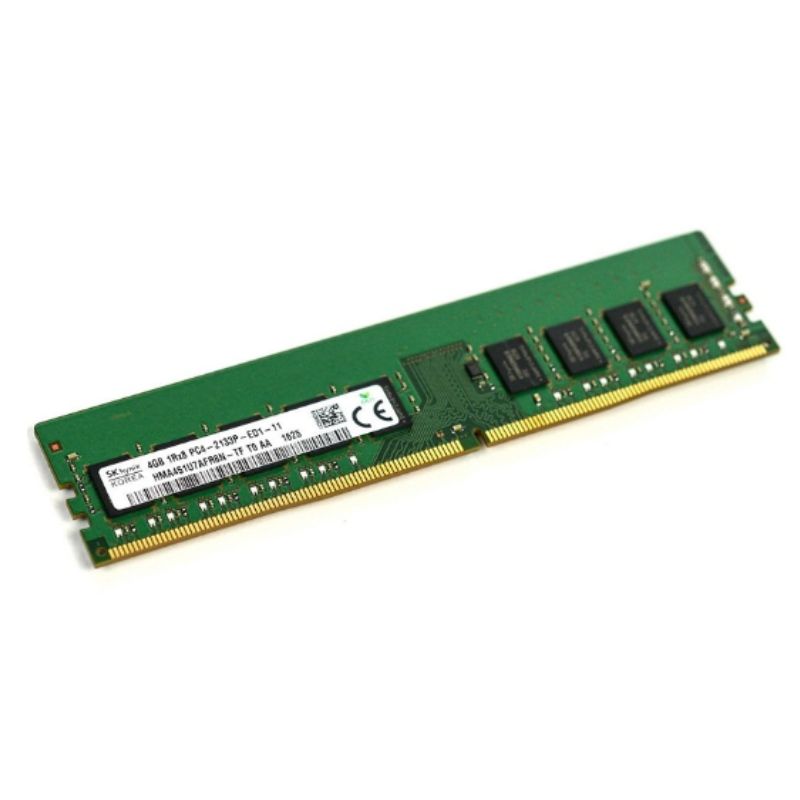
Hynix HMCG88AGBRA191N 32GB 5600MHz Pc5-44800 Dual Rank X8 Ecc Registered 1.1v Cl46 Ddr5 Sdram 288-pin Rdimm Memory Module For Server. New Sealed in Box (NIB) with 3 Year Warranty
| SKU/MPN | Warranty | Price | Condition | You save |
|---|---|---|---|---|
| HMCG88AGBRA191N | 1 Year Warranty | $1,862.00 | New Sealed in Box (NIB) | You save: $651.70 (26%) |
| HMCG88AGBRA191N | 1 Year Warranty | $1,468.00 | New (System) Pull | You save: $513.80 (26%) |
The Hynix HMCG88AGBRA191N 32GB DDR5 5600MHz PC5-44800 Dual Rank x8 ECC Registered memory module delivers exceptional speed, rock-solid stability, and advanced data protection for enterprise-class servers. Designed to support demanding workloads, this RDIMM module ensures dependable performance and efficient handling of data-intensive applications.
This memory module is engineered for seamless integration with various Dell PowerEdge servers. Compatible systems include:
Understanding the alphanumeric string that defines this module is key to appreciating its capabilities. Each segment of "HMCG88AGBRA191N" and its accompanying descriptors tells a specific story about its performance profile and intended use case.
The 32GB capacity strikes an optimal balance for modern server configurations, allowing for substantial in-memory databases, virtualization hosts, and complex application workloads without the excessive power and cost overhead of ultra-high-density modules. Paired with a data rate of 5600 Megatransfers per second (MT/s), operating on a DDR (Double Data Rate) basis, this module delivers a peak theoretical bandwidth of approximately 44.8 GB/s per module. This speed, classified under the PC5-44800 designation (where 44800 MB/s represents the transfer rate), provides a significant uplift over mainstream DDR4 and even baseline DDR5 speeds, reducing bottlenecks for CPU-intensive tasks.
The "Dual Rank x8" configuration is a pivotal design choice. A "rank" is an independent set of DRAM chips addressed simultaneously by the memory controller. A dual-rank module effectively interleaves access between two ranks, often improving performance over a single-rank module by better utilizing the memory bus. The "x8" refers to the data width of the individual DRAM chips (8 bits). This configuration, using multiple x8 chips to form a 72-bit-wide channel (64 data + 8 ECC), is standard for ECC memory and offers an excellent balance of reliability, capacity, and manufacturability compared to x4-based designs which are typically used for higher-capacity LRDIMMs.
What truly distinguishes a module like the Hynix HMCG88AGBRA191N from consumer-grade memory are the twin technologies of Error-Correcting Code (ECC) and Registered (Buffered) design. These are non-negotiable features for any system where data accuracy and signal integrity are critical.
ECC is an absolute requirement for server and workstation memory. It goes beyond simple parity checking. ECC memory includes extra bits (in this case, 8 bits for every 64 bits of data) to create a code word. Sophisticated algorithms, typically Single Error Correction, Double Error Detection (SECDED), allow the memory controller to detect and automatically correct single-bit errors on the fly, without any operating system or application involvement. It can also detect multi-bit errors, triggering a system alert to prevent corrupted data from propagating. In an environment running 24/7, cosmic rays, electrical noise, and subtle hardware faults can cause bit flips. ECC silently and continuously safeguards against silent data corruption, which could otherwise lead to catastrophic database errors, scientific miscalculations, or filesystem corruption.
The "Registered" in RDIMM stands for the presence of a register (or buffer) on the module itself, situated between the memory controller and the DRAM chips. This register buffers the command and address signals, effectively reducing the electrical load on the memory controller. This is not a performance feature in terms of latency; in fact, it adds a minimal, fixed clock cycle of latency. Its primary benefits are **signal integrity** and **scaling capacity**. By cleaning up the electrical signals, RDIMMs enable servers to populate all memory slots with high-density, high-speed modules without risking signal degradation. This allows modern multi-socket servers to support terabytes of RAM reliably. The Hynix module is an RDIMM, making it ideal for fully-populated, high-capacity server platforms.
Beyond the core specifications, several underlying technologies and design elements define the performance and compatibility of this memory module.
DDR5 introduces a revolutionary feature: On-Die ECC. This is a separate, internal ECC mechanism that operates *within* each individual DRAM chip. It handles minor, chip-internal bit errors that occur during cell refresh and operation, improving the chip's yield, longevity, and baseline reliability before data even reaches the module-level ECC managed by the memory controller. This two-tiered ECC approach—on-die plus traditional side-band ECC—creates an exceptionally robust error-handling framework.
DDR5 operates at a lower standard voltage of 1.1V compared to DDR4's 1.2V, contributing to better power efficiency—a crucial factor in dense data center deployments where power and cooling costs are significant. Furthermore, DDR5 modules incorporate a **Power Management IC (PMIC)** directly on the module. This decentralizes power regulation from the motherboard to the DIMM itself, allowing for more granular, stable voltage control, better noise isolation, and improved signal quality, especially during power state transitions.
The CAS Latency (CL) of 46, at the 5600MT/s speed, represents the number of clock cycles between a read command and the first piece of data being available. While this number is higher than typical DDR4 CL values (e.g., CL18), it is evaluated within the context of the much faster clock cycle time of DDR5. True latency in nanoseconds is calculated as (CL / Frequency in MHz) * 2000. For CL46 at 5600MT/s, the approximate latency is (46 / 5600) * 2000 = ~16.4 nanoseconds. This is competitive with or better than many high-speed DDR4 modules, demonstrating that DDR5 provides both higher bandwidth *and* comparable or improved latency.
The physical interface is a 288-pin edge connector, which is specific to DDR5 and is not compatible with DDR4 motherboards (which use a 288-pin design with a different key notch position). The RDIMM form factor ensures it is intended for servers and compatible workstations that specifically support Registered DDR5 memory. It will not function in desktop motherboards designed for Unbuffered DIMMs (UDIMMs).
The Hynix HMCG88AGBRA191N is not a general-purpose component; its value is unlocked in specific, demanding computing environments.
This is the native habitat for such a module. It is designed for deployment in:
Virtualization consolidates multiple workloads onto a single physical server, placing immense pressure on memory bandwidth and capacity. High-speed, high-capacity RDIMMs like this enable higher virtual machine density, smoother live migrations, and better performance for memory-hungry virtualized applications.
Database performance is often directly tied to the ability to cache frequently accessed data (the "buffer pool") in RAM. Faster memory reduces query latency and improves transaction throughput. ECC is critical here to prevent corruption of database indexes and tables in memory.
These platforms store entire datasets in RAM for instant analysis. The combination of high capacity (32GB per module), high bandwidth (5600MT/s), and the absolute data integrity provided by ECC is fundamental to their operation and reliability.
Certain professional workstation platforms (e.g., based on Intel Xeon W or AMD Ryzen Threadripper PRO processors) support Registered ECC memory. For workloads like:
Large, complex models and simulations benefit from both the capacity and the error-free operation of ECC memory, ensuring computational accuracy over days-long simulation runs.
Numerical simulations, genomic sequencing, and climate modeling generate vast datasets and require flawless execution. ECC memory prevents soft errors from invalidating weeks of computational effort.
While often using UDIMMs, high-end rendering farms and compositing workstations dealing with 8K+ content can leverage the stability and scaling potential of RDIMMs in supported platforms.
It is essential to position this Hynix RDIMM within the server memory ecosystem:
Used in desktops and some workstations. They offer the lowest latency but provide no buffering and limited ECC support. They cannot scale to high slot counts with high-density modules due to electrical loading issues.
The standard for mainstream servers. The Hynix module falls here. They offer the best balance of speed, capacity, reliability (with ECC), and scalability. They are the workhorse of the data center.
Use a more advanced buffer (called an iMB) that buffers both data and command/address lines. This allows for the absolute highest capacity per module (e.g., 128GB, 256GB) and the largest total system memory, but typically at a slight cost to latency and a higher price point. The Hynix 32GB module is an RDIMM, targeting the optimal performance-per-watt and performance-per-dollar segment.
Choosing DDR5 over DDR4 for a new server build offers tangible benefits:
DDR5's architecture allows for more efficient access patterns, keeping the data bus busier and improving effective bandwidth beyond just the frequency increase.
A signal integrity feature on the DDR5 interface that allows for higher data rates over the same physical connections by better handling signal reflections and noise.
Each DDR5 DIMM is organized as two independent 32-bit (40-bit with ECC) sub-channels. This improves memory access efficiency by allowing two simultaneous 32-bit accesses per module, reducing contention.


 Contact Us
 Information
 Catalog
 Solid State Drives (SSD)
 Network Switches
 Hard Disk Drives
 HBA & Controllers
 PC & Servers
 PC & Server Memory
 CPU & Processors
 Network Routers
 Power Supplies
 Tape Drives & Libraries
 Network Devices
 Computer & Network Cables