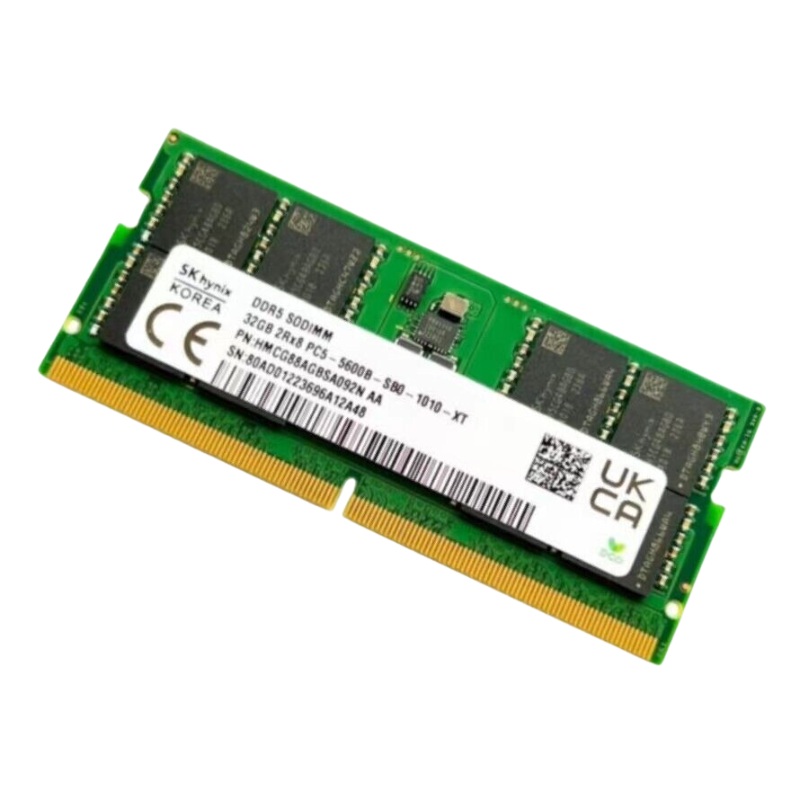
Highlights of Hynix HMCG88AGBRA193N 32GB DDR5 Memory
The HMCG88AGBRA193N Hynix 32GB DDR5 RDIMM memory module is a cutting-edge solution designed for enterprise and data center environments. With a blazing-fast speed of 5600MT/s, this module significantly enhances system responsiveness, making it ideal for high-performance computing applications.
General Information
- Manufacturer: Hynix
- Model Number: HMCG88AGBRA193N
- Category: Memory Module
- Sub Type: DDR5 5600 MT/s (PC5-44800)
Technical Specifications
- Total Capacity: 32GB
- Memory Type: DDR5 SDRAM
- Configuration: 1 x 32GB
- Transfer Rate: 5600MT/s (PC5-44800)
- Error Correction: ECC
- Signal Handling: Registered
- Latency: CL46
- Rank Configuration: Dual Rank (2Rx8)
Physical Dimensions and Weight
- Form Factor: 288-pin RDIMM
- Height: 1.00 inch
- Depth: 6.75 inches
- Weight: 0.20 lbs
Voltage and Efficiency
- Operating Voltage: 1.1V
- Energy Efficiency: Designed for low power consumption without compromising speed.
Advanced Features
- Error Correction Code (ECC): Ensures data accuracy and reliability.
- Registered Buffers: Enhances signal integrity and stability.
- High-Speed Performance: Ideal for data-intensive applications.
Compatibility
- PowerEdge C6620
- PowerEdge HS5610
- PowerEdge HS5620
- PowerEdge MX760c
- PowerEdge R660
- PowerEdge R660xs
- PowerEdge R760
- PowerEdge R760xa
- PowerEdge R760xd2
- PowerEdge R760xs
- PowerEdge T550
Overview of Hynix HMCG88AGBRA193N 32GB DDR5 ECC Memory
The Hynix HMCG88AGBRA193N 32GB DDR5 5600MT/s PC5-44800 Dual Rank X8 ECC CL46 SDRAM 288-Pin RDIMM Memory Module for server environments delivers a new standard of performance, reliability, and efficiency designed for the evolving demands of modern enterprise computing. As data centers expand, applications become more complex, virtualization becomes standard, and workloads like AI, machine learning, real-time analytics, and distributed cloud systems grow, the need for a memory module that supports ultra-fast bandwidth, advanced error correction, and consistent system stability becomes critical.
DDR5 Memory Technology and Its Benefits for Server Workloads
DDR5 represents a major leap forward over DDR4 in nearly every dimension of memory performance and efficiency. With doubled bandwidth, increased density, improved power regulation, and broader concurrency, the Hynix HMCG88AGBRA193N module takes advantage of the full potential of DDR5 architecture. DDR5 introduces improved channel architecture, offering two independent 32-bit channels per DIMM, which increases concurrency and enables servers to handle more simultaneous operations. This structural improvement reduces data bottlenecks, minimizes access latency, and optimizes performance for high-bandwidth applications.
On-Module IC Enhancements
One of the defining features of DDR5 memory is the incorporation of an on-module Power Management Integrated Circuit (PMIC), which enhances voltage regulation accuracy and efficiency. In older generations, power regulation was handled at the motherboard level, but DDR5 shifts this responsibility directly into the DIMM. This results in reduced power losses, more stable operating voltages, and higher efficiency even during demanding workloads. The Hynix HMCG88AGBRA193N module benefits from this technology, providing precise power delivery tailored to memory operation. Improved efficiency reduces heat output, supports longer component lifespan, and enhances performance under sustained heavy load. The memory module also operates at lower voltages than DDR4, which contributes to reduced overall power consumption within server environments.
ECC Functionality for Enterprise-Grade Reliability
Error-Correcting Code technology is essential for servers, where even a single memory bit error can lead to system instability, corrupted data, or downtime. The Hynix HMCG88AGBRA193N provides robust ECC capabilities that detect and automatically correct single-bit errors while identifying multi-bit errors before they result in critical issues. ECC support is crucial in mission-critical operations such as finance, scientific modeling, healthcare analytics, cloud infrastructure, edge computing, and real-time processing environments. With DDR5, error correction is further enhanced through On-Die ECC, which adds another layer of internal error detection within the memory chip itself. This two-tiered approach dramatically improves error detection accuracy and overall system resilience.
Dual Rank X8 Architecture for Enhanced Performance
The Hynix HMCG88AGBRA193N module features a Dual Rank X8 design that significantly enhances overall memory throughput and concurrency. Dual Rank architecture allows the server memory controller to access one rank while the other is refreshing, reducing latency and improving performance in multi-threaded, high-load environments. The X8 configuration refers to the data width per memory chip, offering a balanced structure that supports both reliability and speed. Dual Rank modules often outperform Single Rank modules in performance-intensive server tasks such as virtualization, high-performance computing, AI inferencing, and large-scale data processing.
CL46 Latency and Timing Performance
With a CAS Latency of CL46, the Hynix HMCG88AGBRA193N ensures that the module maintains an optimal balance between high-speed transfer capabilities and stable timing performance. DDR5 technology inherently features different timing structures than DDR4, and CL46 represents a level of responsiveness that allows the module to operate effectively at 5600MT/s speeds. Latency optimization is particularly important in environments where real-time processing is required, such as financial trading algorithms, predictive analytics systems, industrial automation controls, and cloud-native microservice platforms. Application responsiveness, thread scaling, and transaction processing efficiency all benefit from well-optimized latency levels.
288-Pin RDIMM Design and Server
The Hynix HMCG88AGBRA193N memory module is built using the 288-pin Registered DIMM format, which supports full compatibility with modern server platforms that utilize DDR5 memory. Registered DIMMs are specifically designed for enterprise environments where stability is crucial. The module’s register buffer reduces electrical load on the memory controller, enabling servers to accommodate more memory modules without compromising signal integrity or stability. This is essential for large-scale virtualization hosts, database servers, and HPC systems that require large memory capacities. The physical design ensures secure installation and reliable signal transmission, supporting both single-socket and multi-socket server architectures.
Strategies for High-Speed Memory
Operating at 5600MT/s, the Hynix HMCG88AGBRA193N requires highly efficient thermal management to ensure consistent performance and stability. DDR5 improves heat distribution and power efficiency, enabling high-speed modules like this to operate within optimal thermal ranges even under continuous load. The module incorporates advanced thermal sensors that allow real-time temperature monitoring and dynamic adjustments. These sensors work in conjunction with server-side thermal management systems to optimize airflow, adjust fan speeds, and ensure that the memory stays within safe operating temperatures. Effective thermal management is especially important in dense server environments where many DIMMs operate simultaneously, creating conditions that can potentially trap heat.
Increased Memory Bank Grouping and Concurrency Improvements
DDR5 increases the number of memory banks and bank groups, enabling more simultaneous operations and reducing delays caused by memory access conflicts. With more active banks, servers can process multiple requests at once, significantly improving overall bandwidth efficiency. This improvement is particularly valuable for database servers, web hosting clusters, and analytics workloads that rely on parallel data access. The Hynix HMCG88AGBRA193N leverages this expanded concurrency to support smoother application performance, reduced latency in multi-user environments, and faster execution of compute-heavy tasks.
Enhanced Burst Length and Data Prefetch Architecture
DDR5 doubles the burst length from DDR4, allowing more data to be transferred during each burst cycle. The increased burst length boosts effective bandwidth and minimizes the number of cycles required to complete data transfer operations. DDR5 also enhances the internal prefetch architecture, which improves the ability of the module to supply data rapidly and consistently. These enhancements benefit applications with high data throughput demands such as AI model training, scientific simulations, real-time data ingestion, and distributed storage systems.
Advantages in Enterprise Workloads
The Hynix HMCG88AGBRA193N module offers significant performance benefits across a broad range of enterprise workloads. With 5600MT/s transfer speeds, increased bank concurrency, and optimized channel architecture, it handles multi-threaded operations with exceptional efficiency. Applications running on virtualized platforms experience faster VM provisioning, reduced I/O wait times, and smoother operation during high-load events. AI applications benefit from higher memory bandwidth during both training and inference, particularly when processing large datasets. In-memory databases experience accelerated data retrieval, faster indexing, and reduced latency during transactions. Large-scale ERP systems, CRM platforms, and enterprise financial applications also see improved responsiveness due to faster memory throughput.
Data Integrity and Uptime Improvements Through ECC
Businesses operating mission-critical workloads require constant uptime and data reliability. The Hynix HMCG88AGBRA193N protects against common memory-related errors that can destabilize systems or result in data loss. The combination of ECC at the module level and On-Die ECC at the chip level supports near-complete detection of data errors. Even under heavy load, the module maintains a stable environment for running critical applications. ECC memory is especially important in environments involving big data analytics, AI-based decision engines, scientific calculations, healthcare data processing, and cloud infrastructure where accuracy is essential.
Workload-Specific Performance
Each type of enterprise workload benefits differently from DDR5 enhancements. In virtualization environments, memory throughput directly affects the number of virtual machines that can run simultaneously without performance degradation. The Hynix DDR5 RDIMM supports faster VM migration, improved hypervisor performance, and more efficient resource allocation. For cloud computing platforms, high-performance memory ensures smoother autoscaling, faster container orchestration, and efficient distribution of microservices. For machine learning tasks, high memory bandwidth is a key contributor to reduced training time and improved inference accuracy. For enterprise databases, DDR5 enables faster query execution and improved performance of memory-centric operations.
Scalability and Data Center Expansion
As data centers grow and memory requirements intensify, scalability becomes essential. The Hynix HMCG88AGBRA193N module supports large-scale deployments where multiple RDIMMs must operate together at high speeds. Registered DIMMs reduce electrical load on the memory controller and maintain system stability even when many modules are installed. DDR5 density improvements also enable greater capacity per DIMM, allowing servers to scale up total available memory more easily. For organizations using hyperconverged infrastructure, massive virtualization clusters, or big data processing environments, scalable memory is vital. With this module installed across multiple servers, data centers can achieve higher throughput, more efficient job distribution, and improved performance under concurrent workloads.
Long-Term Investment Value and Future-Proofing
Deploying DDR5 memory like the Hynix HMCG88AGBRA193N represents a strategic investment in future infrastructure. As more applications are designed to exploit the advantages of DDR5 bandwidth, organizations with DDR5-based systems will realize greater efficiency and reduced operational barriers. DDR5 adoption continues to increase among server manufacturers, and the long-term availability of DDR5-compatible CPUs ensures ongoing support. Organizations implementing DDR5 memory today can expect long lifecycles, fewer upgrade bottlenecks, and enhanced performance headroom for future applications.
Modern AMD and Intel Server Platforms
Server platforms built on next-generation AMD EPYC and Intel Xeon processors now include full DDR5 support, ensuring seamless compatibility with the Hynix HMCG88AGBRA193N RDIMM module. These platforms rely heavily on DDR5 memory to deliver optimized multi-core performance, high-speed interconnect usage, and maximum memory bandwidth. Whether used in single-socket or dual-socket configurations, the module provides consistent performance and reliable communication with the memory controller. Compatibility with advanced PCIe 5.0 and high-speed networking environments further enhances the module’s utility in modern server ecosystems.
Integration Considerations for Server Administrators
Installing the Hynix DDR5 RDIMM requires awareness of memory population rules, channel balancing, and BIOS-level adjustments. Administrators should ensure firmware is updated to support DDR5 memory modules and configure servers for optimal interleaving across memory channels. Proper cooling and airflow must be maintained, especially in dense blade or rack-mounted environments. With correct installation and configuration, this module delivers remarkable performance improvements across a variety of server architectures.
Through Balanced Memory Configuration
Balanced memory configurations are essential for maximizing module performance. Administrators should populate memory channels evenly and avoid configurations that strain the memory controller. Mixed-rank or uneven-capacity setups can reduce performance, whereas symmetrical configurations improve bandwidth efficiency. When configured properly, the Hynix HMCG88AGBRA193N module achieves its full operational potential.
Hynix HMCG88AGBRA193N Module in Modern Computing
The Hynix HMCG88AGBRA193N 32GB DDR5 5600MT/s Dual Rank X8 ECC CL46 RDIMM supports next-generation computing environments where massive data volumes, rapid processing, and uncompromising stability are required. Its performance characteristics align perfectly with enterprise demands across diverse sectors. Industries experiencing digital transformation, such as finance, manufacturing, healthcare, telecommunications, and cloud computing, all benefit from the upgrades offered by DDR5 memory. Application landscapes continue to evolve toward distributed architectures, real-time processing, AI-based workloads, and data-intensive analytics, making advanced memory modules like this essential for keeping pace with operational demands.
Data-Centric Applications Workloads
Data-centric workloads rely heavily on memory bandwidth and latency. The Hynix DDR5 module supports fast data ingestion and processing, enabling systems to manage large-scale datasets more efficiently. Applications involving predictive modeling, deep learning, server virtualization, transaction-heavy database operations, and computational simulations all leverage the higher throughput enabled by DDR5. As the volume of data generated by enterprise systems continues to grow, modules like this will play an increasingly vital role in enabling modern infrastructure to remain competitive and responsive.
Cloud Computing Enhancements
Cloud platforms rely heavily on memory performance to manage tenant workloads, dynamic resource allocation, and distributed service orchestration. DDR5’s increased bandwidth supports smoother autoscaling and reduces performance degradation under heavy load. Virtualized environments benefit from optimized VM migration times, improved memory ballooning performance, and reduced overhead during multi-user operations.



 Contact Us
 Information
 Catalog
 Solid State Drives (SSD)
 Network Switches
 Hard Disk Drives
 HBA & Controllers
 PC & Servers
 PC & Server Memory
 CPU & Processors
 Network Routers
 Power Supplies
 Tape Drives & Libraries
 Network Devices
 Computer & Network Cables