(7% discount is applied at checkout)
Cart is empty
Your go-to destination for cutting-edge server products
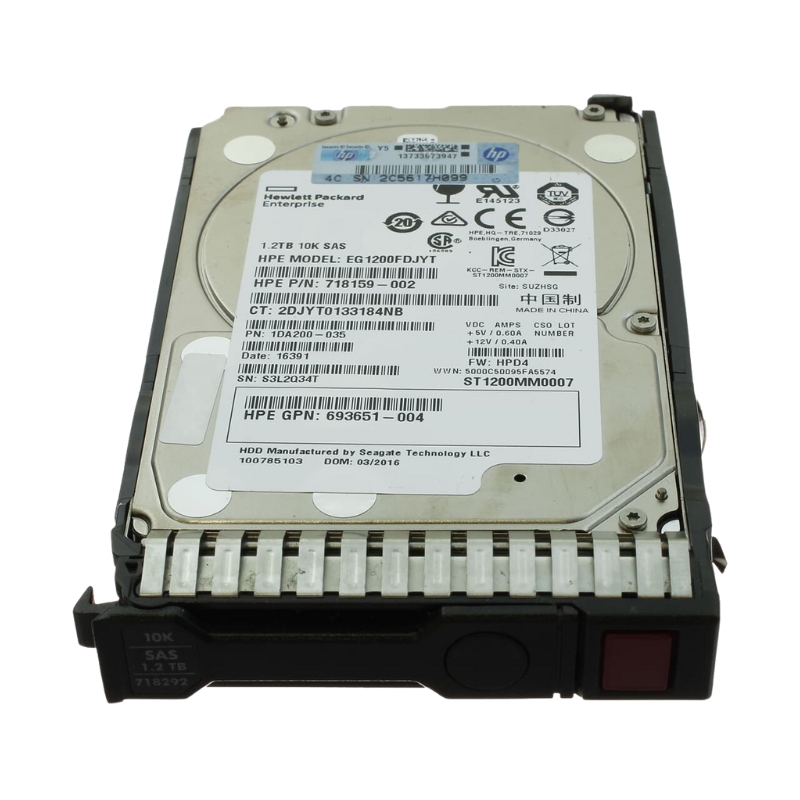


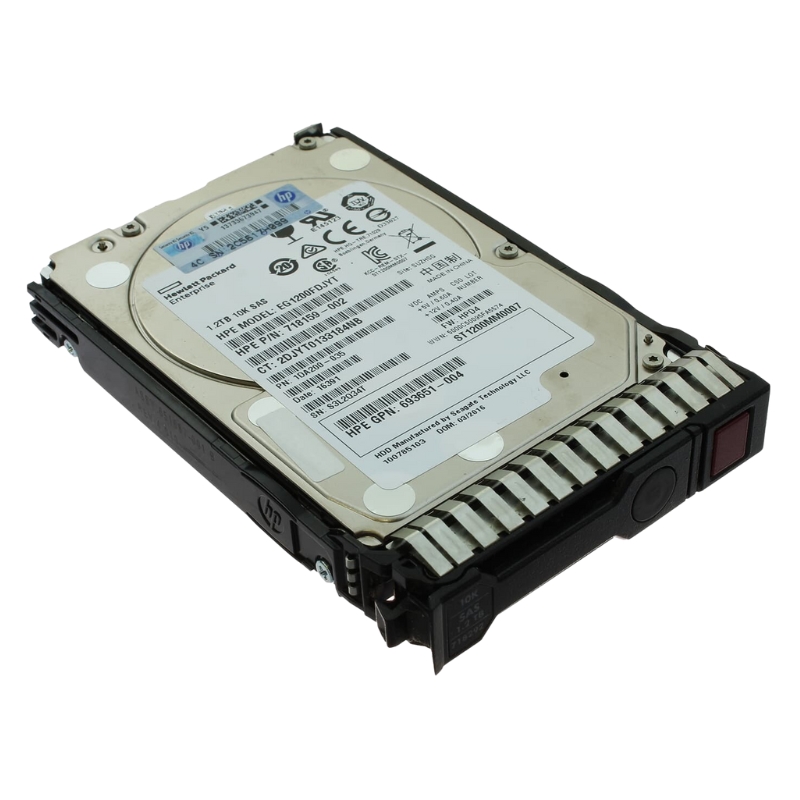
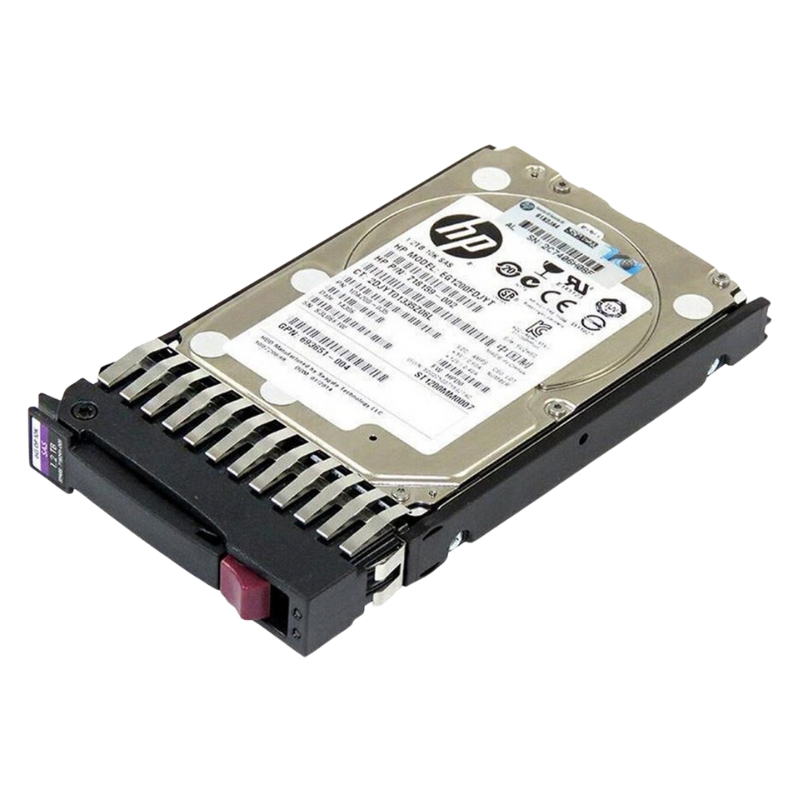
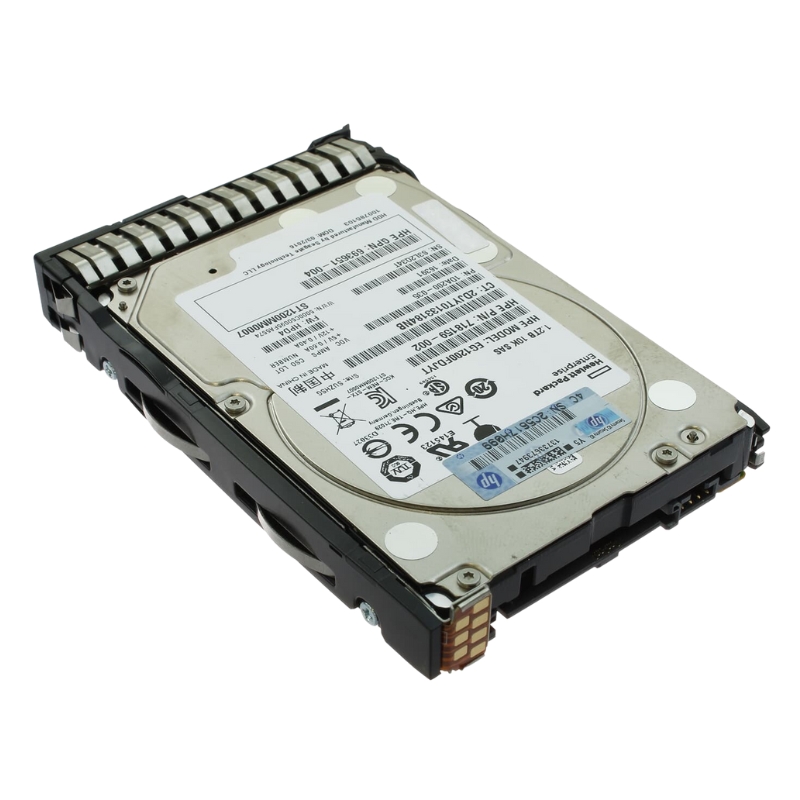
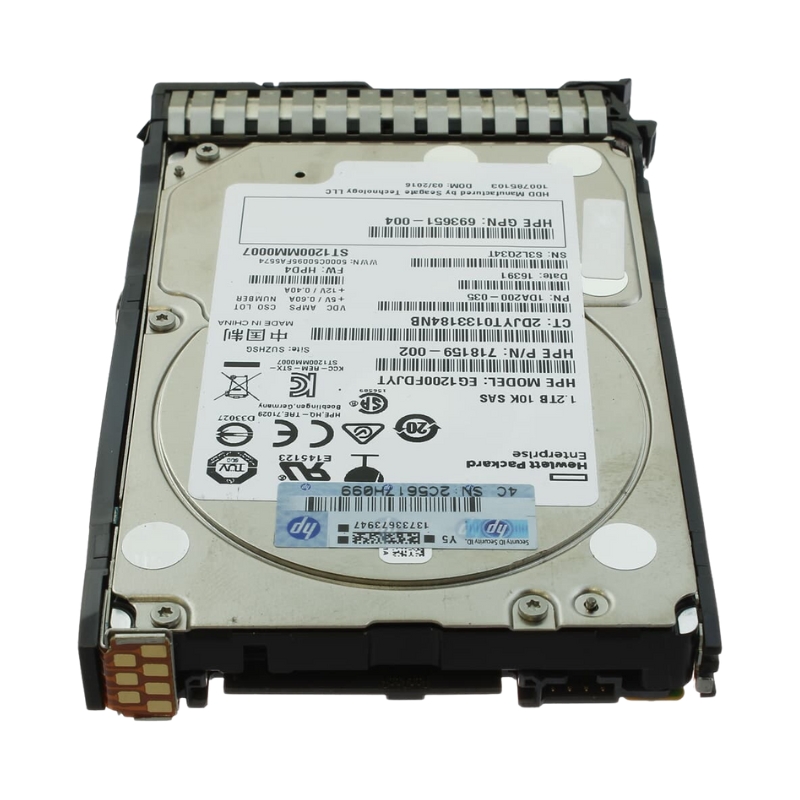
HPE 693651-003 1.2TB SAS 6 Gigabits Per Second 10K RPM Small Form Factor Hard Disk Drive. Excellent Refurbished with 1 year replacement warranty
The HPE 693651-003 1.2TB SAS 6Gbps 10K RPM Small Form Factor (SFF) Hard Disk Drive is designed for enterprises requiring reliable performance, high-speed data transfers, and consistent durability in demanding server and storage environments. Engineered with advanced technology, this hard drive ensures rapid access times, optimized throughput, and a compact size suitable for data-intensive workloads.
The HPE 693651-003 is particularly suitable for enterprise applications where storage speed and reliability are crucial. It excels in virtualization, transaction-heavy databases, and mission-critical applications.
Designed for rack-mounted servers and high-density storage arrays, this hard disk ensures rapid response times and seamless integration into existing HPE infrastructure.
With its 10K RPM rotational speed and SAS 6Gbps interface, this HDD is optimized for workloads demanding low-latency performance, such as real-time analytics, online transaction processing (OLTP), and virtualization.
The HPE 693651-003 1.2TB SAS (Serial Attached SCSI) 6 gigabits per second, 10,000 RPM, Small Form Factor (2.5") hard disk drive (HDD) is a purpose-built enterprise storage component designed for demanding datacenter applications. This category page description focuses on the product family and related subcategories of 2.5" 10K SAS drives optimized for HPE servers and storage arrays. Here you will find detailed explanations of performance characteristics, compatibility matrices, common use cases, best-practice deployment guidance, maintenance tips, and buying considerations tailored to IT buyers, systems integrators, and storage administrators looking for reliable mid-capacity, high-performance spinning-disk storage.
The part number HPE 693651-003 identifies a specific HPE-branded manufacturing batch of a 1.2TB 10K SAS drive. The full product identity includes capacity (1.2TB), interface (SAS), maximum link speed (6 Gb/s), spindle speed (10K RPM), and a small form factor (SFF, 2.5-inch). When shopping or comparing compatible parts, you will also encounter reference model numbers from the OEM's supply chain and cross-references to the drive's manufacturer OEM SKU.
Drives in this category typically conform to enterprise mechanical and electrical specifications. Typical attributes include a 2.5-inch (SFF) form factor, 15 mm or 7 mm z-height variants (verify exact z-height for server compatibility), SAS 6 Gb/s interface with backward compatibility to 3 Gb/s and forward compatibility with SAS expanders and HBAs, and enterprise-class rotational speed of 10,000 RPM delivering a balance between seek performance and power efficiency.
10K RPM SAS drives are designed as a middle ground between high-capacity 7.2K drives and low-latency SSDs. For random I/O workloads—typical of database reads, transactional servers, and virtualization hosts—these drives provide predictable seek times and superior IOPS compared to 7.2K HDDs. With a 6 Gb/s SAS interface, they deliver sustained throughput suitable for sequential reads/writes and can be combined in RAID arrays to scale throughput and redundancy.
When evaluating drives for procurement or replacement, compatibility is the single most important filter. HPE typically validates specific SKUs (such as 693651-003) for use in a range of server families (e.g., ProLiant Gen8/Gen9/Gen10 series) and array platforms (e.g., MSA, EVA legacy systems, or rack storage modules). Support matrices also note differences in carrier/tray requirements, hot-swap bay tolerances, and firmware requirements that can affect interoperability.
HPE-certified drives often come with vendor-specific firmware enabling enhanced monitoring via HPE management tools (iLO, SSA, HPE OneView, SSM). Firmware versions can influence drive behavior under error conditions, error recovery timeouts (ERASE/ERR REC), and reporting via S.M.A.R.T. attributes. For enterprise deployments, it’s recommended to align drive firmware to the firmware baseline used across the fleet.
The HPE 693651-003 1.2TB 10K SAS drive family is commonly used in the following patterns:
In virtualized environments, 10K drives are frequently used for VM boot volumes, mid-tier application storage, and larger OS volumes where cost controls prevent a full flash deployment. They perform well for workloads that benefit from modest seek rates but don’t require SSD latencies.
Small- and medium-sized database instances that require consistent random IOPS per dollar often use arrays built from 10K SAS drives. Proper RAID configuration (RAID 10 or RAID 6 depending on redundancy needs) combined with write-back cache and battery-backed cache on controllers yields strong transactional throughput.
While not a substitute for high-capacity nearline drives, 1.2TB 10K SAS drives can be used for fast access layers in tiered storage architectures—index stores, catalog servers, or intermediate backup staging where relatively faster access is required for restore operations.
Choosing the right RAID level for a drive population affects both performance and resiliency. For HPE 1.2TB 10K SAS drives, administrators typically choose between RAID 10 (striped mirrors) for maximum performance and RAID 6 for capacity-efficient redundancy with double-parity protection. RAID rebuild times, rebuild impact on performance, and sustained throughput during rebuild must be part of architecture planning.
Deploying multiple 10K drives in dense enclosures increases both power draw and heat output compared with slower-spinning HDDs or SSDs. Datacenter planners should account for per-bay power consumption, HVAC capacity, and airflow patterns, especially in high-density blade or rack-mount designs.
Understanding how this drive type stacks against alternatives helps determine where it fits within a storage strategy.
10K SAS drives deliver substantially better random IOPS and lower latency than 7.2K nearline drives, at a higher cost and lower capacity per spindle. Use 10K drives for active working sets where latency matters; use 7.2K nearline drives for bulk capacity and archival tiers.
SSDs provide orders-of-magnitude higher IOPS and lower latency, but at substantially higher cost per GB. Many modern architectures use a hybrid approach: SSDs for hot data and metadata, 10K SAS drives for warm tiers where a balance of cost and performance matters.
Enterprise drives must comply with regional environmental standards (RoHS, WEEE) and often carry certifications or declarations for safe disposal and recycling. Data destruction requirements for end-of-life drives (secure erase, degaussing, shredding) should align with organizational and legal obligations for data protection.
When benchmarking drives for a given workload, measure random read/write IOPS at varying queue depths, sustained sequential throughput, average latency percentiles (P50/P99), and power draw under typical and peak conditions. Use representative test profiles: database OLTP patterns, virtualization mixed-read/write patterns, and large-file sequential copy scenarios to understand how the drive family will behave in production.
Buyers exploring the 1.2TB 10K SAS category often evaluate adjacent categories for a balanced storage architecture:
While planning procurement and operations for HPE 1.2TB 10K SAS drives, document standard operating procedures for hot-swap, failure response, firmware patching, and asset disposal. Maintain consistent firmware baselines and test spare drives in a lab environment before they are placed into production. Keep pairing and cabling diagrams updated to make physical replacements straightforward and reduce human error during maintenance windows.
System architects should view the HPE 693651-003 class drives as flexible building blocks—excellent for mixed workloads, mid-tier performance tiers, and cost-conscious environments where SSDs are not yet economical for all tiers. For integrators, maintaining part number rigor, firmware hygiene, and clear documentation for drive carriers and firmware levels reduces post-deployment surprises and keeps service windows predictable.


 Contact Us
 Information
 Catalog
 Solid State Drives (SSD)
 Network Switches
 Hard Disk Drives
 HBA & Controllers
 PC & Servers
 PC & Server Memory
 CPU & Processors
 Network Routers
 Power Supplies
 Tape Drives & Libraries
 Network Devices
 Computer & Network Cables