(7% discount is applied at checkout)
Cart is empty
Your go-to destination for cutting-edge server products
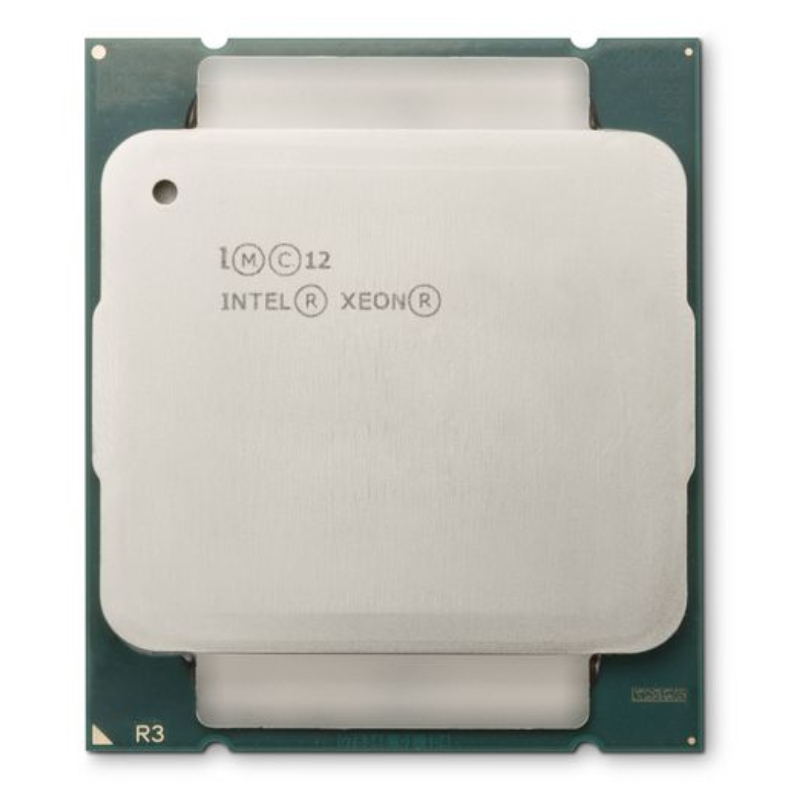


HPE 726994-L21 BL460c Gen9 Intel Xeon E5-2630v3 2.4GHz 8 Core 20MB 85W Processor. New (System) Pull with 1 year replacement warranty
The HPE 726994-L21 is a high-performance Intel Xeon E5-2630 v3 octa-core processor designed for the HPE ProLiant BL460c Gen9 server. Engineered for demanding enterprise workloads, it provides a balanced combination of speed, efficiency, and reliability, making it ideal for virtualization, cloud computing, and data-intensive applications.
Built on the 22nm process technology, the Xeon E5-2630 v3 offers high efficiency and performance for multi-threaded applications. Its octa-core architecture ensures smooth handling of complex workloads and parallel processing, while the 20 MB L3 cache significantly reduces latency for frequent data access operations.
The HPE 726994-L21 processor is designed for optimal thermal performance, with a TDP of 85 Watts and a thermal specification of 72.1°C. This ensures stable operation under heavy loads while maintaining energy efficiency, reducing operational costs, and enhancing server longevity.
This processor is specifically designed for HPE ProLiant BL460c Gen9 servers. With the FCLGA2011-3 socket type, it seamlessly integrates into existing HPE infrastructure, ensuring reliable performance and compatibility with the latest server technologies.
HPE Xeon processors are built for mission-critical workloads, offering exceptional reliability and long-term performance. The octa-core design and high-speed QPI interconnect provide a seamless experience for enterprise applications, from data analytics to virtualization, ensuring minimal downtime and maximum efficiency.
Incorporating the HPE 726994-L21 processor into your enterprise server environment ensures high efficiency, reduced latency, and superior workload management. Whether for virtualization, cloud deployments, or data-intensive operations, this processor delivers consistent and reliable performance.
The Intel Xeon E5-2630 v3 inside the HPE 726994-L21 is built on Intel’s Haswell microarchitecture (22 nm process) and features eight physical cores and sixteen logical threads via Hyper-Threading. The processor’s base clock is 2.40 GHz with a maximum Turbo Boost frequency up to 3.20 GHz — providing higher single-thread performance when thermal and power headroom permit. These attributes make it well-suited to mixed workloads where both parallelism and single-thread responsiveness matter.
The CPU ships with 20 MB of Intel® Smart Cache, and supports DDR4 memory (registered ECC) across the BL460c Gen9 memory architecture. When installed in BL460c Gen9 blades, optimal memory pairing and adherence to HPE’s support matrix ensure maximum memory bandwidth and reliability for database and in-memory applications. The platform’s integrated memory architecture and available NUMA tuning tools allow system administrators to tune workloads for predictable latency and throughput.
The processor has a Thermal Design Power (TDP) of 85 watts, which provides a favorable performance-per-watt profile for dense blade deployments. In BL460c Gen9 enclosures, this TDP class allows multiple blades to operate within the thermal envelope provided by common enterprise blade chassis and cooling designs — while still offering Turbo Boost capability under permitted thermal conditions. Proper chassis airflow and HPE-recommended power configurations should be followed to maintain stable Turbo operation.
With 8 cores / 16 threads, the E5-2630 v3 is a solid choice for virtualization hosts that require moderate per-VM core counts and efficient cost-per-core. The CPU’s threading and cache profile allow for good consolidation ratios in environments running a mix of Linux and Windows hypervisors, container hosts, and mid-sized VMs. Its combination of cores and per-core frequency helps maintain guest responsiveness when multiple VMs contend for CPU resources.
Application stacks — Java application servers, .NET services, PHP/Python backends — benefit from the E5-2630 v3’s cache and Turbo Boost headroom, particularly when optimized for NUMA locality on the BL460c architecture. For stateful middleware and in-memory caching, pairing this CPU with sufficient DDR4 ECC memory and fast local storage (or NVMe mezzanine options where supported) produces predictable performance under sustained load.
For small-to-medium OLTP databases and read-heavy analytic workloads, the 20 MB cache and memory subsystem of a properly configured BL460c Gen9 blade can reduce query latencies and improve throughput. While very large scale databases might need higher core or cache counts, the E5-2630 v3 is ideal for departmental databases, test/dev, and distributed database nodes in clustered architectures.
The 726994-L21 processor kit is listed among supported processor kits for the HPE ProLiant BL460c Gen9 family in HPE documentation and QuickSpecs, ensuring plug-and-play compatibility when following HPE’s guidelines. When installing, confirm firmware/BIOS revision compatibility and use the HPE Service Pack for ProLiant (SPP) release recommended for your chassis to ensure the platform firmware recognizes and fully utilizes the processor features.
The E5-2630 v3 family uses the LGA2011-3 socket (Socket R3) and is supported by X99-class server chipsets and HPE Gen9 server board designs. For BL460c Gen9, only HPE-approved processor kits (matching the blade mechanical and firmware requirements) should be used to ensure thermal, mechanical, and SLMS/management compatibility.
HPE processor kits typically include the CPU assembly (pre-mounted in a sled or carrier where applicable), required thermal interface materials, and part-specific documentation. Field replacement on BL460c Gen9 blades often requires ESD-safe handling, adherence to HPE torque sequences for the socket retention mechanism, and verification of BIOS/firmware updates after installation to ensure correct microcode and platform management behavior.
After installing the processor, apply HPE’s SPP/firmware bundles or the vendor-specific microcode updates to enable stability, mitigate known errata, and unlock platform-level optimizations for features such as Turbo Boost and power capping. HPE’s Support Center and QuickSpecs list recommended firmware baselines for BL460c Gen9 systems.
The BL460c Gen9 architecture supports DDR4 registered ECC modules; for best performance and error correction, pair memory modules according to HPE’s population rules: balanced across channels/slots for single-CPU blades, and follow the memory population guide in the server maintenance manual for dual-socket configurations where applicable. This ensures maximum memory bandwidth and predictable NUMA behavior for high-throughput workloads.
The 85 W TDP per CPU is modest for modern data center blades but still requires attention when populating a chassis with many blades. Calculate total chassis power and cooling based on the maximum configured TDP per blade (including memory and expansion cards), and allocate contingency for Turbo Boost operation and peak transient loads. HPE chassis thermal design guidance helps maintain consistent inlet temperatures across all bays.
Use HPE power management tools, iLO features, and chassis-level power capping to control peak draw while balancing application performance. For mixed workloads, dynamic power profiles can preserve performance for latency-sensitive VMs while reducing aggregate power consumption across a blade bay.
The E5 v3 family (Haswell generation) offered significant improvements over the previous E5 v2 lineup in IPC (instructions-per-cycle), memory support (DDR4), and platform features. Within the v3 family, the E5-2630 v3 serves as a mid-range SKU, offering an 8-core balance between higher-frequency lower-core parts and higher-core lower-frequency parts. This positions it as a cost-efficient option for mixed workloads that require both core parallelism and reasonable single-thread performance.
If your workloads are highly parallel and scale with core counts (e.g., many concurrent small threads), higher-core v3/v4 parts may be preferable. Conversely, if your environment needs fewer VMs with stronger per-thread performance, a higher base-clock SKU or newer generation CPU might be a better fit. The E5-2630 v3 remains a popular choice for legacy and cost-sensitive upgrades of Gen9 blade fleets.
The Intel Xeon E5 v3 family is well-supported across mainstream enterprise hypervisors (VMware ESXi, Microsoft Hyper-V, KVM) and enterprise Linux distributions (RHEL, CentOS/AlmaLinux/RockyLinux, SUSE). HPE maintains compatibility matrices for BL460c Gen9 — check HPE’s support pages for validated OS and hypervisor combinations and supported BIOS/firmware levels.
Because BL460c Gen9 platforms are part of a longer product lifecycle, plan for OS and driver updates that maintain compatibility with iLO management, storage controllers, and NICs. Use HPE’s SPP to reduce the risk of incompatible firmware stacks when updating blades across a chassis.
Use HPE iLO and chassis management to monitor CPU temperatures, power, and error logs. Predictive failure alerts (when available) and proactive spares policies reduce downtime risks — keep a small inventory of verified replacement kits for rapid swap-out in critical environments.
The ProLiant BL460c Gen9 family and the E5-2630 v3 are part of an established enterprise generation. Plan for lifecycle events—such as end-of-life and diminishing firmware updates—and consider standardizing on a few SKU families for longer-term parts management. HPE support pages and QuickSpecs can be referenced for lifecycle timelines and recommended replacement strategies.


 Contact Us
 Information
 Catalog
 Solid State Drives (SSD)
 Network Switches
 Hard Disk Drives
 HBA & Controllers
 PC & Servers
 PC & Server Memory
 CPU & Processors
 Network Routers
 Power Supplies
 Tape Drives & Libraries
 Network Devices
 Computer & Network Cables