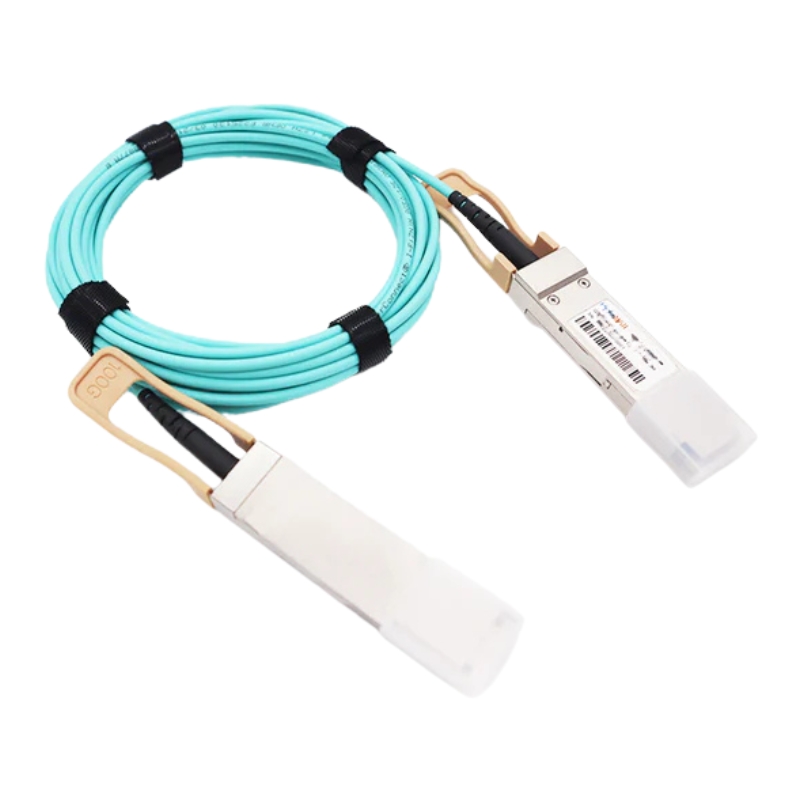
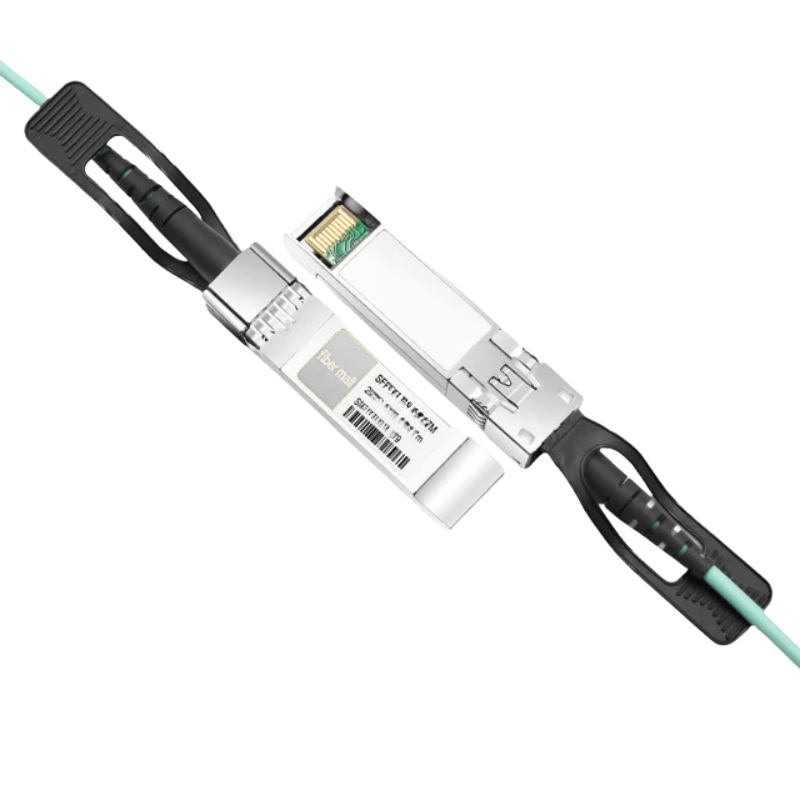
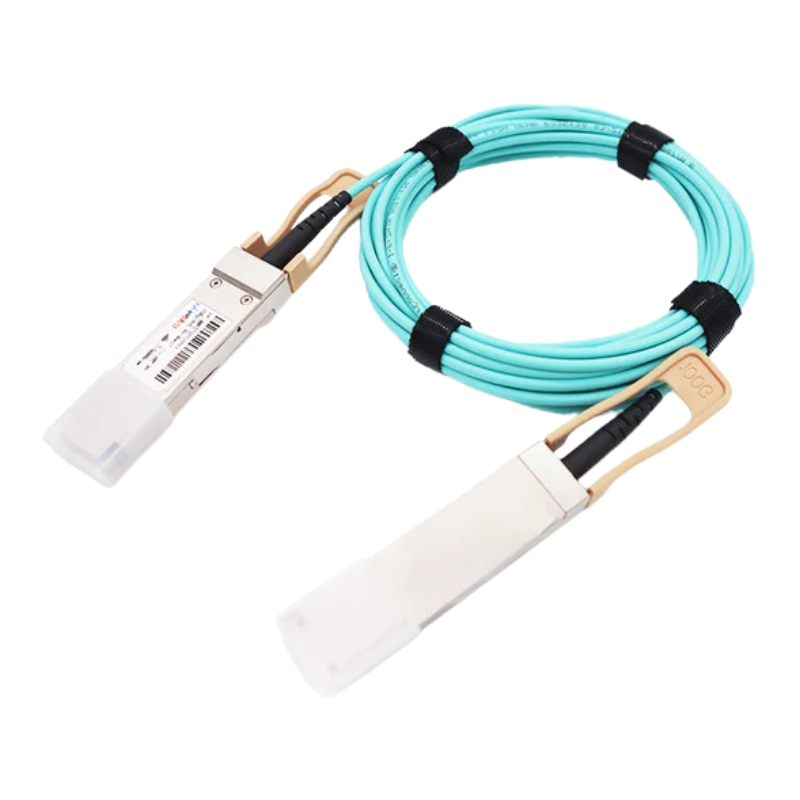
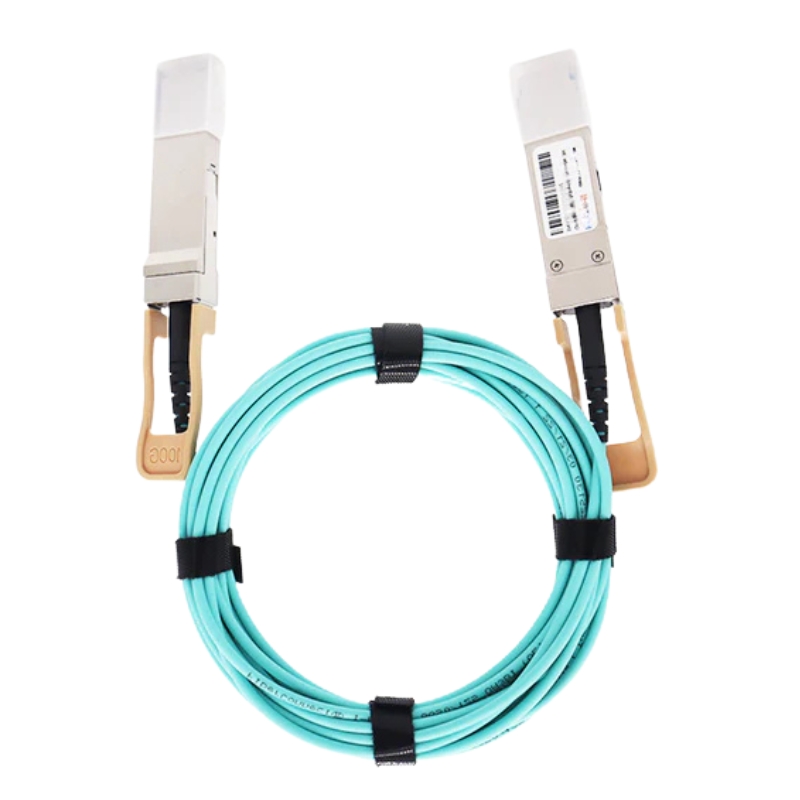
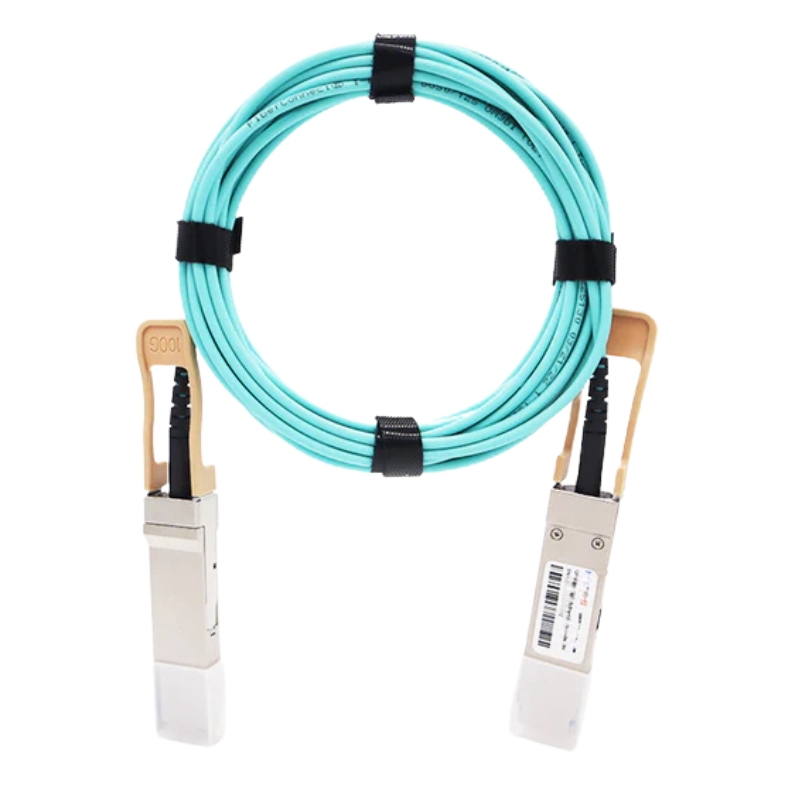
Product Overview of HPE 845413-001 100GB QSFP28 to QSFP28 15m Active Optical Cable
The HPE 845413-001 100GB QSFP28 to QSFP28 15m Active Optical Cable is engineered to deliver
high-speed connectivity, reliability, and efficiency for data-intensive environments. Designed with advanced
optics and high-performance transmission, this active optical cable ensures smooth communication between
networking equipment while reducing latency and maximizing throughput.
Main Details about HPE 845413-001
- Brand / Manufacturer: Hewlett Packard Enterprise (HPE)
- Part Number (SKU): 845413-001
- Cable Category: Active Optical Cable (AOC)
- Connector Type: QSFP28 to QSFP28
- Data Transfer Speed: 100 Gigabit per second (100Gbps)
- Cable Length: 15 meters
- Application: High-bandwidth networking, data centers, cloud computing, enterprise servers
Features and Functional Benefits
This HPE 100GB Active Optical Cable is designed to provide optimal performance for modern
networking requirements. With plug-and-play usability and durable construction, it ensures long-term
stability in demanding IT infrastructures.
Key Features
- Supports ultra-fast 100Gbps data transfer rates
- Engineered with QSFP28 interface for reliable performance
- Lightweight fiber optic design ensures flexibility and simple installation
- Energy-efficient with low power consumption
- Designed for high-density environments in enterprise and data centers
Performance Advantages
- Delivers low latency for high-speed applications
- Ensures signal integrity even across longer distances
- Reduces network downtime through robust construction
- Compatible with multiple HPE switches and servers
Use Cases of HPE 845413-001 Active Optical Cable
The cable is a perfect solution for enterprise networking and IT professionals seeking a dependable
100GbE connection. Its 15-meter reach allows it to bridge connections between
servers, switches, and storage systems without performance degradation.
Typical Applications
- Data center interconnects
- High-performance computing (HPC)
- Enterprise network backbone
- Cloud service providers
- Telecommunication infrastructure
HPE 845413-001 100GB QSFP28 to QSFP28 15m Active Optical Cable
The HPE 845413-001 100GB QSFP28 to QSFP28 15m Active Optical Cable category covers a family of high-performance, data-center-ready active optical cables (AOC) designed to deliver low-latency, high-bandwidth 100 Gigabit Ethernet connectivity over a 15-meter optical link. This page describes technical specifications, deployment scenarios, compatibility, testing and validation best practices, benefits versus alternatives, purchase considerations, and frequently asked questions — all crafted to help network engineers, system integrators, and procurement teams make an informed buying decision.
Defines an HPE 845413-001 100Gb QSFP28 AOC
An HPE 845413-001 AOC is a factory-terminated, pluggable QSFP28 (Quad Small Form-Factor Pluggable 28) to QSFP28 active optical cable that integrates transceivers and fiber optics into a single assembly. Unlike passive copper DACs, an active optical cable contains optical transceivers and uses fiber optics between the QSFP28 endpoints. The 15-meter length makes this product ideal for medium-distance connections inside large server racks, across adjacent rack rows, and between top-of-rack (ToR) and aggregation switches.
Key technical attributes
- Data rate: 100Gbps (supports 100G Ethernet and 4x25G breakout modes where applicable)
- Connector type: QSFP28 to QSFP28
- Length: 15 meters (factory-calibrated)
- Medium: Single assembly AOC (optical fiber with integrated transceivers)
- Form-factor: Hot-pluggable QSFP28 modules on each end
- Power consumption: Lower than equivalent optical transceiver + patch cable combination in many designs — consult datasheet for exact wattage
- Supported distances: Designed for reliable 15m performance in data center environments
The choose a 15m QSFP28 AOC
Choosing a 15-meter QSFP28 active optical cable provides a sweet spot between the ultra-short reach of passive copper DACs and longer span pluggable transceivers plus separate fiber patch cords. Typical reasons engineers select a 15m AOC include:
- Midsize rack-to-rack links: Connecting switches in adjacent rows without extra patch panels.
- Cleaner cabling: One-piece assemblies reduce connector count and potential insertion loss points.
- Lower total cost of ownership: Built-in optics and fixed-length manufacturing can lower lifecycle cost compared to separate transceivers and fiber when deployed at scale.
- Plug-and-play simplicity: AOCs are recognized by HPE and many other vendors and often auto-negotiate without complex configuration.
- Reduced signal integrity concerns: Optical links are immune to electromagnetic interference (EMI), improving reliability in dense installations.
Compatibility and interoperability
Vendor compatibility
This product is commonly used in HPE networking and server ecosystems, but QSFP28 AOCs follow industry electrical and optical specifications which allow interoperability with equipment from multiple vendors. When planning procurement, verify supported part numbers, firmware expectations, and vendor compatibility lists (VCLs) in the target switch or server documentation.
Common compatible platforms
- HPE Aruba and HPE FlexNetwork switches that provide QSFP28 ports
- Top-of-rack (ToR) and leaf switches from multi-vendor data center deployments
- High-performance computing (HPC) nodes and compute clusters requiring 100Gb links
- Storage arrays and NVMe-over-Fabrics (NVMe-oF) deployments using 100GbE
Breakout and multi-rate support
Many QSFP28 AOCs support multi-rate operation and breakout to 4x25Gb lanes (when used with switches that support QSFP28 breakout configurations). This flexibility enables:
- Mixed-speed data center fabrics where downstream ports remain 25GbE
- Gradual upgrades from 25Gb uplinks to 100Gb aggregation layers
- Flexible topology designs for storage, compute, and switching layers
Performance characteristics and signal integrity
Latency, throughput, and error rates
Active optical cables such as the HPE 845413-001 inherently offer excellent throughput and low deterministic latency. In production, typical performance highlights include:
- Throughput: Verified native 100Gb line-rate throughput with support for jumbo frames where the network supports them.
- Latency: Minimal added latency due to integrated optics; suitable for latency-sensitive applications (financial trading, HPC messaging, etc.).
- Bit error rate (BER): Designed to meet industry-grade BER targets (often ≤ 10-12 or better) when used in appropriate environmental and chassis conditions.
Thermal and power considerations
While AOCs consolidate components, they still consume power at the transceiver level. Design racks and chassis cooling plans to account for additional heat in densely populated QSFP28 ports. Key tips:
- Monitor port-level power draw in switch management planes; avoid stacking maximum-rated AOC wattages in poorly ventilated chassis.
- Place high-density switches in cooled zones or use front-to-back airflow compatible cable routing to prevent hot spots.
- Consult HPE technical documentation for per-port power usage to plan PDUs and cooling budgets.
Deployment scenarios and use cases
Data center spine-leaf architectures
In modern spine-and-leaf fabrics, 100Gb QSFP28 AOCs are commonly deployed to interconnect leaf switches to spine switches where distances fall within the 15m range. Advantages in this role include deterministic latency and homogenous physical layer performance across multiple ports.
Use case examples
- Leaf to spine aggregation: 100Gb uplinks using 15m AOCs simplify mid-row cabling between adjacent racks.
- Storage backplanes: High-bandwidth links between storage switches and storage arrays or NVMe fabrics.
- Clustered compute nodes: High-throughput clustering for machine learning and HPC applications.
- Campus aggregation closets: Short optical interconnects within communications rooms.
Edge and colocation facilities
Colocation cages and edge sites often prefer single-assembly AOCs for speed of deployment and reduced onsite cabling errors. Because AOCs are pre-qualified and tested, they minimize troubleshooting time during migrations and rack reconfigurations.
Advantages vs alternatives
AOC vs passive DAC (Direct Attach Copper)
- Signal reach: AOCs can reliably handle longer distances (15m in this case) than many DACs which are typically effective up to 3–7m depending on gauge.
- Weight and flexibility: AOCs are lighter and more flexible than thick copper DAC assemblies, making them easier to route within racks.
- EMI immunity: Fiber optics in AOCs are not susceptible to electromagnetic interference, improving signal integrity in noisy environments.
- Cost trade-offs: Passive DACs are often cheaper at very short lengths; for 15m spans, AOCs or transceiver + patch solutions become more cost-effective.
AOC vs pluggable transceiver + patch fiber
- Simplicity: A single part number, no additional LC patch cords required, fewer connectors to manage.
- Space efficiency: Eliminates bulky patch panels in some topologies, reducing rack complexity.
- Replaceability: Integrated assembly means a single replacement part, but it also means the entire assembly must be replaced if any element fails.
- Customization: Separate transceiver + fiber allows field-specified fiber types and patching topologies, which may be necessary for some hybrid or long-span environments.
Installation and cable management best practices
Handling and bending
Active optical cables contain delicate optical subcomponents; follow manufacturer guidance on bend radius and handling. General recommendations:
- Maintain the manufacturer-specified minimum bend radius at all times.
- Use cable ties and management arms that do not create sharp bends or pinch points.
- Avoid kinking or placing heavy objects on AOCs; optical fiber tolerances are less forgiving than copper.
Connector seating and port status
When inserting a QSFP28 AOC:
- Ensure the link partners support the part number or generic QSFP28 AOC protocols.
- Insert the QSFP28 plug fully until the latch engages; partial seating can cause intermittent errors.
- Monitor switch port LEDs and management logs for lane training and link up notices.
Labeling and documentation
Document every link with end points, length, part number, and installation date. Use rack maps and port labeling to maintain visibility for future troubleshooting and upgrades.
Security, compliance, and environmental factors
Security implications
Physical security for optical links is often overlooked. Optical taps exist, but AOCs are less susceptible to casual tampering than loose patch panels because they present fewer accessible connection points. For high-security environments, implement port-level access controls, physical locks on patch panels, and tamper-evident routing.
Environmental specifications
Check the exact environmental tolerances listed in the vendor datasheet for:
- Operating temperature range
- Storage temperature limits
- Humidity tolerance
- Shock and vibration ratings (important for edge or mobile facilities)
End-of-life and upgrade path
Document the EOL/EOS policies for your chosen parts and review upgrade paths (e.g., migration to 200Gb QSFP56 or 400Gb QSFP-DD technologies). While 100Gb AOCs remain highly relevant in many fabrics, planning ahead avoids forklift upgrades and helps budget for phased migration.
Alternatives and complementary products
Alternative cabling options
- QSFP28 passive DAC: Cost-effective for very short distances but limited in reach.
- QSFP28 SR4 transceivers + multimode fiber patching: Flexible and field-repairable, suitable for structured cabling with patch panels.
- QSFP28 LR/ER optics + single-mode fiber: For much longer runs beyond 15m, often used between separate facilities or across campus.
Complementary accessories
- Cable management trays and horizontal managers for neat routing
- Port dust caps for unused QSFP28 cages
- Labeling solutions and cable testers designed for fiber diagnostics





 Contact Us
 Information
 Catalog
 Solid State Drives (SSD)
 Network Switches
 Hard Disk Drives
 HBA & Controllers
 PC & Servers
 PC & Server Memory
 CPU & Processors
 Network Routers
 Power Supplies
 Tape Drives & Libraries
 Network Devices
 Computer & Network Cables