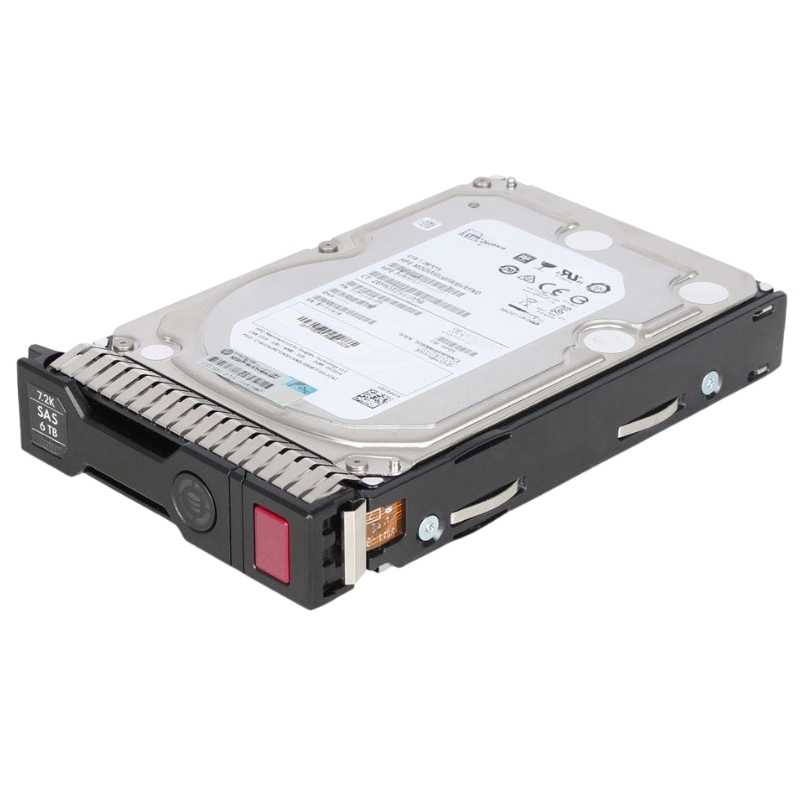
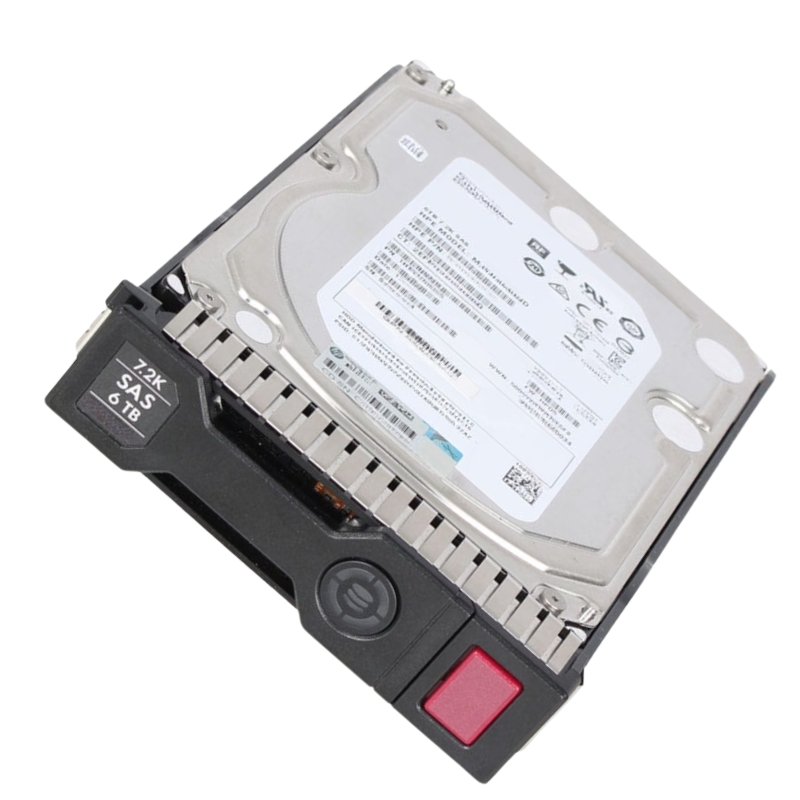
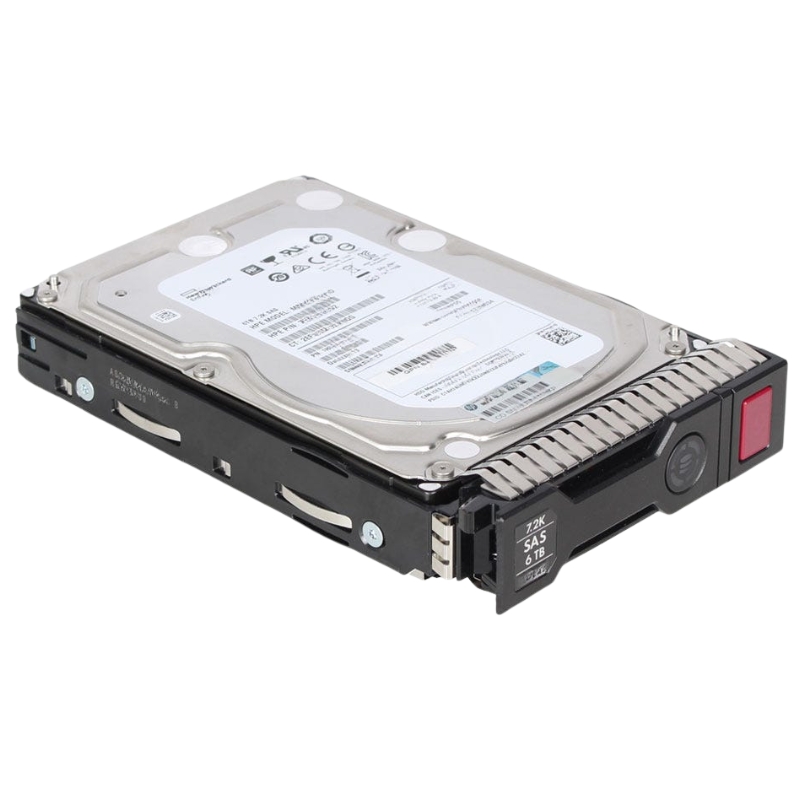
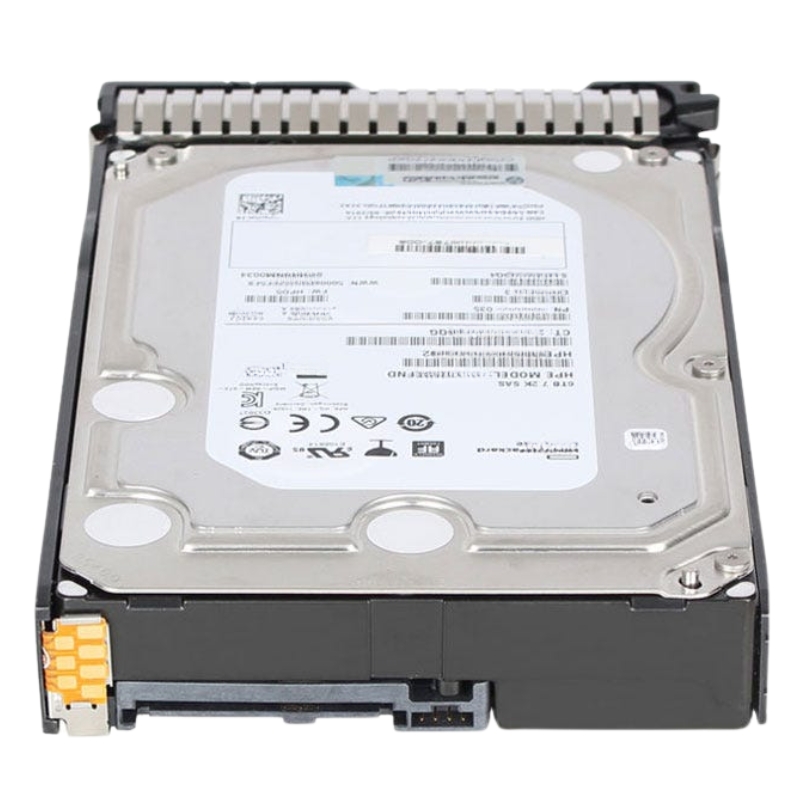
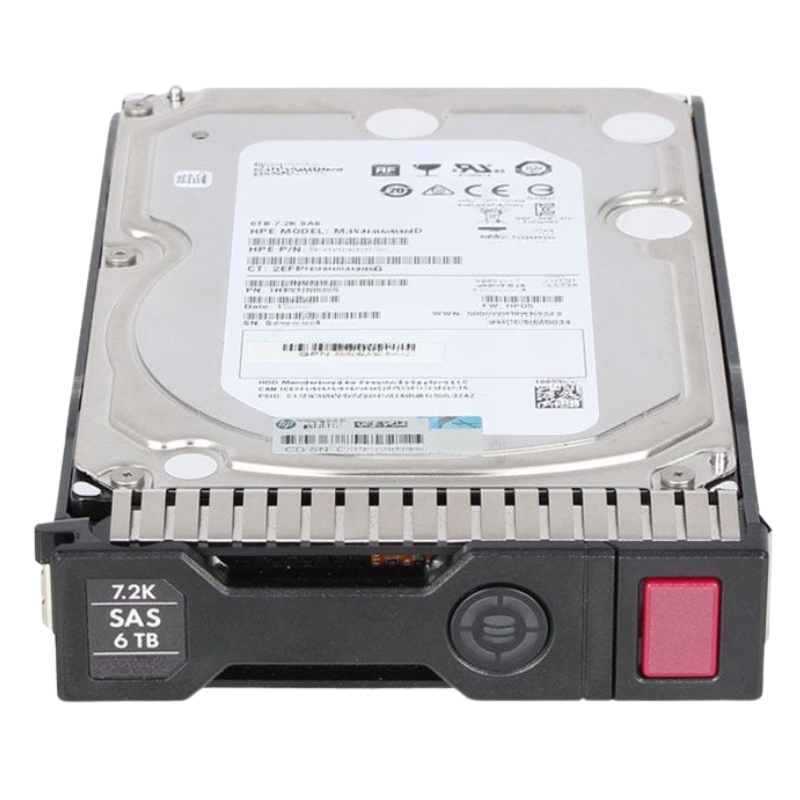
HPE 846787-007 — 6TB SAS 12Gb/s 7.2K RPM 3.5" LFF SC 512e HDD:
The HPE 846787-007 is a high-capacity, enterprise-grade internal hard disk drive engineered for servers, storage arrays, and high-throughput data centers. With 6TB of usable storage, 12Gb/s SAS connectivity, and a reliable 7,200 RPM spindle speed, this 3.5-inch Large Form Factor (LFF) drive balances performance, endurance, and cost-efficiency for mixed workload environments.
Key Specifications & Technical Snapshot
Core specifications
- Model: HPE 846787-007
- Capacity: 6 TB (terabytes)
- Interface: SAS (Serial Attached SCSI)
- Interface speed: 12 Gb/s (12 gigabits per second)
- Rotational speed: 7,200 RPM (revolutions per minute)
- Form factor: 3.5-inch LFF (Large Form Factor)
- Sector format: 512e (512 emulation)
- Drive type: Internal enterprise HDD
Product classification
- Category: Hard drive / magnetic storage
- Design intent: Server-grade storage, network-attached storage (NAS) for businesses, RAID arrays
- Environmental considerations: Eco-friendly design elements
- Assembly: Requires installation into a compatible drive bay or caddy
Performance & Throughput
Transfer rates and data flow
The HPE 846787-007 supports up to 12Gb/s SAS signaling, delivering sustained data throughput suitable for I/O-intensive operations. Coupled with a 7,200 RPM spindle speed, the drive provides a dependable balance between sequential transfer performance and random access latency for mixed workloads.
What to expect in real-world workloads
- Excellent sequential read/write for large files, backups, and archival tasks.
- Smooth performance in multi-drive RAID configurations when paired with enterprise controllers.
- Good cost-per-gigabyte for bulk storage compared to SSDs, making it ideal for scale-out capacity tiers.
Optimizing throughput
- Use with 12Gb/s SAS backplanes and HBA/RAID controllers that fully support SAS-3 to avoid bottlenecks.
- Deploy in RAID levels (e.g., RAID 6, RAID 10) according to redundancy and performance needs.
Reliability, Durability & Environmental Info
Enterprise reliability features
Built for continuous operation, this HPE drive incorporates enterprise-class components and firmware tuned for data center resilience. Expect stable operation under 24/7 workloads and predictable behavior in multi-drive arrays.
Eco-friendly attributes
- Designed with power-efficiency in mind relative to high-RPM alternatives.
- Compliant with relevant environmental standards (check specific datasheet for certifications and power figures).
Serviceability & assembly
- Assembly required: install into server or storage chassis drive bay; hot-swap support depends on chassis.
- Hot-plug capability: depends on system backplane and controller configuration.
Compatibility & Use Cases
Compatible systems
- HPE ProLiant servers and HPE storage systems certified to accept 3.5" SAS drives.
- Third-party servers and storage arrays with 12Gb/s SAS backplanes and SAS-3 compatible HBAs.
- RAID controllers that support 512e sector emulation and enterprise HDD characteristics.
Recommended workloads
- High-capacity archival storage and cold/hot tiering in hybrid storage architectures.
- Database backups, log storage, and bulk media repositories.
- Capacity-heavy virtualization nodes and distributed file systems where throughput matters more than sub-millisecond latency.
Advantages & Competitive Differentiators
- High capacity: 6TB per drive reduces rack footprint and lowers cost-per-TB.
- SAS performance: 12Gb/s interface designed for enterprise I/O consistency.
- Reliable spindle speed: 7,200 RPM offers a compromise between faster 10K/15K drives and slower large-capacity media.
- Form factor flexibility: Standard 3.5" design fits a wide range of servers and enclosures.
- 512e compatibility: Ensures interoperability with many legacy systems and controllers.
Comparing to alternatives
- Vs. SSDs: Lower cost per TB, higher latency, suitable for capacity tiers rather than primary high-IOPS tiers.
- Vs. 10K/15K SAS drives: Slightly lower random I/O performance but superior capacity and better power efficiency per TB.
- Vs. SATA enterprise drives: SAS offers better command queuing, multi-pathing, and reliability features important in mission-critical deployments.
Installation, Setup & Best Practices
Pre-installation checklist
- Ensure chassis backplane supports 3.5" LFF drives and 12Gb/s SAS lanes.
- Confirm firmware compatibility between drive and server/storage controller.
- Prepare drive caddies or sleds that match your server model for secure mounting.
Step-by-step installation tips
- Power down the system if required by the chassis (or use hot-swap bays if supported).
- Insert the drive into a correctly configured 3.5" bay; secure it with the appropriate screws or caddy latch.
- Verify the drive is recognized by the controller BIOS/UEFI or storage management utility.
- If adding to an existing RAID array, follow your controller’s recommended rebuild procedure to minimize rebuild time and risk.
Maintenance & monitoring
- Monitor SMART attributes and logs via server management software to detect early signs of degradation.
- Keep firmware up to date according to HPE advisories to ensure optimal compatibility and performance.
- Plan for periodic disk health checks and maintain spare drives for rapid replacement.
Buying Guide & Decision Criteria
When to choose this model
- You're prioritizing storage density and cost-efficiency over ultra-low latency.
- You need a server-grade drive with SAS reliability features for RAID arrays.
- Your infrastructure supports or requires 12Gb/s SAS connectivity for best throughput.
Factors to evaluate before purchase
- Compatibility with existing server models and drive bays.
- Support and warranty terms from HPE or authorized resellers.
- Intended workload profile (sequential vs. random I/O intensity).
- Total cost of ownership including power, cooling, and replacement spares.
Checklist for procurement teams
- Confirm the exact part number (HPE 846787-007) to avoid cross-model confusion.
- Request firmware and compatibility matrices from your vendor.
- Plan lifecycle replacement and maintain a small pool of identical spare drives.
Performance Profile and Workload Suitability
Throughput and IOPS characteristics
While not an all-flash answer, the HPE 6TB SAS 12Gbps 7.2K HDD provides a compelling price-per-terabyte profile with adequate performance for many enterprise workloads. Typical performance attributes are:
- Sequential throughput: Strong sustained sequential read/write capability well-suited to large-file transfers, media streaming, and backup restore operations.
- Random I/O: Moderate random IOPS suitable for read-heavy applications, capacity-tier virtualization hosts, and cold data sets. For heavy small-block random-write workloads consider hybrid or all-flash tiers.
- Latency: Millisecond-class average latency optimized by 7.2K RPM mechanics and SAS command optimizations.
Best-fit workload categories
The drive is ideal for a range of enterprise and SMB applications where high capacity and enterprise reliability matter more than low-latency flash performance:
- Capacity-tier storage, cold/nearline archives, and object storage nodes.
- Backup and restore targets in disk-based backup appliances and deduplication vaults.
- Virtual machine dense hosts with mixed, primarily read-oriented workloads.
- Media asset management and surveillance storage where continuous sequential writes are predominant.
- Secondary storage arrays and snapshots where capacity and cost efficiency matter most.
Reliability, Endurance, and Data Integrity Features
Enterprise reliability engineering
Enterprise drives are engineered to deliver predictable behavior, longer service life, and data integrity safeguards. The HPE 846787-007 series emphasizes:
- Mean Time Between Failures (MTBF): Enterprise-grade MTBF rating (consult product brief for exact figure) indicating suitability for always-on data-center operations.
- Workload rating: High-duty-cycle workload design supporting sustained operation within server/storage arrays.
- Power management: Advanced power modes that balance performance with energy savings in dense deployments.
- RAID-friendly features: Optimizations to minimize rebuild times and prevent data loss during extended rebuild windows.
Data protection and integrity
Data integrity technologies built into enterprise SAS HDDs reduce the risk of silent corruption, and when combined with higher-level storage stack protections, provide robust end-to-end reliability:
- End-to-end data protection: SCSI CRCs, logical block protection, and advanced error correction mechanisms.
- Sector remapping: Automated reallocation of suspect sectors to spare pools to preserve readable data.
- Temperature and vibration tolerance: Tighter operational tolerances and vibration mitigation for multi-drive enclosures.
Compatibility and Integration Considerations
HPE server & storage compatibility
This HPE-branded drive is optimized for HPE ProLiant servers, HPE storage arrays, and HPE-certified JBOD/RAID controllers. When procuring or integrating:
- Confirm exact part number matches or validated alternatives when replacing existing modules in racks or blades.
- Check HPE QuickSpecs for firmware compatibility and recommended controller driver versions.
- Use HPE Service Pack for ProLiant (SPP) updates to maintain validated firmware/driver stacks for best reliability.
- Consider HPE Smart Carrier and sled compatibility for tool-less hot-swap bay insertion in supported chassis.
Controller, RAID, and firmware notes
Successful deployment requires alignment between drive firmware and the host controller or RAID card:
- Firmware: HPE often ships drives with vendor-certified firmware tuned for HPE hardware; using non-certified variants may void support.
- RAID behavior: Verify rebuild and patrol read behavior with your RAID solution—some controllers have firmware options affecting rebuild performance.
- Host bus adapter (HBA) compatibility: 12Gbps SAS adapters and controllers deliver optimal throughput; backward compatibility with 6Gbps controllers is available but reduces link speed.
- Multipath and dual-port setups: For high-availability deployments, dual-port SAS and multipath configurations increase fault tolerance when supported by the storage stack.
Mechanical and Environmental Details
Physical form factor and mechanical profile
As a 3.5-inch LFF drive, the HPE 846787-007 fits common enterprise bays used across tower, rack, and dense storage enclosures. Mechanical considerations include:
- Mounting compatibility with standard 3.5-inch trays and caddies.
- Drive thickness and connector placement follow enterprise layout norms.
- Shock and vibration tolerances suitable for rack-mounted chassis with multi-drive vibration control.
Power and thermal characteristics
For large-scale deployments, power consumption and cooling are critical operational costs. Typical considerations:
- Idle and active wattage: Enterprise 7.2K drives present a modest power profile per drive — aggregate power should be calculated for populated enclosures.
- Spin-up current: Drives may require higher transient current at spin-up; ensure power supply and backplane support multi-drive spin-up scenarios or staged spin-up.
- Operating temperature range: Designed for data-center climates; confirm environmental tolerances with product literature for extreme deployments.
Alternative capacities and part numbers
This category often includes multiple capacities and similar SKUs to match different density needs. Common alternatives you may see in the same family include:
- Lower capacity 1TB–4TB variants for lighter capacity requirements.
- Larger capacity successors (8TB, 10TB, etc.) in later product generations offering higher density.
- Different sector formatting options (4K native, 512e, etc.) depending on host compatibility.
Real-world Use Cases and Case Examples
Backup appliances and deduplication vaults
Backup appliances that require deep capacity for daily snapshots and long-term retention often use 6TB enterprise HDDs as a core storage tier. Benefits include:
- Large sequential throughput for backup windows and restore operations.
- Cost-effective growth for retention periods measured in months or years.
- Compatibility with backup appliances and deduplication engines that prefer enterprise SAS media.
Archive, surveillance, and media streaming
Surveillance systems and media streaming workloads generate high volumes of sequential data and benefit from capacity-dense, reliable spinning media:
- Continuous write workloads are well-suited to 7.2K RPM enterprise HDDs.
- Large buffer sizes and sustained write tolerance make these drives fit for long-term video retention.
- Scalable JBOD architectures allow adding drives without disrupting existing services.





 Contact Us
 Information
 Catalog
 Solid State Drives (SSD)
 Network Switches
 Hard Disk Drives
 HBA & Controllers
 PC & Servers
 PC & Server Memory
 CPU & Processors
 Network Routers
 Power Supplies
 Tape Drives & Libraries
 Network Devices
 Computer & Network Cables