(7% discount is applied at checkout)
Cart is empty
Your go-to destination for cutting-edge server products
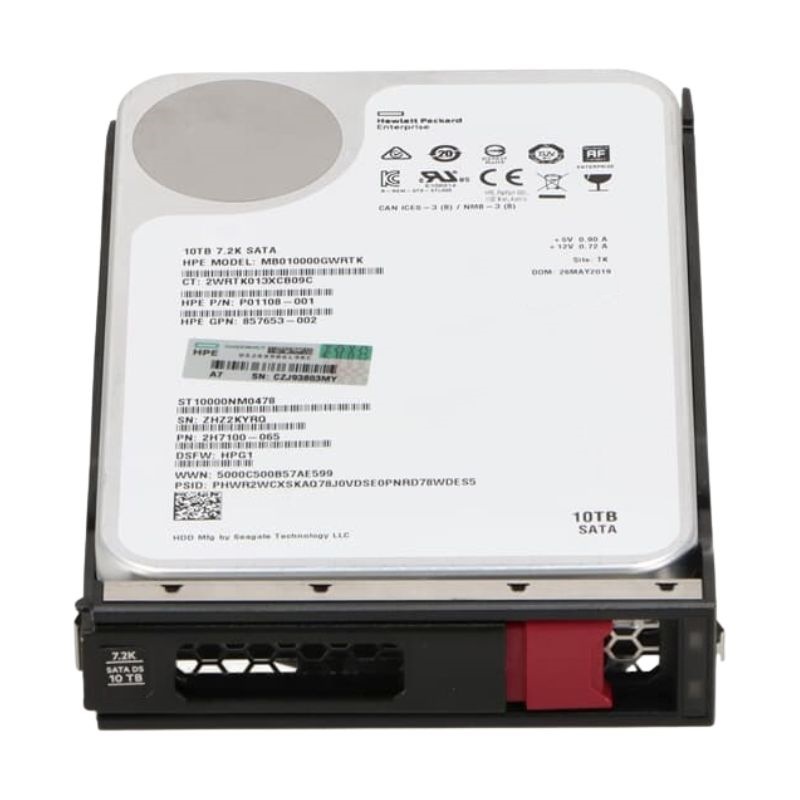


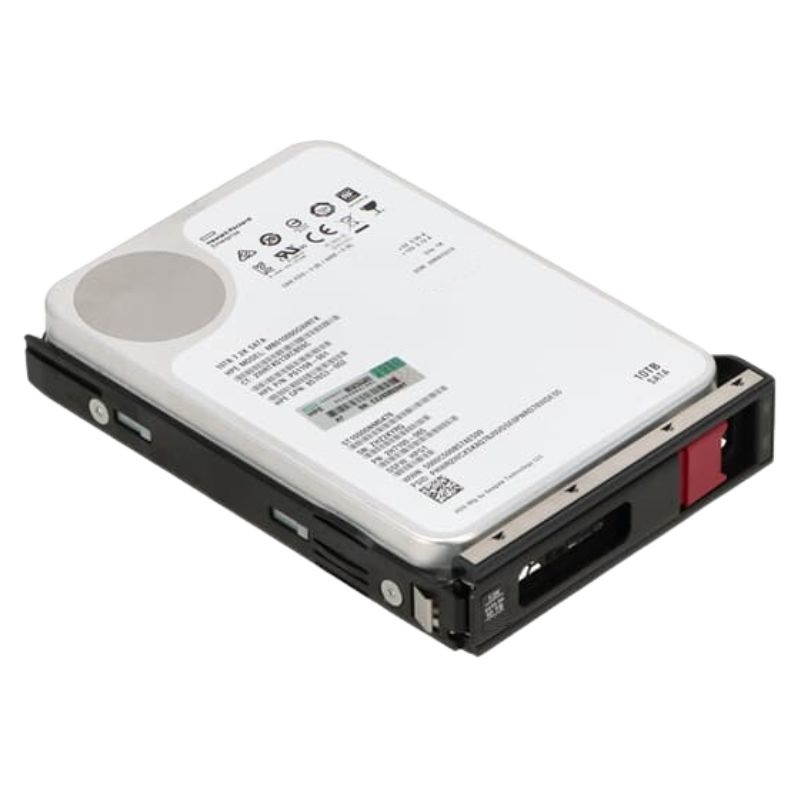
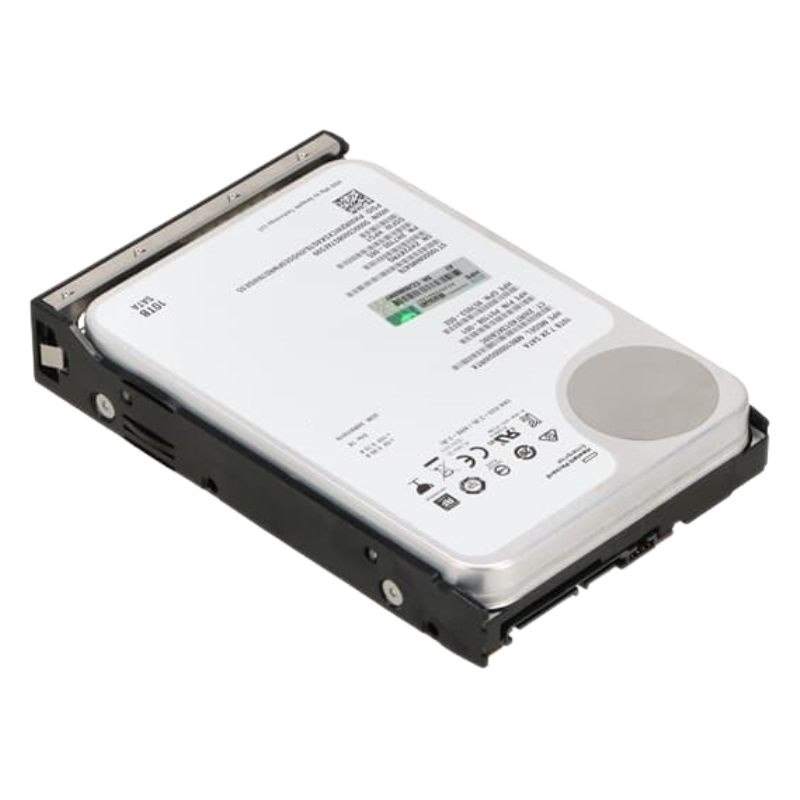
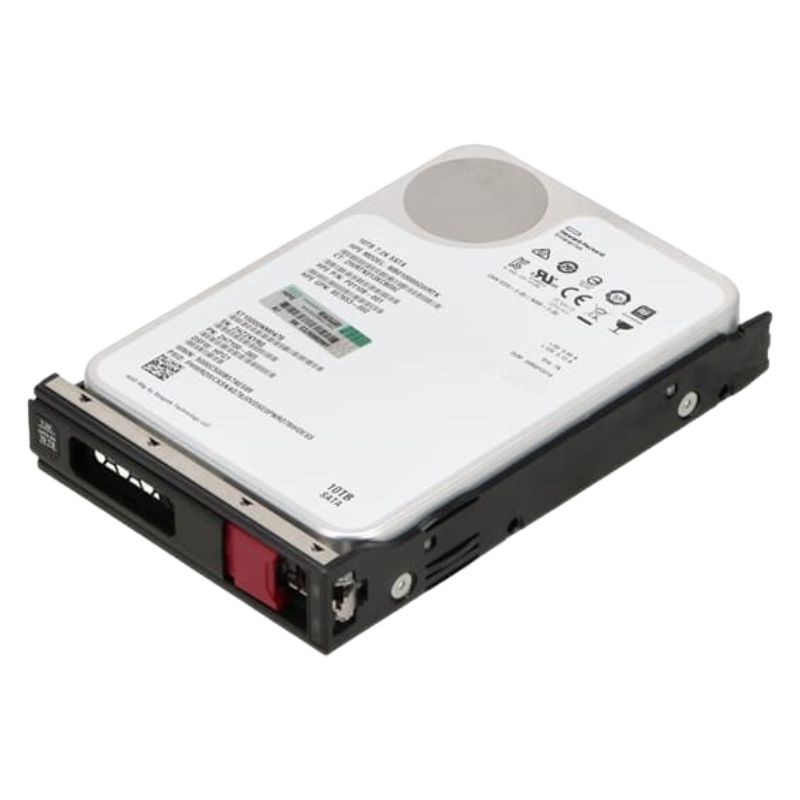
HPE 873777-B21 10TB SATA 6GBPS 7.2K LFF 512e DS Hot-Plug Hard Disk Drive. Excellent Refurbished with 1 year replacement warranty
The HPE 873777-B21 10TB SATA hard disk is an enterprise-grade storage solution built for reliability, scalability, and efficiency. It is designed to meet the requirements of modern datacenters, enterprise workloads, and mission-critical applications. With its hot-plug capability and digitally signed firmware, it provides businesses with secure, high-capacity storage that integrates seamlessly with HPE ProLiant Gen10, Gen10 Plus, Gen11, and Gen12 servers.
The HPE 873777-B21 category centers on a family of enterprise-grade 3.5-inch large form factor (LFF) hard disk drives designed for HPE servers and storage arrays. These drives pair high-capacity 10TB storage with a SATA 6Gb/s interface, conservative 7,200 RPM spindle speed for balance of throughput and efficiency, and 512e sector emulation for compatibility with legacy software and firmware. Labeled as hot-plug units, they are intended for data center and business-critical uses where high reliability, predictable performance, and ease of serviceability are priorities.
The trade-offs of this class make it a pragmatic choice: compared with 873777-B21, the per-gigabyte cost is substantially lower; compared with smaller 2.5" drives, the LFF design packs more raw capacity per bay. Versus higher-RPM drives (10K/15K), a 7.2K drive consumes less power and produces less heat while still offering acceptable sequential read/write speeds for backups, streaming, and large file transfers. For many tiered storage strategies, this model is an economical building block for capacity-heavy layers.
The 3.5-inch form factor allows manufacturers to use more platters and higher areal density to reach 10TB per drive. In rack-based servers this translates to higher density per chassis when populated with LFF bays.
7,200 RPM provides a balance between disk latency and energy efficiency. This speed is best suited to applications where sequential throughput and capacity are primary concerns. Seek to place these drives in storage tiers where low-latency random transactional workloads are not the primary requirement.
SATA 6Gbps (SATA III) is widely supported by server motherboards and HBA/RAID controllers. Note that while the SATA bus can support high sequential throughput, the drive's mechanical nature dictates peak and sustained performance characteristics; do not expect HDD-like randomness or microsecond-level latencies.
Drives with 512e report 512-byte logical sectors to the operating system while actually using larger physical sectors internally. This preserves backward compatibility with older OS kernels, hypervisors, and storage management software while benefiting from higher areal densities at the hardware level.
Enterprise-class drives intended for HPE systems include firmware tuned for server workloads, built-in SMART telemetry for predictive failure analysis, and specific HALT/AE thresholds for vibration and shock in multi-drive enclosures. When deployed in RAID arrays, the drives' firmware typically cooperates with HPE Smart Array controllers for rebuild prioritization and background media scanning (BMS).
Because HPE often validates drives as part numbers (such as HPE 873777-B21), these units are typically guaranteed to work in ProLiant Gen servers, HPE storage shelves, and particular HPE expansion enclosures when used with supported firmware and controllers. Always check the server or array compatibility matrix before procurement to ensure that the drive's exact part number is listed; this avoids unexpected firmware incompatibilities or unsupported configurations.
Always align drive firmware with the HPE platform's recommendations. HPE often publishes firmware bundles and advisories — running the recommended firmware reduces the risk of incompatibility with array management and increases the longevity of the deployed solution.
A 7.2K rotational SATA drive will deliver modest IOPS (usually in the low hundreds for random reads/writes depending on queue depth and workload) and relatively high sequential throughput (sustained MB/s rates suitable for large file transfers and backups). For I/O-sensitive applications (databases, virtualization with many random small I/Os), these drives should be paired with HDD caching tiers or reserved for sequential-oriented workloads.
Map how many LFF bays your chosen chassis supports (e.g., a 2U chassis might support 8 LFF bays, dense JBOD enclosures may support many more). Multiply usable capacity after chosen RAID to estimate effective usable storage. Don't forget overhead for hot spares and capacity for snapshots and replication staging.
When retiring drives, follow your organization’s data destruction policies. Options include secure erase (if supported), multiple-pass overwrites, or degaussing and physical destruction for drives leaving controlled facilities. Ensure appropriate certificates of destruction where required for compliance.
Long rebuilds are expected with 10TB drives — mitigate risk by limiting rebuild concurrency, implementing spare policies, and using controllers that support features like background patrol reads. Repeated rebuild failures may indicate latent sector errors; run drive-level scans and consider replacing the drive if BAD sector counts increase.
Adding drives can require RAID reshaping or parity redistribution which impacts performance during the operation. Schedule such maintenance during low-usage periods and ensure write-back cache policies are suitable to the workload.
Generic OEM drives of identical mechanical specification can be less expensive, but HPE-branded parts ensure compatibility and support from HPE. For large-scale deployments where vendor support and validated configurations matter, prefer HPE part numbers. For lab, test, or cost-sensitive archival uses where vendor support is less important, generic equivalents may be viable — but they carry higher operational risk in production systems.
Some industries require specific retention and destruction policies. When using high-density drives in regulated settings (finance, healthcare, government), ensure records of sanitization and vendor certificates are maintained to demonstrate compliance.
873777-B21 deliver far superior latency and random IOPS but at a much higher price per TB. Use 873777-B21 for hot tiers and transactional databases; use 10TB SATA drives for cold/warm tiers where capacity matters more than latency.
10K and 15K RPM drives offer better random I/O and lower latency but consume more power and usually offer lower maximum capacity per cost. For heavy transactional workloads (OLTP databases, virtualization hosts with dense VMs), consider higher-RPM SAS drives or HDDs; for archive and backup, 10TB 7.2K SATA is more economical.
Higher-capacity LFF drives reduce the number of drives to manage and lower power per TB, but each drive becomes a larger fault-domain during rebuilds. Many smaller drives can offer better parallelism for I/O and faster rebuilds at the cost of higher power and complexity. Evaluate based on rebuild windows, risk tolerance, and physical rack/coolant constraints.
For scale-out storage, populate JBOD shelves with many 10TB drives and connect via validated controllers. Use erasure coding or distributed redundancy (in SDS solutions) to reduce rebuild impact and to distribute fault domains across racks and failure zones.
Logical sector size of 512 bytes presented to the operating system while the physical sectors are larger (commonly 4K). 512e avoids compatibility issues with legacy software while enabling higher-density physical media.
Refers to 3.5-inch drive size, favored where capacity per bay matters more than small physical footprint.
The capability to insert or remove a drive while the system remains powered and running, assuming the enclosure and controller support hot-swap operations.
Self-Monitoring, Analysis and Reporting Technology — diagnostic telemetry reported by drives to indicate health and predictive failure signals.


 Contact Us
 Information
 Catalog
 Solid State Drives (SSD)
 Network Switches
 Hard Disk Drives
 HBA & Controllers
 PC & Servers
 PC & Server Memory
 CPU & Processors
 Network Routers
 Power Supplies
 Tape Drives & Libraries
 Network Devices
 Computer & Network Cables