(7% discount is applied at checkout)
Cart is empty
Your go-to destination for cutting-edge server products
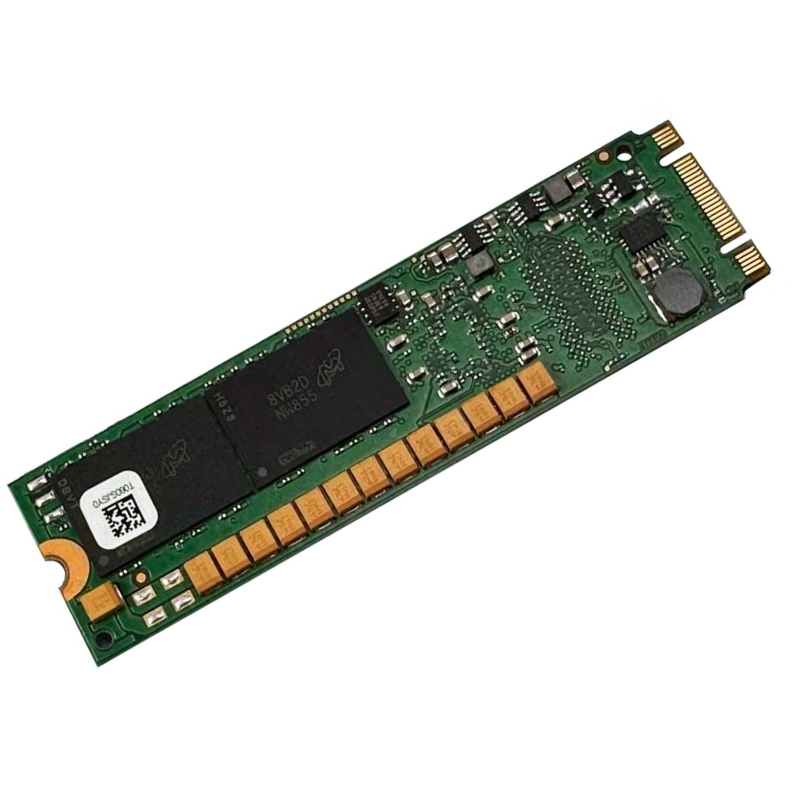


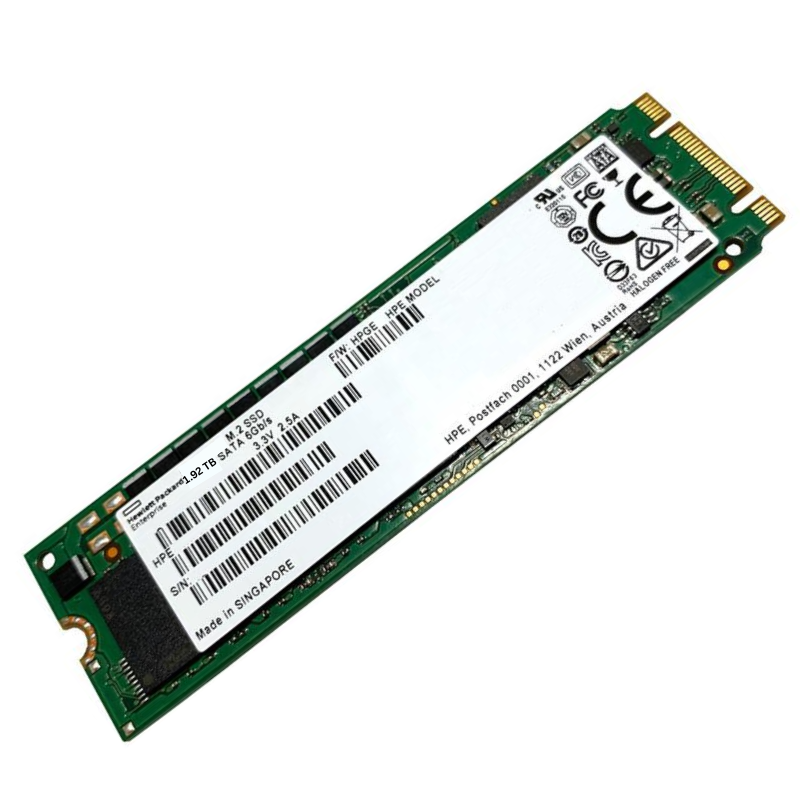
HPE 875854-001 1.92TB Solid State Drive M.2 2280 SATA-6GBPS. Excellent Refurbished with 1 year replacement warranty
Engineered for demanding workloads, the HPE 875854-001 solid-state drive delivers reliable performance and secure data handling for Gen9 and Gen10 ProLiant blade systems.
The HPE 875854-001 1.92TB SATA-6GBPS M.2 2280 Read Intensive Solid State Drive represents a focused class of enterprise storage engineered specifically for HPE ProLiant Blade environments — notably Gen9 and Gen10 generation blades — where read-dominant workloads demand predictable performance, low latency, and platform-level firmware authentication. This category encompasses single-socket M.2 format drives with digitally signed firmware that provide a secure, compact, and high-capacity storage option ideal for boot, caching, read-heavy data sets, and small-form-factor server designs. The category is defined by a combination of physical form factor (M.2 2280), interface (SATA III 6Gbps), workload profile (read intensive), enterprise-grade reliability attributes, and firmware signing that enforces platform compatibility and integrity. Within this continuous category description, the product is explored from every angle likely to influence purchase decisions: technical specifications and architecture, performance characteristics under read-dominant loads, compatibility considerations with ProLiant Blade Gen9 and Gen10 servers, integration and deployment best practices, lifecycle management and firmware update policy, endurance and reliability metrics, security and compliance features provided by digitally signed firmware, and commercial considerations including warranty, replacement policy, and total cost of ownership when compared to alternative storage options.
The HPE 875854-001 drive adheres to the M.2 2280 mechanical standard: 22 millimeters wide by 80 millimeters long, optimized for dense blade and rack-mounted server designs where board space and drive bay constraints preclude larger 2.5-inch or 3.5-inch form factors. The SATA-6GBPS interface provides proven interoperability with SATA controller ecosystems in ProLiant blade systems while delivering a balance of throughput and compatibility. Delivering a nominal usable capacity of 1.92TB, this drive leverages high-density TLC NAND arranged for read-intensive workloads. The controller firmware is digitally signed by HPE, a design choice that prevents unauthorized firmware from being installed, and it allows system-level validation during server boot and array initialization. Key electrical and mechanical characteristics include standard M.2 power envelopes suitable for blade server power profiles, support for native command queuing (NCQ), TRIM support for maintaining long-term performance, and SMART attributes for telemetry and predictive failure analysis. These specifications position the drive as a fit-for-purpose component where density and read throughput are prioritized over write endurance typical of mixed-use or write-intensive SSD families.
SATA III (6Gbps) remains a widespread and dependable protocol in server ecosystems, particularly in blade server platforms where SAS or NVMe lanes may be scarce or reserved for other I/O duties. SATA's compatibility with legacy SATA controllers and HBA firmware stacks means straightforward integration — the drive enumerates as a standard SATA device, supports AHCI paradigms when required by the host, and benefits from mature OS driver support across mainstream enterprise operating systems and hypervisors. Although NVMe offers higher raw throughput and parallelism, the SATA interface in this category is deliberately chosen to balance cost, backward compatibility, and thermal/power constraints inside blade chassis. Understanding that SATA bandwidth is bounded compared to NVMe is important for architects: the drive provides excellent random read IOPS for small-block operations common in system boot, metadata services, and read-heavy caches, but it will not match high-concurrency NVMe arrays for extremely parallel workloads.
Read intensive class SSDs are tuned for environments where read operations significantly outnumber writes. Typical use cases include web servers serving static content, database read replicas, virtualization boot drives, container image caches, index services, and certain analytics workloads where sequential and random reads dominate. The HPE 875854-001 is optimized to minimize read latency and provide a stable IOPS baseline under sustained read loads. This is achieved through firmware-level read path optimizations, over-provisioning strategies that reserve capacity to smooth index structures, and NAND wear-leveling schemes that protect write hotspots. Buyers should match the drive's workload profile to their application characteristics: if the environment performs frequent large-scale writes — heavy logging, large database ingests, or high-volume temporary file creation — a write-optimized or mixed-use drive class may provide better longevity. Conversely, for read-heavy virtual desktop infrastructure (VDI) boot storms, content delivery systems, and read-cached database layers, this drive delivers cost-effective performance and extended useful life relative to write-optimized SSDs that are over-specified for read-dominant scenarios.
Expect predictable random read IOPS and low latency for small-block (4K–16K) read operations, along with strong sequential read throughput within the ceiling of SATA 6Gbps limitations. Benchmarking should focus on workload-representative tests: measure steady-state random read IOPS with an I/O depth representative of the application, evaluate read latency percentiles (p50, p95, p99) under sustained load, and monitor performance degradation patterns as the drive approaches fullness. Real-world testing should avoid synthetic peak-only tests that do not account for workload bursts; instead, implement mixed arrival rates and examine the impact of background maintenance tasks like garbage collection and firmware housekeeping. Because the drive uses TLC NAND with enterprise-oriented controllers, performance consistency across long-duration read workloads will be superior to consumer-grade M.2 SSDs, but administrators must still observe drive telemetry during the initial burn-in and at production scale to establish baseline metrics for service-level objectives (SLOs) and alert thresholds.
Compatibility is a pivotal aspect of this category. The HPE 875854-001 is designed, certified, and often shipped on HPE ProLiant Blade platforms to ensure the firmware signing and device identity match HPE system firmware expectations. Gen9 and Gen10 ProLiant blades incorporate firmware validation steps and storage controller configurations that assume HPE-signed devices for full functionality and predictable firmware update behavior. Administrators should consult HPE compatibility matrices and server release notes when deploying these drives, as BIOS/UEFI revisions and Smart Array controller firmware levels in blades can influence drive discovery, RAID compatibility, and passthrough behavior. Because the firmware is digitally signed, third-party unsigned firmware images cannot be flashed, which both protects system integrity and constrains third-party cross-flashing attempts. When upgrading server components or changing controller firmware, plan to check compatibility notes for the drive to avoid unexpected incompatibilities during firmware or BIOS updates on the host platform.
Endurance in read-intensive drives is presented in context: because writes are comparatively lower, the typical endurance rating (expressed as DWPD or TBW) will often be lower than mixed-use or write-intensive counterparts, but the design is optimized to provide many years of dependable service under read-heavy patterns. The controller firmware implements wear-leveling algorithms, background garbage collection, and over-provisioning to distribute write cycles evenly across the NAND array. Reliability metrics include MTBF targets, uncorrectable bit error rate (UBER) specifications, and mean time to data loss (MTTDL) metrics that relate to enterprise expectations. For planning, administrators should map application write profiles to the drive's TBW rating: even small percentages of write-intensive activity aggregated across a fleet can affect lifespan. Predictive replacement strategies using SMART attributes and HPE system event logs allow drive replacement prior to failure, minimizing unscheduled downtime. Additionally, HPE’s warranty and replacement policies commonly include proactive replacement for devices reporting imminent failure indicators under covered conditions.
When considering storage modernization or refresh decisions, compare this HPE M.2 SATA read intensive to alternative technologies: mixed-use SATA SSDs, NVMe M.2 or U.2 SSDs, and traditional 2.5-inch enterprise SSDs. Mixed-use SSDs provide improved write endurance and may be preferable in environments with a higher ratio of write operations. NVMe drives offer significantly higher parallelism and lower latency and are ideal where ultra-low latency and higher throughput are necessary; however, NVMe often incurs a higher cost per GB and may require different controller and firmware management. The M.2 SATA read intensive category wins on price-per-GB for read-focused tasks, minimized power consumption compared to larger spindles, and compact physical footprint for blade servers where front-panel drive bays are unavailable. The category also minimizes complexity in environments where existing SATA controller infrastructure is leveraged. For organizations evaluating cost-performance trade-offs, pilot deployments are recommended to quantify the point where NVMe’s performance advantage justifies its higher cost and complexity.
Specific environments where the HPE 875854-001 excels include infrastructure boot drives for virtualized hosts, image caches for container platforms, web content servers hosting read-heavy static assets, search index nodes where read patterns dominate query workloads, and read-replica nodes for database systems. In hyperconverged setups where compute nodes host a mix of roles, using this drive as a boot or caching medium preserves higher-end NVMe lanes for primary storage tiers if present. The drive is also an economical choice for edge data center servers that require enterprise-level reliability in a constrained physical envelope. For each of these cases, the alignment of read-optimized firmware behavior, low-latency read performance, and HPE platform integration reduces risk and streamlines operations.
Successful large-scale deployment of HPE 875854-001 drives in blade fleets follows a repeatable checklist: validate server firmware and controller compatibility prior to wide deployment, stage firmware updates in a test environment and verify digital signature validation, establish monitoring for SMART and temperature attributes, document serial numbers and firmware versions in asset management tools, implement secure erase procedures for end-of-life drives, and schedule regular firmware review cycles aligned with the organization’s change management policy. Additionally, plan spare inventory based on observed failure rates and maintenance windows to balance cost and availability. Training for operations staff should emphasize that M.2 modules in blade servers may not be hot-swap capable and to follow vendor instructions for replacements to avoid damage to adjacent components or connectors.


 Contact Us
 Information
 Catalog
 Solid State Drives (SSD)
 Network Switches
 Hard Disk Drives
 HBA & Controllers
 PC & Servers
 PC & Server Memory
 CPU & Processors
 Network Routers
 Power Supplies
 Tape Drives & Libraries
 Network Devices
 Computer & Network Cables