
(7% discount is applied at checkout)
Cart is empty
Your go-to destination for cutting-edge server products
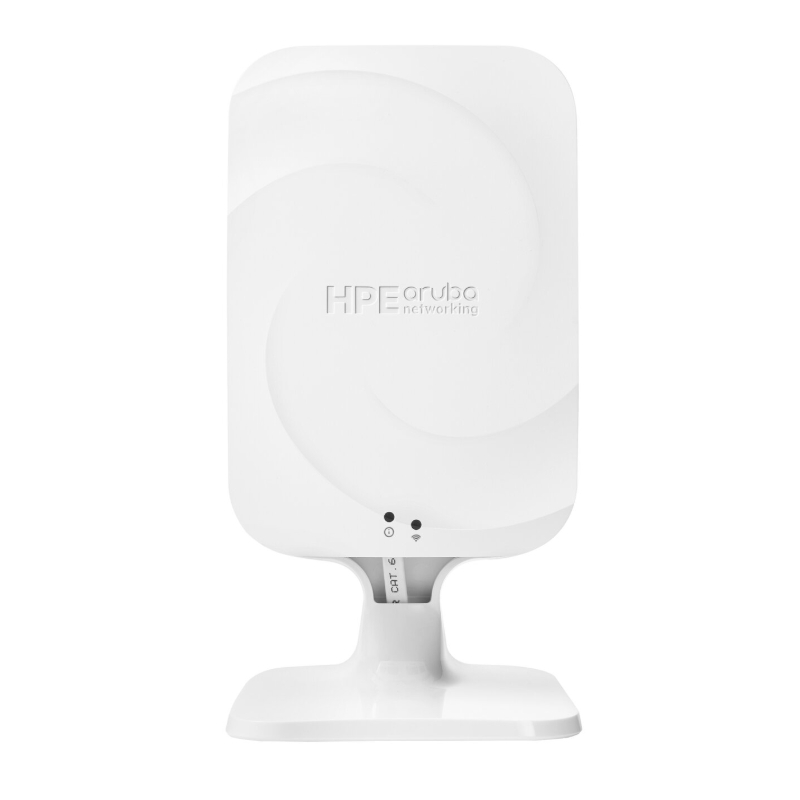
HPE AP-605H Aruba Networking (US) Hospitality ZigBee Bluetooth Wi-Fi 6E Wireless AP. Factory-Sealed New in Original Box (FSB) with 3 Years Warranty
The HPE AP-605H is a high-performance tri-band indoor wireless access point engineered for modern enterprise networking environments. It delivers ultra-fast combined wireless throughput of up to 3.6 Gbps by utilizing advanced IEEE 802.11 standards across 2.4 GHz, 5 GHz, and 6 GHz frequency bands. Built with internal antenna architecture and enhanced MU-MIMO capability, this device ensures stable connectivity, reduced latency, and optimized traffic handling in dense user environments. With integrated Bluetooth 5 and IoT-ready Zigbee support, it extends connectivity beyond traditional Wi-Fi use cases, making it suitable for smart offices, hospitality networks, and enterprise-grade deployments. Flexible mounting options such as wall, desktop, and box installation further enhance deployment convenience while maintaining compact efficiency.
The HPE AP-605H Tri Band Indoor Wireless Access Point
The category of enterprise-grade indoor wireless access points built around tri-band architecture and advanced WiFi 6 technology represents a major evolution in modern network infrastructure. Devices such as the HPE AP-605H Tri Band IEEE 802.11 indoor access point are designed to deliver high-capacity connectivity, intelligent traffic handling, and flexible deployment options across a wide range of professional environments. This class of networking hardware integrates multiple radio bands, advanced antenna design, and high-speed Ethernet uplinks to support dense user environments while maintaining stability and performance consistency.
Modern indoor wireless access points in this category are built on a layered networking architecture that integrates multiple wireless standards including IEEE 802.11 a, b, g, n, ac, and ax. This backward compatibility ensures seamless integration into existing infrastructure while enabling future-ready performance enhancements. The inclusion of WiFi 6 capabilities introduces improved modulation techniques, higher spectral efficiency, and reduced latency for connected devices.
The tri-band structure typically includes 2.4 GHz, 5 GHz, and 6 GHz frequencies, allowing dynamic traffic distribution across different radio channels. This enables devices to reduce congestion and optimize throughput depending on environmental conditions. In dense enterprise environments such as hotels, office floors, campuses, and retail deployments, this capability becomes essential for maintaining uninterrupted connectivity.
The utilization of three distinct frequency bands provides a significant advantage in wireless network performance. The 2.4 GHz band is known for its long-range coverage and strong penetration through walls and obstacles, making it suitable for legacy devices and broader coverage zones. The 5 GHz band offers higher data rates with reduced interference, making it ideal for bandwidth-intensive applications. The 6 GHz band introduces an expanded spectrum that significantly reduces congestion and supports ultra-low latency communication.
In environments where multiple access points operate simultaneously, intelligent band steering becomes crucial. Devices in this category dynamically allocate client devices to the most efficient band based on signal strength, device capability, and current network load. This ensures that high-demand applications such as video conferencing, cloud computing, and real-time data processing maintain optimal performance.
Wireless access points designed under this category are capable of reaching multi-gigabit aggregate throughput levels, often up to 3.60 Gbit/s depending on configuration and environmental conditions. This is achieved through advanced MIMO technology, channel bonding, and efficient modulation schemes. Multiple spatial streams enable simultaneous data transmission and reception, reducing bottlenecks in high-density environments.
The combination of WiFi 6 enhancements and tri-band operation allows these access points to handle significantly more simultaneous connections compared to previous generation devices. This is particularly beneficial in environments where hundreds of users or IoT devices are connected concurrently, such as smart buildings or enterprise campuses.
Multiple Input Multiple Output technology plays a central role in the performance capabilities of modern wireless access points. By utilizing multiple antennas for both transmission and reception, the system can send and receive multiple data streams simultaneously. This improves overall network efficiency and increases total throughput without requiring additional spectrum.
Advanced beamforming techniques further enhance MIMO performance by directing wireless signals toward specific client devices rather than broadcasting uniformly in all directions. This results in stronger signal strength, reduced interference, and improved connection stability across a variety of device types and usage scenarios.
Enterprise wireless access points in this category are equipped with multiple network interfaces, including RJ-45 ports supporting both Gigabit Ethernet and 2.5 Gigabit Ethernet standards. These high-speed wired connections ensure that the wireless backbone is not limited by uplink constraints. Instead, the access point can fully utilize its wireless capacity without experiencing bottlenecks at the wired interface level.
Multiple network ports also provide flexibility for network segmentation, daisy-chaining, or redundancy configurations. In complex deployments, administrators can design layered network topologies that improve resilience and ensure continuous operation even in case of partial network failure.
Power over Ethernet capability simplifies installation by allowing both data and electrical power to be delivered through a single Ethernet cable. This eliminates the need for separate power adapters and reduces installation complexity, especially in large-scale deployments. Devices in this category typically support efficient power consumption levels while maintaining high performance output.
This feature is particularly beneficial in environments where ceiling or wall-mounted installations are required. It enables deployment in locations without direct access to power outlets, providing greater flexibility in network design and placement strategy.
Integrated Bluetooth 5 functionality extends the capabilities of these access points beyond traditional WiFi connectivity. This enables support for IoT devices, location-based services, and proximity detection applications. Bluetooth integration also supports advanced enterprise use cases such as asset tracking, indoor navigation, and device provisioning.
The combination of Bluetooth and WiFi within a single device reduces infrastructure complexity while expanding the range of supported applications. This convergence of technologies is particularly valuable in smart building environments where multiple communication protocols must operate in harmony.
Devices in this category are engineered with flexible form factors that support wall mounting, desktop placement, and box mount installation. This adaptability ensures compatibility with a wide range of architectural environments and deployment requirements. The compact internal design allows for discreet installation while maintaining high thermal efficiency and signal performance.
The physical structure is designed to support both aesthetic integration and functional performance. Ventilation, heat dissipation, and antenna placement are optimized to ensure consistent operation even under heavy network load conditions.
Wireless access points of this type are widely used in enterprise environments such as corporate offices, educational institutions, healthcare facilities, hospitality venues, and retail spaces. Each environment presents unique connectivity challenges that require adaptable and scalable wireless infrastructure.
In office environments, high-density user connectivity is a primary requirement. These access points support seamless roaming, ensuring uninterrupted communication as users move between different areas. In educational institutions, large-scale device connectivity is essential for digital learning platforms and online collaboration tools.
Healthcare environments require secure and reliable wireless communication for medical devices, patient monitoring systems, and administrative networks. The stability and security features of this category of access points make them suitable for such critical applications.
Security is a fundamental component of enterprise wireless infrastructure. Devices in this category typically incorporate advanced encryption standards, authentication protocols, and access control mechanisms. These ensure that only authorized devices and users can connect to the network.
Role-based access control allows administrators to define user permissions based on identity, device type, or location. This ensures that sensitive network resources are protected while still providing flexibility for different user groups. Additional security layers may include intrusion detection, rogue access point detection, and secure guest networking capabilities.
One of the key advantages of this category of wireless access points is their ability to scale within large network infrastructures. Multiple units can be deployed across a building or campus and managed centrally through network controllers or cloud-based management systems.
This centralized approach simplifies configuration, monitoring, and maintenance. Network administrators can apply updates, adjust settings, and monitor performance metrics across all connected devices from a single interface, improving operational efficiency.
Modern wireless infrastructure increasingly relies on cloud-based management platforms for configuration and monitoring. Devices in this category support remote management capabilities that allow administrators to control network settings from virtually any location.
This enables real-time monitoring of network performance, automated alerts for potential issues, and streamlined firmware updates. Cloud integration also supports advanced analytics that help optimize network performance based on usage patterns.
In high-density environments, wireless interference and signal overlap can significantly impact performance. Devices in this category incorporate advanced interference mitigation techniques that dynamically adjust channel selection and transmission power.
This ensures consistent connectivity even in environments with a large number of overlapping networks. The combination of tri-band operation and intelligent spectrum management allows for optimized performance in challenging wireless conditions.
The evolution of wireless networking continues to move toward higher speeds, lower latency, and increased device density. Access points built on IEEE 802.11 ax standards are designed to accommodate future technological advancements while maintaining compatibility with existing systems.
As digital transformation continues across industries, the demand for reliable, scalable, and high-performance wireless infrastructure will continue to grow. This category of wireless access points represents a foundational component in building next-generation network environments capable of supporting emerging applications and services.


 Contact Us
 Information
 Catalog
 Solid State Drives (SSD)
 Network Switches
 Hard Disk Drives
 HBA & Controllers
 PC & Servers
 PC & Server Memory
 CPU & Processors
 Network Routers
 Power Supplies
 Tape Drives & Libraries
 Network Devices
 Computer & Network Cables