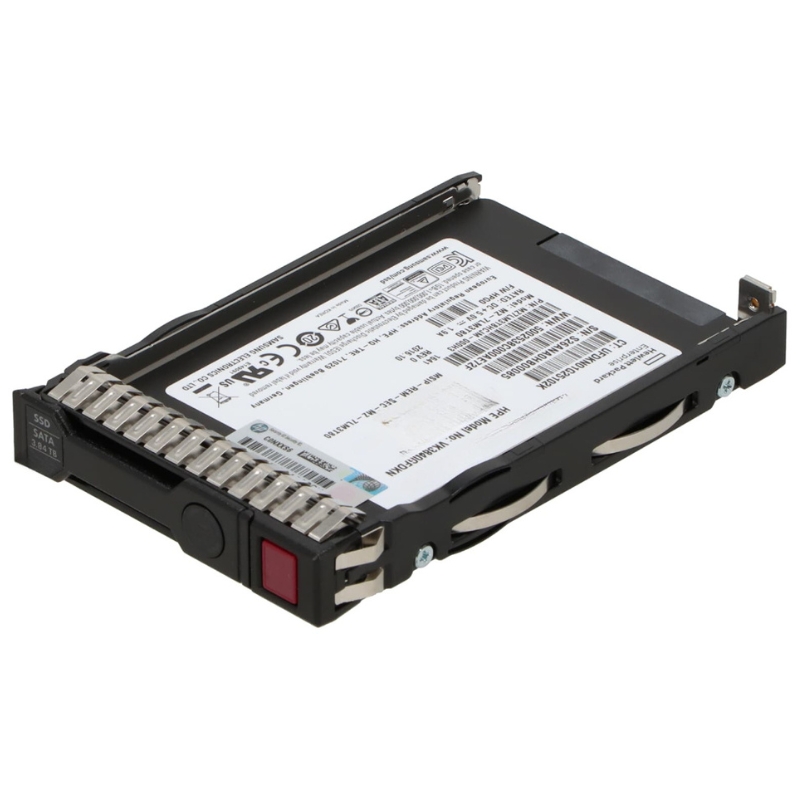
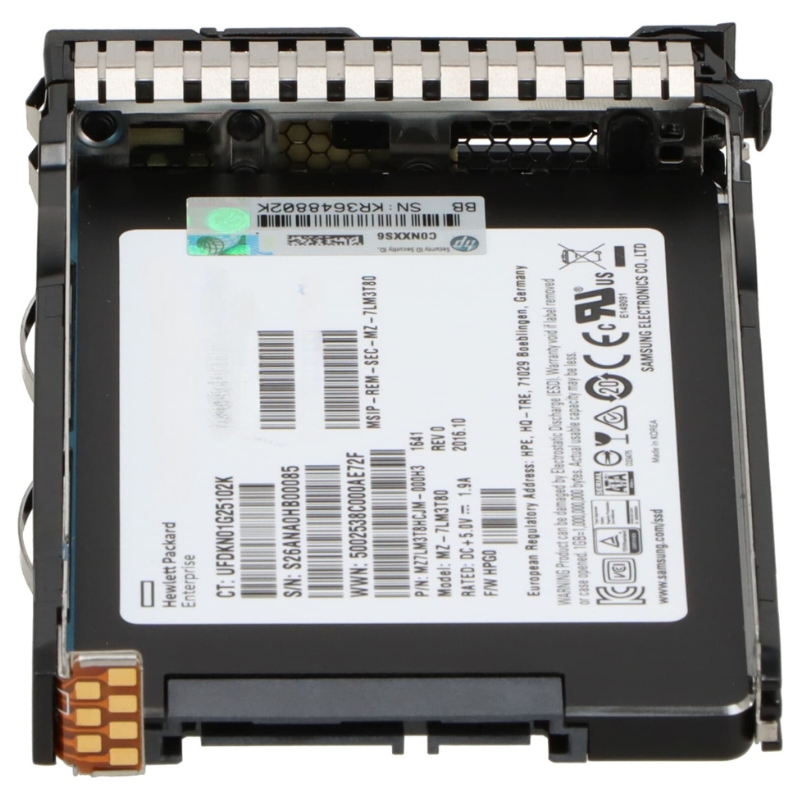
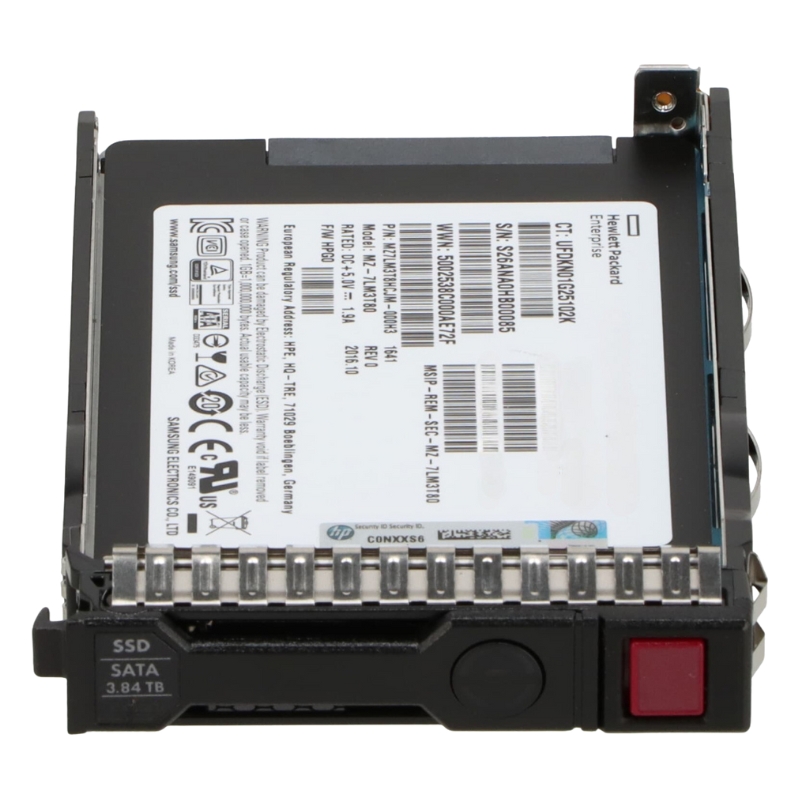
HPE MZ7LM3T8HCJM-000H 3.84TB SATA 6G RI-3 SFF SC SSD — Product Overview
The HPE MZ7LM3T8HCJM-000H 3.84TB SATA Read Intensive SSD is designed for enterprise workloads requiring
reliability, consistent performance, and efficient data handling. With its advanced features and optimized architecture,
this drive is suitable for large-scale deployments where high data integrity and endurance are vital.
Core Specifications
- Manufacturer: HPE
- Part Number: MZ7LM3T8HCJM-000H
- Drive Type: Internal Solid State Drive
- Form Factor: 2.5-inch Small Form Factor (SFF)
- Storage Capacity: 3.84 Terabytes
- Flash Technology: Triple Level Cell (TLC) NAND
- Interface: SATA 6.0 Gb/s
- MTBF (Mean Time Between Failures): 2,000,000 hours
Performance Highlights
Built to deliver consistent speed and smooth operations, this drive ensures faster data handling for both read and
write workloads.
- Random Read IOPS: Up to 99,000
- Random Write IOPS: Up to 18,000
- Designed for: Read-intensive environments
- Data Transfer Rate: Optimized with SATA 6Gbps interface
Security and Reliability
Encryption & Data Protection
- Equipped with 256-Bit AES Encryption to safeguard sensitive information
- End-to-End Data Protection ensures error-free data handling
- Advanced Error Correcting Code (ECC) for improved integrity
Reliability Enhancements
- Flash Cell Care Technology prolongs NAND endurance
- Power-Loss Protection (PLP) maintains data safety during sudden power outages
- Dynamic Thermal Guard Algorithm protects against overheating
Additional Capabilities
- TRIM Support for maintaining peak performance over time
- S.M.A.R.T Monitoring for proactive health tracking
- Optimized for enterprise-scale workloads where read-heavy operations dominate
Enterprise-Grade Endurance
With a strong balance between capacity and durability, this drive suits businesses running demanding databases,
virtualized environments, and high-capacity storage arrays.
Consistent Data Handling
From fast random reads to reliable write operations, the SSD guarantees smooth workloads, even under pressure,
ensuring operational continuity for mission-critical systems
Primary Attributes and Value Proposition
At its core, the HPE MZ7LM3T8HCJM-000H features a high-capacity NAND configuration that delivers reliable storage for read-intensive workloads and mixed-use environments. This drive is purpose-built to:
- Provide dense storage at a lower cost per gigabyte compared to enterprise NVMe alternatives.
- Maintain broad compatibility with legacy and modern HPE servers and storage controllers that support SATA 6Gb/s interface and SFF (small form factor) drive bays.
- Offer strong endurance for its target class of applications—particularly when used in read-intensive or mixed-access scenarios.
- Enable fast boot, application load times, and improved overall system responsiveness versus traditional spinning disks.
Key Specifications
- Capacity: 3.84TB (formatted capacity may vary)
- Interface: SATA 6Gb/s (SATA III)
- Form Factor: SFF (2.5-inch small form factor)
- Drive Type: Enterprise SATA SSD
- Endurance Class: Read-Intensive / Mixed (RI-3 classification)
- Flash Technology: High-density 3D NAND (manufacturer-specific implementation)
- Power & Thermal: Low-power idle states and thermal management suited for rack servers
- Compatibility: Certified for many HPE ProLiant generations and HPE storage arrays (verify model-specific compatibility)
Understanding the RI-3 Endurance Classification
RI-3 denotes a read-intensive endurance tier within HPE's classification system (or the vendor-recommended tiering nomenclature), indicating that the drive is optimized for high read workloads with moderate write activity. This makes it especially suitable for workloads such as:
- Large-scale content delivery systems
- Virtual desktop infrastructure (VDI) boot storms (read-heavy patterns)
- Database read replicas and reporting nodes
- Cold/nearline flash tiers in hybrid storage architectures
Performance Characteristics
While SATA SSDs are bounded by the SATA 6Gb/s interface, they still provide transformative performance improvements over mechanical drives. Expect significantly improved random I/O performance, greatly reduced latency and consistent throughput under read-heavy workloads. Key performance considerations include:
- Random Read / Write IOPS: Strong uplift compared to HDDs—SATA SSDs excel at random reads and smaller block I/O.
- Sequential Throughput: Beneficial for streaming heavy sequential reads, backups and large file access.
- Latency: Consistently lower latency, which improves application responsiveness and reduces queuing delays across multi-drive arrays.
- Consistency: Enterprise-class controllers and firmware manage wear and ensure consistent performance across the drive's usable life.
Real-world benchmarks and expectations
Benchmarks for SATA 6Gb/s drives vary by firmware, controller and system environment. In a well-tuned HPE server, administrators typically observe read latencies measured in low hundreds of microseconds for small-block random reads, while sequential transfers can near the saturated throughput of the SATA link under optimal conditions. Always validate with workload-specific testing to set realistic SLAs and capacity planning assumptions.
Compatibility & Integration
Compatibility is critical when selecting drives for enterprise infrastructure. The MZ7LM3T8HCJM-000H has been engineered to integrate smoothly into HPE ecosystems. Points to verify before procurement:
- Server model and controller compatibility (consult HPE QuickSpecs and support matrices).
- Drive carrier/backplane fitment for SFF bays and hot-swap capability.
- BIOS/firmware requirements for older hosts—update host firmware where recommended to ensure optimal behavior.
- RAID controller support and recommended RAID levels for SSD arrays (some controllers may impose stripe or queue considerations for SSDs).
Firmware and maintenance
For long-term stability and performance, maintain current firmware for both the drives and host systems. HPE frequently releases firmware updates that improve compatibility, security and performance. Use HPE's support resources and management tools (such as HPE Smart Storage Administrator, iLO, or the appropriate storage management suite) to monitor drive health, update firmware and track endurance metrics.
Use Cases and Deployment Scenarios
This drive category is tailored to a wide spectrum of enterprise use cases where higher-than-HDD performance and greater capacity per drive are required without migrating to higher-cost NVMe solutions. Common deployment scenarios include:
- Read-heavy application tiers: Web servers, content caching, CDN edge nodes and analytics reporting servers.
- Hybrid storage pools: Use RI-class SATA SSDs in a flash tier for frequently accessed datasets while keeping colder data on HDD tiers.
- VDI and desktop boot acceleration: Improve login and boot times for virtual desktops by placing OS images on SSD tiers.
- Database read replicas: Improve read query performance and reduce load on primary database instances.
- Backup target and acceleration: Use high-capacity SSDs to reduce backup window times for random-access restore operations.
Edge & Remote Office deployments
Because of the SFF form factor and power-efficient design, these drives are also well suited for remote sites, distributed edge nodes and compact servers where space is at a premium but reliable, fast storage remains necessary. They offer a favorable balance of capacity, performance and thermal profile.
Lifecycle, Durability and Endurance Management
Enterprise SSD selection requires a clear view of drive endurance and lifecycle expectations. While the RI-3 classification implies lower write endurance than data center mixed or write-intensive SSDs, practical longevity depends on real-world write amplification, workload patterns and capacity provisioning.
- Write endurance: Sufficient for read-heavy workloads and many mixed-use cases but validate for heavy write scenarios.
- Monitoring: Employ S.M.A.R.T. metrics and HPE storage health tools to track remaining life, uncorrectable sectors and media wear indicators.
- Overprovisioning: Consider firmware-level or controller-level overprovisioning to enhance endurance and maintain consistent performance.
- RAID strategy: Use RAID configurations that protect against drive failures while considering rebuild impact on SSD endurance and array performance.
End-of-life and replacement planning
Plan drive refresh cycles based on telemetry and application SLAs rather than fixed calendar rules alone. Drives used in mixed workloads may require earlier replacement than drives predominantly used for reads. Maintain spare inventory and validate replacement part numbers against HPE compatibility lists to streamline field replacements.
Security Features & Data Protection
Modern enterprise SSDs incorporate multiple layers of data protection and security functions. For customers with regulatory or data security requirements, verify that your chosen SKU supports:
- Data-at-rest encryption: Self-encrypting drive (SED) capability may be included or available as an alternate SKU; check specifications for TCG Opal or other supported standards.
- Secure erase functions: Rapid cryptographic erase options for secure decommissioning of drives.
- Power-loss protection: Drive firmware and power-loss mitigation features to protect in-flight data, where applicable.
Compliance and auditing
For regulated industries, confirm that the storage deployment meets your compliance needs (data handling, encryption standards, audit logging). Combining drive-level encryption with storage array security policies and HPE management tools creates layered protection for sensitive information.
Procurement Guidance and SKU Variations
When procuring HPE drives, pay attention to the exact part number (e.g., MZ7LM3T8HCJM-000H), firmware bundle, and whether the drive is sold as an HPE-branded module or as an OEM-compatible component. Consider the following procurement tips:
- Buy from authorized HPE resellers or distributors to ensure warranty coverage and firmware support.
- Confirm whether the drive is bundled with an HPE carrier/backplane kit or sold as a bare drive.
- Check warranty terms, on-site replacement options and RMA procedures to reduce downtime risk.
- Ask about bulk purchase pricing and lifecycle support offerings if deploying at scale.
Common SKU variants and what they mean
HPE and OEMs often produce multiple variants of the same capacity—different endurance ratings, encryption options, temperature tolerances, or firmware versions. Match SKU attributes to your workload rather than purchasing purely on capacity—doing so mitigates unexpected performance or endurance mismatches.
Best Practices for Deployment and Optimization
- Right-size the tier: Use RI-class SATA SSDs for read-heavy datasets and avoid placing heavy write logs or temp workloads unless monitored.
- Update firmware: Apply validated firmware updates to both drives and host controllers during maintenance windows.
- Enable monitoring: Integrate drive telemetry into centralized monitoring for proactive alerts.
- Design for redundancy: Use appropriate RAID levels and hot-spare configurations with SSD-aware rebuild strategies.
- Test performance under load: Validate real-world I/O patterns with representative benchmarks before moving production data.
Tuning suggestions
Work with your HPE systems engineer to fine-tune RAID stripe sizes, cache policies and host-side queue depths for SATA SSDs. Tuning parameters that benefit HDDs may not be ideal for SSDs; revisiting OS and storage stack configuration is essential to fully realize flash advantages.
Comparison with Other Drive Classes
Understanding where the MZ7LM3T8HCJM-000H fits in the broader storage landscape helps make informed decisions:
- vs. HDDs: SSDs drastically reduce latency, increase IOPS and consume less power; SATA SSDs offer a simpler migration path for existing SATA backplanes.
- vs. NVMe SSDs: NVMe generally outperforms SATA in throughput and latency but at higher cost. SATA RI-class SSDs are cost-effective when NVMe performance is not strictly necessary.
- vs. Write-Intensive SSDs: Write-intensive (WI) SSDs are designed for heavy-write databases and logging. RI-class SSDs are appropriate where reads dominate and writes are moderate.





 Contact Us
 Information
 Catalog
 Solid State Drives (SSD)
 Network Switches
 Hard Disk Drives
 HBA & Controllers
 PC & Servers
 PC & Server Memory
 CPU & Processors
 Network Routers
 Power Supplies
 Tape Drives & Libraries
 Network Devices
 Computer & Network Cables