(7% discount is applied at checkout)
Cart is empty
Your go-to destination for cutting-edge server products


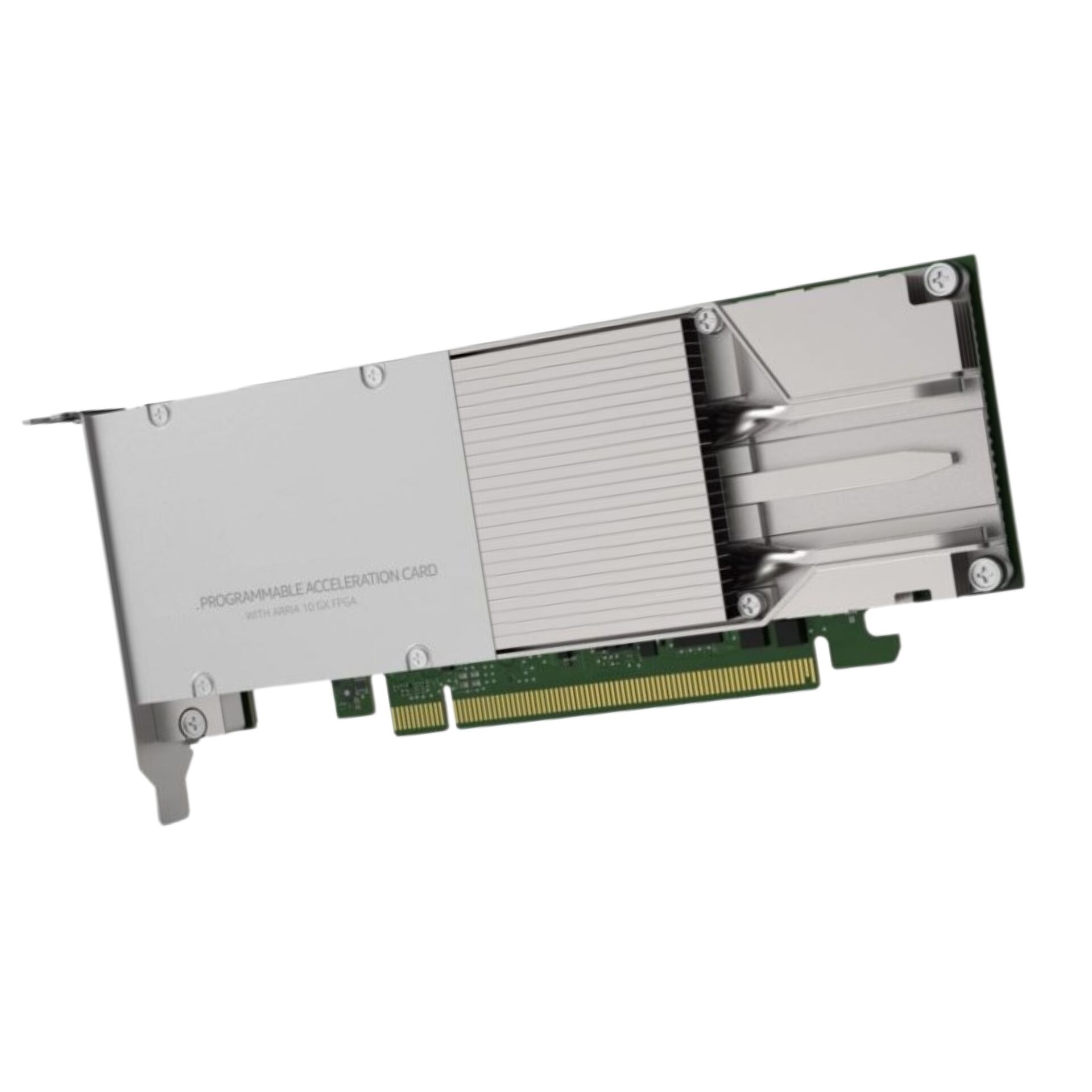
HPE P02425-001 Intel Arria 10 GX FPGA Accelerator Expansion Module. Factory-Sealed New in Original Box (FSB) with 3 Years Warranty
The HPE P02425-001 Intel Arria 10 GX FPGA Accelerator Expansion Module is engineered to deliver advanced computational acceleration for enterprise-grade notebooks. Designed for seamless integration, this module enhances performance and efficiency across demanding workloads.
Connectivity
The HPE P02425-001 Intel Arria 10 GX FPGA Accelerator Expansion Module represents a specialized hardware solution designed to accelerate workloads in enterprise environments. Built on Intel’s Arria 10 GX FPGA technology, this expansion module integrates seamlessly into HPE servers, enabling organizations to harness programmable logic for high-performance computing, data analytics, and workload-specific acceleration. Its architecture is optimized for adaptability, allowing enterprises to tailor acceleration to unique application demands while maintaining compatibility with HPE’s enterprise ecosystem.
The module is powered by Intel Arria 10 GX FPGA technology, which delivers a balance of performance, power efficiency, and flexibility. The FPGA fabric provides reconfigurable logic blocks, DSP capabilities, and high-speed transceivers, enabling parallel processing and custom acceleration. This architecture is particularly suited for workloads that require deterministic performance, low latency, and adaptability to evolving algorithms.
Designed specifically for HPE ProLiant and Apollo systems, the P02425-001 expansion module integrates into PCIe slots, offering plug-and-play compatibility. This integration ensures that enterprises can deploy FPGA acceleration without extensive modifications to existing infrastructure. The module leverages HPE’s management tools, allowing administrators to monitor performance, power consumption, and workload distribution seamlessly.
The expansion module utilizes PCIe Gen3 connectivity, ensuring high-bandwidth communication between the FPGA and host system. This connectivity is critical for workloads such as real-time analytics, encryption, and machine learning inference, where rapid data transfer between CPU and FPGA accelerators is essential.
The module supports onboard DDR4 memory, providing high-speed data buffering and storage for FPGA workloads. This memory architecture enhances throughput and ensures that the FPGA can handle large datasets efficiently, making it suitable for applications in financial services, genomics, and artificial intelligence.
One of the defining features of FPGA acceleration is its ability to deliver deterministic low-latency processing. The HPE P02425-001 leverages this capability to accelerate workloads such as high-frequency trading, real-time video transcoding, and cybersecurity threat detection. By bypassing traditional CPU bottlenecks, the module ensures that latency-sensitive applications achieve optimal performance.
The FPGA fabric supports massive parallelism, allowing multiple tasks to be executed simultaneously. This parallelism is particularly beneficial for workloads involving matrix computations, deep learning inference, and signal processing. Enterprises can scale performance by deploying multiple expansion modules across servers, creating a distributed acceleration environment.
Compared to GPU-based acceleration, FPGA modules often deliver superior energy efficiency for specific workloads. The HPE P02425-001 balances performance with power consumption, enabling enterprises to reduce operational costs while maintaining high throughput. This efficiency is critical in data centers where energy budgets and cooling requirements are significant considerations.
Unlike fixed-function accelerators, FPGAs can be reprogrammed to adapt to evolving workloads. The P02425-001 allows enterprises to deploy custom logic tailored to applications such as encryption algorithms, compression techniques, or proprietary machine learning models. This adaptability ensures long-term relevance and investment protection.
In AI and ML workloads, the expansion module accelerates inference tasks by implementing custom neural network architectures directly in FPGA logic. This approach reduces latency and enhances throughput compared to CPU-only execution. Enterprises deploying recommendation engines, fraud detection systems, or natural language processing benefit from FPGA acceleration.
Financial institutions leverage the module for high-frequency trading, risk analysis, and fraud detection. The deterministic low-latency processing ensures that trading algorithms execute with minimal delay, providing competitive advantages in markets where microseconds matter. Additionally, FPGA acceleration enhances encryption and decryption processes, safeguarding sensitive financial data.
Genomics research requires processing massive datasets with complex algorithms. The HPE P02425-001 accelerates sequence alignment, variant calling, and pattern recognition, reducing time-to-insight in precision medicine. Healthcare institutions benefit from faster analytics, enabling improved patient outcomes and research efficiency.
Media companies utilize FPGA acceleration for real-time video transcoding, compression, and streaming optimization. The module’s parallelism ensures that multiple streams can be processed simultaneously, reducing latency and improving viewer experiences. This capability is particularly valuable in live broadcasting and cloud-based media delivery.
The P02425-001 is compatible with HPE ProLiant DL and Apollo series servers, ensuring broad deployment across enterprise environments. Compatibility lists include models optimized for high-performance computing, cloud workloads, and storage-intensive applications. This integration ensures that enterprises can deploy FPGA acceleration without disrupting existing infrastructure.
Intel provides development tools such as Quartus Prime and OpenCL SDK, enabling developers to design and deploy FPGA workloads efficiently. HPE complements these tools with management software, ensuring that administrators can monitor and optimize FPGA utilization. This ecosystem integration simplifies deployment and enhances productivity.
The expansion module supports major operating systems, including Linux and Windows Server, ensuring compatibility with enterprise environments. Driver support and APIs enable seamless integration with applications, reducing development overhead and accelerating time-to-deployment.
Enterprises deploying hybrid cloud environments benefit from FPGA acceleration in virtualized workloads. The module integrates with virtualization platforms, enabling workload migration between on-premises and cloud environments while maintaining acceleration capabilities. This flexibility supports modern enterprise strategies focused on scalability and agility.
Onboard DDR4 memory provides high-speed buffering and storage for FPGA workloads. Memory capacity ensures that large datasets can be processed efficiently, supporting applications in AI, genomics, and financial analytics.
PCIe Gen3 connectivity ensures high-bandwidth communication between FPGA and host system. Additional connectivity options may include support for Ethernet interfaces, enabling direct network acceleration for workloads such as packet processing and network function virtualization.
The expansion module is designed for standard PCIe slots, ensuring compatibility with HPE servers. Its form factor balances performance with space efficiency, enabling deployment in dense data center environments.
Enterprises deploy the module in data centers to accelerate workloads such as AI inference, financial analytics, and cybersecurity. Its scalability allows multiple modules to be deployed across servers, creating a distributed acceleration environment that enhances overall data center performance.
In edge environments, the module accelerates workloads requiring low latency and real-time processing. Applications such as IoT analytics, industrial automation, and smart city infrastructure benefit from FPGA acceleration, ensuring rapid insights and responses at the edge.
Hybrid cloud strategies leverage FPGA acceleration to optimize workloads across on-premises and cloud environments. The module’s compatibility with virtualization platforms ensures seamless workload migration, supporting enterprise agility and scalability.
Research institutions utilize FPGA acceleration for computationally intensive workloads such as simulations, modeling, and data analytics. The module’s adaptability ensures that researchers can implement custom algorithms, accelerating innovation and discovery.
The FPGA’s reprogrammable nature ensures that enterprises can adapt to evolving workloads without hardware replacement. This capability protects investments and ensures long-term relevance in rapidly changing technology landscapes.


 Contact Us
 Information
 Catalog
 Solid State Drives (SSD)
 Network Switches
 Hard Disk Drives
 HBA & Controllers
 PC & Servers
 PC & Server Memory
 CPU & Processors
 Network Routers
 Power Supplies
 Tape Drives & Libraries
 Network Devices
 Computer & Network Cables