(7% discount is applied at checkout)
Cart is empty
Your go-to destination for cutting-edge server products
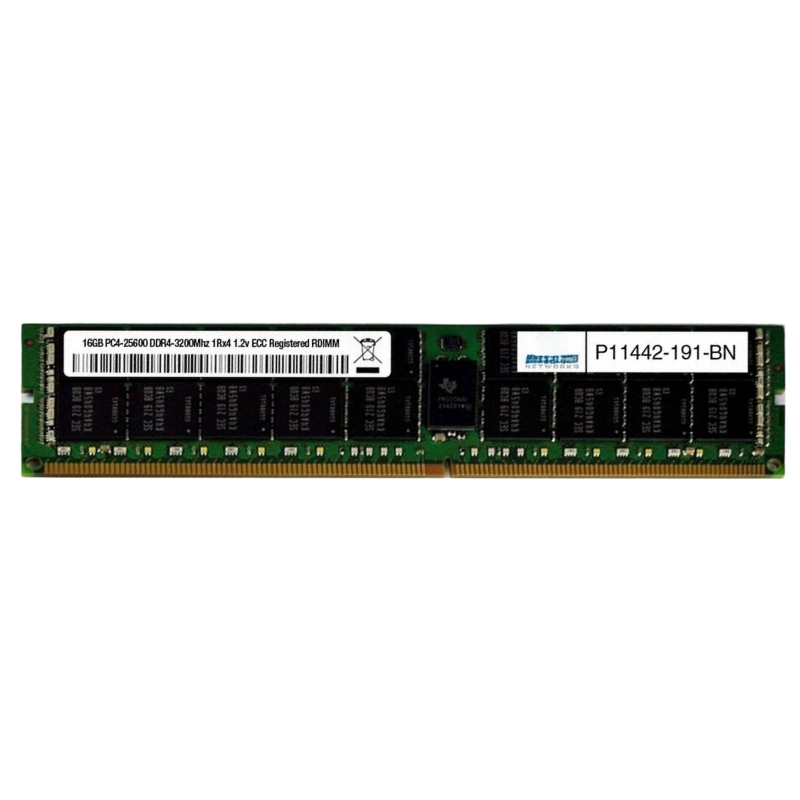


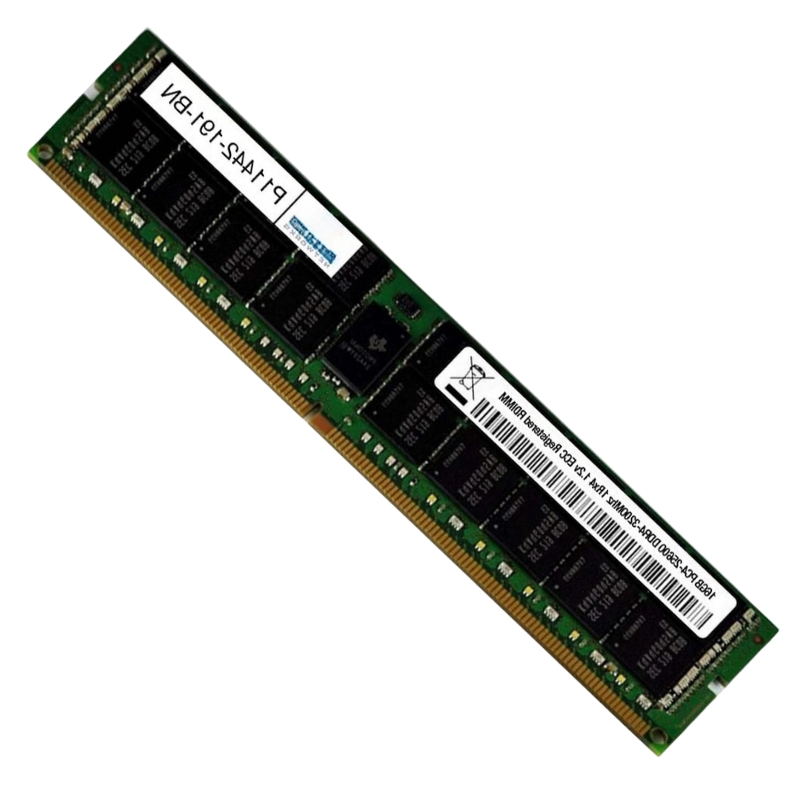
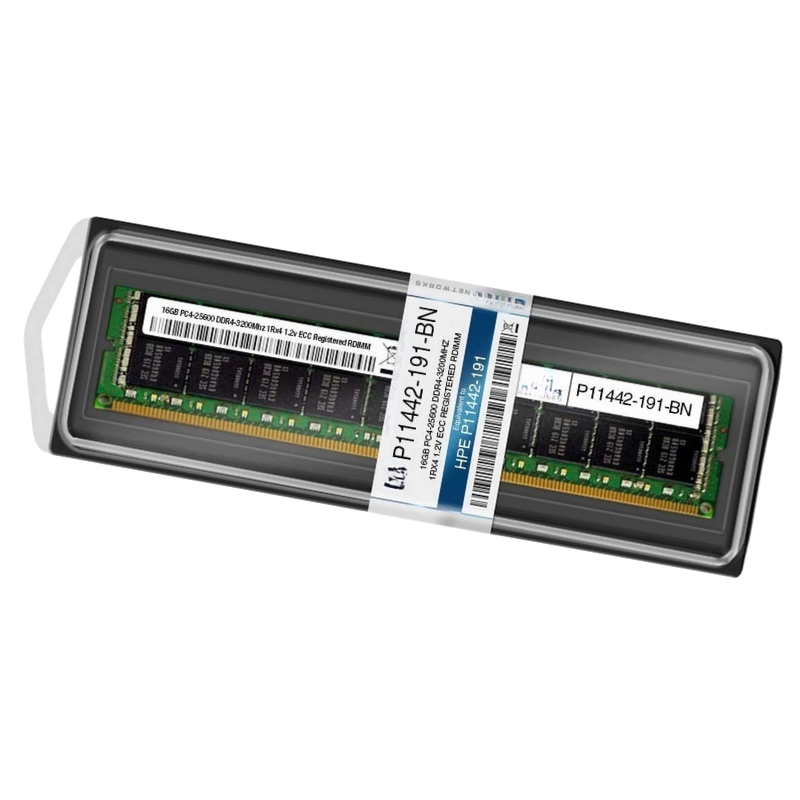
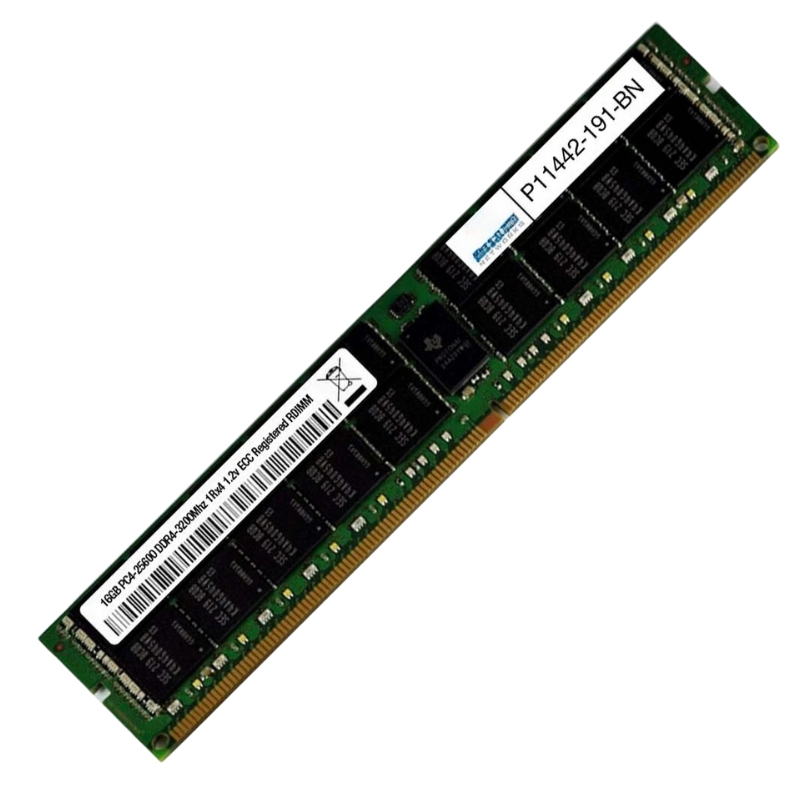
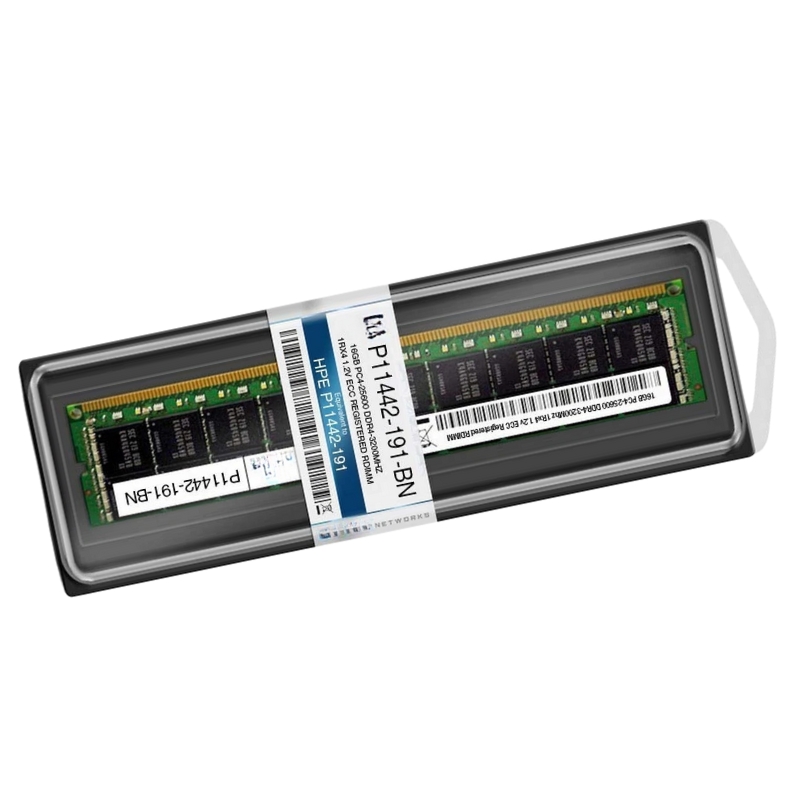
HPE P11442-191 16GB DDR4 3200MHz Cl22 288 Pin PC4-25600 Single Rank X4 ECC Registered Memory Module. New (System) Pull with 1 year replacement warranty
The HPE P11442-191 is a server-grade 16GB DDR4-3200 RDIMM engineered for enterprise workloads where performance, stability, and data integrity are non-negotiable. Built around a 288-pin dual in-line memory form factor and tuned to the PC4-25600 bandwidth class, this module pairs JEDEC-compliant DDR4 architecture with Hewlett Packard Enterprise validation to deliver predictable throughput, low latency relative to its class, and robust RAS (Reliability, Availability, Serviceability) features. With ECC and register buffering, it sustains high memory channel utilization while protecting against soft errors, making it a dependable choice for virtualization clusters, database servers, software-defined storage, and cloud-native application hosts.
Registered DIMMs reduce the electrical load on a server’s memory controller by inserting a register between the DRAM and the controller for command/address signals. This buffering allows more DIMMs per channel and improved signal integrity at high speeds such as 3200 MT/s. When combined with ECC, RDIMMs provide a foundation for round-the-clock reliability in mission-critical environments. The P11442-191 module leverages these characteristics to maintain consistency across variable workloads, helping meet service-level objectives without sacrificing capacity or timing stability.
Memory Architecture and Performance
This component is a validated and certified upgrade specifically engineered for select HPE ProLiant Gen10 Plus servers, ensuring flawless integration and optimal performance.
This is a system-specific memory upgrade engineered to expand the capabilities of compatible HPE server infrastructures, from virtualized environments to data-heavy analytics.
PC4-25600 denotes an approximate peak theoretical bandwidth of 25.6 GB/s per module when operating at 3200 MT/s across a 64-bit data bus (plus additional bits for ECC). While real-world throughput depends on channel counts, memory interleaving, and workload access patterns, the 3200 data rate ensures high sustained bandwidth for in-memory databases, analytics engines, and virtualization hypervisors that thrive on parallel memory access.
CAS latency (CL) describes the number of clock cycles between a read command and the data availability. CL22 at 3200 MT/s aligns with mainstream server-validated DDR4 timing, balancing frequency and stability under multi-DIMM channel populations. In practical terms, CL22 at 3200 outperforms lower-frequency modules with tighter timings due to the higher effective data rate. For latency-sensitive microservices and transaction processing, this balance sustains low tail latency while maximizing throughput.
Single Rank indicates the memory controller addresses one 64-bit data rank per module (plus ECC bits). Fewer ranks can reduce rank-to-rank switching overhead and help achieve rated speeds with multiple DIMMs installed. The x4 device width enhances ECC robustness: x4-based RDIMMs allow advanced error correction schemes to isolate failures at the nibble level in certain server architectures, improving fault containment compared with x8 devices under specific failure modes.
Optimal performance emerges from populating memory in pairs or sets aligned to the number of channels on the CPU. Many HPE ProLiant platforms offer 6 or 8 channels per CPU (depending on generation). Deploying identical 16GB RDIMMs across channels enables symmetric interleaving, which improves bandwidth and reduces latency jitter. The P11442-191 module’s 3200 MT/s speed lets channels saturate faster, especially in NUMA-aware applications that localize memory to each socket.
ECC detects and corrects single-bit errors and detects (but does not always correct) multi-bit errors, preventing silent data corruption caused by cosmic rays, electrical noise, or marginal signal conditions. For workloads such as financial computation, medical imaging, scientific modeling, and distributed caches, ECC reduces crash rates and preserves database integrity during long uptimes.
The register on RDIMMs stabilizes command and address signal timing. This reduces the load seen by the memory controller, allowing more modules to populate each channel without dropping speed tiers unnecessarily. Stability at 3200 MT/s is crucial for dense memory configurations under thermal stress and vibration in data center racks.
Many enterprise RDIMMs integrate a Temperature Sensor on DIMM (TSOD) accessible via SMBus. HPE iLO and system firmware can read TSOD values to manage fan curves and protect modules from overheating. When temperatures rise, systems can adjust airflow or reduce memory frequency to maintain reliability. The P11442-191 operates efficiently at 1.2V, lowering thermal output compared with legacy DDR3 while offering higher performance.
The P11442-191 is intended for HPE systems that support DDR4 3200 RDIMM modules, including many ProLiant rack and tower servers from the DDR4 era. Platform support varies by CPU generation and BIOS/UEFI version. Matching RDIMM type (registered) and speed class (3200/PC4-25600) across all installed modules ensures best results. Mixing RDIMM with LRDIMM within the same system is not supported; RDIMM must be used consistently per platform guidelines.
If combining 16GB DDR4-3200 RDIMMs with lower-speed DDR4 modules, the memory controller typically trains to the lowest common speed and loosest timings detected. For consistent latency and throughput, maintain a uniform set of P11442-191 modules across all channels.
Ensure the server runs a firmware version that recognizes DDR4-3200 RDIMMs and supports the installed CPU microcode. Enabling memory interleaving, NUMA optimization, and ECC scrubbing schedules can further improve stability and predictability for long-running workloads.
Hypervisors such as VMware ESXi, Microsoft Hyper-V, and KVM prioritize memory stability and predictable latency. A 16GB RDIMM capacity point is ideal for granular scaling of per-host memory pools. Deploying banks of P11442-191 modules lets administrators tune vCPU-to-RAM ratios, reduce swapping, and maintain high consolidation ratios while preserving performance isolation between tenants.
Transactional databases (OLTP) and analytical workloads (OLAP) both benefit from high memory bandwidth and ECC reliability. Buffer caches, query planners, and columnar engines leverage fast DDR4-3200 to keep hot data resident. Single rank organization helps sustain 3200 MT/s at higher population counts, a practical advantage for nodes that must scale capacity without stepping down to lower speed bins.
Storage platforms—whether object, block, or distributed file—rely on RAM for metadata caching, deduplication tables, and write-back buffers. ECC RDIMMs guard against silent data corruption cascading into storage layers. The P11442-191’s bandwidth and latency profile keeps I/O front-end services responsive, reducing tail latency during consistency checks and rebuilds.
At the edge, environmental variability and limited on-site support increase the value of server-grade memory. With ECC and robust timing at 3200 MT/s, the module supports container orchestration, local AI inference caches, and retail POS back-ends where service continuity matters.
DDR4 modules use a single notch keyed differently than DDR3, preventing mis-insertion. The 288-pin edge connector maximizes contact density and signal integrity. Installation should be perpendicular with even pressure on the latches to avoid flexing the PCB.
Running at 1.2V, DDR4 improves power efficiency compared with DDR3’s 1.5V/1.35V variants. Actual power draw depends on activity factor, refresh rates, and temperature. Data center operators can estimate per-DIMM power to fine-tune rack-level power budgets. Lower per-DIMM consumption helps increase memory capacity per rack within power and cooling constraints.
RDIMMs (Registered) and LRDIMMs (Load-Reduced) both buffer command signaling, but LRDIMMs additionally buffer data lines to allow higher module density. RDIMMs typically offer lower latency and cost per GB at moderate capacities, making 16GB P11442-191 modules a strong fit for mainstream servers requiring balanced performance without the overhead of load-reduction on the data bus.
Single rank modules can deliver consistent timing at higher channel populations, but may have fewer parallel banks than dual-rank modules. When multiple 16GB single-rank modules populate all channels, bank-level parallelism remains high thanks to multi-channel interleaving, preserving bandwidth efficiency for multithreaded workloads.
In dual-socket servers, place equal numbers of P11442-191 RDIMMs on each CPU to maintain balanced NUMA nodes. Pin memory-intensive services to local NUMA nodes to minimize remote memory access. Many modern operating systems and orchestrators support NUMA hints and automatic placement to take advantage of this layout.
Enable background scrubbing to proactively read and correct memory contents. Demand scrubbing corrects errors when detected during normal operation, while patrol scrubbing periodically scans all addresses. Together with ECC, these features reduce uncorrectable error risk over long uptimes.
Homogeneous memory configurations simplify fleet management. Using the same 16GB DDR4-3200 RDIMM across nodes ensures predictable performance and reduces spare-part SKUs. Automation tools can rely on consistent hardware characteristics to provision images and set performance baselines.
Kubernetes and similar orchestrators benefit from deterministic node memory. With a bank of P11442-191 modules, resource quotas map cleanly to physical capacity, enabling higher pod density without memory ballooning. ECC confines transient errors from affecting containerized microservices sharing the same host.
Virtual desktop infrastructures and app streaming platforms thrive on memory capacity and throughput. A 3200 MT/s RDIMM alleviates contention during login storms and profile synchronization. The 16GB increment allows precise scaling to match user concurrency and profile sizes.
Follow the server’s memory slot color coding and numbering. Typically, primary slots per channel populate first to enable dual-channel or hexa-/octa-channel modes at full speed. Consult chassis-specific labels or maintenance guides to map channels A–H correctly for symmetric interleaving.
After installation, update system ROM and iLO firmware. Run built-in memory diagnostics or burn-in tests to validate stability at 3200 MT/s. Monitor ECC event logs; correctable errors should remain rare and evenly distributed. A spike in correctable errors on a single module may warrant reseating or replacement.
HPE-validated modules are tested for compatibility with HPE firmware, thermal envelopes, and mechanical tolerances. Tight BOM control reduces variance between production lots, aiding predictable long-term behavior. Combined with platform security features and signed firmware, the memory stack becomes a dependable foundation for regulated industries.
While DIMMs themselves do not encrypt data, their reliability supports higher-level encryption solutions (such as OS disk encryption, database TDE, and application-layer crypto) by keeping key material and buffers error-free under load. ECC reduces the chance that cryptographic operations will fail or, worse, silently corrupt, safeguarding sensitive workloads.
Choosing 16GB steps offers flexibility for growth. Organizations can start with a balanced set across channels and scale to higher total capacity while maintaining 3200 MT/s. Single rank x4 modules often preserve top speed with more DIMMs per channel compared with heavier dual-rank parts, letting administrators expand without a speed drop.
Latency-sensitive services (e.g., trading gateways, real-time control) benefit from fewer, faster ranks across many channels, making 16GB single rank RDIMMs attractive. Throughput-bound analytics can also profit from higher rank counts for interleaving; however, with many channels populated by P11442-191, the aggregate bank parallelism remains substantial, maintaining a strong throughput profile.
Error-Correcting Code: A method for detecting and correcting single-bit memory errors and detecting certain multi-bit errors, critical for server reliability.
Registered DIMM: A buffered memory module that places a register (buffer) on the address/command lines to reduce load and improve scalability.
Bandwidth rating signifying approximately 25.6 GB/s theoretical bandwidth for DDR4-3200 modules.
The number of memory clock cycles between a read command and data availability; lower values mean fewer cycles, but higher clock speeds can offset higher CL numerically.
Operating at the DDR4 standard voltage lowers per-DIMM power draw, allowing a higher memory footprint per system within the same power envelope. For large clusters, this translates into meaningful OPEX reductions without compromising performance.
Predictable heat output simplifies cooling design. With adequate front-to-back airflow and proactive temperature monitoring, high-density nodes can maintain top speed bins even during sustained memory-intensive workloads.
Keep module type, speed, and capacity identical per channel set. Uniform populations enable the memory controller to use optimal interleaving and maintain 3200 MT/s with minimal training retries during boot.
Use iLO telemetry and OS tools to monitor correctable error counts, TSOD temperatures, and memory bandwidth utilization. Early visibility helps schedule maintenance before user-visible impact occurs.
Standardizing on a single 16GB DDR4-3200 RDIMM SKU simplifies spares management, accelerates replacement workflows, and reduces risk during emergency maintenance. With consistent specifications—CL22, single rank x4, ECC registered—performance baselines remain stable across nodes and time.
As long as the platform supports 3200-class RDIMM at 1.2V, integration is straightforward. In mixed environments, ensure that BIOS policies prevent speed regressions due to a small subset of slower DIMMs. Phased upgrades using P11442-191 modules can gradually lift cluster performance while keeping capital spending predictable.
The module’s x4 organization enhances fault isolation capability at the DRAM device level. With ECC and parity on control signals, the memory subsystem maintains integrity even under adverse environmental conditions.
Enterprise-class RDIMMs undergo tighter screening for signal integrity, thermal performance, and long-term reliability. This discipline ensures consistent frequency margins at 3200 MT/s, reducing the risk of intermittent timing fallout over years of service.
Tool-less latch mechanisms on HPE servers enable fast replacement. Clear labeling and slot maps reduce servicing time, and iLO logs help pinpoint the affected slot and module before physical access.
With 8 memory channels per CPU, deploying eight 16GB P11442-191 modules yields 128GB per socket while maintaining 3200 MT/s and uniform rank distribution. This configuration supports mid-sized virtualization clusters and medium OLTP instances.
Mirroring the population on both sockets preserves NUMA balance: 256GB total with low cross-node latency. Memory-intensive containers can be pinned to the local node, improving cache locality and reducing scheduler overhead.
Starting with four modules per CPU (64GB per socket) provides the baseline. Later, adding four more identical modules per CPU doubles capacity without changing speed or timing, avoiding disruptive requalification cycles.
Key-value stores like Redis or Memcached rely on low latency and consistent bandwidth. Uniform 3200 MT/s across all channels reduces request jitter, improving p99 and p999 latencies during traffic spikes.
Parallel compilers and container builds benefit from broad memory bandwidth. The P11442-191’s single rank design helps maintain full speed as channels fill, sustaining throughput for multi-core compile pipelines.
CPU-bound inference services and feature-store lookups profit from fast RDIMM bandwidth. ECC ensures model weights and feature vectors remain intact across long uptimes, minimizing silent degradation.
At the 16GB capacity point, RDIMMs typically align to favorable cost-per-GB curves while delivering top bin speeds. This balance makes it practical to standardize across fleets without over-provisioning.
Combining 3200 MT/s speed with single rank stability yields strong performance per watt and per RU (rack unit). For facilities optimizing for density, these characteristics translate to more application capacity in the same footprint.
JEDEC-aligned timings and speeds improve cross-platform predictability. When paired with HPE platform validation, JEDEC compliance reduces integration surprises and firmware rework.
The DIMM’s SPD (Serial Presence Detect) stores timing profiles and operational parameters that system firmware reads during boot. Accurate SPD data enables proper training at 3200 MT/s and assists diagnostics when investigating interoperability issues.
Fine-grained interleaving across channels distributes memory addresses to parallelize access, smoothing bandwidth and minimizing hot-spotting. For most enterprise applications, default interleaving balances well between locality and parallelism.
Enabling huge pages can cut TLB misses and improve memory-bound compute efficiency. Combined with 3200 MT/s bandwidth, this setting benefits JVMs, databases, and HPC codes that repeatedly access large contiguous memory regions.
Avoid aggressive memory overcommit when targeting consistent latency. The throughput reserves provided by P11442-191 support steady performance, but ballooning and swapping can negate these gains. Right-size VM memory to the physical capacity provided by the RDIMM set.
Compared to DDR4-2666 or DDR4-2933, DDR4-3200 offers improved bandwidth that can materially reduce wait states in memory-bound applications. In multi-tenant environments, higher bandwidth lowers contention and enhances quality of service.
Unbuffered DIMMs lack ECC and registered buffering, limiting scalability and increasing error exposure under data center conditions. The P11442-191 RDIMM is purpose-built for enterprise reliability and multi-channel density.
Tag each module with rack, chassis, and slot metadata. Align procurement SKUs and warranty records to the P11442-191 identifier for streamlined RMA and lifecycle tracking.
Retain installation logs, firmware versions, and diagnostic outputs after each memory expansion event. Consistent documentation accelerates root-cause analysis should anomalies arise months later.
Standardizing on DDR4-3200 RDIMM like the HPE P11442-191 provides a reliable foundation through multiple OS and software revisions. Predictable behavior eases upgrades to newer CPU microarchitectures within the same memory generation.
16GB increments offer granular control over capacity planning, enabling cost-effective scaling while retaining top speed. With careful channel population and firmware stewardship, the memory subsystem remains a quiet, dependable backbone for enterprise services.


 Contact Us
 Information
 Catalog
 Solid State Drives (SSD)
 Network Switches
 Hard Disk Drives
 HBA & Controllers
 PC & Servers
 PC & Server Memory
 CPU & Processors
 Network Routers
 Power Supplies
 Tape Drives & Libraries
 Network Devices
 Computer & Network Cables