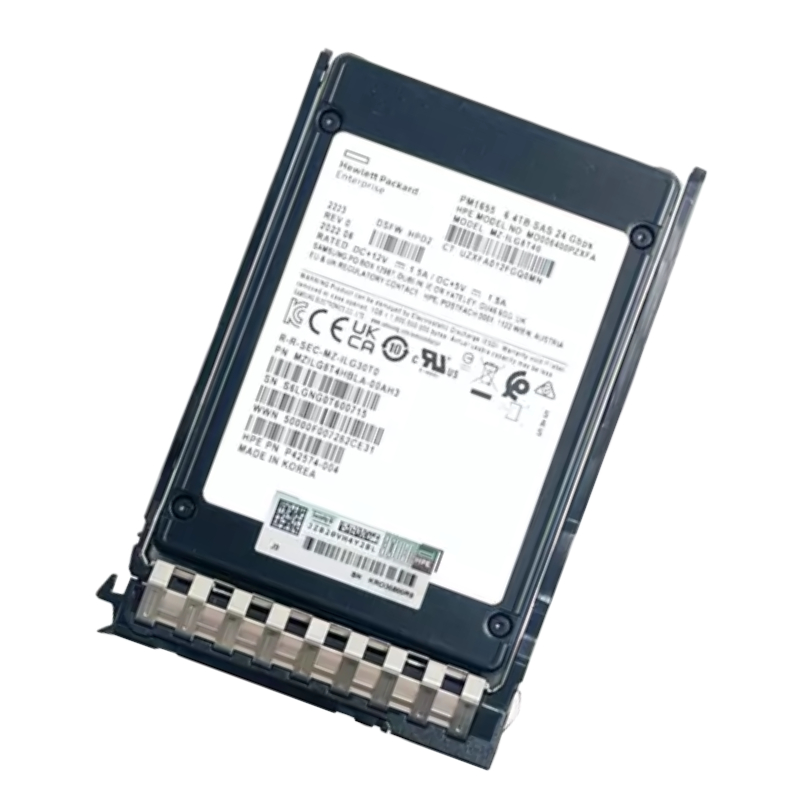
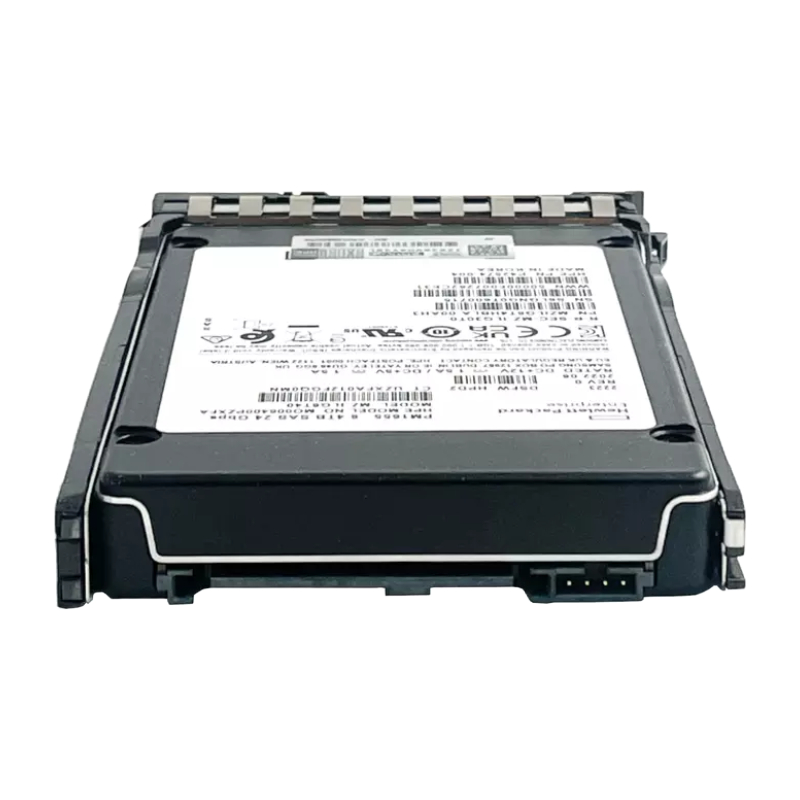
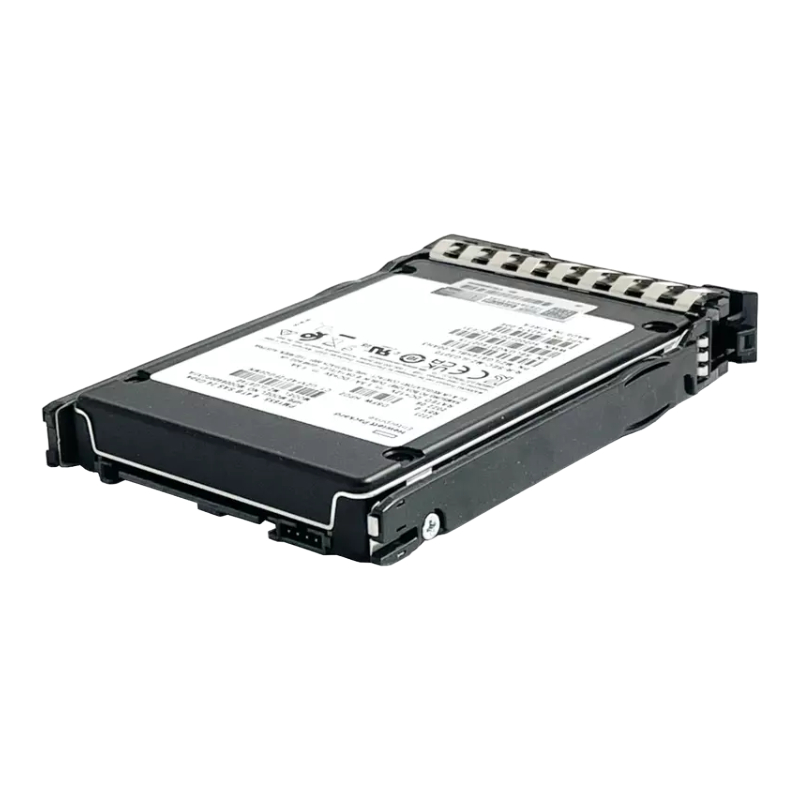
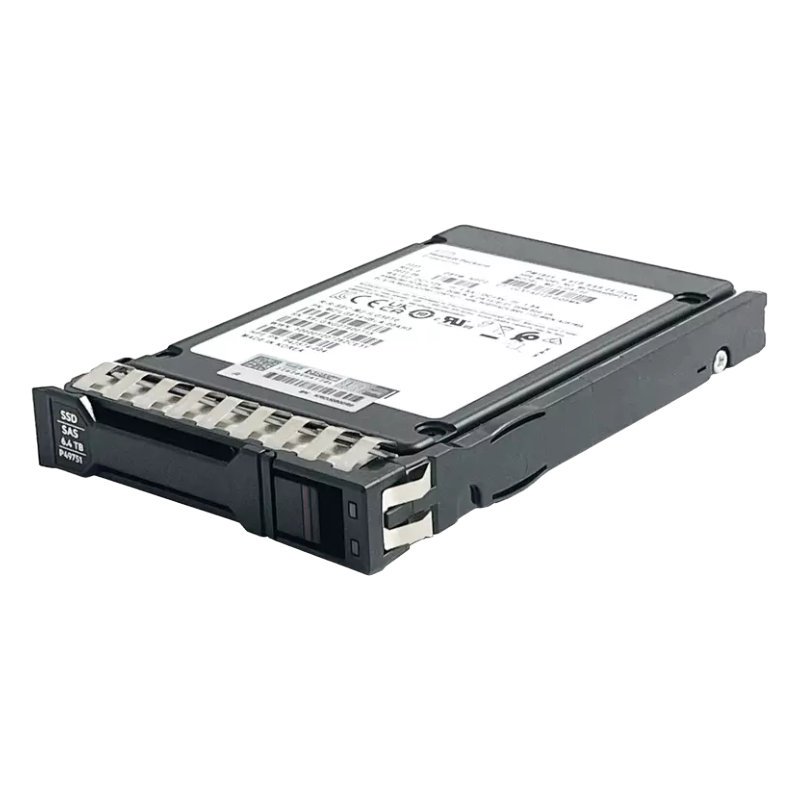
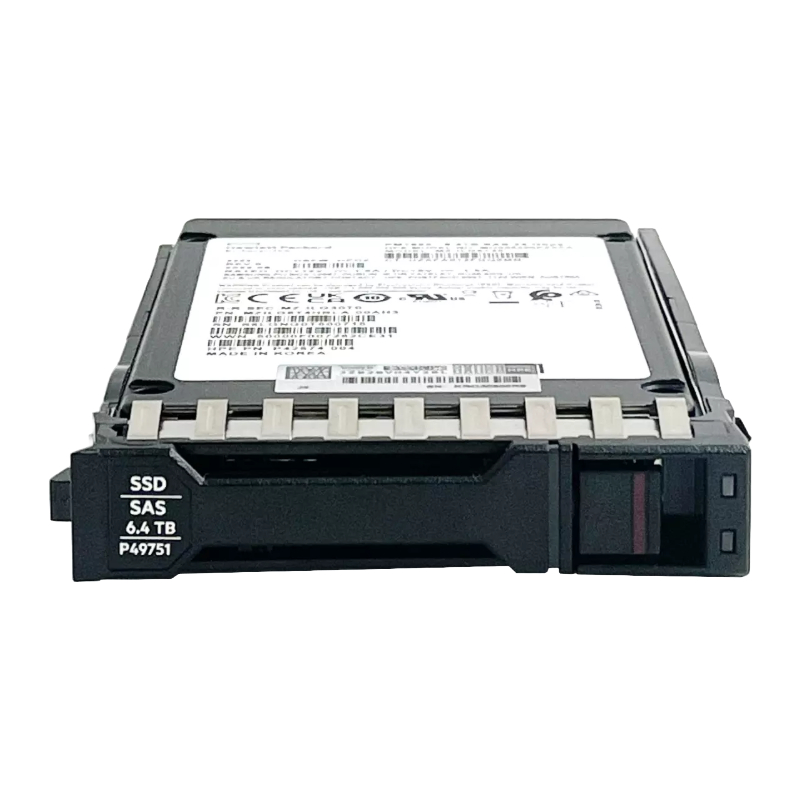
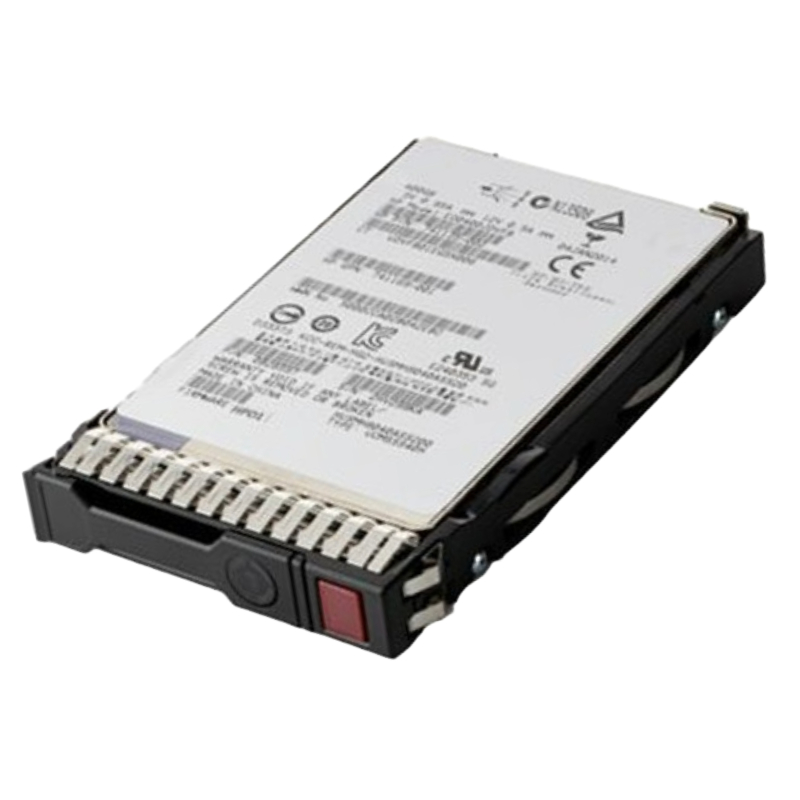
HPE P49339-001 6.4TB Mixed-Use SAS SSD
The HPE 6.4TB Mixed-Use SAS 12Gb/s solid-state drive is engineered for demanding enterprise environments that require a balance of high capacity, strong sustained throughput, and reliable endurance. This 2.5" hot-swap SSD (SFF) uses TLC NAND, supports dual-port SAS connectivity, carries digitally signed firmware, and ships with an HPE Smart Carrier for easy rack server integration. It is purpose-built for Gen10 ProLiant servers and optimized for mixed workload profiles where both read and write performance matter.
General Information 6.4TB Mixed-Use SAS SSD
- Brand: HPE
- Manufacturer Part Number: P49339-001
- Product Type: 6.4TB solid-state drive
Core specifications at a glance
- Form factor: 2.5" SFF, hot-swap compatible
- Capacity: 6.4 TB (usable enterprise capacity)
- Interface: SAS 12 Gb/s (dual-port)
- NAND type: Triple-Level Cell (TLC)
- Drive class: Mixed-Use (balanced read/write)
- External transfer rate: up to 1.2 Gbps
- Internal sustained rates: ~1080 Mbps read / ~1030 Mbps write
- Random I/O: up to 105k IOPS (4KB reads) and 120k IOPS (4KB writes)
- Endurance: ~34,241 TB total DWPD profile equivalent
- Power (typical): idle 3.69 W; operational up to 9.82 W (max)
- Bundled: HPE Smart Carrier
- Compatibility: Extensive list of HPE ProLiant DL360 Gen10 and DL380 Gen10 configurations
Power, thermal profile, and efficiency
Power consumption breakdown
- Idle power: ~3.69 W — energy efficient for large arrays where many drives remain idle.
- Random read/write operational: ~7.63 W — typical mixed workload consumption.
- Sequential peak: up to 9.82 W — useful to note for rack power budgeting under heavy sequential jobs.
Thermal considerations
Because the drive is designed for hot-swap server bays, accurate airflow and chassis cooling management are important. Use the HPE Smart Carrier as intended to maintain optimal airflow, and consult server documentation for drive bay temperature guidelines to ensure long-term reliability.
Enterprise features and firmware integrity
Digitally signed firmware
Digitally signed firmware ensures the drive boots with verified and authenticated firmware images. This reduces risk from tampered firmware and simplifies secure provisioning in environments with strict compliance or security policies.
Dual-port SAS for high availability
Dual-port SAS enables multipath connectivity to controllers and HBAs, providing redundancy and failover capability. For SAN, clustered, or dual-controller systems, dual ports deliver continuous access even during component maintenance or failure.
Benefits of dual-port architecture
- Non-disruptive failover between controllers
- Load sharing for increased aggregate throughput
- Improved resilience in clustered storage setups
Compatibility and supported HPE platforms
Validated ProLiant server families
This drive is explicitly designed for HPE ProLiant DL360 Gen10 and DL380 Gen10 configurations, including a wide spectrum of pre-validated server SKUs tailored for performance, all-flash, hybrid, and software-defined storage deployments. It supports server models provisioned for Cohesity, Datera, Weka, CTERA, SAP HANA compute blocks, and standard compute or SMB profiles.
Example supported configurations
- DL360 Gen10: Performance, All-Flash, Compute, Entry, Plus, Premium, and specialized variations
- DL380 Gen10: Entry, Performance, Hybrid, All-Flash NVMe variants, SMB and Solution builds
- Software-defined and storage-optimized servers for partners like Cohesity and Weka
Physical and logical bay compatibility
Fits into 2.5" SFF drive bays; confirm whether your chassis uses drive carriers or backplanes that require the HPE Smart Carrier. Hot-swap functionality allows field replacement without powering down systems in supported chassis.
Deployment scenarios and ideal use cases
Mixed workload databases
For enterprise databases that require both steady read throughput and sustained write capability — such as OLTP systems, analytics nodes, and mid-sized NoSQL clusters — this mixed-use SSD is a compelling option. The DWPD rating and random IOPS make it suitable for transactional latency-sensitive applications.
Virtualization and VDI
Virtual machine density benefits from the drive’s high random I/O capability. Boot storms and desktop I/O surges are mitigated by strong 4KB random read/write performance, improving user experience during peak times.
Software-defined storage and caching tiers
Where cost-per-GB and capacity matter, but you still need enterprise performance, mixed-use TLC SSDs serve well as capacity or cache tiers in SDFS architectures. They strike a balance between endurance and cost relative to higher-end SLC/MLC options.
Backup, snapshot, and deduplication patterns
Workloads involving frequent snapshots or deduplication can leverage the drive’s capacity and sequential throughput; however, consider I/O patterns and retention policies when sizing. For heavy, sustained sequential writes (e.g., media ingest), monitor thermal and power budgets closely.
Data integrity, firmware, and security
Firmware signing and update practices
Digitally signed firmware reduces risk of unauthorized modifications. Follow HPE’s firmware update process and use validated HPE management tools to apply updates in production — this ensures compatibility with server controllers and RAID/HBA firmware.
Encryption and data-at-rest considerations
If hardware encryption is required, pair the drive with an HPE controller or enclosure that supports self-encrypting drive (SED) features, or implement host-level encryption. Confirm SED support with your HPE sales or support representative if encryption is mandatory for compliance.
Capacity planning and scalability
Sizing guidance
- Assess working set size vs. total capacity: mixed-use TLC is cost-efficient for large active datasets that fit within the drive's capacity and endurance profile.
- Factor in RAID overhead: choose RAID levels based on performance vs. capacity tradeoffs (RAID 10 for lower latency, RAID 6/RAID-DP for higher capacity efficiency).
- Use monitoring tools to track write amplification, wear level, and remaining endurance to plan replacements before performance degradation occurs.
Scaling in dense server environments
The 2.5" SFF format enables high drive density in blade and rack servers. When deploying many drives per chassis, aggregate power and cooling must be considered. Plan rack-level power and airflow to support peak SSD operational loads.
Comparisons and purchasing considerations
Mixed-use TLC vs. all-flash NVMe
All-NVMe drives deliver lower latency and higher throughput per device but at a higher cost per GB. Mixed-use SAS TLC drives offer strong cost efficiencies for large capacity needs where absolute lowest latency isn’t required. Choose NVMe for ultra-low latency and highest single-threaded performance; choose mixed-use SAS TLC for balanced capacity, cost, and endurance.
When to choose a higher endurance drive
- If your environment records more than 3 DWPD sustained daily writes, consider higher endurance MLC or enterprise-grade TLC variants with higher DWPD.
- Write-heavy logging or caching tiers may justify drives rated higher than 3 DWPD to extend lifespan and reduce replacements.
Cost of ownership factors
Calculate TCO by combining acquisition price, expected service life (based on write rates), energy and cooling costs, and replacement/RMA probabilities. Mixed-use drives tend to lower $/GB while still delivering predictable enterprise performance.
HPE P49339-001 PM1655 6.4TB SAS SSD Product overview
The HPE P49339-001 (PM1655) 6.4TB SAS 12G Mixed Use SFF SC TLC Multi-Vendor SSD is engineered for enterprise-class storage tiers within HPE Gen10 and Gen10 Plus servers. Positioned as a high-capacity, mixed-use solid state drive in a 2.5" small form factor (SFF) with Single-Connector (SC) interface options, this drive blends sustained throughput, consistent low latency, and data integrity features required by modern data center workloads. It is a multi-vendor certified option designed for direct replacement or fleet expansion across heterogeneous HPE server deployments, offering compatibility, predictable behavior under mixed read/write patterns, and the high endurance characteristics expected for server-attached SAS storage.
This SSD category matters for modern enterprise
Data centers have shifted toward hybrid storage architectures where SSDs handle active datasets and HDDs act as capacity tiers. The PM1655 6.4TB SAS 12G Mixed Use SSD category targets the “mixed use” sweet spot — workloads that combine both reads and writes in moderate-to-high intensity: virtual desktop infrastructure (VDI), database indexing, web application backends, caching layers, analytics staging areas, and virtual machine boot/storage tiers. These drives provide:
- High-capacity flash in a compact SFF form factor, enabling denser storage configurations per server bay.
- Enterprise-grade SAS 12G interface for compatibility with existing HBA/RAID controllers and predictable behavior under multi-queue workloads.
- Cost-effective TLC (Triple-Level Cell) NAND with optimized firmware and over-provisioning for improved endurance in mixed-use scenarios.
Targeted workloads and use cases
The category excels in use cases where consistent responsiveness matters and data set sizes require larger single-drive capacities:
- Virtualization & VM density: Boot volumes, VM disks for moderate write patterns, and storages supporting many small I/O operations.
- Databases & analytics: Indexes, temp tablespaces, and OLTP/OLAP staging where a balance of read and write performance is required.
- Web & application servers: Session stores, high-concurrency caches, and file metadata where predictable latency is critical.
- Edge & remote data centers: Compact servers (SFF chassis) needing larger SSD capacity without moving to larger form factors.
Technical highlights and differentiators
Form factor, interface and capacity
These SSDs come in a 2.5-inch SFF form factor optimized for HPE server trays and hot-swap bays. The SAS 12G (12.0 Gbit/s) interface ensures broad compatibility with enterprise SAS controllers and HBAs and supports dual-port redundancy in multi-path configurations where applicable. The 6.4TB capacity provides a high-density option for environments that need to maximize storage per slot while retaining enterprise features.
Mixed use TLC NAND and endurance considerations
The PM1655 series uses TLC NAND optimized for mixed-use workloads by combining firmware-level write amplification controls, dynamic over-provisioning, and advanced error-correction algorithms. Key endurance and reliability strategies include:
- Wear-leveling algorithms to extend usable lifetime across TLC die.
- Dynamic spare area allocation to maintain steady performance as the drive fills.
- Power-loss protection (where implemented at controller/firmware level) to ensure metadata consistency and prevent write interruption corruption.
- Enterprise SMART reporting and telemetry to monitor health, remaining life, and error conditions.
Performance metrics and what to expect
In this category, drives are tuned to deliver a mix of sequential and random performance characteristics appropriate for mixed workloads:
- Sequential throughput: Strong sequential read and write rates for data-moving operations and large-file transfers.
- Random IOPS: Tuned random read/write IOPS to support many small blocks, database transactions, and virtual machine I/O.
- Latency: Consistent sub-millisecond access times under normal load; designed for deterministic performance under bursty or mixed load patterns.
Compatibility with HPE Gen10 and Gen10 Plus servers
The “Multi Vendor” designation indicates HPE certification across OEM and compatible third-party suppliers, providing administrators flexibility when procuring drives or when mixing vendor-sourced drives for cost, availability, or warranty reasons. Key compatibility notes:
- Certified for HPE ProLiant Gen10 and Gen10 Plus server lines; check specific server firmware and HBA versions for best compatibility.
- Works with standard HPE drive trays and interposers; many models are digitally signed firmware to satisfy HPE SmartComponents requirements.
- Supports SAS RAID controllers commonly used in HPE servers—ensure firmware is up-to-date on controllers to avoid interoperability issues.
Deployment best practices
Firmware and controller considerations
Deploying drives in enterprise servers requires attention to firmware matching between drive and system controller. Best practices include:
- Always verify HPE advisories and supported firmware matrices for Gen10/Gen10 Plus servers prior to large-scale rollout.
- Apply controller firmware updates that enable SAS 12G stability and any vendor-recommended patches for PM1655 compatibility.
- When replacing drives in an existing array, follow HPE’s drive replacement procedure to avoid rebuild issues, and allow RAID controllers to perform full background initialization if required.
Over-provisioning, queue depth and RAID tuning
To extract the most consistent performance:
- Consider logical over-provisioning at the storage layer (leaving some unused capacity) to reduce write amplification and improve endurance.
- Tune HBA queue depths to balance parallelism and latency; enterprise SAS controllers often have recommended queue depth settings for mixed-use SSDs.
- Choose RAID levels according to workload characteristics — RAID 10 for write-heavy or latency-sensitive workloads; RAID 5/6 for capacity-efficient configurations where slight write penalty is acceptable.
Thermal and power management
Large-capacity TLC SSDs can generate heat under sustained I/O. Consider:
- Ensuring server airflow paths are unobstructed and fans are operating per HPE’s thermal guidance.
- Monitoring drive temperature SMART attributes and setting alerts for rising temperatures.
- Deploying drives in bays recommended by HPE for thermal distribution if using mixed drive types in the same chassis.
Comparisons and decision criteria
How PM1655 6.4TB compares with alternative tiers
When evaluating the PM1655 category against alternatives, consider these vectors:
- Cost per GB: TLC-based mixed-use drives typically offer a lower cost per GB than high-endurance SLC/MLC enterprise drives while delivering acceptable endurance for many production workloads.
- Endurance (DWPD/TBW): Assess drive endurance ratings expressed as drive writes per day (DWPD) or total bytes written (TBW) over warranty period — choose a drive whose endurance fits your write profile.
- Interface: SAS 12G offers multi-path redundancy and enterprise-level compatibility versus NVMe’s lower latency; choose SAS if existing infrastructure relies on SAS HBAs/RAID controllers and you need controller-managed RAID capabilities.
- Firmware support: HPE digitally signed firmware variants may be required for SmartComponents compatibility—factor in procurement availability.
When to choose PM1655 6.4TB over NVMe or lower-capacity SSDs
The PM1655 6.4TB SAS drive is an excellent choice when:
- You need high capacity per 2.5" bay while retaining SAS connectivity and RAID controller features.
- The workload is a mixed read/write profile where the cost-efficiency of TLC outweighs the ultra-low latency of NVMe.
- Existing server fleets are Gen10/Gen10 Plus ProLiant systems with validated SAS environments and you want minimal architecture change.
Procurement, warranty and lifecycle considerations
Buying tips and SKU verification
Procurement teams should verify SKU details carefully:
- Confirm the exact part number (HPE P49339-001) matches the required firmware signing and warranty conditions for your region.
- Check if the drive is new, refurbished, or multi-vendor compatible; multi-vendor may indicate equivalent OEM/third-party products that meet HPE’s interoperability standards.
- Request vendor-supplied compatibility matrices and the latest HPE server storage compatibility guides to avoid unexpected incompatibilities.
Warranty, RMA and lifecycle planning
Enterprise SSDs typically carry limited warranties and RMA procedures:
- Review the warranty period (often 3–5 years for enterprise SSDs) and whether the warranty is OEM-backed or provided by a reseller.
- Maintain spare drive inventory and follow HPE RMA procedures to minimize downtime in case of predictive or actual drive failures.
- Plan for lifecycle upgrades—monitor SMART metrics to preemptively replace drives approaching end-of-life and to schedule non-disruptive replacements during maintenance windows.
Checklist for buyers and admins
Before purchase
- Confirm the exact HPE part number and firmware signing requirements.
- Validate compatibility with your specific Gen10 or Gen10 Plus server model and RAID controller revision.
- Match endurance specs (DWPD/TBW) to anticipated workload writes.
During deployment
- Register drives and enable health telemetry in HPE management tools.
- Monitor initial burn-in behavior under expected workload to confirm thermal and performance profiles.
- Set alerts for temperature and SMART thresholds to catch issues early.
After deployment
- Track long-term SMART trends and plan replacements when drives approach manufacturer's end-of-life indicators.
- Keep firmware and controller drivers aligned with HPE guidance, and validate updates in staging environments first.
- Maintain spare units and document RMA processes for quick swap in the event of failure.
Closing content block for conversion and trust signals
For the continuous category description (placed near CTAs), add trust-building elements: verified compatibility badges, warranty callouts, vendor certification notes, and a short buyer checklist. Encourage contact with technical sales for compatibility verification and bulk pricing, and offer links to datasheets and HPE knowledge resources (ensure these links are current and point to official resources).





 Contact Us
 Information
 Catalog
 Solid State Drives (SSD)
 Network Switches
 Hard Disk Drives
 HBA & Controllers
 PC & Servers
 PC & Server Memory
 CPU & Processors
 Network Routers
 Power Supplies
 Tape Drives & Libraries
 Network Devices
 Computer & Network Cables