(7% discount is applied at checkout)
Cart is empty
Your go-to destination for cutting-edge server products
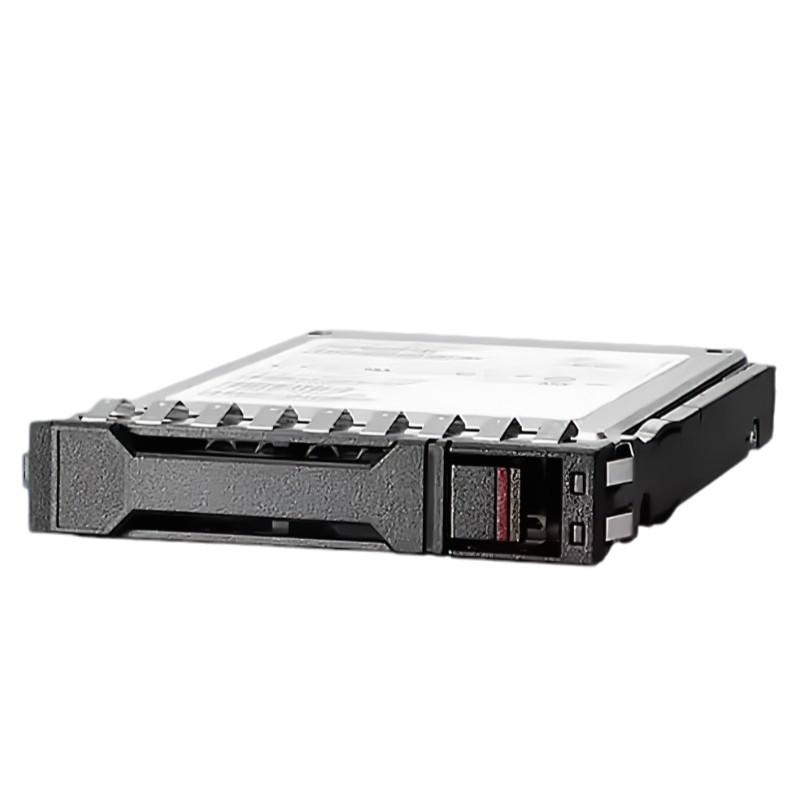


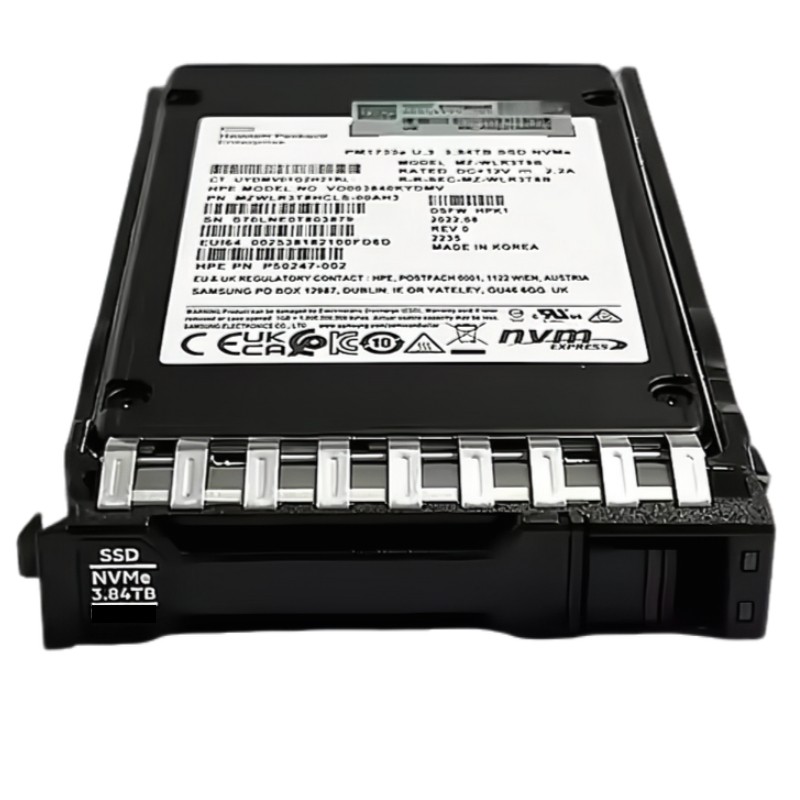
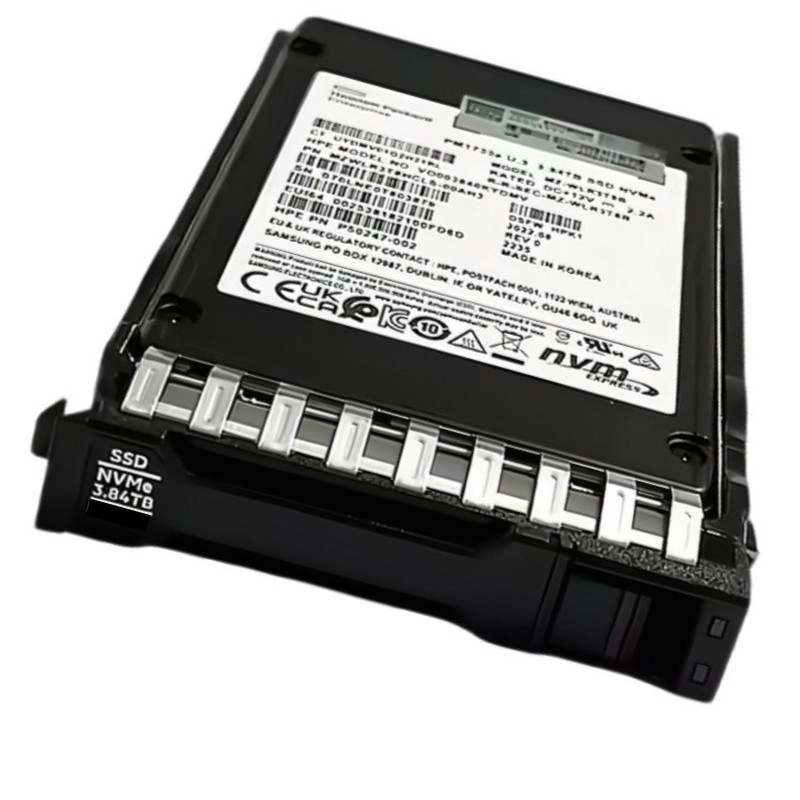
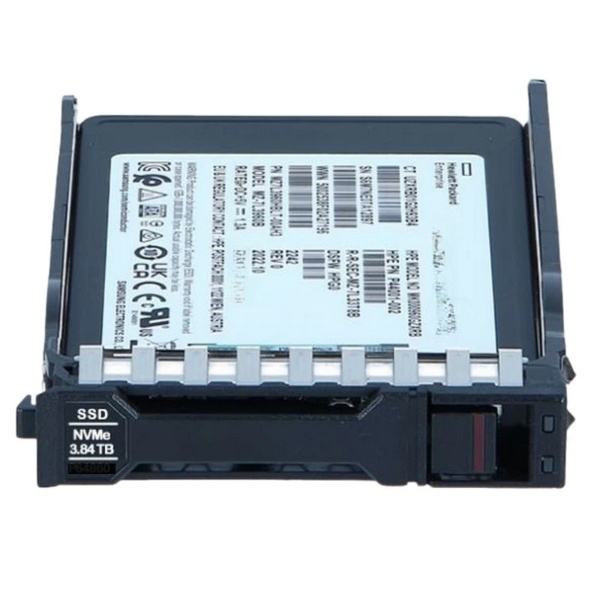
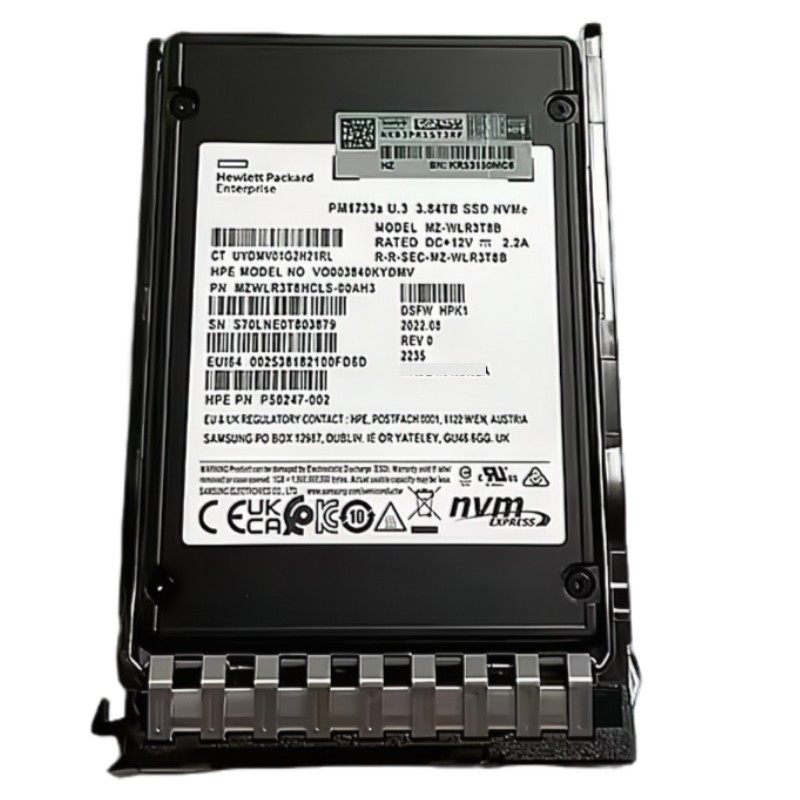
HPE P57767-B21 3.84TB NVME Read Intensive BC U.3 Sm Ntx Solid State Drive With Tray. Excellent Refurbished with 1 year Replacement Warranty
The HPE P57767-B21 is a high-speed NVMe solid-state drive designed for read-intensive workloads. With a generous 3.84TB storage capacity and advanced PCIe interface, this enterprise-grade SSD is ideal for data centers and server environments requiring fast and reliable data access.
Within the domain of high‑end storage solutions, read‑intensive NVMe solid state drives (SSDs) in the U.3 2.5‑inch small form factor (SFF) category occupy a critical niche. These storage devices are engineered specifically for environments where the workload is dominated by read operations — such as data analytics, virtual desktop infrastructure (VDI), large‑scale caching, and database query acceleration. The category encompasses SSDs that marry very high throughput and very low latency with endurance tailored to mostly read workloads. Choosing such a drive means prioritizing read performance metrics and compatibility with modern server backplanes (for example the U.3 interface) while accepting a proportionally lower endurance than write‑intensive or mixed‑use SSDs.
Drives in this category typically conform to the 2.5‑inch SFF dimension, often within hot‑swappable trays or carriers designed for enterprise servers. The U.3 interface ensures backward compatibility with U.2 and supports NVMe protocols over PCI Express lanes, thus delivering extremely high data transfer rates. The “read‑intensive” classification means the drive is optimized with firmware, NAND type and wear‑leveling schemes that favour superior read latency and throughput at high queue depths. Endurance (often expressed in Drive Writes Per Day — DWPD) is tailored for read‑heavy workloads rather than sustained heavy writes. Additionally, these drives are packaged with a carrier or tray (e.g., a “Basic Carrier”) for seamless integration into existing server bay systems.
Within read‑intensive U.3 NVMe SSDs there is always a trade‑off between capacity, performance (particularly read throughput and IOPS), and endurance. Drives with larger capacities often deliver higher parallelism in NAND channels and thus higher throughput, but the 3.84TB capacity of the P57767‑B21 places it at a sweet‑spot for many enterprise deployments where extreme capacity is not the primary driver but fast retrieval is. Because the endurance demands are lower (since writes are fewer), the cost per gigabyte can be more favourable compared to mixed‑use or write‑intensive SSDs. This makes the category especially attractive in scenarios where large volumes of read data need fast access but the write traffic is comparatively modest.
The underlying technology that enables this category draws from advanced NAND flash memory (often TLC or QLC in enterprise‑grade), NVMe protocol over PCIe lanes (typically Gen 3 or Gen 4 and increasingly Gen 5), and form factors designed for efficient thermals and serviceability. The U.3 standard provides flexibility for servers that might support U.2 earlier; the backwards compatibility and high bandwidth make it a versatile choice. Moreover, read‑intensive SSDs are tuned at the firmware level to optimise for low latency reads, large sequential throughput, high random read IOPS and minimal performance drop‑off under sustained read loads.
The 2.5‑inch SFF form factor remains the standard in enterprise server bays, offering a balance between size, cooling, tray compatibility and serviceability. The U.3 interface utilises the same connector as U.2, but supports NVMe over PCIe lanes rather than legacy SAS/SATA, thereby unlocking high‑speed PCIe transfers. This interface enables data rates that substantially exceed what SATA or SAS can deliver. For example, typical Gen 4 or Gen 5 NVMe drives in this category may approach tens of gigabytes per second of throughput in sequential operations. While specific published numbers for the P57767‑B21 may not be widely listed in public specs, its classification places it within this high‑performance regime.
Within the broader realm of enterprise NVMe SSDs, three major workload‑based subcategories exist: write‑intensive (WI), mixed‑use (MU), and read‑intensive (RI). Each of them targets a different operational profile. Read‑intensive drives (such as the P57767‑B21) are optimised for workloads where the read count far exceeds the write count. Mixed‑use drives are designed for a more balanced workload of reads and writes, often in virtualization or database scenarios with moderate write traffic. Write‑intensive drives are built for heavy write workloads and highest endurance, used in logging, transactional systems or high‑write caching.
In enterprise data centres, read‑intensive U.3 NVMe SSDs like the P57767‑B21 are deployed in hot‑swappable trays compatible with server chassis from vendors such as Hewlett Packard Enterprise. Integration includes verifying the server supports NVMe drives with U.3 connector, confirming firmware compatibility, ensuring proper cooling and lane allocation, and confirming that the drive bay supports the correct form factor and lane count. Because these drives draw less power than some write‑intensive models and generate less heat, they often fit into dense NVMe server architectures where space, cooling and energy efficiency are critical.
The category of read‑intensive NVMe U.3 SSDs delivers multiple benefits tailored to enterprise needs. First, the high read performance translates into lower latency for database queries, faster boot times for virtual desktops, and quicker access for analytics engines. Second, the efficiency of the drive — with fewer writes to manage — often leads to lower power draw, less cooling requirement, and extended operational life in read‑heavy environments. Third, compatibility with current server architectures offers ease of deployment without needing specialised hardware changes. Fourth, the higher effective performance of read‑intensive drives allows organisations to serve more users, handle more requests or complete analytic jobs faster while maintaining responsive performance.
Because these SSDs are tuned for heavy read loads, they scale well in clustered and parallelised storage systems. They are ideal where multiple drives can be used in RAID or NVMe over Fabrics setups to deliver high concurrency. The 3.84 TB capacity of the P57767‑B21 is large enough to store substantial data sets, yet still maintain the high‑performance profile expected of this category. In scale‑up architectures, you might deploy multiple such drives in one node, enabling large in‑memory caches or extremely fast local data access. In scale‑out storage arrays, they can function as the high‑speed tier for “hot” data while colder data remains on slower media.
While the read‑intensive U.3 NVMe SSD category offers compelling advantages, there are trade‑offs and considerations to evaluate prior to deployment. Since endurance is calibrated for read‑heavy workloads, these drives may not be the best choice for write‑heavy environments such as log writes, large‑scale video ingestion, or high‑frequency transactional workloads. Over‑provisioning or choosing a mixed‑use drive may be wiser if the workload includes significant writes. Additionally, although the U.3 interface provides high bandwidth, one must ensure the server backplane and NVMe lanes are properly configured to exploit the full performance. Thermal and cooling design remains important: while these drives may draw less power than heavy‑write counterparts, they still generate heat under sustained high I/O and need proper airflow in dense server racks.
This category of SSDs is particularly well‑suited for a variety of enterprise use cases. In analytics clusters, where large datasets must be scanned and processed rapidly, the low latency and high throughput of read‑intensive NVMe drives enable faster time‑to‑insight. In virtual desktop infrastructure (VDI) environments, using read‑optimized SSDs for user boot volumes and shared images improves startup and responsiveness. In content delivery, caching layers and database front ends, the ability to handle many concurrent reads with minimal delay is essential. Large‑scale search engines, indexing platforms, AI inference nodes, and storage tiers for “hot” data are all natural fits for this category. Importantly, the capacity and form factor of 3.84 TB, as with the P57767‑B21, allow substantial data volume without sacrificing the performance advantages of NVMe.
When evaluating models in this category, IT decision‑makers should focus on interface generation (Gen 3 vs Gen 4 vs Gen 5), total capacity, latency and throughput specifications, endurance rating (even for read‑intensive drives), carrier/tray compatibility, vendor support, and long‑term roadmap. The P57767‑B21 offers a strong balance between these factors: from HPE, one of the most established enterprise storage vendors, with a 3.84 TB capacity aligned to many mainstream server configurations and a tray included for easy installation. While larger capacities or newer interface generations may exist, the value proposition of this particular model lies in its mature specification, broad compatibility, and ideal fit for many “hot‑data” use‑cases.


 Contact Us
 Information
 Catalog
 Solid State Drives (SSD)
 Network Switches
 Hard Disk Drives
 HBA & Controllers
 PC & Servers
 PC & Server Memory
 CPU & Processors
 Network Routers
 Power Supplies
 Tape Drives & Libraries
 Network Devices
 Computer & Network Cables