(7% discount is applied at checkout)
Cart is empty
Your go-to destination for cutting-edge server products
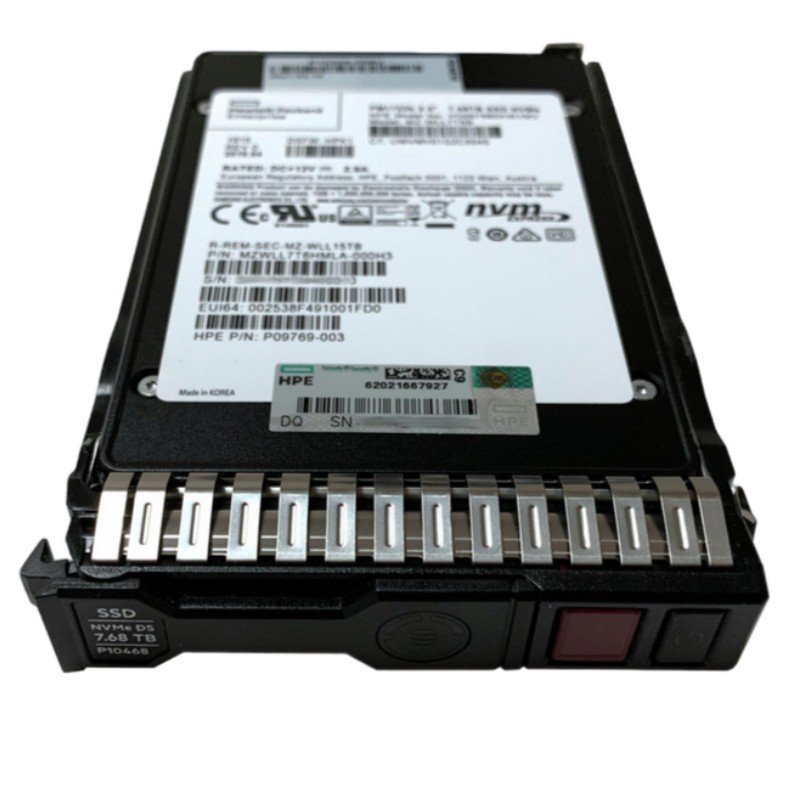


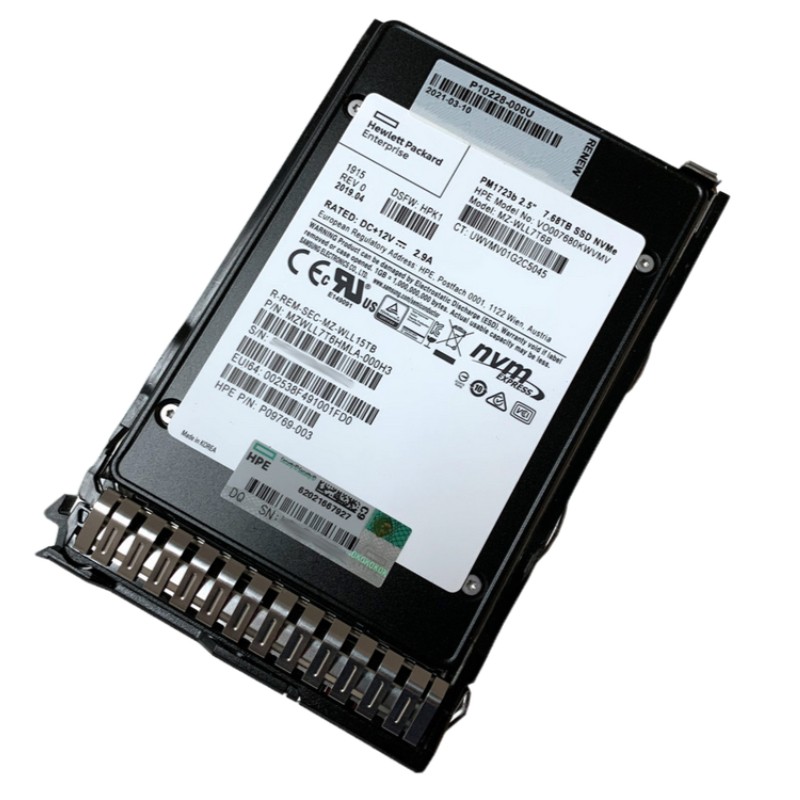
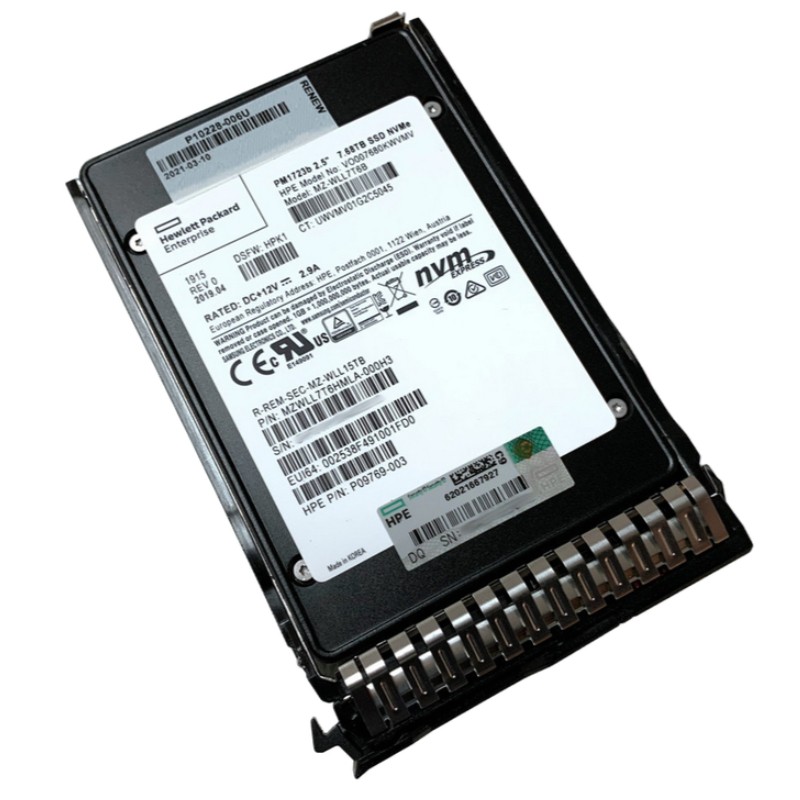
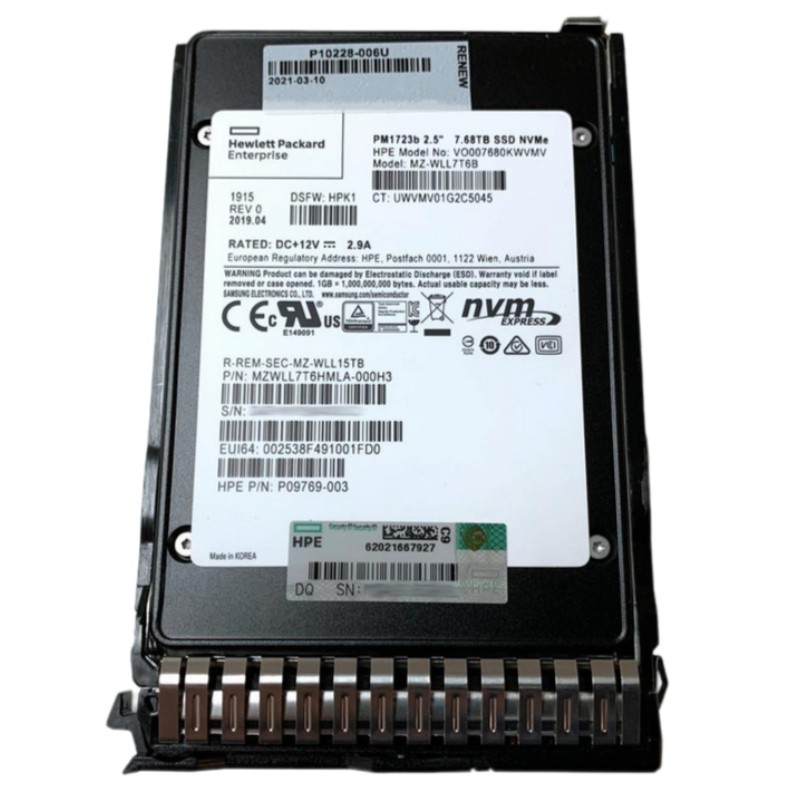
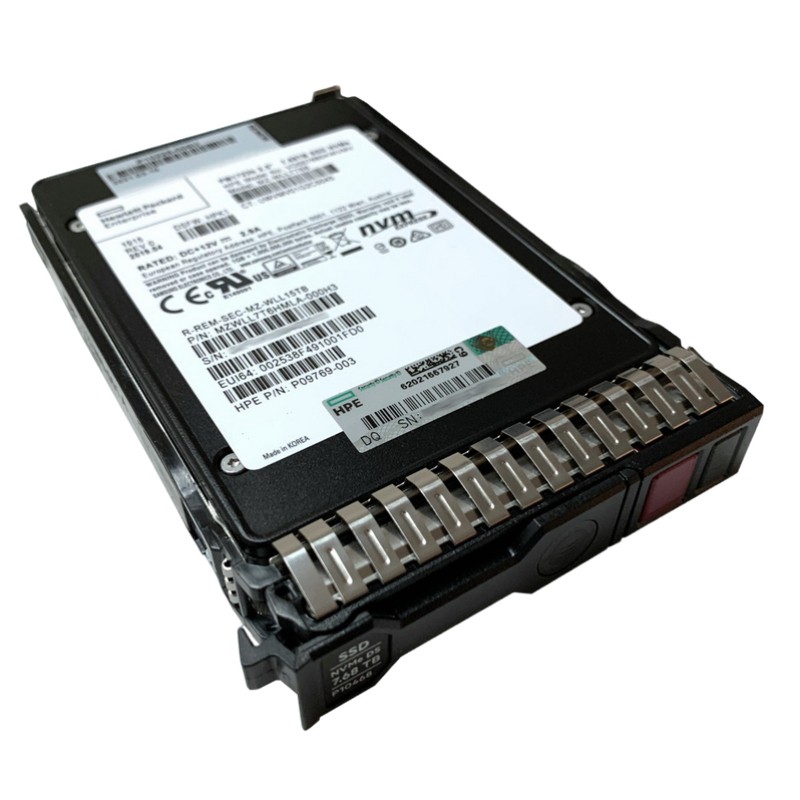
HPE P57769-B21 7.68TB NVMe Read Intensive BC U.3 Sm Ntx Solid State Drive With Tray. Factory-Sealed New in Original Box (FSB) with 3 Years Warranty
| SKU/MPN | Warranty | Price | Condition | You save |
|---|---|---|---|---|
| P57769-B21 | 1 Year Warranty | $3,030.00 | New Sealed in Box (NIB) | You save: $1,060.50 (26%) |
| P57769-B21 | 1 Year Warranty | $5,225.00 | Factory-Sealed New in Original Box (FSB) | You save: $1,828.75 (26%) |
The HPE P57769-B21 7.68TB NVMe Read Intensive BC U.3 Smart NVMe Solid State Drive delivers exceptional storage performance tailored for read-heavy workloads. Designed with enterprise reliability in mind, this high-capacity SSD fits seamlessly into your existing HPE infrastructure, enhancing both speed and efficiency.
This enterprise-grade NVMe SSD integrates seamlessly with compatible HPE servers and storage arrays, ensuring scalable storage expansion without compromising speed or reliability.
In the world of data centres and high‑performance server environments, the category of read‑intensive NVMe solid‑state drives (SSDs) plays a crucial role in delivering rapid access to large volumes of data. These drives are optimized primarily for workloads where reading speed, throughput and low latency matter most. The model HPE P57769‑B21 is an exemplar of this class. By focusing on read‑optimized performance, enterprises can deploy storage devices that are tailored for analytics, caching, boot volumes, content delivery, virtual desktop infrastructure and other use‑cases where reading dominates writing. Within the broader category of SSDs one differentiates read‑intensive from mixed‑use or write‑intensive models, thereby selecting the right tool for the job’s workload profile.
Read‑intensive SSDs are characterized by a design that favours high read input/output operations per second (IOPS), minimal latency when accessing stored data and generally lower write endurance requirements compared to write‑heavy drives. Unlike write‑intensive drives which must endure frequent data generation, read‑intensive models are engineered to excel where the majority of operations are retrieval rather than persistent writing. This category aligns with enterprise applications such as database query‑serving, large‑scale content delivery, streaming, boot volumes and other environments that demand scalable, predictable read performance.
The workloads ideal for read‑intensive drives include scenarios where large data sets are served repeatedly, such as analytics platforms interrogating big data volumes, virtualization hosts providing virtual desktops or applications, large‑scale web servers requiring fast content delivery, and archival systems where data is frequently accessed but less frequently updated. In these environments, the storage subsystem must deliver consistent high‑throughput reads and low latency rather than focus on high write volumes or continuous rewriting. Systems that deploy read‑intensive SSDs benefit from reduced access times, faster response for end‑users and greater efficiency in I/O patterns dominated by reads.
The HPE P57769‑B21 is a compelling representative of the read‑intensive NVMe SSD category. With its 7.68 TB capacity, NVMe interface and enterprise form factor compatibility, it brings high capacity and performance to the read‑centric tier of storage. Designed by Hewlett Packard Enterprise (HPE), this model is purpose‑built for enterprise and datacentre usage, offering robust integration and compatibility with HPE server and storage platforms. It belongs to the class of drives that enable high‑density deployment of NVMe-based read‑intensive storage, making it suitable for modern data‑driven enterprises.
One of the standout attributes of the P57769‑B21 is its 7.68 TB storage capacity, which places it in the large‑capacity segment of enterprise read‑intensive NVMe drives. For organisations needing to hold significant data volumes on high‑performance media, this capacity helps reduce the number of drives required and simplifies management. The device uses a 2.5‑inch small form factor (SFF) with a U.3 interface, enabling compact deployment in server chassis that support NVMe U.3 carriers. Additionally, the inclusion of a tray ensures simplified installation into HPE infrastructures, reducing deployment friction for system integrators and site engineers.
The P57769‑B21 employs a PCI Express (PCIe) NVMe interface, which offers dramatic performance advantages over legacy SATA or SAS interfaces. NVMe communicates directly with the host CPU via a streamlined command set and multiple I/O queues, delivering much lower latency and higher bandwidth than traditional drives. In this read‑intensive category, NVMe drives like this one help remove storage bottlenecks and permit sustained high‑throughput access from large datasets. The U.3 form factor ensures broad compatibility across modern server generations, enabling enterprises to use proven infrastructure while upgrading to higher performance drives.
Although read‑intensive drives are optimized primarily for reads, endurance and reliability remain key concerns in enterprise deployments. The P57769‑B21 is engineered to handle enterprise workload patterns with robust wear‑leveling, error‑correction, and enterprise‑grade firmware to ensure consistent uptime and predictable performance. While its write endurance specifications may not match write‑intensive drives, the drive’s design is matched to the class of workload it is intended for, and thereby offers the right balance of capacity, performance and endurance for read‑dominated environments.
High performance NVMe SSDs generate more heat and can draw more power than earlier generation drives, especially in dense deployments. Within the read‑intensive category, large‑capacity drives may still require effective chassis cooling, especially in 1U/2U systems packing many drives. Ensuring that airflow passes around the drive bay, that drive firmware implements proper thermal throttling and that system monitoring tracks drive temperature are critical practices. While the P57769‑B21 is optimised for read‑intensive load (which typically imposes less stress on the NAND than heavy writes), the enterprise‑grade build still demands appropriate infrastructure support.
Within the broader category of read‑intensive NVMe solid‑state drives, several sub‑categories or variants emerge based on capacity, form factor, interface generation, and vendor features. Understanding how these variants differ helps storage managers make informed decisions when selecting the optimal drive for their environment.
One axis of differentiation is capacity. Enterprise read‑intensive NVMe SSDs come in varying sizes: from lower capacities (e.g., 1.6 TB, 3.2 TB) for environments emphasising many small drives, up to high‑capacity models (6.4 TB, 7.68 TB, 15.36 TB) that reduce drive count and simplify management. The P57769‑B21 occupies the high‑capacity tier at 7.68 TB, offering the benefit of fewer units for the same storage volume. For organisations prioritising density or consolidation, selecting a large‑capacity variant can deliver lower total drive‑count overhead, less cabling, fewer failure points and simpler operations at scale.
Another differentiation axis is form factor and interface generation. Within the read‑intensive NVMe category, one finds drives in 2.5‑inch SFF form factors (such as U.3), EDSFF (E3.S) form factors, and various interface generations (PCIe Gen3, Gen4, Gen5). Older servers may support U.3 Gen4 NVMe, while next‑generation platforms may adopt EDSFF Gen5 NVMe for higher density. The P57769‑B21 uses the U.3 interface in a 2.5‑inch SFF form factor, making it compatible with many existing server infrastructures while still benefiting from NVMe speed. When planning upgrades, storage architects may compare whether a Gen5 EDSFF alternative is appropriate or whether the U.3 SFF design offers better compatibility with existing chassis and carriers.
Within the read‑intensive NVMe category, vendor‑specific features, firmware optimisations and ecosystem compatibility create further sub‑variants. For example, drives may include enterprise firmware with secure erase, power‑loss protection, self‑encrypting drive (SED) support, or native monitoring tools. HPE’s SmartCarrier, Smart Wear Gauge and firmware integration with HPE ProLiant servers exemplify this ecosystem approach. While the P57769‑B21 may not list every advanced feature publicly, its inclusion in the HPE enterprise storage catalogue signals full integration with the HPE ecosystem, enabling features such as drive health monitoring, firmware updates via HPE tooling and full compatibility with HPE server families.
Choosing the correct drive within this category requires alignment between workload demands, infrastructure compatibility and cost considerations. For organisations evaluating the P57769‑B21 or similar models, several factors merit detailed analysis.
Since read‑intensive drives are optimised for high read loads, one must assess the actual workload to confirm suitability. If the application involves heavy writes, log‑intensive databases or frequent snapshots, a mixed‑use or write‑intensive SSD might be more appropriate. However, if the workload emphasises large volumes of read operations, caching layers, virtual desktop servicing or large‑scale analytics with limited writes, then a drive like the P57769‑B21 becomes an excellent match. It delivers the capacity and NVMe performance expected for high‑scale, read‑dense environments.
Ensure the server or storage chassis supports the drive’s form factor (2.5‑inch SFF U.3 in this case) and that the backplane and carrier are compatible. The inclusion of the tray with the P57769‑B21 simplifies mounting in HPE servers, but administrators must also ensure the system’s firmware, NVMe driver support and cooling/power design align with the drive’s characteristics. Choosing a high‑capacity NVMe SSD into an unsupported bay or one without NVMe drive support may lead to sub‑optimal performance or non‑recognition by the system.
When deploying many high‑capacity NVMe drives, thermal and power considerations become significant. High‑density NVMe racks may require enhanced airflow, carefully managed power budgeting and attention to drive heat‑dissipation. For example, if the P57769‑B21 is deployed in large numbers within a 1U/2U chassis, the cumulative heat may influence ambient temperatures and fan speeds. Additionally, verify that the system supports the drive’s peak power draw and that any thermal throttling is manageable in your environment. These factors ensure the chosen drive performs reliably under heavy read demands without unintended latency or performance drops.
Beyond initial deployment, organisations must plan for operational lifecycle, drive monitoring, firmware updates and eventual replacement strategies when using read‑intensive NVMe SSDs like the P57769‑B21.
The category of enterprise read‑intensive NVMe solid‑state drives is tailored for workloads where reading performance, low latency and large capacity matter most. The HPE P57769‑B21 sits at the upper echelon of this category, offering 7.68 TB of capacity, NVMe U.3 interface, tray‑included installation and enterprise‑grade integration within the HPE ecosystem. For organisations building or upgrading storage tiers to meet large‑scale read demands—whether for analytics, virtual desktop infrastructure, content delivery or high‑performance caching—this class of SSD delivers the combination of capacity, speed and reliability needed. By selecting this drive or similar ones, enterprises can construct a high‑performance, cost‑effective read‑tier storage layer that scales efficiently, aligns with current infrastructure and prepares for future growth.


 Contact Us
 Information
 Catalog
 Solid State Drives (SSD)
 Network Switches
 Hard Disk Drives
 HBA & Controllers
 PC & Servers
 PC & Server Memory
 CPU & Processors
 Network Routers
 Power Supplies
 Tape Drives & Libraries
 Network Devices
 Computer & Network Cables