(7% discount is applied at checkout)
Cart is empty
Your go-to destination for cutting-edge server products
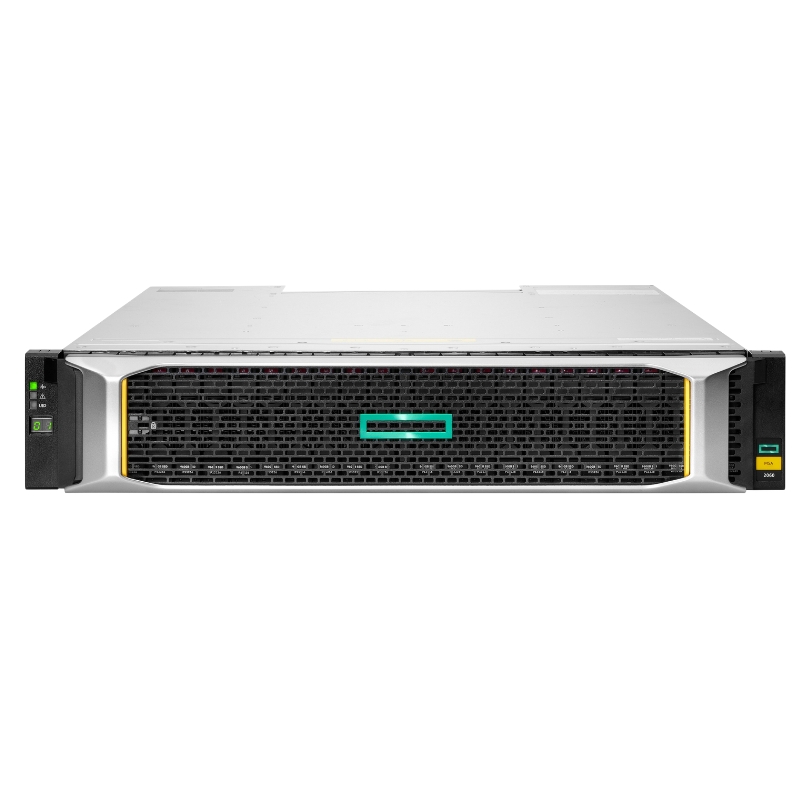


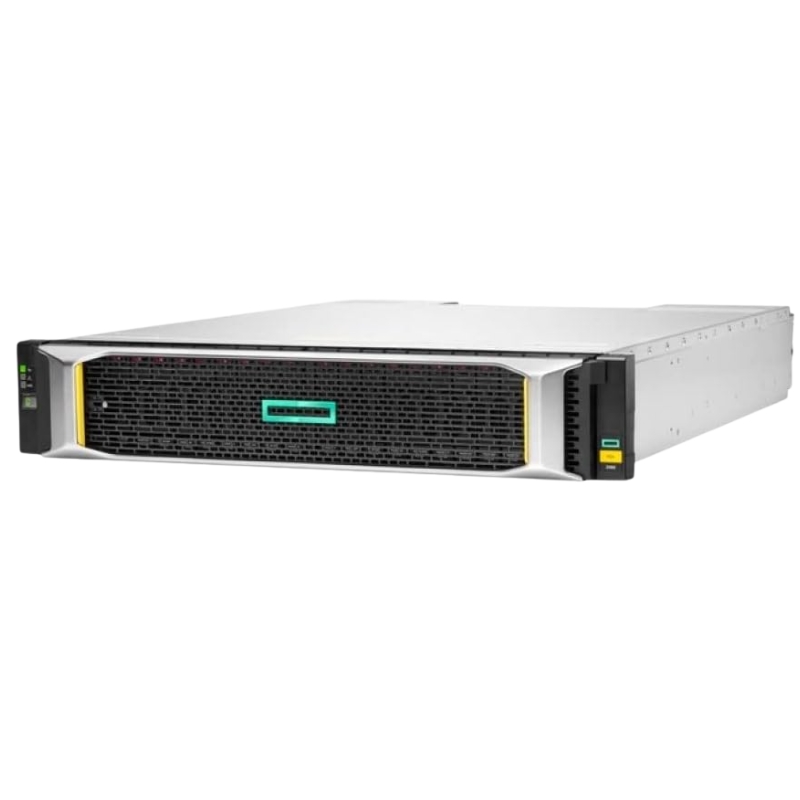
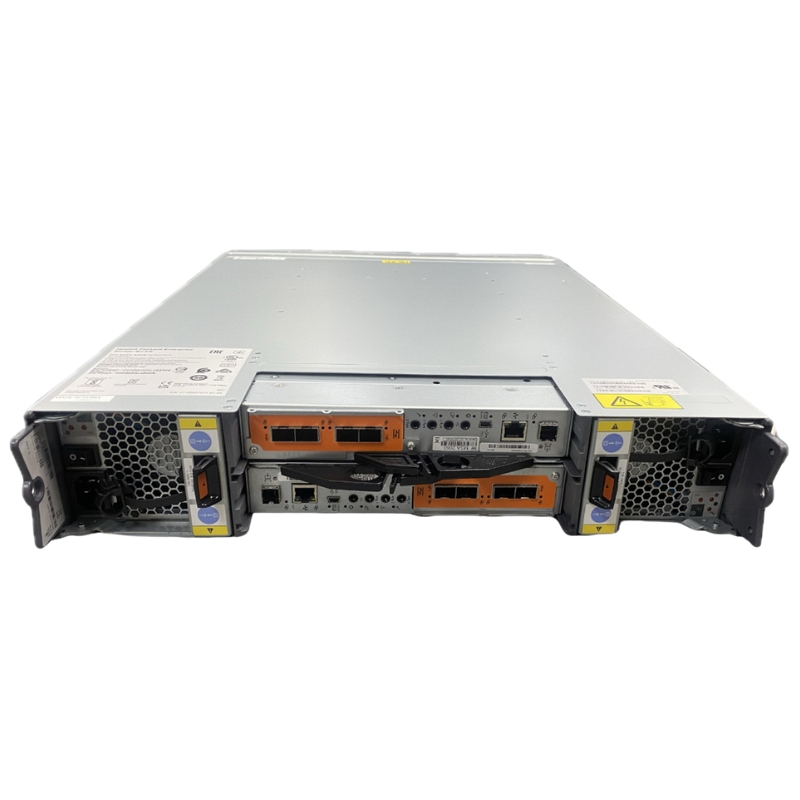
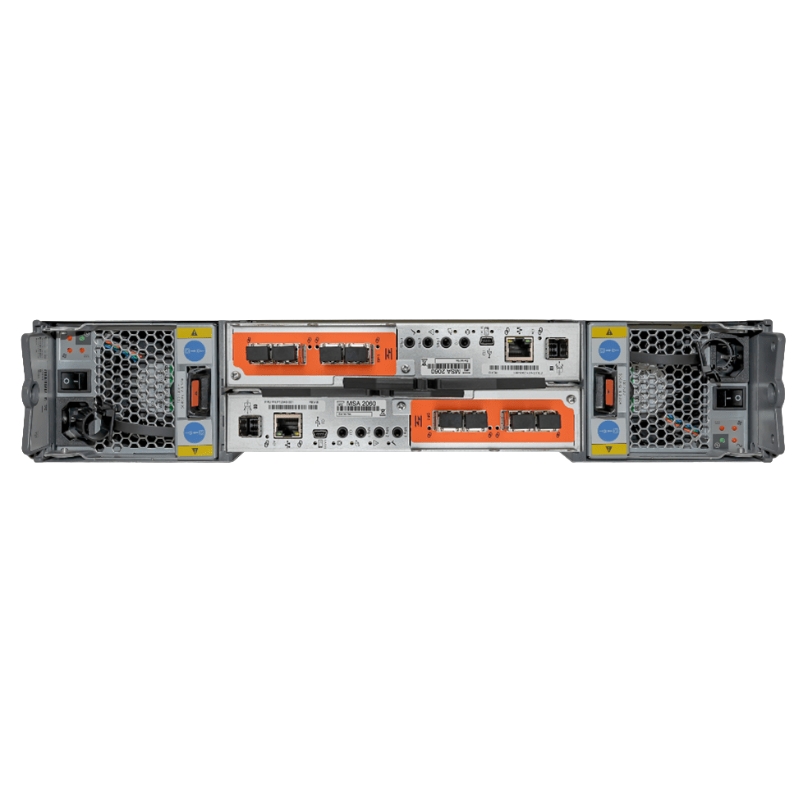
HPE R0Q74B Modular Smart Array MSA 2060 16GB Fibre Channel 2U Small Form Factor Storage. Excellent Refurbished with 1 year replacement warranty
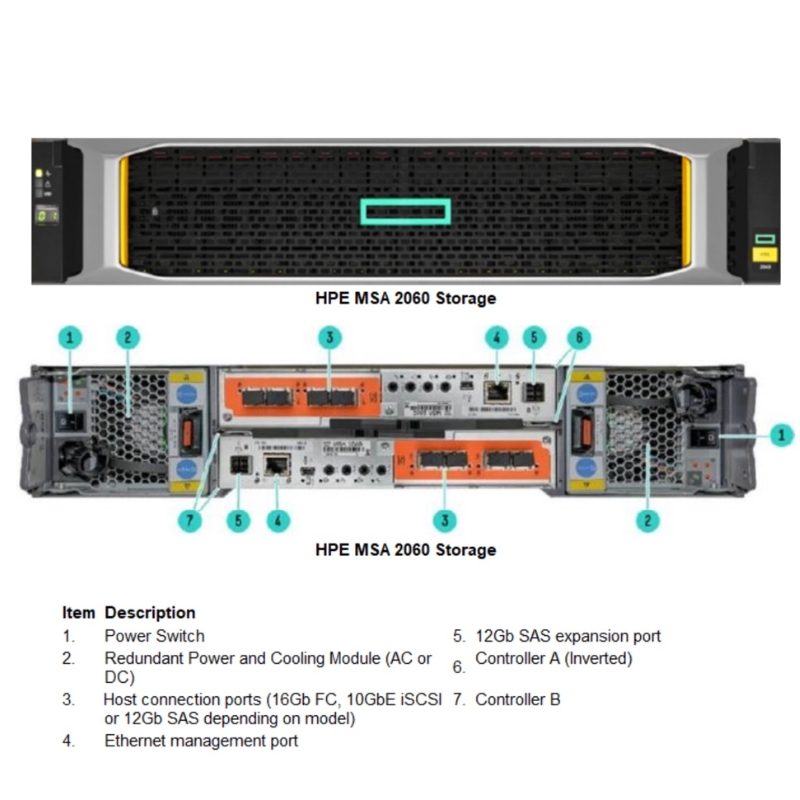
Built as a 2U chassis with SFF drive bays, the R0Q74B ships with dual active controllers (designed for redundancy and non-disruptive operations) and supports configurations that include 4-port 16Gb Fibre Channel controllers. The architecture enables high availability, persistent cache mirroring between controllers, and live firmware updates that minimize planned downtime for maintenance and upgrades.
The “16GB Fibre Channel” designation indicates support for 16 Gigabit Fibre Channel host ports (typically delivered as two 4-port controllers, yielding multiple FC host ports per array). This fabric connectivity is optimized for high-throughput, low-latency application traffic and is commonly used for VMware, Microsoft SQL Server, Oracle, and other I/O-intensive workloads. When configured with flash drives, the MSA 2060 can deliver substantial IOPS and consistent response times suitable for consolidation of mixed workloads.
The MSA 2060 platform is explicitly designed to be flash-ready: it supports any mix of SSDs and SAS HDDs, enabling organizations to start with lower-capacity or lower-cost HDDs and add SSDs later for caching or tiering. This hybrid approach delivers a balance of cost and performance and helps extend the usable life of deployed storage by letting you introduce flash acceleration when workload demands increase.
Onboard snapshot capabilities provide fast point-in-time copies that are ideal for backups, dev/test clones, and rapid recovery scenarios. The MSA’s snapshot implementation is designed to be space efficient and to reduce restore times for critical application data. These features help businesses implement short-term protection without the overhead of external backup systems for many common recovery workflows.
The MSA 2060 supports remote replication via Fibre Channel and IP (when paired with appropriate host adapters or gateways), enabling asynchronous replication to a second array for offsite disaster recovery and business continuity. This capability is especially valuable for organizations that require fast, reliable failover of production data to a secondary site without complex orchestration.
To maximize performance-per-dollar, the array supports both automated caching and tiering mechanisms (depending on configuration and licensed options). Hot data is placed on SSDs while less frequently accessed data remains on high-capacity HDDs, which optimizes IOPS and latency for mixed workloads and reduces total cost of ownership.
The SFF chassis supports a number of drive bay configurations and can be expanded via HPE expansion enclosures when capacity needs grow. This allows incremental growth from modest starting capacities to substantial usable storage pools without complete forklift upgrades. The modular design makes it straightforward to add drive enclosures, mix drive types, and reconfigure pools for performance or capacity as business needs change.
Controller upgrades and replacement components are supported, offering a migration path to newer MSA generations or higher-capacity configurations. This future-proofs the investment and lets organizations adopt new features and improved performance through component refresh rather than full array replacement.
The 16Gb FC controllers require compatible Fibre Channel switches, host HBAs and transceivers. Multi-pathing drivers (MPIO) on guest OSes or hypervisors are essential for redundancy and path failover. When deploying in VMware environments, VMware HBA best practices and proper zoning reduce the risk of LUN visibility issues and performance bottlenecks. Ensure transceiver compatibility and SFP+ or QSFP mapping are confirmed with HPE support resources to avoid interoperability issues.
The MSA line provides tested interoperability with major hypervisors like VMware ESXi and Microsoft Hyper-V, as well as enterprise OSes (Linux, Windows Server). HPE publishes compatibility matrices and QuickSpecs to validate supported host drivers, firmware levels and multipathing drivers—consult these resources for the exact HBA driver versions and OS patches recommended for production deployments.
Small and medium-sized virtualization clusters often use the MSA 2060 to consolidate VM datastores, leveraging SSD caching and high-speed Fibre Channel links to support high VM densities and variable I/O demands. The array’s simplicity and predictable performance make it a common choice for SMB virtualization projects.
Transactional databases (OLTP) and reporting/analytics workloads (OLAP) benefit from the low-latency properties of Fibre Channel-supported SSD tiers and the array’s ability to deliver high random I/O performance. Proper RAID and pool design, combined with Fibre Channel zoning and host tuning, allow database administrators to squeeze maximum performance from the platform.
For remote/branch offices that require local fast storage and the ability to replicate to a central datacenter, the MSA 2060 offers a compact footprint, local performance and the option to enable replication for centralized backups or DR orchestration. The small 2U chassis fits constrained rack space while providing enterprise features needed at distributed sites.
Interoperability with third-party transceivers, HBAs and switches is common but should be validated against HPE compatibility lists. Using non-validated components can lead to support limitations and unexpected behavior; where possible, use HPE-qualified parts or check QuickSpecs for validated third-party combinations.
Mixing drive firmware revisions or drive types within the same RAID group can create reliability and performance inconsistencies. When expanding the pool, standardize on drive models and firmware where possible and follow HPE guidelines for replacement and expansion to maintain performance and resiliency.
Compared with entry-level JBODs or consumer NAS solutions, the MSA 2060 offers stronger data services, validated host interoperability, and redundancy suited for production workloads. Compared with higher-end enterprise arrays, the MSA delivers a lower entry price while offering many of the essential features required by SMBs—trading off some advanced scale and feature-rich software suites found in flagship products for a simpler, more cost-effective experience. For organizations that need an upgrade path, the MSA’s modular design allows reasonable future growth without a complete platform migration.


 Contact Us
 Information
 Catalog
 Solid State Drives (SSD)
 Network Switches
 Hard Disk Drives
 HBA & Controllers
 PC & Servers
 PC & Server Memory
 CPU & Processors
 Network Routers
 Power Supplies
 Tape Drives & Libraries
 Network Devices
 Computer & Network Cables