
(7% discount is applied at checkout)
Cart is empty
Your go-to destination for cutting-edge server products
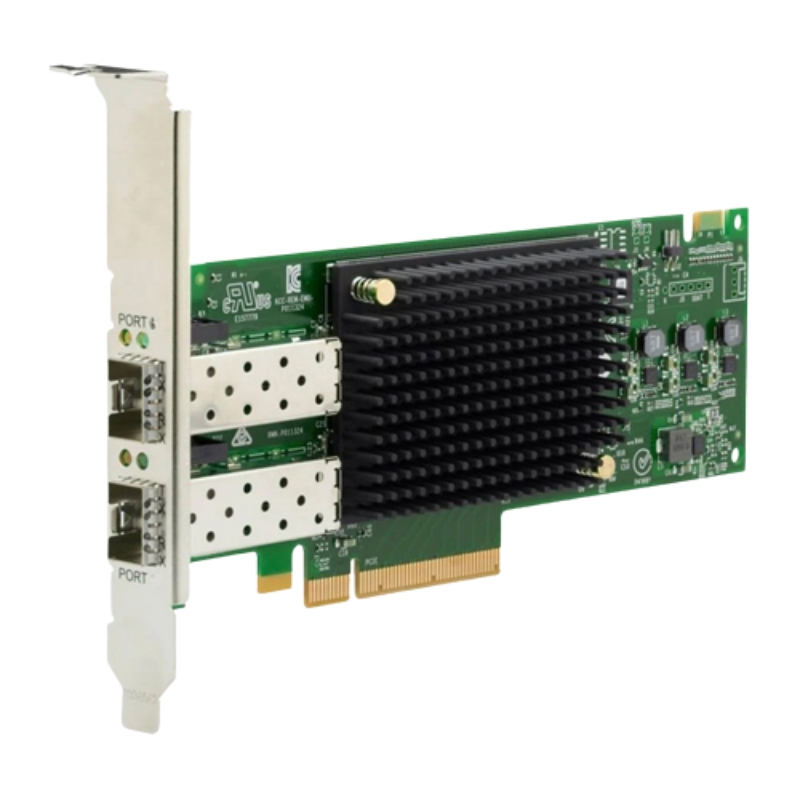
HPE R7N78-63001 64GB SN1700E 2Port Fibre Adapter. Factory-Sealed New in Original Box (FSB) with 3 years Warranty
Enhance your enterprise storage infrastructure with the HPE R7N78-63001 Sn1700e 64GB 2-Port Fibre Channel Host Bus Adapter, engineered for speed, reliability, and seamless integration.
This adapter ensures high availability, low latency, and robust performance for mission-critical applications, virtualization, and large-scale storage networks.
The HPE R7N78-63001 SN1700E 64GB 2-Port Fibre Adapter category covers modern 64 Gigabit Fibre Channel (64GFC) host bus adapters (HBAs) and converged Fibre Channel adapters designed for enterprise SAN connectivity, high-throughput NVMe-over-Fibre workflows, and server-to-storage interconnects in data centers. Products in this category are engineered to deliver low-latency, high-bandwidth fabric connectivity for ProLiant servers, HPE Alletra and Nimble storage systems, and third-party SAN fabrics where 64GFC is deployed. These adapters are generally PCIe Gen4 plug-in cards, support SFP-based optics, and include firmware and driver stacks validated by HPE for predictable interoperability and manageability.
The defining characteristic for the SN1700E family is support for 64 Gigabit per second Fibre Channel lanes — usually provided as two ports on a single adapter — enabling sustained multi-gigabit throughput for sequential and random IO streams common to enterprise workloads. This bandwidth level supports contemporary all-flash arrays and high-density VM hosts by reducing SAN bottlenecks and improving response times under heavy concurrency.
SN1700E adapters are built for PCIe Gen4, which increases the available host interface bandwidth compared with previous generations. PCIe Gen4 ensures that the adapter-to-server link does not become the limiting factor when the Fibre Channel ports are saturated, allowing the host CPU and memory subsystem to benefit from full fabric throughput.
The R7N78-63001 (or R7N78A / SN1700E family) typically ships as a dual-port HBA that accepts SFP+/SFP28 style optics compatible with 64GFC. The two-port design offers flexibility — you can use a single port active and the other as a redundant link, or run both ports aggregated for higher aggregate bandwidth and multipath performance with MPIO or vendor multipathing drivers. Several vendors and resellers offer the adapter bundled with HPE-qualified transceivers for short and long reach.
These adapters are full-height, low-profile PCIe cards that fit standard 2U and tower ProLiant servers; they typically consume minimal power compared to active switching equipment but do require a compatible slot with PCIe Gen4 lanes. Check vendor documentation for exact thermal and electrical characteristics when planning dense deployments.
HPE validates SN1700E models for a wide set of HPE ProLiant server families (Gen11 and supported Gen10 variants), Alletra storage arrays, and popular SAN switches. When purchasing for heterogeneous environments, verify HPE's compatibility matrix and ensure firmware and driver versions match the supported combinations to avoid interoperability issues.
Management for adapters in this category includes both in-OS driver utilities and integration with HPE management tools
such as HPE OneView and HPE iLO for inventory and firmware orchestration. The adapters support Fibre Channel standards
for link management, port zoning, and reporting, making them compatible with common fabric management workflows.
This Category Matters Business and Technical Value
As flash arrays and NVMe-backed storage platforms continue to push storage performance, server-to-fabric adapters must scale accordingly. 64GFC adapters like the SN1700E reduce the fabric layer as a bottleneck, allowing compute and storage tiers to fully leverage IOPS and throughput potential. This yields shorter transaction times, faster VM operations, and lower tail latencies for latency-sensitive databases and analytics workloads.
Upgrading server HBAs to 64Gb-capable SKUs protects SAN investments by enabling higher fabric speeds without requiring immediate overhaul of the switching layer. Organizations can deploy dual-port adapters and migrate to higher fabric speeds incrementally as switch and storage upgrades arrive, preserving CAPEX flexibility.
All-flash storage systems deliver very high IOPS and throughput; therefore, linking them to hosts using 64GFC adapters ensures that the storage performance gains are not constrained by host connectivity. SAN-attached databases, VDI farms, and high-performance compute clusters benefit strongly from this category.
While NVMe-over-Fabric implementations vary, Fibre Channel NVMe transport is an increasing use case. The SN1700E family’s high throughput and low latency characteristics make these adapters suitable for environments moving from block SCSI to NVMe transports, enabling faster IO paths for latency-critical applications.
Backup servers, deduplication appliances, and replication initiators that must move large datasets across the SAN rely on high sustained throughput. Dual-port 64GFC HBAs provide redundancy and parallelism for backup windows and replication links, shortening job times and reducing backup windows.
Always confirm the server model and BIOS/UEFI versions supported by HPE for the SN1700E variant you're purchasing. Not every ProLiant generation supports full PCIe Gen4 operation, which can limit the adapter’s host-side throughput if installed in older hardware. Check the HPE product documentation and compatibility matrices before procurement.
Determine whether your SAN switches and fabric modules support 64G speeds, or if they will operate at backward-compatible 32G/16G speeds. Mixed-speed fabrics work, but to achieve the full benefits of these adapters you should plan a fabric upgrade path or staggered migration to 64G-capable switches.
The category relies on proper SFP28/64GFC-qualified optics and compatible cabling. HPE strongly recommends using HPE-qualified transceivers and passive/active cables to maintain support and predictable signal integrity for high-speed links.
Mount HBAs in a static-free environment, verify slot lane allocation (preferably direct CPU-attached lanes for maximum performance), and follow server vendor torque and fastening guidelines. If installing in blade or dense rack servers, ensure proper airflow and thermal margins are maintained.
Keep firmware and driver packages aligned across your environment. HPE provides firmware bundles and platform driver packs that ensure interoperability between adapters, server firmware, and storage arrays. Schedule upgrades during maintenance windows and validate in a staging environment when possible.
Configure multipath I/O (MPIO) with vendor-recommended policy settings to balance IO across ports. Use fabric zoning to isolate host-to-storage traffic and enable flow control where supported. For maximum throughput, avoid oversubscription on switch ports and consider link aggregation where your fabric and storage support it.
Use HPE OneView, iLO, and management agents to monitor adapter health, link status, and firmware versions centrally. Alerts for link flaps, optic issues, and error rates help detect cabling or transceiver problems early. :contentReference[oaicite:9]{index=9}
Proper zoning and access control on the SAN ensure hosts can only access authorized storage, protecting against accidental or malicious cross-access. Use WWPN zoning and restrict management interfaces to a trusted network segment.
While HBAs and Fibre Channel do not encrypt data in flight by default, modern storage platforms support array or fabric encryption options. Validate your compliance requirements and implement end-to-end encryption at the array or application layer if required by policy.


 Contact Us
 Information
 Catalog
 Solid State Drives (SSD)
 Network Switches
 Hard Disk Drives
 HBA & Controllers
 PC & Servers
 PC & Server Memory
 CPU & Processors
 Network Routers
 Power Supplies
 Tape Drives & Libraries
 Network Devices
 Computer & Network Cables