(7% discount is applied at checkout)
Cart is empty
Your go-to destination for cutting-edge server products


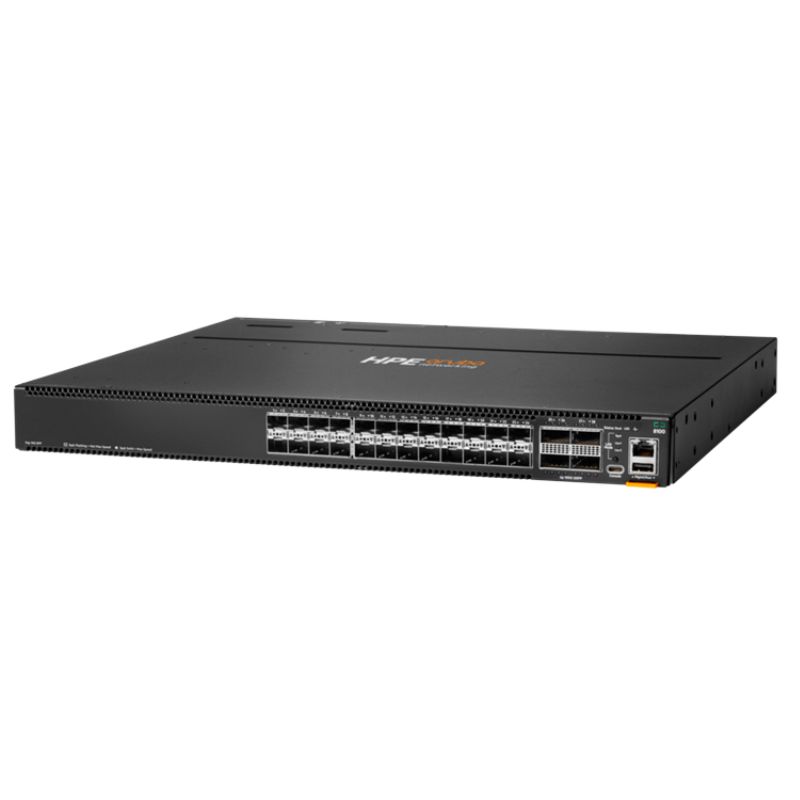
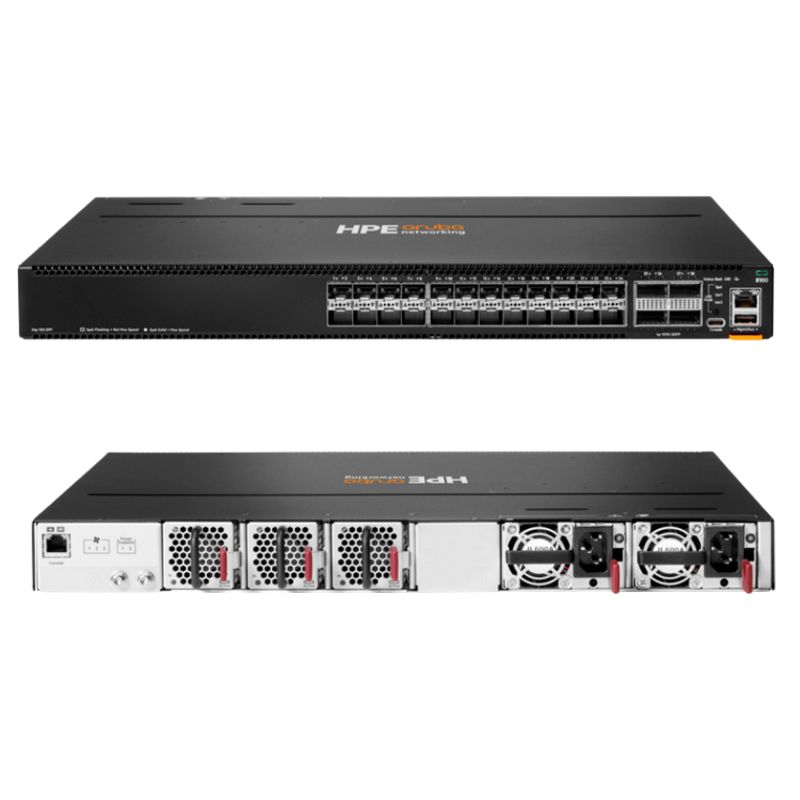
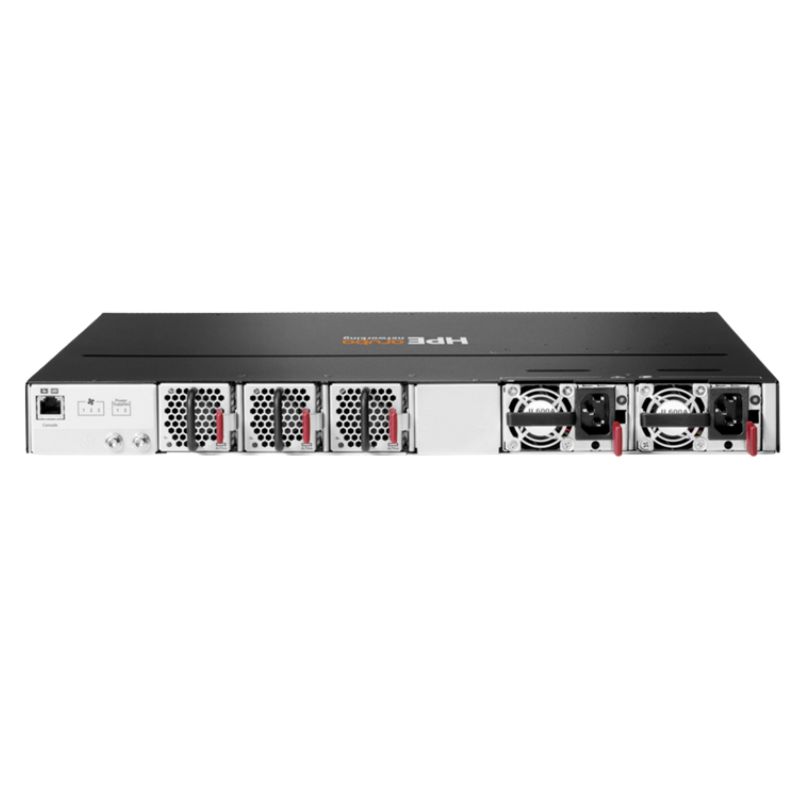
HPE R9W86A Aruba Networking Cx 8100 24x10g Sfp+ 4x40/100g Qsfp28 Switch L3 Managed 24 Ports Rack-mountable. Excellent Refurbished with 1 year replacement warranty
Elevate spine-and-leaf, aggregation, or high-density access layers with the HPE R9W86A Aruba Networking CX 8100. This Layer 3, fully managed switch blends wire-speed 10GbE optics with flexible 40/100GbE uplinks, front-to-back airflow, and enterprise-class automation to keep modern data centers and core networks fast, resilient, and simple to operate.
Built for scale-out architectures, the CX 8100 provides deep buffers, rich ACL capacity, extensive routing, and standards-based interoperability. It’s ideal for enterprises standardizing on 10G optical access with high-bandwidth 100G uplinks to cores or spines.
The HPE R9W86A Aruba Networking CX 8100 switch family entry described here — a 24x10G SFP+ plus 4x40/100G QSFP28 L3 managed, front-to-back airflow, rack-mountable platform — is positioned for organizations that require high-density 10 Gigabit connectivity with native uplink options to 40 Gigabit and 100 Gigabit fabrics. This category page content explains what buyers, architects, and operations teams need to know when evaluating the Aruba CX 8100 model for top-of-rack, aggregation, or compact core deployments. The description emphasizes the product’s role in modern data center and campus fabrics, how its port mix accelerates server-to-switch connectivity and uplink consolidation, and why ArubaOS-CX software and modern management capabilities matter when you plan for automation, security, observability, and lifecycle simplicity.
The 24x10G SFP+ port density addresses the widespread need to migrate racks and server clusters from 1 Gigabit to 10 Gigabit server connectivity without over-provisioning physical space. The additional four QSFP28 ports that can operate as 40G or 100G uplinks let network teams consolidate uplinks to high-capacity aggregation or spine layers, reducing the number of discrete cables, transceivers, and intermediate devices. Customers running virtualized server farms, hyperconverged infrastructure, storage networks requiring predictable throughput, or east-west application traffic will find the 24x10G + 4xQSFP28 combination especially attractive because it balances high-port density at the access layer with upgrade paths to multi-hundred-gig fabrics.
This model’s rack-mountable chassis and front-to-back airflow are designed for modern data center hot aisle / cold aisle cooling architectures and for environments where directional airflow is a requirement for thermal containment strategies. Front-to-back airflow minimizes impact on the data center’s chilled air management and simplifies integration into enclosed racks or containment systems. The chassis also supports standard rack rail mounting and is sized to fit common 19-inch racks, allowing easy replacement of older access switches or consolidation of multiple smaller switches into a single CX 8100 unit. For procurement and operations teams, this reduces rack footprint while preserving or increasing port count and power/thermal predictability.
One of the most important buying considerations for network architects is software capability. The Aruba CX operating system brings a programmable, modular network OS to the CX 8100 platform. ArubaOS-CX emphasizes modern automation, stable APIs, and operational features that reduce time-to-deploy and time-to-repair. For organizations adopting automation, the platform supports REST and streaming telemetry, configuration as code workflows, and integration with popular automation frameworks such as Ansible, Python scripting, and CI/CD pipelines. These programmable interfaces enable netops teams to treat the switch like an infrastructure resource that can be version-controlled, validated, and rolled out at scale.
Observability is built into the platform in the form of enhanced telemetry streams, real-time statistics, and comprehensive counters that facilitate troubleshooting and capacity planning. Telemetry data can be exported to your chosen analytics or monitoring system for long-term trending or to feed machine learning models that detect anomalies. This capability shortens mean-time-to-innocence by enabling clearer root cause analysis of traffic patterns, microbursts, and host-level congestion issues. For teams transitioning from CLI-only operations, ArubaOS-CX provides both the traditional CLI and a rich API surface for automated monitoring and remediation.
As an L3 managed switch, the CX 8100 supports a broad set of routing and Layer 3 services required in modern fabrics. It is designed to handle IPv4 and IPv6 routing scenarios, static and dynamic routing protocols, and routing features that matter at the access and aggregation layers. Expect support for OSPF and BGP for dynamic connectivity, VRF-based segmentation for multi-tenant or service separation, and ECMP for load-distribution across multiple paths. These routing capabilities let the device participate as a resilient aggregation point or a compact distribution node in larger campus or data center networks while preserving deterministic forwarding behavior.
Performance on this class of switch is tuned for low-latency, predictable forwarding behavior under mixed traffic loads. The architecture supports wire-speed forwarding on all ports while minimizing microburst impact through effective buffering strategies and hardware-based queuing. Resilience is achieved through redundant management and failover paths at the software level and through modular hardware elements like replaceable fans and serviceable power options at the chassis level. Network teams will value the predictable failover characteristics that support high-availability designs across hypervisor clusters and clustered storage arrays.
The 10G SFP+ ports are compatible with a wide range of SFP+ transceivers and DAC/active optical cable assemblies, giving you flexibility in choosing cost-effective copper or higher-performing fiber attachments. The QSFP28 uplinks provide flexible breakout options: you can run a QSFP28 as a single 100G link, as a 40G QSFP+ where supported, or use breakout cables to create multiple 10G/25G links when consolidation or staged migrations are required. This flexibility is crucial for phased data center upgrades because it allows gradual replacement of cabling and optics without disrupting live services. Choosing the right optics strategy — mixing direct-attach copper for short, cost-sensitive connections and SR/LR optics for longer fiber runs — helps control total cost of ownership while meeting performance goals.
When deploying the CX 8100 in a mixed-speed fabric, careful planning of uplink consolidation and oversubscription ratios is required. The 24x10G access ports can be aggregated into the 40/100G uplinks using link aggregation and LACP or through routed uplinks with ECMP. Design decisions should factor in the expected east-west traffic, server-to-storage patterns, and whether storage fabrics or bursty east-west traffic will require larger buffers or additional uplink capacity. The switch’s flexible QSFP28 ports make it easy to add higher-capacity uplinks as traffic demands grow, which is ideal for organizations that want to avoid forklift upgrades when application use increases.
Security is a fundamental requirement for any modern network device. The Aruba CX 8100 supports a layered security model that includes access control lists, role-based access, and port-level security policies. In deployments where encryption and secure link-level protection are required, features such as MACsec can be leveraged where supported and licensed. Microsegmentation and VRF-based separation are key strategies supported by the platform to isolate tenant traffic, separate production from management planes, and enforce east-west traffic controls at the access layer. For compliance-driven environments, the ability to apply consistent policy across physical and virtual workloads simplifies audit readiness and reduces configuration drift.
Modern campus and data center environments rely on identity and context-aware policies. Aruba platforms integrate with identity services and directory systems to enforce dynamic network access based on user, device, or workload identity. This means it’s possible to apply granular security and quality-of-service rules tied to workloads rather than only to IP or MAC addresses, improving both security posture and application performance. The device can also integrate with centralized policy controllers and orchestration tools to ensure consistent enforcement as workloads move or scale.
Operational simplicity is achieved through a combination of ArubaOS-CX’s automation, built-in health checks, and integration with Aruba Central or third-party orchestration systems. Zero-touch provisioning (ZTP) capabilities reduce the labor required to bring new switches into production, and configuration templates or device groups let administrators push consistent settings across multiple boxes in a single action. For day-2 operations, the platform supports advanced diagnostics and troubleshooting tools that shorten time-to-resolve by providing detailed visibility into cable status, transceiver diagnostics, CPU and memory health, and per-interface performance metrics.
When planning maintenance windows, network teams should note the platform’s support for online software upgrades and rolling update patterns where applicable. Redundant design at the fabric level minimizes disruption during maintenance, and replaceable field parts such as fans simplify in-rack serviceability. Because the CX 8100 targets environments that need high uptime, it’s often deployed with redundant uplinks and paired for graceful failover. Documenting upgrade paths and testing in a non-production environment before wide-scale changes helps ensure that software revisions and feature toggles behave as expected.
This switch is ideal for a range of common and evolving enterprise network patterns. In a data center top-of-rack (ToR) role it connects server blades, hyperconverged nodes, and storage arrays to high-capacity aggregation fabrics. In campus networks it can function as a compact distribution switch where multiple 10G links need to converge into fewer 40/100G uplinks. For service providers with edge compute requirements, the device offers a balance of density and uplink flexibility without consuming excessive rack units. In all these scenarios, its combination of SFP+ and QSFP28 ports simplifies migration from legacy 1G infrastructures to 10G and beyond.
High-performance virtualized environments and container platforms benefit from the increased east-west bandwidth and low-latency forwarding. Database clusters and storage traffic especially appreciate the reduced oversubscription when uplinks are upgraded to 40G or 100G. Virtual desktop infrastructures, AI/ML training clusters, and media processing pipelines also see measurable benefits from a larger aggregate bandwidth and deterministic forwarding. For campuses, linking buildings or wiring closets with 40G/100G uplinks reduces the number of devices required and simplifies network topologies.
Choosing the correct optics is a critical planning detail. For short-reach connectivity inside a rack or between adjacent racks, direct-attach copper or short-range multimode optics are cost-effective choices. For longer runs that cross rooms or buildings, single-mode optics with appropriate reach are appropriate. The QSFP28 uplinks are versatile; they can operate as native 100G or be broken out to multiple 10G/25G links using breakout cables — a useful capability for phased upgrades. When creating a procurement list, match transceiver types and distances to your cabling plant and reserve spares for common failure modes.
Although this model is not a PoE access switch, power provisioning and cable management still matter. A clean cable plant reduces airflow obstruction, supports easier inventory and maintenance, and improves cooling efficiency in containment designs. Power selection should consider the redundancy model you intend to use — single or dual power inputs where available — and the expected power draw under peak port utilization. Coordinating power and airflow planning with facilities avoids thermal throttling and supports predictable long-term operations.
Deploying the CX 8100 typically happens as part of a broader Aruba or mixed-vendor ecosystem. Integration with Aruba Central or on-premises management tools provides centralized visibility, role-based access, and lifecycle management across wired and wireless infrastructure. Open APIs and common standards ensure the switch can also integrate with third-party orchestration, security, and monitoring tools. This interoperability gives IT teams the flexibility to adopt cloud-based management or maintain traditional on-premises control without sacrificing feature parity in day-to-day operations.
Before purchase, review licensing models for advanced features such as encryption, advanced telemetry, and premium support services. Enterprise-grade support contracts can include enhanced SLAs, on-site spares, and access to feature-rich software releases. Warranty and support tiers vary by vendor and region; organizations should align their purchase with the level of operational assurance they require. For critical deployments, extended support and hardware replacement options can provide rapid recovery paths and predictable operational budgets.


 Contact Us
 Information
 Catalog
 Solid State Drives (SSD)
 Network Switches
 Hard Disk Drives
 HBA & Controllers
 PC & Servers
 PC & Server Memory
 CPU & Processors
 Network Routers
 Power Supplies
 Tape Drives & Libraries
 Network Devices
 Computer & Network Cables