(7% discount is applied at checkout)
Cart is empty
Your go-to destination for cutting-edge server products
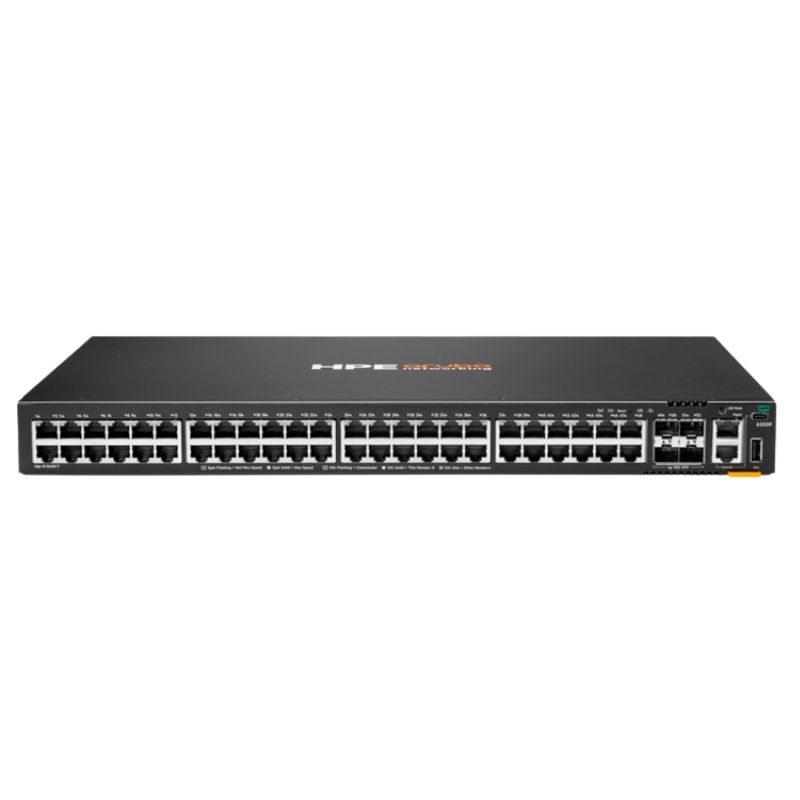


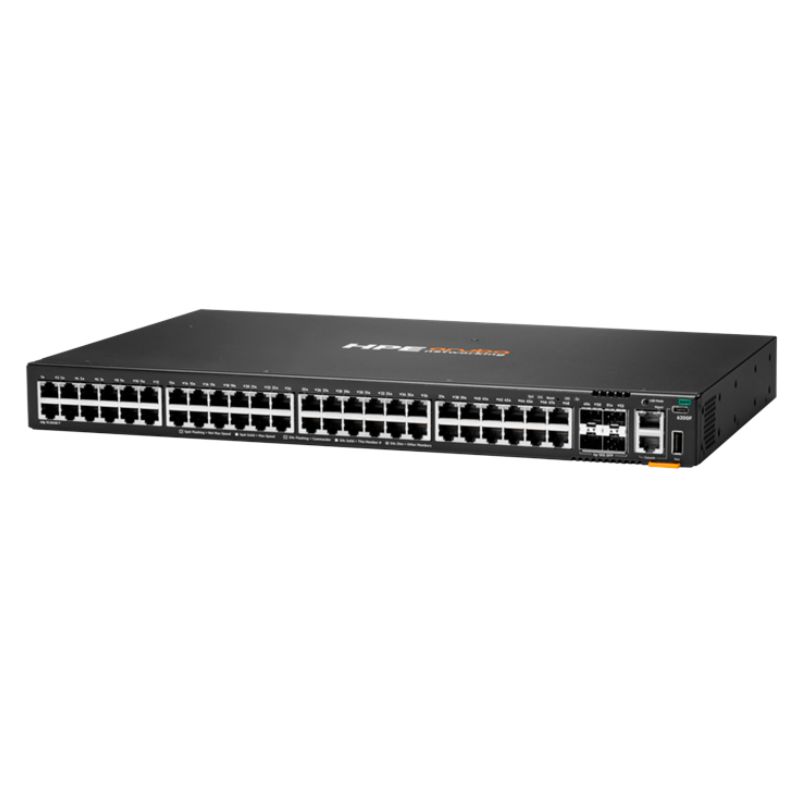
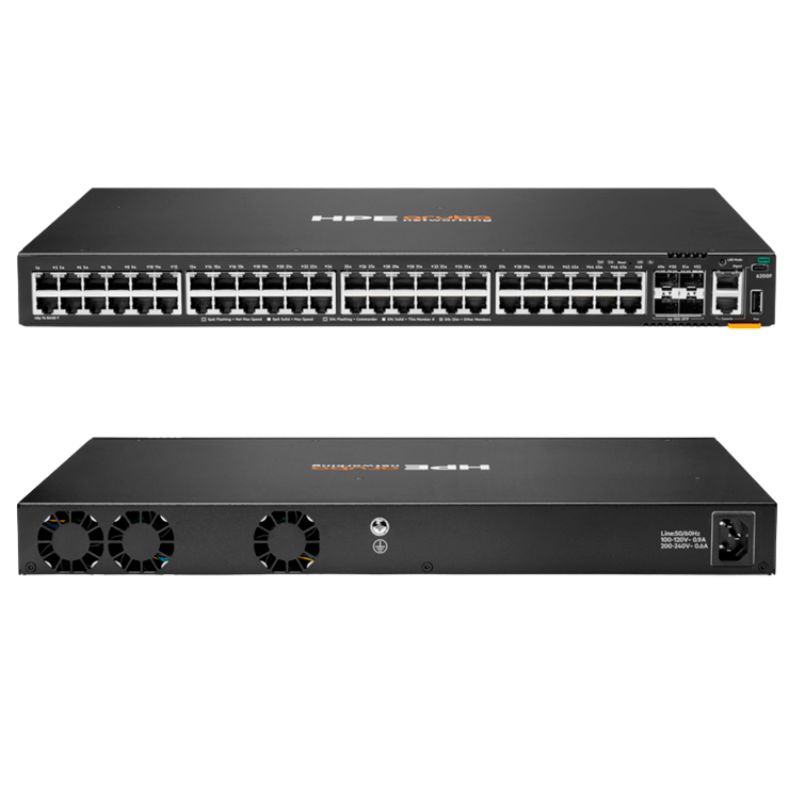
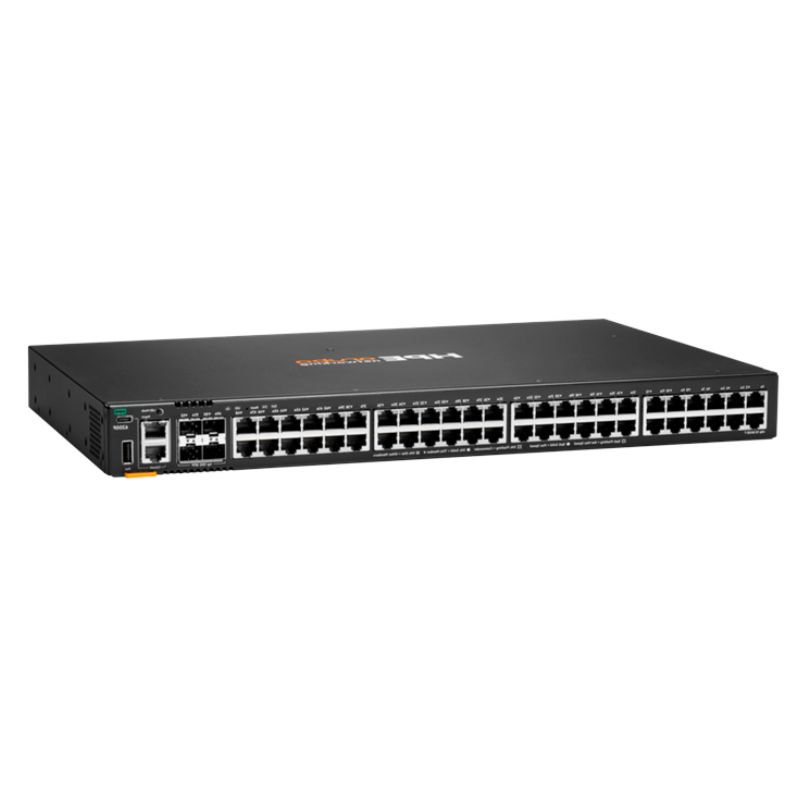
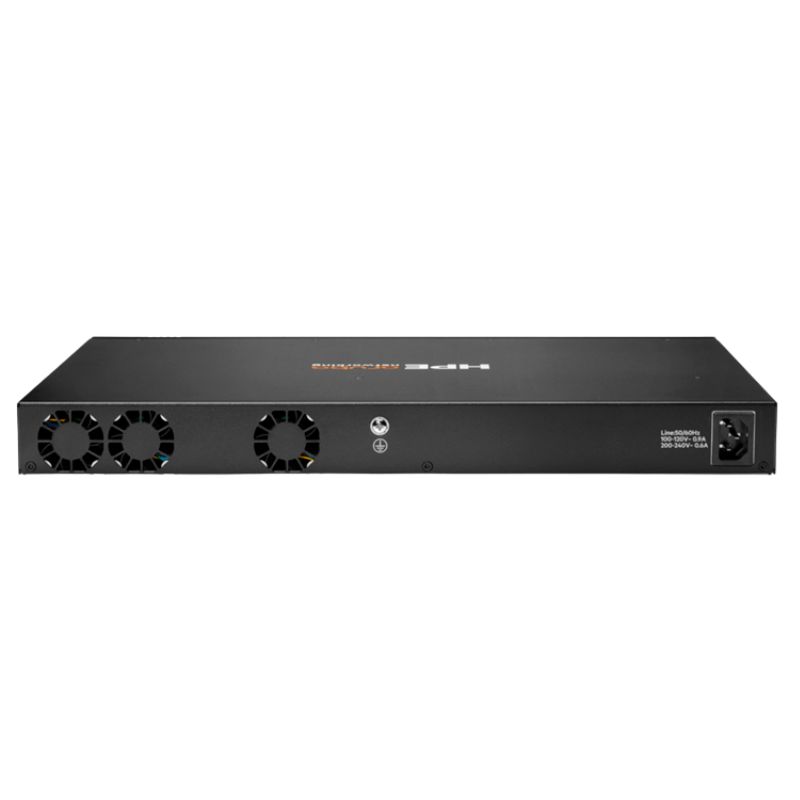
HPE S0M85A Aruba Networking Cx 6200f 48g Class 4 Poe 4sfp 740w 48 Ports Managed Rack-mountable Switch. Factory-Sealed New in Original Box (FSB) with 3 Years Warranty
The HPE Aruba CX 6200F (S0M85A) is a high-density, rack-mountable Layer-3 switch designed for modern enterprise edge deployments. Combining powerful Power-over-Ethernet capability with advanced stacking and routing features, this 1U appliance delivers resilient connectivity for access-layer aggregation, IP phones, wireless access points, and edge routing tasks.
The HPE S0M85A Aruba Networking CX 6200F 48G Class 4 PoE 4SFP 740W switch represents a class-leading access-layer solution for modern enterprise and campus networks. This category focuses on managed, rack-mountable gigabit edge switches designed for dense device environments that require robust Power over Ethernet (PoE) capability, predictable performance, and long-distance stacking. The product SKU highlighted here can act as a model example for network architects looking to standardize on Aruba CX-series access switches that combine a full set of Layer 2 and foundational Layer 3 features with a high PoE power budget — making it ideal for access deployments powering wireless access points, IP phones, surveillance cameras and other powered devices.
Buyers choosing switches in this category are seeking several simultaneous outcomes: an enterprise-class hardware platform with 48 gigabit copper ports to connect client devices, the capability to deliver Class 4 PoE to power demanding endpoints, a substantial shared PoE power budget (740W in this SKU), and flexible fiber uplinks through SFP ports. They also want managed features for traffic segmentation, security, Quality of Service (QoS), monitoring and automation — all packaged in a compact, rack-mountable form factor. The CX 6200F family addresses these needs by combining stable hardware engineering with Aruba’s modern CX operating environment, making the switches suitable for campus access, branch consolidation, small data center top-of-rack, and converged infrastructure where voice, video and wireless traffic coexist.
At the core of this category are switches with 48 10/100/1000 Mbps RJ-45 ports offering high port density for user access. For uplinks and stacking, the inclusion of SFP slots allows administrators to deploy fiber or fiber-to-copper conversion modules depending on the site architecture. The presence of four SFP ports in the CX 6200F configuration gives network designers the flexibility to build resilient uplink topologies, to aggregate traffic towards distribution switches, or to interconnect across fiber runs when copper cabling is impractical. The emphasis in this category is on delivering predictable gigabit performance for hundreds of devices across wiring closets and small aggregation points.
Power delivery is a defining attribute for switches in this category. The “Class 4 PoE” designation indicates elevated power capability compared to basic PoE switches, enabling support for a wide range of powered devices commonly deployed at the network edge. The 740W aggregate power budget on the CX 6200F SKU allows organizations to power many devices concurrently without needing separate power injectors or midspan devices. Practically, this translates into simplified cabling, easier installation of wireless access points and cameras, and reduced rack clutter, which is particularly valuable in tight spaces such as branch offices, classrooms, retail locations and wiring closets.
Successful PoE deployments require careful planning of the shared power budget. The 740W capacity in the CX 6200F delivers significant headroom for powering APs, phones and cameras, but administrators should account for peak draw, redundancy requirements, and the types of power-sourcing equipment (PSE) and powered devices (PD). Aruba switches provide per-port power control and allocation features that help operators set power limits, schedule power availability and monitor real-time consumption, enabling granular and audit-ready management of powered deployments.
Another important differentiator for this category is stacking capability. The CX 6200F’s designation of “Max. Stacking Distance 10 Kms” points to the ability to interconnect switches across extended fiber links, enabling a single logical stack across sites or campus buildings separated by longer spans. This long-distance stacking capability helps preserve centralized management, simplifies firmware upgrades, and provides unified control-plane behavior while maintaining physical distribution. For enterprises with geographically spread wiring closets or campus buildings, extended stacking reduces management overhead and supports consistent policy enforcement across the network.
Designers can leverage stacking either to create high-availability fabric within a single wiring closet or to span multiple closets across a campus using fiber links that approach the 10-kilometer capability. Typical use cases include campus edge aggregation where several access switches must present a unified management plane, and branch office environments where simplified operations are prioritized. Stacked switches behave as a single logical unit for many administrative tasks, reducing configuration drift and easing the application of network-wide updates and policies.
Operationally, stacking reduces the number of devices an administrator must log into, centralizes the control plane, and often simplifies high-availability strategies by enabling rapid failover across members of the stack. In environments where uptime is critical, stacking provides fault isolation and continuity so that a single device or uplink failure does not result in a broad outage. The ability to span stacks over long distances also supports disaster-avoidant physical designs, where redundant links can be routed via separate fiber conduits to protect against localized infrastructure damage.
Switches in the HPE Aruba CX 6200 family are built to integrate with Aruba’s CX operating environment and management ecosystem. This includes support for modern programmability paradigms, telemetry and automation tools that reduce manual configuration toil. Administrators expect features like role-based access control, policy-based segmentation, integrated DHCP helper and IP helper capabilities, and support for VLANs, VXLAN overlays and advanced routing primitives depending on the model. In smart campus deployments, the ability to manage these switches through Aruba Central or on-premises controllers improves operational visibility and accelerates troubleshooting.
The category emphasizes programmability and observability. Support for RESTful APIs, streaming telemetry and standard management interfaces allows network teams to integrate the switch into their existing automation pipelines and network monitoring stacks. Real-time telemetry enables proactive detection of anomalies, planned capacity upgrades, and better SLA enforcement for delay-sensitive applications such as VoIP and video conferencing. These software capabilities make the switch more than just a hardware endpoint — they transform it into an instrumentable element of a policy-driven network.
Organizations with multiple sites or distributed branch architecture gain strong benefits from centralized cloud management. In such scenarios, Aruba Central or similar management platforms can push templates, apply consistent security policies, and collect logs and telemetry from all CX 6200 devices in a single pane of glass. This reduces the time to provision new sites and enforces consistent configurations across regions, making scale-out deployments more predictable and less error-prone.
Performance expectations for this type of switch include consistent packet forwarding, low-latency handling for real-time traffic, and hardware QoS that prioritizes voice and video flows. The 48-port CX 6200F models provide the throughput necessary to support dense edge deployments and include QoS mechanisms to honor traffic classes. This enables network administrators to build converged networks where data, voice and video share the same infrastructure while still meeting performance SLAs.
For organizations deploying IP telephony, unified communications or live video, predictable latency and jitter are critical. The switches in this category are engineered to minimize buffering and maintain consistent forwarding behavior under load. They also support classification and shaping features to prioritize mission-critical traffic and to prevent congestion from degrading user experience.
Resiliency is provided through features like link aggregation, redundant uplinks, multiple spanning tree instances or alternatives, and the aforementioned stacking capabilities. These constructs allow networks to remain operational despite individual component failures and help preserve business continuity in high-availability environments.
The HPE Aruba CX 6200F 48G switches are particularly well-suited for a broad set of deployment scenarios. Education campuses require reliable connectivity for classrooms, labs and administrative offices; healthcare facilities demand secure segmentation for sensitive systems; retail locations prioritize easy PoE deployment for point-of-sale terminals and cameras; and corporate offices need dense access switching for worker devices and conferencing systems. These switches serve as the hardened edge that supports digital transformation initiatives in each of these industries.
In campus access layers, the 48-port density affords consolidation of multiple client connections into a single rack unit, while fiber uplinks and stacking enable flexible topologies. IT teams benefit from the CX OS feature set and from Aruba’s ecosystem for managing thousands of access ports from a central console. This reduces both the footprint and the complexity of campus network designs while enabling advanced features like user-based policies and distributed analytics.
For branch offices, the ability to power devices directly from the switch and to use long-distance stacking or fiber uplinks simplifies site design. A single CX 6200F switch can provide connectivity, power and local intelligence to a small office, eliminating the need for multiple devices and reducing points of failure. Remote sites can also be centrally managed from the headquarters via cloud or controller-based management platforms.


 Contact Us
 Information
 Catalog
 Solid State Drives (SSD)
 Network Switches
 Hard Disk Drives
 HBA & Controllers
 PC & Servers
 PC & Server Memory
 CPU & Processors
 Network Routers
 Power Supplies
 Tape Drives & Libraries
 Network Devices
 Computer & Network Cables