
(7% discount is applied at checkout)
Cart is empty
Your go-to destination for cutting-edge server products
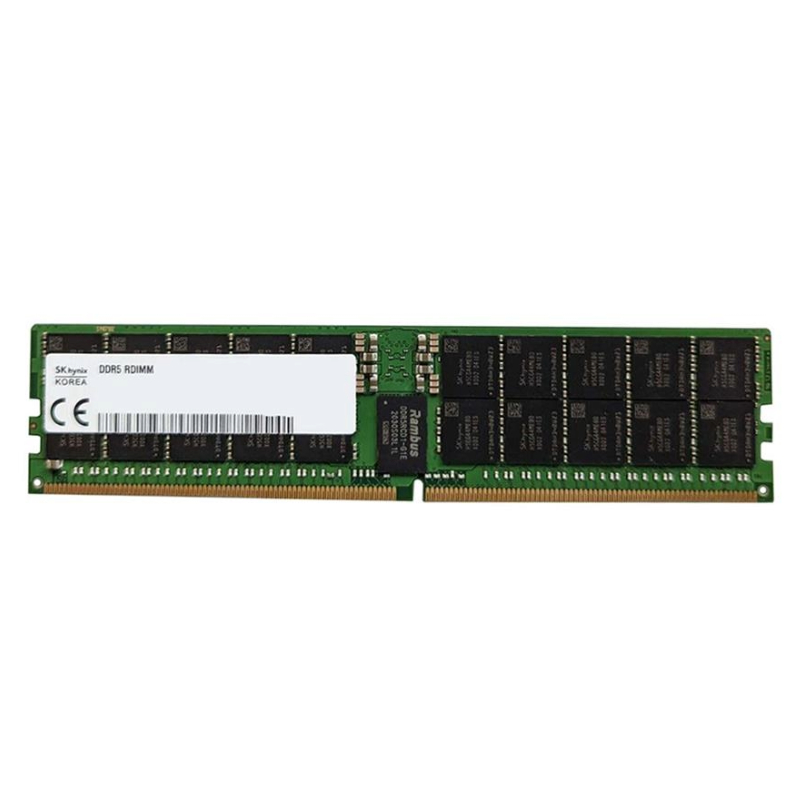
Hynix HMCG84MEBRA116N 32GB PC5-38400 DDR5-4800MHz ECC Registered CL40 288-Pin RDIMM 1.1V Single Rank Memory Module. New (System) Pull with 1 year replacement warranty
The Hynix HMCG84MEBRA116N is a high-performance 32GB DDR5 memory module designed for servers and workstation platforms that require reliable, error-correcting memory. This is an ECC Registered RDIMM (registered) module built to deliver stable throughput and enterprise-grade data integrity.
Ideal for data centers, virtualization hosts, database servers, and workstation systems that require:
This specific module encapsulates the cutting-edge transition from DDR4 to DDR5 technology in the server space. The part number itself, HMCG84MEBRA116N, follows SK Hynix's internal coding but decodes to reveal its key specifications: a 32GB capacity, DDR5-4800 speed, ECC Registered design in a 288-pin RDIMM form factor. Let's dissect the core technologies that make this module a powerhouse for next-generation servers.
DDR5 memory is not merely an incremental speed bump over DDR4; it represents a fundamental architectural overhaul designed to address the bottlenecks of modern multi-core processors and data-intensive workloads.
The HMCG84MEBRA116N operates at a data rate of PC5-38400 (4800 MT/s), offering a significant boost in peak theoretical bandwidth compared to mainstream DDR4-3200. This is achieved through a combination of higher clock speeds and a more efficient bus design. DDR5 divides each memory channel into two independent sub-channels. While this module is a single-rank design, this architectural shift allows the memory controller to address each sub-channel separately, improving concurrency and efficiency for smaller, more random access patterns common in server applications.
A pioneering feature of DDR5 is the inclusion of On-Die ECC. This is distinct from the module-level ECC provided by the traditional ECC bits. ODECC operates internally within each DRAM chip, correcting minor bit errors that occur *inside* the chip before data is sent to the memory buffer or controller. This layer of protection enhances the chip's longevity and reliability, reducing the burden on the main ECC system and contributing to overall system data integrity—a critical feature for servers in remote or high-availability environments.
DDR5 modules relocate the voltage regulation from the motherboard to the module itself via an integrated PMIC. Operating at a nominal voltage of 1.1V, the PMIC provides more stable and cleaner power delivery to the DRAM chips. This leads to improved signal integrity, better overclocking potential (even in JEDEC-spec servers), and greater power efficiency. The PMIC also enables more granular power management, allowing systems to optimize consumption per module based on workload demands.
Paired with the registered design is ECC, a fundamental technology for mission-critical systems. ECC memory has the ability to detect and correct the most common types of internal data corruption. As memory densities increase and transistor sizes shrink, the susceptibility to single-bit errors from cosmic rays, alpha particles, or electrical noise grows. ECC works by adding extra bits (e.g., 8 bits for a 64-bit word) to create a code word. When data is read, the memory controller recalculates the ECC bits and compares them to the stored values. If a single-bit error is detected, it is instantly corrected before the data is sent to the CPU. Multi-bit errors are detected and reported, allowing the system to halt gracefully rather than propagate corrupted data, which could lead to application crashes, corrupted files, or incorrect scientific calculations. For any server handling financial transactions, patient data, or acting as a host for virtual machines, ECC is an indispensable safeguard.
The physical interface has changed from DDR4's 288-pin layout to a new 288-pin design for DDR5, with a differently placed notch to prevent accidental insertion into an incompatible slot. The RDIMM (Registered DIMM) construction of this Hynix module means it includes a Register Clock Driver (RCD). The RCD buffers the command and address signals from the memory controller, as well as the clock signals, ensuring clean and stable electrical communication to all the DRAM chips on the module. This is essential for maintaining signal integrity at high speeds and high densities, especially when populating all memory slots in a multi-CPU server board.
This module is specified as a Single Rank (1Rx4 or 1Rx8) design. A "rank" is an independent set of DRAM chips that is accessed simultaneously by the memory controller. Single-rank modules generally place less electrical load on the memory channel compared to dual-rank (2R) modules. This often allows for slightly higher operating frequencies or easier support for higher numbers of modules per channel. The choice between single and dual rank involves a trade-off between potential speed, capacity per module, and the total population configuration of the server.
The Hynix 32GB DDR5-4800 ECC RDIMM is engineered for specific server platforms that demand a balance of high bandwidth, large capacity, and unwavering reliability.
This memory is designed for servers powered by Intel Xeon Scalable Processors (Sapphire Rapids and Emerald Rapids generations) and AMD EPYC 7004 "Genoa" and 8004 "Siena" series processors. These platforms natively support DDR5 memory, leveraging its increased bandwidth to feed their numerous CPU cores and advanced I/O subsystems. It is crucial to always verify motherboard and CPU compatibility lists (QVL) before purchasing, as BIOS support and speed limitations can vary.
Hypervisors like VMware vSphere, Microsoft Hyper-V, and KVM are extremely memory-hungry. Each virtual machine (VM) requires dedicated RAM, and overall consolidation ratios depend heavily on available memory capacity and speed. The 32GB size per module offers a excellent density for building large memory pools (e.g., 256GB, 512GB, or 1TB+ per server), while the bandwidth of DDR5-4800 ensures responsive performance when multiple VMs are actively competing for memory resources.
Technologies such as SAP HANA, Oracle Database In-Memory, and Redis keep entire datasets in RAM for ultra-low latency access. For these applications, memory is the primary storage tier. The combination of high capacity (32GB per module), high bandwidth (PC5-38400), and the critical data integrity provided by ECC makes this type of memory ideal. Faster memory directly translates to quicker query times, real-time analytics, and more efficient transaction processing.
Clusters used for computational fluid dynamics, finite element analysis, genomic sequencing, and climate modeling require immense memory bandwidth to feed thousands of concurrent computing threads. The bandwidth offered by DDR5 in a registered configuration is vital for minimizing processor idle time. Furthermore, ECC protection is often mandatory in scientific computing to ensure the absolute accuracy of lengthy, complex calculations that can run for days or weeks.
Modern scale-out storage appliances and high-end Network Attached Storage (NAS) devices use substantial RAM for caching, metadata operations, and deduplication tables. Faster, larger memory pools accelerate data serving speeds, improve metadata lookup times, and enhance the performance of storage protocols like SMB, NFS, and iSCSI. ECC is, again, critical here to prevent silent data corruption within the storage system's cache.


 Contact Us
 Information
 Catalog
 Solid State Drives (SSD)
 Network Switches
 Hard Disk Drives
 HBA & Controllers
 PC & Servers
 PC & Server Memory
 CPU & Processors
 Network Routers
 Power Supplies
 Tape Drives & Libraries
 Network Devices
 Computer & Network Cables