
(7% discount is applied at checkout)
Cart is empty
Your go-to destination for cutting-edge server products
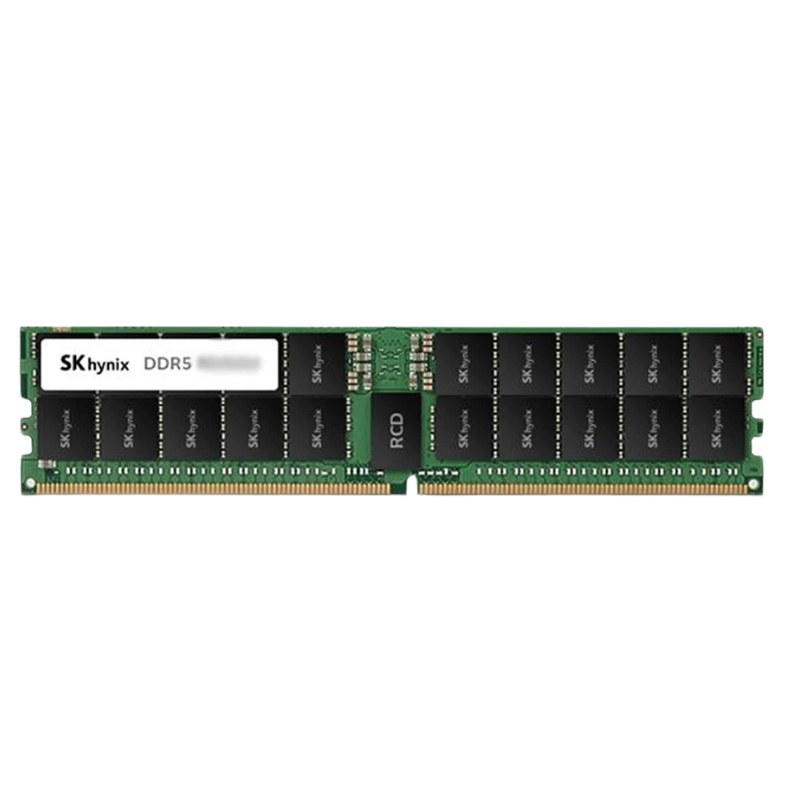
Hynix HMCG88AGBRA186N 32GB Pc5-44800 DDR5-5600MT/s 2Rx8 ECC Memory. New (System) Pull with 1 year replacement warranty
| SKU/MPN | Warranty | Price | Condition | You save |
|---|---|---|---|---|
| HMCG88AGBRA186N | 1 Year Warranty | $1,862.00 | New Sealed in Box (NIB) | You save: $651.70 (26%) |
| HMCG88AGBRA186N | 1 Year Warranty | $1,468.00 | New (System) Pull | You save: $513.80 (26%) |
Discover the Hynix 32GB DDR5 SDRAM registered memory module (model HMCG88AGBRA186N) — engineered for servers and workstations that require dependable, high-throughput memory. This RDIMM module delivers industry-grade ECC protection, ultra-fast 5600MT/s transfer rates and robust signal buffering for mission-critical environments.
Use cases
Best suited for
To understand the capabilities of this module, a deep dive into its part number is essential. Each segment of "HMCG88AGBRA186N" and its accompanying specifications tells a story of advanced engineering:
This 32GB capacity is the sweet spot for many modern server configurations, balancing high density with broad platform compatibility. The "2Rx8" designation is crucial. It means the module is dual-ranked (2R) and uses an x8 DRAM device organization. Dual-ranking allows the memory controller to access one rank while the other is preparing data, improving overall efficiency and throughput compared to single-rank modules at the same density. The x8 organization provides an optimal balance of performance, reliability, and capacity, making it a preferred choice for enterprise environments.
The 2Rx8 architecture reduces the load on the memory bus compared to x4-based modules, allowing for more stable operation at higher speeds and enabling systems to support more modules per channel. This is vital for maximizing total system memory capacity in multi-socket servers.
The module operates at a data rate of 5600 Megatransfers per second (MT/s), often colloquially referred to as DDR5-5600. This translates into a raw peak bandwidth of 44800 MB/s per module, as indicated by the "PC5-44800" classification (PC5 denotes DDR5, and 44800 is the bandwidth in MB/s). This represents a substantial increase over previous-generation DDR4 ECC modules, directly accelerating data-intensive tasks such as in-memory databases, virtualization, scientific simulation, and large-scale financial modeling.
DDR5's architectural improvements, including the doubling of burst length and the introduction of two independent 32-bit sub-channels per module (each with its own 7-bit ECC), contribute significantly to achieving this higher bandwidth. This effectively reduces latency and improves concurrent access, a key benefit for multi-threaded server workloads.
The "ECC" in the description is arguably the most critical feature for enterprise deployment. ECC memory can detect and correct the most common types of internal data corruption—single-bit errors—and detect multi-bit errors. This happens in real-time, transparent to the operating system and applications.
This Hynix module leverages the full DDR5 ECC architecture. Beyond the traditional module-level ECC that protects data on the bus, DDR5 incorporates On-Die ECC. ODECC operates inside each DRAM chip, scrubbing errors before they ever leave the die. This two-tiered approach—ODECC plus module-level ECC—dramatically improves chip yield, increases reliability, and reduces system-level failure rates, ensuring data integrity from the silicon level upwards.
The Hynix HMCG88AGBRA186N is not a general-purpose memory; it is a specialized component designed for specific, high-stakes computing environments.
In servers handling transactional databases (like Oracle, SQL Server), ERP systems, and customer relationship management (CRM) platforms, data corruption is not an option. The ECC functionality ensures data accuracy, while the high bandwidth supports rapid query processing and concurrent user access. For cloud service providers and hyperscale data centers, the module's density and reliability contribute directly to lower total cost of ownership (TCO) through reduced downtime and higher virtual machine density.
Simulations in fields like computational fluid dynamics, genomic sequencing, and climate modeling require massive datasets to be held in memory. The 32GB capacity per module allows for large problem sets, and the 5600MT/s speed accelerates computation cycles. Similarly, training machine learning models involves iterative processing of vast data arrays, where memory bandwidth can become a significant bottleneck. This DDR5 module helps alleviate that bottleneck.
Workstations used for computer-aided engineering (CAE), 4K/8K video editing, and complex 3D rendering rely on faultless operation. A single memory error could corrupt a render that took days to compute or invalidate a finite element analysis. ECC memory provides the necessary protection, and the DDR5 bandwidth drastically reduces wait times during asset manipulation and compilation.
Deploying the HMCG88AGBRA186N requires careful attention to system compatibility. It is designed explicitly for server and workstation platforms that support DDR5 memory with ECC functionality.
Before purchase, it is imperative to consult your server or motherboard manufacturer's Qualified Vendor List (QVL). The QVL specifies the exact memory models (including this Hynix part number) that have been tested and validated for use in that specific system. Using a QVL-listed module ensures optimal performance, stability, and eligibility for technical support. The Hynix HMCG88AGBRA186N is commonly found on QVLs for major OEM server platforms from Dell, HPE, Lenovo, and Supermicro.
This module is typically programmed with standard JEDEC timings for DDR5-5600, ensuring broad, plug-and-play compatibility in enterprise environments. It generally does not support extreme performance (XMP/EXPO) profiles, which are geared towards consumer overclocking. Its value lies in standardized, reliable operation at its rated speed.
The Hynix HMCG88AGBRA186N embodies the key architectural shifts that define the DDR5 standard, offering tangible benefits over DDR4.
A revolutionary change in DDR5 is the migration of the power management from the motherboard to the memory module itself. Each module, including this Hynix model, features an onboard PMIC. This allows for more precise voltage regulation, cleaner power delivery, and improved signal integrity. It also enables better power scaling and efficiency, which is critical for data centers managing power budgets across thousands of modules.
DDR5 doubles the number of bank groups compared to DDR4 (to 8 per channel). This increases parallelism, allowing more memory accesses to be in flight simultaneously. Coupled with a doubled burst length (BL16), the module can transfer more data per column access command, improving efficiency for sequential access patterns and feeding hungry CPUs more effectively.
These architectural enhancements mean that even at the same MT/s rating as a theoretical DDR4 module, a DDR5 module like this Hynix part would deliver higher effective bandwidth due to reduced overhead and greater access parallelism.
To achieve higher data rates on the electrical interface, DDR5 employs Decision Feedback Equalization. DFE allows the receiver to better interpret signals by accounting for interference from previously sent symbols, enabling cleaner data transmission at 5600MT/s and beyond. This technology is key to maintaining stability and signal integrity at the module's high operating frequency.


 Contact Us
 Information
 Catalog
 Solid State Drives (SSD)
 Network Switches
 Hard Disk Drives
 HBA & Controllers
 PC & Servers
 PC & Server Memory
 CPU & Processors
 Network Routers
 Power Supplies
 Tape Drives & Libraries
 Network Devices
 Computer & Network Cables