
(7% discount is applied at checkout)
Cart is empty
Your go-to destination for cutting-edge server products
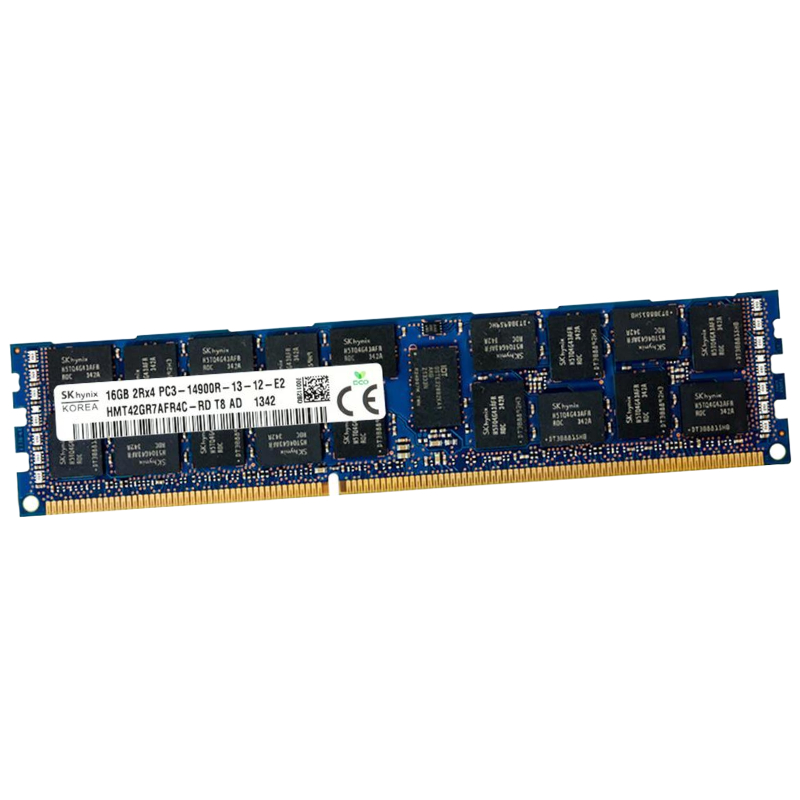
Hynix HMT42GR7AFR4C-RD 16GB PC3-14900 1866MHz DDR3 SDRAM 240-Pin ECC Reg RAM. New (System) Pull with 1 year replacement warranty
The Hynix HMT42GR7AFR4C-RD 16GB PC3-14900 1866MHz DDR3 ECC Registered Memory Module is a high-performance server-grade RAM stick designed for dependable operation, exceptional multitasking, and enhanced data stability. It is engineered for enterprise systems, data centers, and professional workstations that require consistent speed and reliability.
This memory module is compatible with systems that support **DDR3 ECC Registered RDIMM** architecture. It will not operate in desktops or laptops that require unbuffered (UDIMM) or non-ECC memory.
The Hynix HMT42GR7AFR4C-RD 16GB PC3-14900 1866MHz DDR3 SDRAM 240-Pin ECC Registered RAM module belongs to a highly dependable class of server-grade memory products known for stability, speed, and long-term durability. As a member of the broader DDR3 ECC Registered memory category, this module is a popular choice for enterprise servers, professional workstations, data storage systems, network hardware, and virtualized computing environments. Its 1866MHz performance speed and 16GB density make it suitable for modern workloads that require enhanced bandwidth and reliable multi-thread processing. This category of memory is specifically engineered for mission-critical systems where errors must be detected and corrected automatically to avoid crashes, data corruption, or unexpected downtime.
DDR3 ECC Registered memory modules such as the Hynix HMT42GR7AFR4C-RD are widely used across many IT infrastructures due to their consistent performance and compatibility with a wide range of Intel and AMD server platforms. Because they incorporate both Error-Correcting Code (ECC) and Register/Buffered technology, they help stabilize the memory signal and reduce electrical load on the memory controller. As a result, systems using ECC Registered RAM can support larger memory capacities with improved reliability compared to typical unbuffered modules. This makes the category especially important for organizations and professionals managing resource-heavy applications, including virtualization, cloud computing, analytics, 3D rendering, scientific computing, and enterprise databases.
The category that includes the Hynix HMT42GR7AFR4C-RD 16GB PC3-14900 DDR3 ECC Registered RAM focuses on providing fully compliant, server-ready memory modules that adhere to strict JEDEC specifications. These modules are built using high-quality DRAM chips designed to withstand continuous operation under heavy workloads. They offer strong thermal reliability, efficient electrical performance, and long-term endurance, all of which are crucial for enterprise applications. The PC3-14900 rating ensures that the module operates at an effective speed of 1866MHz, representing one of the highest speed grades available within the DDR3 platform. This allows faster data access, reduced bottlenecks, and improved system responsiveness.
Within this category, memory modules undergo rigorous testing and validation processes to ensure compatibility with server motherboards, cloud infrastructure systems, and professional workstation platforms. ECC functionality corrects common memory errors such as single-bit faults, while Registered/Buffered architecture stabilizes communication between the memory controller and the RAM module. These characteristics form the foundation of enterprise memory design and significantly reduce the risk associated with handling real-time business data or executing large-scale computational tasks.
Performance is a priority factor when selecting DDR3 ECC Registered memory, and modules in this category are engineered to meet enterprise-level expectations. The PC3-14900 classification corresponds to a peak transfer rate of approximately 14900MB/s, enabling high throughput for demanding workloads. The 1866MHz speed rating offers improved frame stability, reduced latency, and smoother multitasking capability. Systems equipped with higher-speed memory modules can manage larger datasets and support more users simultaneously in virtualized environments.
Another significant advantage of this category is the reduction in data interruptions. ECC functionality catches and corrects errors that occur during data transmission, which is especially important for servers running 24/7. Memory errors can occur from electrical interference, excessive heat, or degraded components, but ECC prevents these disturbances from reaching the operating system or user applications. For industries such as finance, cloud hosting, medical imaging, and telecommunications, this protection is essential.
Memory in this category is optimized for continuous uptime and dependable performance. Servers and professional workstations must operate without interruption, sometimes for years at a time. Because DDR3 ECC Registered memory reduces strain on the memory controller and provides auto-correction for errors, systems maintain superior stability even under intense workloads. The buffering mechanism within registered RAM manages the flow of electrical signals, ensuring clean communication between hardware components and minimizing signal distortion.
The Hynix HMT42GR7AFR4C-RD and other modules within its category are designed with advanced thermal distribution features. They efficiently dissipate heat, helping prevent system throttling or sudden shutdowns caused by overheating. Many enterprise servers also include advanced cooling mechanisms, and ECC Registered memory complements these by maintaining consistent thermal behavior.
ECC memory automatically detects and corrects common types of memory errors that can occur naturally during operation. These errors include single-bit faults, which are the most typical. Without ECC, a single-bit error can cause crashes, corrupt files, or compromise the accuracy of calculations. In high-performance computing, even small errors can lead to major operational losses. ECC memory prevents this by performing real-time analysis of data and correcting faults before they affect the system. In some cases, multi-bit errors can be detected and flagged, alerting administrators to take action before broader issues occur.
One of the biggest advantages of this category is its scalability. Organizations can start with a smaller amount of memory and expand over time as workloads increase. Because ECC Registered RAM is designed for high-density environments, servers can often support dozens of modules simultaneously. This flexibility enables enterprises to scale their infrastructure according to business growth.
Memory upgrades within this category are straightforward thanks to the standard 240-pin layout and broad compatibility. IT staff can replace faulty modules or increase memory capacity without extensive system reconfiguration. Many data centers rely on categories like the Hynix HMT42GR7AFR4C-RD due to the ease of sourcing replacements and matching specifications.
This category of memory is utilized across a wide variety of professional and enterprise environments. Due to its error-correcting capabilities and high-speed performance, it is ideal for any scenario where system uptime, stability, and data precision are essential. Many IT managers and professionals rely on these modules for server upgrades, cloud expansion, virtualization clusters, storage arrays, and computational systems.
Data centers prioritize stability, thermal reliability, and error-free computation. ECC Registered memory ensures that underlying hardware operates smoothly without unexpected crashes or costly downtime. High workload scenarios such as load balancing, database management, network routing, and cloud storage all benefit from robust memory solutions like the Hynix HMT42GR7AFR4C-RD.
Research institutions, universities, and laboratories often use HPC clusters that require large quantities of reliable memory. Tasks involving statistical modeling, physics simulations, genomics research, and AI training depend on uninterrupted data flow. ECC Registered memory is essential in preventing errors that could invalidate entire research computations.
Organizations benefit greatly from deploying memory products within this category. Even though DDR4 and DDR5 options exist, many businesses continue using DDR3 platforms due to their long-term reliability, cost-effectiveness, and proven performance. The category remains relevant for maintenance, upgrades, and extended lifecycle management of infrastructure systems.


 Contact Us
 Information
 Catalog
 Solid State Drives (SSD)
 Network Switches
 Hard Disk Drives
 HBA & Controllers
 PC & Servers
 PC & Server Memory
 CPU & Processors
 Network Routers
 Power Supplies
 Tape Drives & Libraries
 Network Devices
 Computer & Network Cables