
(7% discount is applied at checkout)
Cart is empty
Your go-to destination for cutting-edge server products
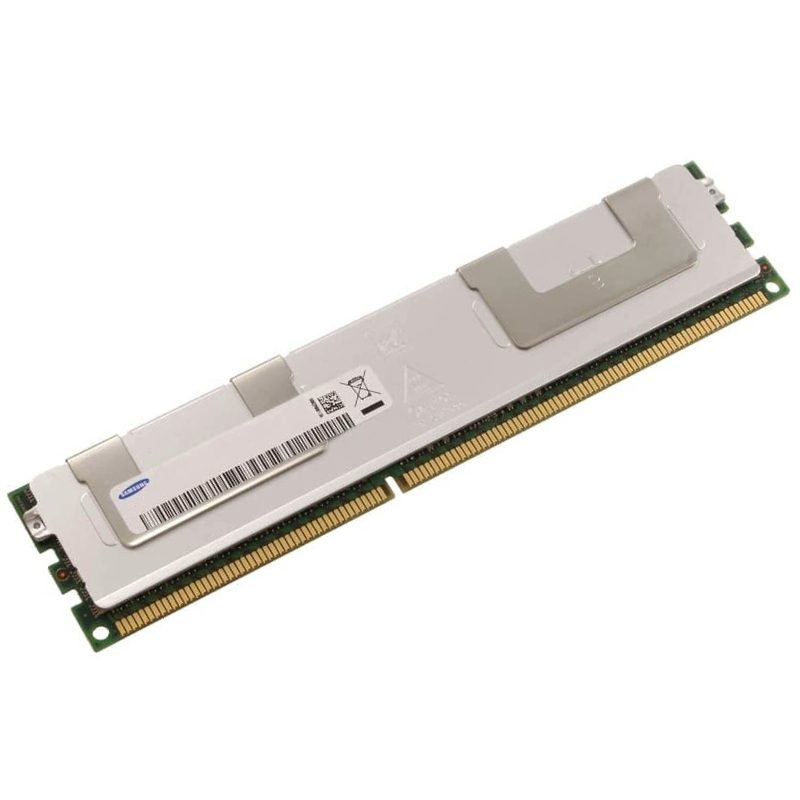
Samsung M386B4G70DM0-YK04 32GB RAM 1600Mhz PC3-12800 Ecc Reg SDRAM DDR3. New (System) Pull with 1 year replacement warranty
Elevate server reliability and speed with the Samsung M386B4G70DM0-YK04 memory module. This high-capacity 32GB PC3-12800 DDR3-1600MHz 4Rx4 ECC Registered DIMM is engineered for enterprise workloads, virtualization, and data-intensive computing, delivering consistent throughput and error-correct resilience.
The Samsung M386B4G70DM0-YK04 32GB DDR3 LRDIMM memory module belongs to a specialized category of enterprise-grade server memory engineered to support large-capacity configurations, high reliability, and stable performance in mission-critical computing environments. This category focuses on load reduced dual in-line memory modules designed specifically for data centers, enterprise servers, virtualization platforms, and memory-intensive workloads where capacity scalability and signal integrity are essential. DDR3 LRDIMM technology represents an advanced evolution beyond standard RDIMM solutions, enabling higher memory densities while maintaining electrical stability across populated memory channels.
DDR3 SDRAM technology serves as the foundation for this memory category, offering improved power efficiency and bandwidth compared to earlier DDR2 generations. Operating at 1600MT/s and rated as PC3-12800, this memory classification supports balanced throughput and latency characteristics suitable for enterprise workloads that rely on predictable memory performance. DDR3 server memory emphasizes consistency, error protection, and compatibility with multi-socket server architectures rather than raw consumer-oriented speed.
Error Correcting Code functionality is a defining characteristic of this category. ECC memory continuously monitors data integrity, detecting and correcting single-bit errors while identifying multi-bit faults. In environments such as databases, financial systems, scientific computing, and virtualization clusters, ECC memory plays a vital role in maintaining system stability and preventing silent data corruption. This category is engineered for systems where uptime, accuracy, and reliability outweigh consumer-level performance metrics.
Registered memory introduces a register between the memory controller and the DRAM chips, reducing electrical load and allowing more modules to be installed per channel. Load Reduced DIMM technology extends this concept further by incorporating a memory buffer that isolates the DRAM devices from the memory controller almost entirely. This category enables significantly higher memory capacities per server compared to RDIMM or UDIMM solutions, making it ideal for enterprise servers that require dense memory footprints.
LRDIMM memory modules like the Samsung M386B4G70DM0-YK04 are designed to overcome the electrical limitations associated with high-capacity memory configurations. By reducing the load seen by the memory controller, this category supports more ranks per channel and higher total memory capacities without sacrificing stability. This design is particularly beneficial in systems running large in-memory databases, virtualization hosts, and analytics platforms that require substantial RAM allocation.
Quad rank memory modules represent a significant advantage in this category, allowing more memory cells to be packed onto a single DIMM. Each rank operates as a separate set of memory chips, enabling efficient utilization of memory channels. Quad rank configurations are commonly found in high-capacity LRDIMM modules, making them suitable for servers that need to maximize memory density while minimizing physical DIMM slots.
The x4 DRAM organization used in this memory category enhances error detection and correction capabilities. By using narrower data paths per chip, x4 configurations improve ECC effectiveness, allowing systems to handle certain failure scenarios more gracefully. This design choice aligns with enterprise requirements where fault tolerance and data protection are paramount.
PC3-12800 memory operates at an effective data rate of 1600MT/s, providing sufficient bandwidth for a wide range of server workloads. This performance tier balances throughput, latency, and power efficiency, making it suitable for mixed-use environments that include transactional processing, virtualization, and application hosting. While newer memory standards exist, DDR3 PC3-12800 remains widely deployed in legacy and transitional enterprise infrastructures.
CAS latency plays a critical role in determining memory responsiveness. CL11 timing in this category represents a stable and widely supported latency configuration for DDR3 1600MT/s memory. This timing profile ensures compatibility with a broad range of enterprise server platforms while delivering predictable performance under sustained workloads.
In virtualized environments, memory latency affects application response times, VM density, and overall system efficiency. Memory modules in this category are engineered to deliver consistent latency behavior, reducing performance variability across virtual machines. This predictability is essential for service-level agreements and workload consolidation strategies.
Low voltage DDR3 memory operating at 1.35V is a key attribute of this category, contributing to reduced power consumption and thermal output. In large-scale data centers, energy efficiency directly impacts operational costs and cooling requirements. By lowering voltage without compromising stability, this memory category supports greener and more cost-effective infrastructure deployments.
Lower operating voltage results in reduced heat generation at the module level. This characteristic allows for denser memory configurations without exceeding thermal limits, supporting high-density server deployments. Efficient thermal behavior also contributes to longer component lifespan and reduced stress on cooling systems.
The 240-pin DIMM form factor is a standard for DDR3 server memory, ensuring compatibility with a wide range of enterprise server motherboards. This physical design supports robust electrical connections and secure module installation. The category emphasizes mechanical reliability, signal integrity, and compliance with industry standards.
This memory category is designed for compatibility with enterprise-grade servers that support DDR3 LRDIMM technology. These platforms typically include multi-socket processors, advanced memory controllers, and firmware optimized for registered and load reduced memory. Compatibility considerations extend beyond physical fit, encompassing BIOS support, memory training algorithms, and platform validation.
Multi-socket server systems benefit significantly from LRDIMM memory due to their ability to maintain signal integrity across multiple memory channels. This category supports balanced memory population strategies, enabling uniform access latency and bandwidth across processor sockets. Such configurations are essential for NUMA-aware applications and high-performance computing workloads.
Scalability is a defining feature of this memory category. Organizations can start with moderate memory configurations and expand capacity as workload demands increase. LRDIMM technology supports this growth without requiring a complete platform replacement, extending the useful life of enterprise servers.
Memory modules in this category are commonly deployed in environments that demand large memory pools and high reliability. Typical use cases include virtualization hosts running multiple virtual machines, database servers handling in-memory datasets, enterprise applications with high concurrency, and analytics platforms processing large volumes of data.
Virtualization platforms rely heavily on available memory to maximize VM density and performance. This category supports higher per-server memory capacity, allowing cloud providers and enterprises to consolidate workloads efficiently. Stable ECC-protected memory ensures that virtual machines operate reliably even under heavy utilization.
Databases benefit from large memory allocations to cache data and accelerate query performance. DDR3 LRDIMM memory enables servers to host larger datasets in memory, reducing disk I/O and improving transaction throughput. This category is well-suited for relational databases, data warehouses, and in-memory analytics solutions.
Within the broader DDR3 server memory ecosystem, 32GB LRDIMM modules occupy a high-capacity segment tailored for demanding workloads. They bridge the gap between standard RDIMM solutions and newer memory technologies by offering proven reliability and mature platform support. This category remains relevant in environments where DDR3 platforms continue to deliver sufficient performance.
Compared to UDIMM memory, LRDIMM modules provide significantly higher capacity and reliability, making them unsuitable for consumer systems but ideal for servers. When compared to RDIMM memory, LRDIMM offers superior scalability at the cost of slightly higher latency, a trade-off that is acceptable in capacity-driven enterprise workloads.
Consistent supply and long-term availability are important considerations for enterprise memory procurement. This category benefits from stable manufacturing processes and predictable specifications, enabling organizations to standardize on a specific memory module across multiple server generations..


 Contact Us
 Information
 Catalog
 Solid State Drives (SSD)
 Network Switches
 Hard Disk Drives
 HBA & Controllers
 PC & Servers
 PC & Server Memory
 CPU & Processors
 Network Routers
 Power Supplies
 Tape Drives & Libraries
 Network Devices
 Computer & Network Cables