
(7% discount is applied at checkout)
Cart is empty
Your go-to destination for cutting-edge server products
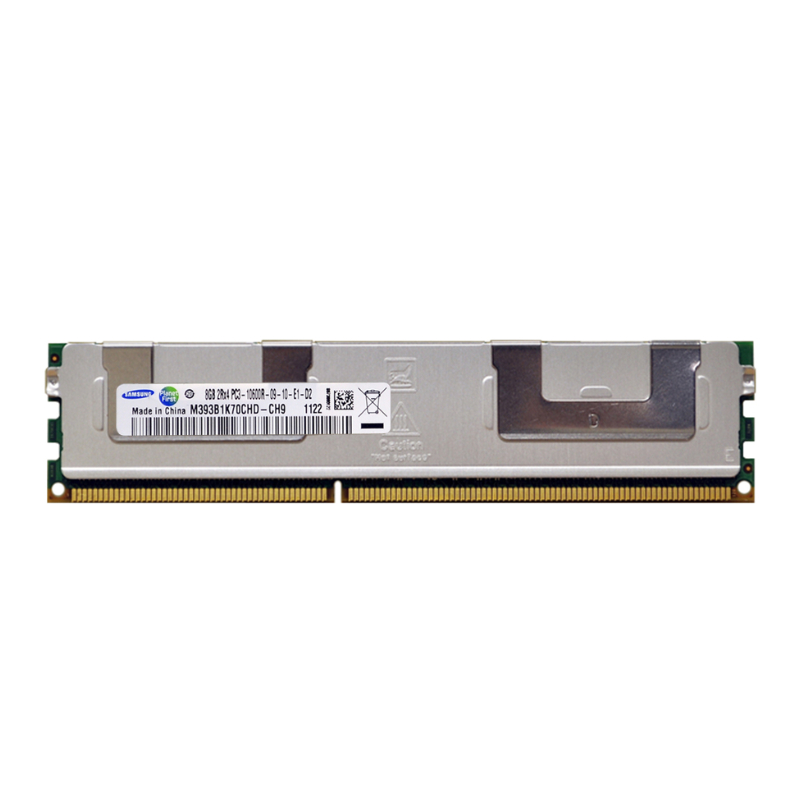
Samsung M393B1K70CHDYH9 8GB PC3-10600 1333Mhz DDR3 SDRAM Registered Ecc RAM. New (System) Pull with 1 year replacement warranty
The Samsung M393B1K70CHDYH9 8GB PC3-10600 DDR3 ECC RAM is a high-performance memory solution designed for servers and workstations requiring stability and speed.
The Samsung M393B1K70CHDYH9 8GB PC3-10600 DDR3 Registered ECC RAM belongs to the enterprise-class server memory category designed for mission-critical computing environments. This category focuses on stability, compatibility, and sustained performance rather than consumer-oriented overclocking features. DDR3 registered ECC memory modules are widely deployed in data centers, enterprise servers, and professional workstations where reliability and data integrity are mandatory requirements. Unlike unbuffered memory, registered DIMMs incorporate a register between the DRAM modules and the memory controller, reducing electrical load and enabling higher memory capacities in multi-slot server configurations.
This memory category remains relevant in legacy and long-life infrastructure where DDR3 platforms continue to operate in production environments. Many organizations rely on proven DDR3 server architectures to support virtualization, enterprise databases, ERP systems, and network services that prioritize uptime over frequent hardware refresh cycles. Samsung’s engineering expertise positions this module as a dependable choice within this specialized memory segment.
PC3-10600 memory operates at an effective data rate of 1333MHz, offering a balanced combination of bandwidth efficiency and thermal stability. The Samsung M393B1K70CHDYH9 module adheres to JEDEC DDR3 specifications, ensuring predictable performance across supported server platforms. This architecture was designed during a period when enterprise workloads demanded consistency, moderate power consumption, and strong error resilience.
The DDR3 architecture uses a prefetch buffer of eight bits per memory cell, allowing efficient data transfer while maintaining lower operating voltages compared to earlier DDR2 technologies. At 1.5 volts, this memory type provides an optimal balance between power efficiency and signal integrity, making it suitable for densely populated server memory banks.
The registered design of this module significantly enhances system stability by buffering command and address signals. This buffering reduces signal distortion and timing issues that can occur when multiple memory modules are installed. As a result, servers can support higher memory capacities without sacrificing reliability, which is a critical requirement in enterprise environments.
Signal buffering also improves scalability, allowing system architects to fully populate memory channels while maintaining consistent performance. This makes registered ECC DDR3 memory ideal for servers designed to operate continuously under heavy workloads.
Error Correcting Code technology is a defining feature of this memory category. ECC functionality enables the detection and correction of single-bit memory errors while identifying multi-bit errors that could compromise data integrity. This is especially important in environments where even minor data corruption can lead to application crashes, incorrect computations, or system instability.
The Samsung M393B1K70CHDYH9 integrates ECC at the hardware level, working in conjunction with compatible server chipsets and CPUs. This ensures that memory-related errors are managed proactively, contributing to higher system uptime and reduced maintenance costs.
The 8GB capacity of this DDR3 registered ECC module is optimized for balanced server configurations. It allows administrators to scale memory capacity incrementally while maintaining cost efficiency. In multi-socket server systems, deploying multiple 8GB modules enables flexible memory layouts tailored to specific workload requirements.
This capacity is particularly suitable for application servers, virtualization hosts, and file servers that require stable memory allocation without excessive overprovisioning. By using standardized 8GB modules, organizations can maintain uniformity across server fleets, simplifying inventory management and upgrade planning.
The internal organization of this module reflects Samsung’s high-quality DRAM manufacturing standards. Carefully selected memory chips are arranged to ensure consistent electrical characteristics and thermal behavior. This contributes to predictable performance under sustained load, which is essential in enterprise environments.
Optimized chip density also enhances compatibility with a wide range of DDR3 server motherboards. This ensures that the module can be deployed across multiple platforms without requiring specialized BIOS configurations.
The Samsung M393B1K70CHDYH9 is engineered for broad compatibility with DDR3-supporting server platforms from major OEMs. It is commonly used in systems based on Intel Xeon and AMD Opteron processors that support registered ECC DDR3 memory. Compatibility with industry-standard chipsets ensures seamless integration into existing infrastructure.
Server administrators benefit from predictable behavior when deploying this module, as it conforms strictly to JEDEC specifications. This eliminates the uncertainty often associated with non-standard or consumer-grade memory products.
Proper BIOS recognition is a key factor in enterprise memory deployment. This module is designed to be automatically detected by compatible server BIOS firmware, ensuring correct timing, voltage, and ECC settings. Automatic configuration reduces deployment time and minimizes the risk of configuration errors.
Stable BIOS recognition also supports features such as memory mirroring and sparing, which are commonly used in enterprise systems to enhance fault tolerance.
In multi-channel server architectures, balanced memory population is essential for optimal performance. The 1333MHz data rate of PC3-10600 memory supports efficient channel utilization, delivering consistent bandwidth across CPU sockets. While not designed for peak throughput benchmarking, this memory excels in sustained, real-world workloads.
Samsung applies rigorous testing and validation processes to its enterprise memory products. The M393B1K70CHDYH9 undergoes extensive stress testing to ensure long-term reliability under continuous operation. This includes thermal cycling, signal integrity testing, and compatibility validation with a wide range of server platforms.
Enterprise memory reliability is not solely about performance metrics but about consistent operation over years of service. Samsung’s manufacturing expertise ensures that each module meets strict quality standards required for data center deployment.
Thermal performance is a critical consideration in densely populated server racks. DDR3 registered ECC memory is designed to operate within defined thermal envelopes, ensuring stability even when airflow is limited. The module’s design supports efficient heat dissipation, reducing the risk of thermal throttling or premature failure.
Consistent thermal behavior also contributes to predictable power consumption, which is essential for data center energy planning and cooling strategies.
This memory category is ideally suited for a wide range of enterprise use cases. Application servers benefit from the stability and error correction features, ensuring smooth operation of business-critical software. Database servers rely on ECC memory to maintain data accuracy during intensive read and write operations.
Virtualization environments also leverage registered ECC DDR3 memory to support multiple virtual machines with consistent performance. By reducing memory-related errors, administrators can maintain higher VM density without compromising reliability.
Operating at 1333MHz, this DDR3 module delivers stable memory bandwidth suitable for enterprise workloads. Latency characteristics are optimized for reliability rather than aggressive tuning, ensuring predictable response times under sustained load. This consistency is particularly valuable in environments where performance spikes must be avoided.
While newer memory technologies offer higher speeds, DDR3 PC3-10600 remains effective for applications that prioritize stability and compatibility over raw throughput.
Memory efficiency directly influences overall system performance. By maintaining stable latency and bandwidth, this module supports efficient CPU utilization and reduces the likelihood of bottlenecks. This contributes to smoother application performance and improved user experience in enterprise systems.
Within the broader server memory category, DDR3 registered ECC modules occupy a critical position. They serve as the backbone of many enterprise systems that continue to deliver value years after deployment. This category emphasizes consistency, compatibility, and proven performance rather than rapid technological change.
The Samsung M393B1K70CHDYH9 exemplifies these principles by offering dependable 8GB capacity, ECC protection, and registered signaling in a standardized DDR3 form factor.
As part of a complete enterprise hardware ecosystem, this memory module complements server CPUs, storage solutions, and networking components designed for continuous operation. Its predictable behavior supports system-wide optimization, enabling IT teams to focus on application performance rather than hardware reliability concerns.


 Contact Us
 Information
 Catalog
 Solid State Drives (SSD)
 Network Switches
 Hard Disk Drives
 HBA & Controllers
 PC & Servers
 PC & Server Memory
 CPU & Processors
 Network Routers
 Power Supplies
 Tape Drives & Libraries
 Network Devices
 Computer & Network Cables