
(7% discount is applied at checkout)
Cart is empty
Your go-to destination for cutting-edge server products
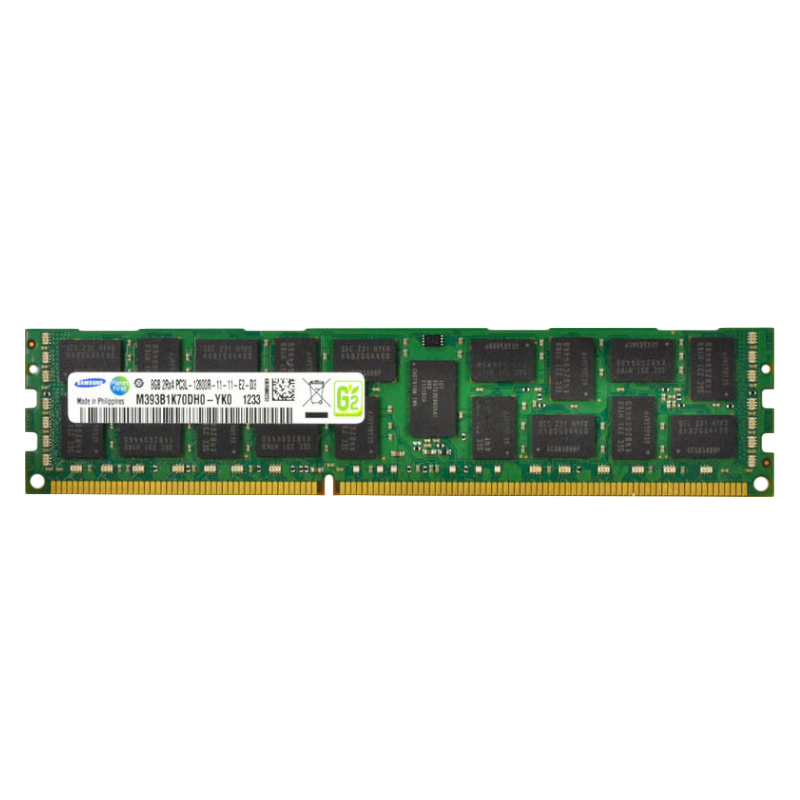
Samsung M393B1K70DH0YK0 8GB 1600MHz PC3-12800 CL11 DDR3 SDRAM ECC Registered 240-Pin Memory. New (System) Pull with 1 Year Replacement Warranty
The Samsung M393B1K70DH0YK0 8GB 1600MHz PC3-12800 CL11 DDR3 SDRAM ECC Registered 240-Pin Memory belongs to the enterprise-grade DDR3 ECC Registered memory category, a class of server-focused RAM designed to deliver stability, reliability, and predictable performance under sustained workloads.
The Samsung M393B1K70DH0YK0 8GB 1600MHz PC3-12800 CL11 DDR3 SDRAM ECC Registered 240-Pin Memory belongs to the enterprise-grade DDR3 ECC Registered memory category, a class of server-focused RAM designed to deliver stability, reliability, and predictable performance under sustained workloads. This category addresses the needs of data centers, enterprise servers, virtualization platforms, and mission-critical computing environments where data integrity and uptime are essential. DDR3 ECC Registered memory differs fundamentally from consumer desktop memory by incorporating advanced error detection, correction mechanisms, and signal buffering that allow systems to scale memory capacity while maintaining electrical stability.DDR3 SDRAM technology represented by PC3-12800 modules operates at an effective data rate of 1600MHz, enabling balanced throughput and efficiency for legacy and transitional server architectures. Within this category, ECC Registered DIMMs play a critical role in reducing system crashes, silent data corruption, and unpredictable errors that can occur in long-running workloads such as databases, cloud services, and enterprise applications. The Samsung M393B1K70DH0YK0 module exemplifies these design principles by combining Samsung’s manufacturing expertise with JEDEC-compliant specifications to ensure interoperability across a wide range of compatible server platforms.
DDR3 SDRAM represents a mature and well-established memory technology that balances performance, power efficiency, and reliability. Operating at 1600MHz, PC3-12800 memory delivers a theoretical bandwidth of up to 12.8GB per second per module. This level of throughput supports a broad range of enterprise workloads, including virtualization, application hosting, file servers, and legacy database systems. The Samsung M393B1K70DH0YK0 module leverages DDR3 architecture to provide stable performance without the increased power draw associated with higher-frequency memory generations.The CL11 latency rating of this module reflects optimized timing parameters designed to ensure consistent access speeds while maintaining stability. In server environments, predictable latency is often more valuable than raw speed, as it ensures balanced performance across multiple concurrent processes. The DDR3 PC3-12800 category continues to be relevant for organizations maintaining existing server platforms that do not support DDR4 or DDR5, offering a dependable solution for memory upgrades and replacements.
Error Correcting Code Registered memory is specifically engineered for servers and workstations that require consistent accuracy. ECC functionality enables the memory module to detect and correct single-bit errors in real time, preventing data corruption before it affects applications or operating systems. This capability is vital in environments where even a minor memory error can compromise transactional integrity, lead to application downtime, or cause system instability. Registered memory further enhances reliability by incorporating a register that buffers control signals, reducing the electrical load on the memory controller and allowing for higher memory density configurations.Within this category, the Samsung M393B1K70DH0YK0 8GB DDR3 ECC Registered memory module is designed to support enterprise-grade processors and chipsets that accept registered DIMMs. This ensures compatibility with server motherboards from major OEMs and system integrators, making it suitable for deployment in rack servers, tower servers, and enterprise workstations. ECC Registered DDR3 memory continues to be widely deployed in existing infrastructures where DDR3 platforms remain operational due to their proven stability and cost efficiency.
The 1600MHz operating frequency of the Samsung M393B1K70DH0YK0 module aligns with widely supported DDR3 server standards. Many enterprise-grade CPUs and chipsets from Intel Xeon and compatible platforms are optimized for DDR3-1600 memory, ensuring seamless integration and stable operation. This frequency supports efficient data transfer rates without placing excessive stress on memory controllers, making it ideal for systems designed for continuous operation.System compatibility is a defining characteristic of this memory category. Registered DDR3 DIMMs such as this Samsung module are engineered to meet JEDEC specifications, ensuring that they function reliably across a wide array of server motherboards. This standardization reduces deployment risks and simplifies maintenance in multi-server environments where consistency and interchangeability are essential.
Samsung is globally recognized as a leader in semiconductor manufacturing, and its server memory products reflect decades of engineering expertise. The M393B1K70DH0YK0 module is manufactured using high-quality DRAM components that undergo rigorous testing to meet enterprise standards. This focus on quality ensures long-term reliability, even under sustained workloads and elevated operating temperatures commonly encountered in data centers.Within the DDR3 ECC Registered memory category, Samsung modules are valued for their consistency and adherence to strict quality control processes. Each module is designed to deliver uniform performance across production batches, reducing variability and ensuring predictable behavior when deployed in large-scale server environments. This reliability is particularly important for organizations that prioritize uptime and data integrity.
Thermal management is a critical consideration in server memory design. The Samsung M393B1K70DH0YK0 DDR3 ECC Registered module is engineered to maintain stability under continuous operation, even in densely populated server configurations. Efficient heat dissipation and robust component selection contribute to extended service life, reducing the likelihood of memory-related failures over time.Long-term reliability is further enhanced by Samsung’s validation processes, which include stress testing and compatibility testing across supported platforms. This ensures that the module performs consistently throughout its operational lifespan, making it a dependable choice for enterprise environments that demand continuous availability.
The 8GB capacity of the Samsung M393B1K70DH0YK0 module represents a versatile option within the DDR3 ECC Registered memory category. This capacity is well-suited for a wide range of server configurations, from entry-level servers to more complex multi-DIMM systems. By combining multiple 8GB modules, administrators can scale system memory to meet specific workload requirements while maintaining balanced channel configurations.Scalability is a defining advantage of registered memory. The buffering provided by the register allows systems to support a greater number of DIMMs without compromising signal integrity. This enables higher total memory capacities, which are essential for virtualization, in-memory databases, and enterprise applications that require substantial RAM resources.
Virtualization platforms benefit significantly from ECC Registered DDR3 memory, as they rely on stable memory allocation across multiple virtual machines. The Samsung M393B1K70DH0YK0 module supports this use case by providing reliable error correction and consistent performance. This ensures that virtual machines operate without interruption due to memory-related errors.Enterprise applications such as ERP systems, messaging platforms, and file servers also benefit from the stability offered by ECC Registered memory. By reducing the risk of data corruption and system crashes, this memory category helps maintain service continuity and protect critical business data.
The 240-pin DIMM form factor is a standard design for DDR3 server memory, ensuring compatibility with a wide range of server motherboards. The Samsung M393B1K70DH0YK0 module adheres to this standard, enabling straightforward installation and replacement in compatible systems. This form factor supports secure physical connections and reliable electrical performance.Server integration is simplified by the standardized design of DDR3 ECC Registered DIMMs. Administrators can deploy these modules with confidence, knowing that they meet industry specifications and are supported by major server platforms. This compatibility reduces downtime during upgrades and maintenance operations.
Registered DIMMs incorporate a register that buffers address and control signals, improving signal integrity and reducing electrical load on the memory controller. This design allows servers to support more memory modules per channel, enabling higher total memory capacities. The Samsung M393B1K70DH0YK0 module benefits from this architecture, making it suitable for memory-intensive server configurations.Improved signal integrity translates into enhanced system stability, particularly in environments with multiple populated DIMM slots. This advantage is a key reason why ECC Registered memory remains the preferred choice for enterprise servers and professional workstations.
Data integrity is a core requirement in enterprise computing, and ECC memory plays a vital role in achieving this goal. By detecting and correcting single-bit errors, ECC Registered DDR3 memory prevents silent data corruption that can compromise system reliability. The Samsung M393B1K70DH0YK0 module incorporates robust ECC functionality to safeguard critical data.In addition to correcting errors, ECC memory can detect multi-bit errors and alert system administrators, enabling proactive maintenance and reducing the risk of unexpected failures. This level of protection is essential in environments where data accuracy and system stability are paramount.
System uptime is directly influenced by memory reliability. Memory-related errors can lead to system crashes, application failures, and data loss. By utilizing ECC Registered DDR3 memory, organizations can significantly reduce these risks. The Samsung M393B1K70DH0YK0 module contributes to overall system reliability by providing consistent performance and error protection.In mission-critical environments, this reliability translates into improved service availability and reduced maintenance costs. The ability to operate continuously without memory-related disruptions is a key advantage of this memory category.


 Contact Us
 Information
 Catalog
 Solid State Drives (SSD)
 Network Switches
 Hard Disk Drives
 HBA & Controllers
 PC & Servers
 PC & Server Memory
 CPU & Processors
 Network Routers
 Power Supplies
 Tape Drives & Libraries
 Network Devices
 Computer & Network Cables