
(7% discount is applied at checkout)
Cart is empty
Your go-to destination for cutting-edge server products
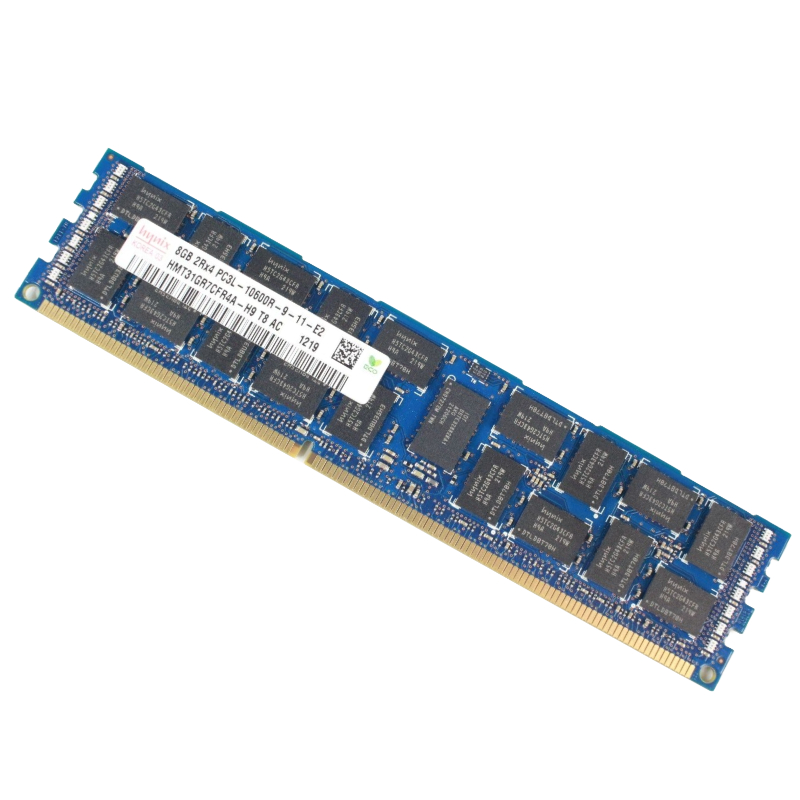
Hynix HMT31GR7CFR4A-H9 8GB DDR3 1333mhz SDRAM Cl9 Ecc Registered 240-pin Memory. New Sealed in Box (NIB) 3 Years Warranty
| SKU/MPN | Warranty | Price | Condition | You save |
|---|---|---|---|---|
| HMT31GR7CFR4A-H9 | 1 Year Warranty | $50.00 | New Sealed in Box (NIB) | You save: $17.50 (26%) |
| HMT31GR7CFR4A-H9 | 1 Year Warranty | $48.00 | New (System) Pull | You save: $16.80 (26%) |
Hynix 8GB DDR3 1333MHz ECC RAM
Elevate server reliability with the Hynix HMT31GR7CFR4A-H9, an 8GB DDR3 ECC Registered (RDIMM) module engineered for stable performance in enterprise-class environments. This dual-rank x4 module delivers consistent throughput at 1333MHz, ideal for virtualization, databases, and high-uptime workloads.
The Hynix HMT31GR7CFR4A-H9 8GB DDR3 1333MHz SDRAM CL9 ECC Registered 240-pin Memory module belongs to a class of enterprise-grade DDR3 RDIMMs designed to support stable, efficient, and reliable server operations. This memory type plays an essential role in datacenters, enterprise applications, virtualization environments, scalable workstations, and high-demand computing frameworks. DDR3 memory, particularly registered ECC variants, has long been valued for its balance of performance, affordability, and compatibility with a wide range of server generations. The Hynix RDIMM brings together ECC error correction, a registered buffer for signal integrity, and a proven frequency of 1333MHz to deliver steady throughput in complex workloads. Its architecture focuses on minimizing latency, ensuring operational stability, and extending hardware longevity.
DDR3 Registered DIMMs, such as the Hynix HMT31GR7CFR4A-H9, occupy a critical position in enterprise infrastructure where memory reliability is paramount. The architecture incorporates a register placed between the DRAM chips and the system memory controller. This register reduces the electrical load on the system by buffering control and address signals. As a result, servers can populate more memory modules per channel without compromising performance or encountering signal degradation. The 240-pin form factor complies with standard DDR3 RDIMM layouts, ensuring universal compatibility with supported server boards. The memory’s CL9 timing further enhances responsiveness by maintaining a practical balance between speed and latency.
Registered memory integrates a buffer designed to streamline communication between the DIMM and the processor’s memory controller. This buffering mechanism is crucial in systems using numerous memory modules, where unbuffered DIMMs might otherwise stress or overload the memory bus. The Hynix Registered module enables servers to maximize their DIMM capacity per channel, resulting in improved scalability for workloads that benefit from larger memory pools. Virtualization clusters, hypervisors, high-performance databases, and simulation environments rely heavily on memory density, making registered memory a requisite component in these deployments.
ECC memory enhances reliability by detecting and correcting common types of data corruption. Even a single-bit error, if unchecked, can lead to system instability, application crashes, or data loss. The ECC mechanism built into the Hynix HMT31GR7CFR4A-H9 continuously monitors data transfers and automatically corrects single-bit errors while detecting more severe multi-bit inconsistencies. This ensures strong resilience against random electrical interference, cosmic radiation, and microscopic DRAM defects. For organizations running persistent applications, such as enterprise resource management systems, scientific computations, or cloud-hosted services, ECC memory constitutes a fundamental requirement.
Running at 1333MHz (PC3-10600), this Hynix module delivers dependable bandwidth that aligns with typical server workloads of its generation. While modern memory technologies such as DDR4 and DDR5 offer higher frequencies, DDR3 remains widely deployed due to its stability, compatibility with legacy enterprise hardware, and cost efficiency. Enterprises maintaining existing server fleets or hybrid infrastructures benefit from DDR3 RDIMMs as they can upgrade memory capacity without replacing entire platforms. The 1333MT/s speed supports effective multitasking across applications such as virtualization hosting, container environments, distributed computation nodes, and file servers.
The CAS Latency value of CL9 is standard for 1333MHz enterprise DDR3 modules and reflects optimized timing for daily usage in server ecosystems. Memory latency plays a role in determining how quickly data can be accessed by the processor. With CL9 timing, this Hynix module offers a balanced relationship between speed and stability. Enterprises that prioritize deterministic performance rely on memory modules like the HMT31GR7CFR4A-H9 to maintain predictable workload execution without spikes or inconsistencies. This attribute is particularly important in transactional systems, batch-processing environments, and database-driven applications.
The DDR3 RDIMM 240-pin configuration is compatible with many server architectures built around Intel Xeon and AMD Opteron processors. Its electrical specifications, thermal tolerances, and signaling standards ensure broad interoperability with motherboards that accept ECC Registered memory. Because server infrastructures typically evolve gradually over time, compatibility and multi-generation support provide long-term value. Enterprises can incrementally expand memory capacity by integrating modules like the Hynix 8GB RDIMM into existing server nodes without needing extensive hardware adjustments.
The Hynix HMT31GR7CFR4A-H9 supports essential memory functions for demanding enterprise workflows. Its design facilitates efficient data exchange under constant load. Applications benefiting from this memory span virtualization clusters, scientific research computation, cloud environments, embedded server operations, and large-scale data indexing. Because memory bandwidth and stability directly influence application throughput, upgrading RDIMMs effectively yields performance improvements without changes to hardware architecture. Given its registered ECC capabilities, this module ensures continuous operation even under high utilization.
Virtual machines require dynamic allocation of memory resources, and the underlying physical memory must maintain absolute stability. With its ECC and registered architecture, the Hynix module safeguards against uncorrected memory errors that could cascade into VM failures. Hypervisors such as VMware ESXi, Proxmox, XenServer, or Hyper-V depend on consistent memory integrity. DDR3 RDIMMs like this Hynix variant remain widely used in virtualization clusters where the server hardware spans multiple generations.
Databases including SQL, NoSQL, and in-memory DB engines experience continuous read and write cycles. Memory corruption or instability can severely affect these workloads. The HMT31GR7CFR4A-H9 supports steady data pipelines for transactional systems, analytics software, and distributed storage frameworks. Its 1333MHz frequency ensures adequate throughput, while ECC safeguards data required for indexing, caching, and data retrieval operations.
DDR3 RDIMMs are engineered to tolerate varying environmental temperatures common in enterprise server racks. The Hynix HMT31GR7CFR4A-H9 is built using high-quality DRAM chips that maintain stable operation across extended cycles. Thermal efficiency is key to preventing heat buildup, and server airflow typically complements the module’s heat distribution characteristics. This promotes longer memory lifespan and reduces the risk of hardware-related failures.
DDR3 memory, while not as energy-efficient as DDR4 and DDR5 modules, provides respectable power usage characteristics suitable for systems designed around its generation. The Hynix RDIMM balances power draw with output performance. This balance becomes particularly relevant in multi-node server environments operating simultaneously for extended durations, where power demands scale significantly. Efficient memory reduces operational costs and heat output, helping maintain predictable server-room temperatures.
Many organizations continue to operate server systems compatible with DDR3 RDIMMs. These infrastructures remain productive and cost-efficient, and memory upgrades significantly extend their usability. The Hynix HMT31GR7CFR4A-H9 integrates seamlessly into these environments, enabling improved multitasking, reduced bottlenecks, and enhanced responsiveness without a system overhaul. This memory module supports servers that continue serving roles in backup environments, development clusters, departmental servers, and hybrid cloud systems.
DDR3 RDIMM solutions remain scalable for organizations that require steady performance without migrating to more recent technologies. Expanding server memory with modules like this Hynix product can improve user experience, application handling, and data throughput. The registered and ECC features allow for higher-density configurations, giving administrators the flexibility to build memory pools that suit organizational growth.
Even with modern alternatives available, ECC RDIMMs continue to be essential in industries prioritizing data safety and application uptime. Many enterprise server lines maintain backward compatibility with DDR3 to ensure long-term return on investment. These environments often require consistent performance over raw speed, making the HMT31GR7CFR4A-H9 a valuable component. The memory's proven reliability is essential in applications where data accuracy is critical.
Industries such as finance, scientific research, education, manufacturing, and telecommunications rely heavily on memory integrity. ECC Registered DDR3 remains common in these sectors due to its predictable behavior and tested reliability. Servers running legacy software or embedded systems that cannot be easily ported to newer hardware also continue to depend on DDR3 memory modules for stable operation.
The internal architecture of the Hynix HMT31GR7CFR4A-H9 incorporates multiple DRAM chips configured to maximize performance and capacity. These chips operate in coordinated arrays that allow rapid access to stored data. The registered buffer improves communication between the CPU and DRAM, ensuring high signal accuracy. The memory module's layout follows industry-standard design principles that emphasize efficient electrical routing and minimal interference.
This 8GB RDIMM typically features a dual-rank configuration, which provides improved memory addressing flexibility. Dual-rank modules can offer better performance in certain workloads due to interleaving, allowing the processor to access data from one rank while the other refreshes. This contributes to smoother performance during multitasking and heavy data operations. As part of an enterprise system, dual-rank designs help maintain equilibrium between capacity and stability.
Balancing memory channels by installing identical RDIMMs helps optimize throughput. The Hynix module supports dual- and triple-channel configurations depending on the server board. Balanced memory configurations help achieve peak performance by ensuring consistent bandwidth across channels. This improves workloads such as virtualization, computational processing, server hosting, and storage indexing.
Many industries require compliance with data integrity regulations and operational standards. ECC Registered memory assists organizations in meeting compliance guidelines by preventing undetected data errors. This makes the Hynix module relevant for sectors requiring auditability, consistency, and strict data verification.


 Contact Us
 Information
 Catalog
 Solid State Drives (SSD)
 Network Switches
 Hard Disk Drives
 HBA & Controllers
 PC & Servers
 PC & Server Memory
 CPU & Processors
 Network Routers
 Power Supplies
 Tape Drives & Libraries
 Network Devices
 Computer & Network Cables