
(7% discount is applied at checkout)
Cart is empty
Your go-to destination for cutting-edge server products
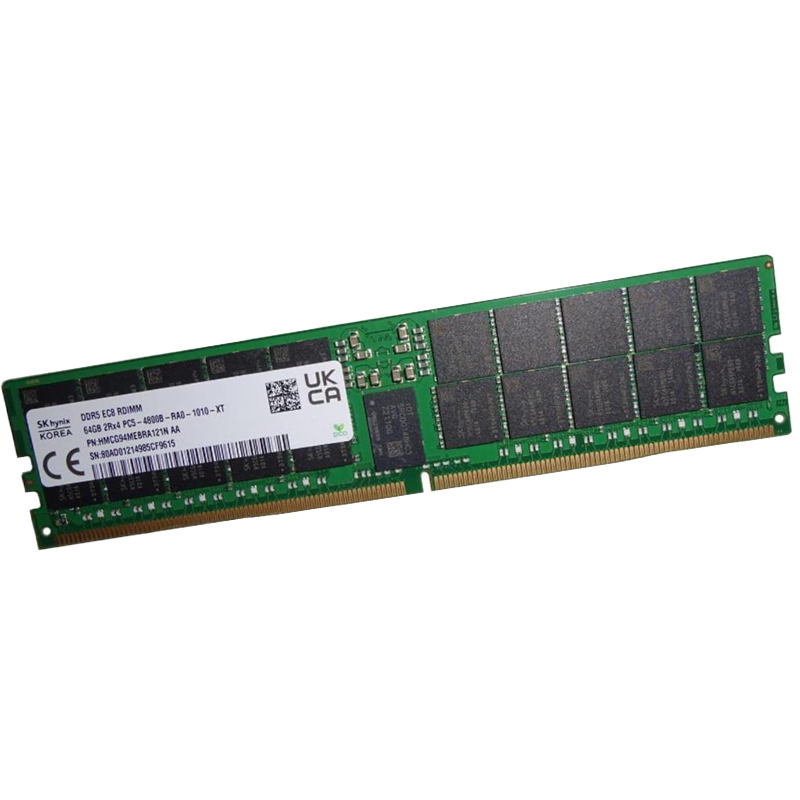
Hynix HMCG94MEBRA121N 64GB DDR5 SDRAM PC5-38400 4800Mhz Cl40 Ecc Reg 288-Pin Ram. New Sealed in Box (NIB)
| SKU/MPN | Warranty | Price | Condition | You save |
|---|---|---|---|---|
| HMCG94MEBRA121N | 1 Year Warranty | $1,872.00 | New (System) Pull | You save: $655.20 (26%) |
| HMCG94MEBRA121N | 1 Year Warranty | $2,544.00 | New Sealed in Box (NIB) | You save: $890.40 (26%) |
The Hynix HMCG94MEBRA121N 64GB DDR5 RDIMM offers advanced performance, optimized stability, and enhanced data accuracy for enterprise-grade servers and high-demand computing platforms. This memory solution is engineered to support heavy workloads by combining elevated bandwidth, efficient architecture, and improved error-correction features.
ECC technology provides additional layers of data validation, greatly reducing application disruptions and preventing minor bit-level issues from compromising system performance. The registered signal buffering further improves command flow, allowing the module to function seamlessly in multi-channel and multi-module server layouts.
With a bus speed of 4800MT/s, this memory component enables rapid information transfer, minimizing bottlenecks during CPU-intensive tasks. It supports smooth multitasking, efficient virtualization, and enhanced responsiveness for large-scale computational activities.
DDR5 technology introduces better power distribution and improved thermal balance, resulting in lower total energy consumption while maintaining maximum performance. These features help prolong system lifespan and ensure stable operation under extended workloads.
The Hynix HMCG94MEBRA121N 64GB PC5-38400 800MHz DDR5 SDRAM module represents a new generation of advanced server memory technology engineered to support data-intensive enterprise workloads. It integrates a redesigned architecture that focuses on higher throughput, minimized latency windows, and strengthened stability across multitiered server infrastructures. With a total capacity of 64GB housed within a 288-pin registered module layout, this DDR5 ECC Reg memory solution serves as a dependable foundation for virtualization platforms, hyperscale computing environments, and mission-critical configurations where dependable data processing is an absolute requirement. The module’s 800MHz internal clock speed and PC5-38400 bandwidth rating help maintain predictable operation under demanding applications, making it suitable for firms managing extensive daily workloads within cloud operations, data analytical services, live computational modeling, scientific processing, and sophisticated AI-supported applications.
Every design element of this module is tailored to align with the heightened expectations of modern server ecosystems. Its DDR5 foundation introduces substantial improvements over previous memory generations, especially in terms of data transfer efficiency, parallelized channel operation, and individualized power management components that reduce unnecessary electrical load during prolonged usage cycles. This memory module supports CL40 latency, ensuring a balanced configuration that blends fast response intervals with consistent, thermally stable performance metrics. These transformations enable data center administrators to expand their system’s computational reach without compromising reliability or negatively affecting multitasking throughput.
The transition from DDR4 to DDR5 marked one of the most influential evolutions in server memory design. The Hynix HMCG94MEBRA121N utilizes these architectural changes to provide significantly higher performance ceilings. DDR5 technology introduces two independent 32-bit channels per DIMM, enabling greater communication concurrency at the hardware level. This channel separation reduces potential data traffic conflicts, enhances address mapping efficiency, and supports improved predictive load balancing when servers execute multi-threaded tasks. These capabilities are vital in settings where numerous virtual machines operate simultaneously or where real-time calculations require unwavering consistency.
The module’s on-DIMM power management further strengthens system stability. Unlike earlier memory generations, which depended heavily on the motherboard for voltage regulation, DDR5 introduces power management ICs directly onto the memory stick. This localized control helps minimize power disturbances, reduces electrical noise, and ensures more precise voltage delivery. For enterprise-grade systems, such improvements translate to better sustained performance, reduced thermal variance, and a substantially lowered risk of system instability during continuous heavy load operation.
Bandwidth remains one of the most critical factors in determining how efficiently a server can manipulate large datasets. With a PC5-38400 designation, the Hynix HMCG94MEBRA121N delivers elevated data rates tailored for memory-intensive software ecosystems. This bandwidth tier supports high-volume data streaming processes, simulation workloads, distributed computing tasks, and precision-driven applications that must maintain consistent performance levels while executing thousands of simultaneous operations.
Enterprises that handle artificial intelligence frameworks or machine learning classification engines particularly benefit from modules that maintain strict bandwidth integrity. AI operations often involve rapid sequences of calculations, matrix transformations, and algorithmic iterations. A server’s memory subsystem must not only store but also rapidly exchange large volumes of information with the CPU. The enhanced throughput profile of this DDR5 module ensures that processing units remain fully utilized rather than idling due to memory response delays. In turn, this allows organizations to develop, train, and refine algorithms more efficiently.
Latency plays a crucial role in preserving system responsiveness. The CL40 timing profile of the Hynix HMCG94MEBRA121N is optimized to deliver predictable performance within fast-paced server conditions. This latency level is engineered for enhanced reliability while maintaining a stable equilibrium between transfer speed and responsiveness. For computational environments performing large-scale rendering workflows, scientific evaluations, or high-pressure transactional systems, consistent latency values help avoid data bottlenecks. Stability becomes even more essential as these systems execute multistage operations that cannot afford unpredictable delays.
By maintaining CL40 timings within a DDR5 framework, this module supports a level of uniform performance suitable for environments that mandate constant uptime. Banking systems, industrial process controllers, infrastructure management servers, and customer service platforms heavily depend on latency-sensitive memory performance to ensure uninterrupted functionality. This module’s timing configuration reduces the likelihood of unanticipated stalls, thereby contributing to the broader efficiency of the computational ecosystem.
Error-correcting code (ECC) technology remains an essential component for professional-grade server memory. The Hynix HMCG94MEBRA121N incorporates ECC functionality to detect and automatically correct memory errors that typically go unnoticed in non-ECC systems. These can include single-bit inconsistencies resulting from electromagnetic interference, thermal fluctuation, or cosmic particle interaction. Over extended periods, even isolated discrepancies can jeopardize critical data processes. ECC ensures accuracy is retained throughout long operation cycles, preventing silent data corruption and reducing the probability of system disruptions.
Beyond ECC features, the registered (buffered) architecture provides an additional layer of stability. Registered memory modules incorporate a hardware register between the DRAM chips and the memory controller. This register helps balance electrical load and signal distribution during high-density configurations. When servers utilize numerous memory modules simultaneously, the buffering capability ensures that signals remain synchronized and intact. In effect, registered memory reduces strain on the CPU’s memory controller, improves processing determinism, and supports seamless operation in large-capacity installations commonly found in enterprise environments.
Virtualized environments rely heavily on memory resources to sustain multiple operating systems and applications running simultaneously on a single server node. The Hynix HMCG94MEBRA121N supports these scenarios by offering a mix of high capacity, elevated bandwidth, and robust ECC protections. When virtual machines share memory resources, even minor inconsistencies can propagate across the system. ECC Reg memory counters such vulnerabilities by assuring data integrity while maintaining configurable memory allocations for each virtual instance. Administrators can scale their virtual machine density while maintaining performance consistency.
Multi-node clusters and distributed computing environments also benefit greatly from such high-end server memory. These systems routinely execute parallelized tasks across interconnected nodes. Predictable performance and stability, especially in memory transactions, allow compute and storage clusters to remain synchronized. This enhances workload distribution, reduces computational delays, and ensures efficient deployment of sequencing tasks, batch operations, and real-time analytics. The reliability of registered ECC memory becomes indispensable when entire networks rely on the integrity of each server’s internal workflow.
Organizations operating mission-critical systems require predictable uptime. Failures triggered by memory errors can be catastrophic in such environments, leading to data loss, system outages, or prolonged service downtime. Registered ECC memory mitigates these risks through continuous real-time error detection and correction mechanisms that protect the data stream. These protections help extend the operational lifecycle of server hardware by reducing unexpected behaviors and limiting cumulative system strain over time.
Predictability is essential for enterprise planning. Systems that run 24/7 must be capable of handling operational fluctuations without requiring frequent manual intervention. Memory modules like the Hynix HMCG94MEBRA121N contribute to this predictability by maintaining stable functioning even under heavy stress conditions. This reduces emergency maintenance scenarios and provides administrators with more reliable performance baselines when analyzing system behavior, planning upgrades, or scaling their infrastructure.
The 288-pin RDIMM form factor ensures compatibility with a broad range of modern server platforms designed around DDR5 memory standards. This standardized pin configuration allows system architects to integrate the Hynix HMCG94MEBRA121N into multiple server categories, including rack units, blade servers, tower servers, and specialized workstations that support enterprise-grade memory technologies. The rigidity and structural integrity of the 288-pin interface also provide improved communication performance and stronger physical durability under repeated installation or maintenance cycles.
Compatibility is further improved by the module’s adherence to JEDEC specifications. JEDEC compliance ensures that the memory operates within established industry-standard voltage thresholds, timing configurations, and command protocols. This standardization reduces potential integration conflicts and provides smoother deployment across mixed hardware environments. Administrators adopting heterogeneous server clusters benefit from this consistency because it eliminates unnecessary configuration complexities.
DDR5 memory architecture places increased emphasis on thermal regulation. The Hynix HMCG94MEBRA121N is engineered to uphold temperature stability during sustained high-load operations. Enhanced thermal characteristics help minimize the likelihood of overheating, ensuring continuous stability during data-intensive processes. Optimized heat dissipation also protects the internal circuitry from degradation over time, improving the overall lifespan of the module.
Efficient heat management becomes more vital as servers operate for prolonged durations in high-density racks where airflow may be limited. The module’s internal structural design supports balanced thermal distribution across its surface, ensuring that no single region experiences disproportionate heat saturation. This consistent thermal spread strengthens long-term reliability and improves the efficiency of adjacent cooling systems.
Maintaining signal integrity is one of the most critical elements of server memory reliability. The 288-pin interface helps promote cleaner signal pathways by creating well-defined electrical routes between the memory module and the motherboard. This reduces interference, minimizes voltage fluctuations, and enhances data stability during high-speed transfers. Combined with DDR5’s refined command structure and on-board power management, this module ensures that signal synchronization remains dependable even under extensive computational pressure.
Electrical optimization also contributes to reduced overall system power consumption. The distributed electrical architecture of DDR5 enables the memory module to manage energy flow more precisely, lowering operational power demands. Over extended deployment cycles, this contributes to decreased energy costs and supports long-term sustainability goals, particularly for large-scale data center operations where efficiency metrics significantly affect operational budgets.
The Hynix HMCG94MEBRA121N 64GB DDR5 ECC Registered memory module provides exceptional functionality for enterprise-grade applications that demand high computational throughput. Its blend of increased capacity, accelerated bandwidth, and robust error protection offer a crucial advantage for organizations requiring consistent system responsiveness. This module integrates effortlessly into infrastructures dedicated to complex software operations, in-memory databases, server clusters, scientific simulations, multimedia rendering, and content delivery systems operating at global scale.
Businesses aiming to expand their server capabilities benefit from this memory module’s scalable design. Whether expanding from a single-server installation to a multi-rack configuration or migrating from legacy DDR4 environments, the module supports long-term operational growth. The DDR5 architecture ensures a forward-compatible foundation that aligns with future system requirements and evolving computational trends.
Real-time data operations represent some of the most demanding tasks placed on modern servers. Financial systems, market analysis engines, encryption services, and digital monitoring applications all require precise memory timing and uninterrupted throughput. The Hynix HMCG94MEBRA121N’s combination of expanded bandwidth and low-variance latency supports the rapid movement of data within these high-pressure environments, ensuring that processors can interpret and process information with speed and accuracy.
Large-scale data analysis platforms also benefit significantly from a module capable of sustaining consistent speed regardless of workload fluctuations. Machine learning pipelines, data warehousing systems, and predictive analytics processes generate continuous cycles of memory reads and writes. This DDR5 module’s architectural innovations ensure that performance remains stable, minimizing bottlenecks that could otherwise limit analytical efficiency or reduce system responsiveness.
Cloud computing environments routinely deploy memory-dense server clusters to support a wide assortment of hosted applications. These include collaborative software, enterprise management suites, development environments, and extended cloud storage solutions. The Hynix HMCG94MEBRA121N excels in these setups by offering high capacity and enhanced processing headroom. The module ensures that cloud servers retain their responsiveness even when supporting substantial user loads and continuously active virtual containers.
Virtual infrastructure scalability directly influences cloud performance. As more users connect to a hosted service or as more applications deploy across a cloud node, memory demand can sharply increase. DDR5-based servers equipped with this 64GB ECC Reg module maintain steadiness under sudden load variations, ensuring predictable system behavior without compromising user experience.


 Contact Us
 Information
 Catalog
 Solid State Drives (SSD)
 Network Switches
 Hard Disk Drives
 HBA & Controllers
 PC & Servers
 PC & Server Memory
 CPU & Processors
 Network Routers
 Power Supplies
 Tape Drives & Libraries
 Network Devices
 Computer & Network Cables