
(7% discount is applied at checkout)
Cart is empty
Your go-to destination for cutting-edge server products
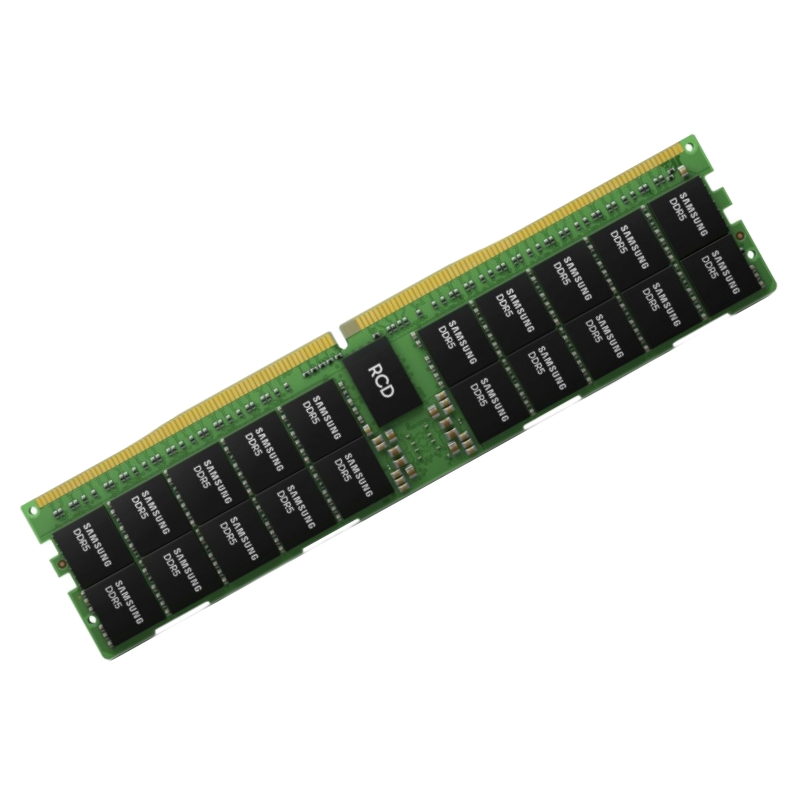
Samsung M321R4GA0BB0-CQKMG 32GB DDR5 SDRAM Ecc Reg Ram 4800Mhz PC5-38400 CL40. New Sealed in Box (NIB) with 3 Years Warranty
The Samsung M321R4GA0BB0-CQKMG module is a quintessential example of this advanced class of memory, this 32GB module is designed to operate in multi-channel configurations, providing the scalable, high-capacity, and robust memory foundation required for virtualization, in-memory databases, high-performance computing (HPC), and intensive transactional workloads.
The Samsung M321R4GA0BB0-CQKMG represents a pivotal advancement in server memory technology, embodying the transition to the DDR5 standard for enterprise-level computing. As a 32GB Registered ECC RDIMM (Reduced Dual In-line Memory Module) operating at 4800 Megatransfers per second (MT/s), this module is engineered for next-generation servers requiring unparalleled data integrity, increased bandwidth, and superior power efficiency. It is a critical component for data centers, cloud infrastructure, high-performance computing (HPC), and enterprise servers where system uptime and error-free operation are non-negotiable. This module is not a standard desktop DIMM; it is a specialized component designed for system boards that support Registered (Buffered) ECC memory, typically found in servers and workstations.
At its heart, this module is defined by a set of precise technical parameters that dictate its compatibility and performance profile. Understanding these specifications is essential for proper system integration and optimization.
The module offers a substantial 32GB of memory capacity on a single stick. This high density allows servers to achieve large total memory footprints with fewer modules, conserving motherboard slots for future expansion. The configuration is denoted as 1x32GB, indicating a single module, and 1Rx4, which describes its physical memory organization.
The "1R" signifies a single-rank module. A rank is a set of DRAM chips that work together to provide a 64-bit data width. In a 1R design, all chips on one side (or both sides) are accessed simultaneously. The "x4" refers to the data width of the individual DRAM chips used on the module—in this case, 4-bit chips. A x4 organization is intrinsically linked to the module's advanced error correction capabilities, as it enables the implementation of ECC SDDC (Single Device Data Correction). This architecture allows the memory subsystem to correct a full chip failure, a critical feature for server resilience.
This module operates at a data rate of 4800 Megatransfers per second (MT/s), often marketed as 4800Mbps. This is the fundamental speed at which the memory interface operates.
The designation PC5-38400 provides a clear reference to this speed. In DDR5 naming conventions, "PC5" indicates DDR5, and the number "38400" represents the module's peak theoretical bandwidth in megabytes per second (MB/s). Calculating this involves multiplying the transfer rate (4800 MT/s) by the module's data width (64 bits = 8 bytes). Thus, 4800 * 8 = 38,400 MB/s. This bandwidth is a significant leap over previous DDR4 generations, directly translating to faster data access for CPUs and reduced latency in memory-intensive workloads.
A hallmark of DDR5 technology is improved power management. This Samsung RDIMM operates at a nominal voltage of 1.1V, a reduction from DDR4's standard 1.2V. This lower voltage directly decreases the power consumption of the memory subsystem, a crucial factor for large-scale data centers managing power and cooling costs. Furthermore, DDR5 architecture features an integrated Power Management IC (PMIC) on the module itself. This distributes power regulation from the motherboard to the DIMM, enabling more stable voltage delivery, better signal integrity, and improved granularity in power management at the module level.
The "ECC Registered" in the module's description points to two of its most critical server-oriented features, which work in tandem to ensure maximum reliability and stability in multi-module configurations.
ECC is a non-negotiable feature for enterprise servers. It provides hardware-level error detection and correction. As data is written to memory, the module calculates and stores additional parity bits. When data is read, these bits are recalculated and compared. ECC can detect single-bit and multi-bit errors and, most importantly, automatically correct single-bit errors on the fly without any operating system or application intervention. This prevents silent data corruption, system crashes, and application faults caused by cosmic rays, electrical interference, or minor component degradation. The x4 chip organization of this module enhances this further with SDDC, offering chipkill-level protection.
In a standard unbuffered DIMM, the memory controller addresses each DRAM chip directly. This creates significant electrical load on the controller when many modules are installed, limiting the total capacity and speed achievable. A Registered DIMM (RDIMM) incorporates a register, or buffer, on the module for the address and command signals (but not the data). This buffer reduces the electrical load on the memory controller, allowing servers to support a much larger number of high-capacity DIMMs per channel while maintaining signal integrity and stable high-speed operation. The trade-off is a slight increase in latency (typically one clock cycle), which is a worthwhile compromise for the scalability and stability it provides in multi-CPU, high-memory systems.
The module adheres to the standard 288-pin design used by all DDR5 DIMMs. However, the key notch position on a DDR5 module is different from DDR4, preventing accidental insertion into an incompatible motherboard slot.
It is vital to distinguish this Registered DIMM from other types. UDIMMs (Unbuffered DIMMs) are common in desktops and lack both a register and ECC (or may have ECC in rare cases). They are not suitable for large-scale server configurations. LRDIMMs (Load Reduced DIMMs) take buffering a step further by also buffering the data lines, enabling even higher capacities and ranks but at a higher cost and latency. The Samsung M321R4GA0BB0-CQKMG, as an RDIMM, occupies the optimal middle ground for mainstream enterprise servers, offering the perfect balance of capacity, performance, reliability.
While bandwidth is crucial, latency—the delay between a request and its fulfillment—is equally important. This module operates at a CAS Latency (CL) of 40 cycles at its 4800 MT/s speed.
CAS Latency is measured in clock cycles. A higher MT/s means each clock cycle is shorter in duration. Therefore, while CL40 is a numerically higher latency than a DDR4-3200 CL22 module, the actual time in nanoseconds (ns) may be similar or even improved. The true latency in nanoseconds is calculated as (CL / MT/s) * 2000. For this module: (40 / 4800) * 2000 = ~16.67 nanoseconds. This represents a balanced timing for server-grade memory, prioritizing stability and signal integrity at high speeds over ultra-tight timings, which are more critical in consumer overclocking scenarios.
The Samsung M321R4GA0BB0-CQKMG is purpose-built for environments where reliability, capacity, and consistent performance are paramount.
This is the primary domain for this module. It is ideal for virtualization hosts (VMware, Hyper-V), database servers (SQL, Oracle), enterprise resource planning (ERP) systems, and large file servers. The combination of high capacity, ECC, and registered design ensures that these critical applications can run multiple demanding workloads simultaneously without data corruption or system instability, even under continuous 24/7 operation.
In computational research, financial modeling, and the training phases of machine learning, datasets are enormous and must be held in memory for rapid processing. The high bandwidth of DDR5-4800 accelerates data feeding to CPUs, while the large 32GB per module capacity allows researchers to tackle larger problems in-memory, avoiding slower disk-based swapping.
For cloud service providers, hardware uniformity, reliability, and power efficiency are key drivers. This Samsung DDR5 RDIMM, with its on-DIMM PMIC and lower 1.1V operating voltage. Its robust error correction minimizes unplanned downtime and hardware failures across thousands of deployed servers.


 Contact Us
 Information
 Catalog
 Solid State Drives (SSD)
 Network Switches
 Hard Disk Drives
 HBA & Controllers
 PC & Servers
 PC & Server Memory
 CPU & Processors
 Network Routers
 Power Supplies
 Tape Drives & Libraries
 Network Devices
 Computer & Network Cables