(7% discount is applied at checkout)
Cart is empty
Your go-to destination for cutting-edge server products


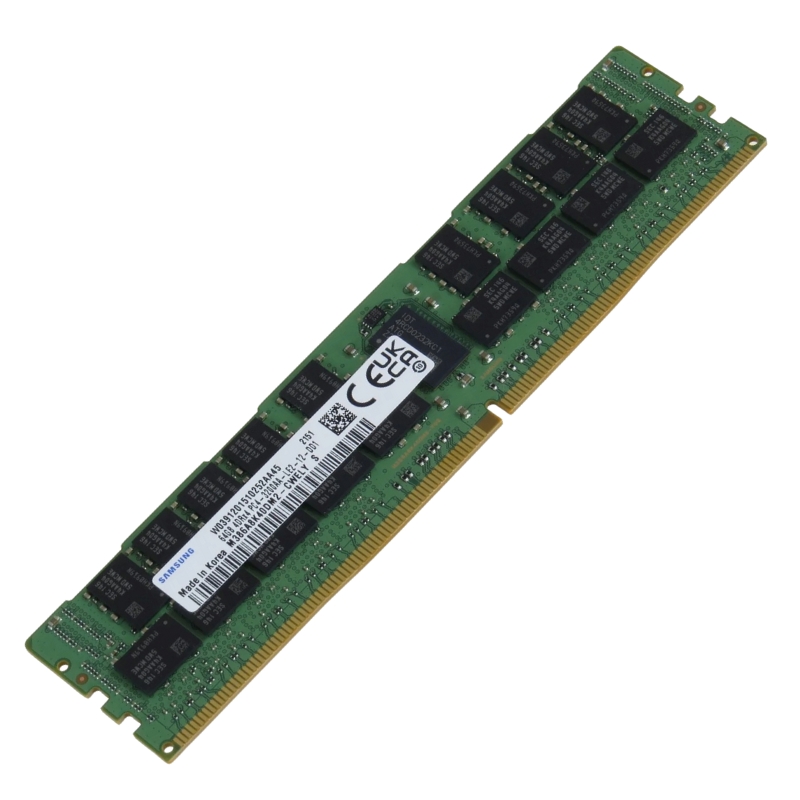
Samsung M393A8G40AB2-CWEGY 64GB 3200Mhz PC4-25600 Cl24 DDR4 SDRAM Ecc Reg Ram. New Sealed in Box (NIB) with 3 Years Warranty
| SKU/MPN | Warranty | Price | Condition | You save |
|---|---|---|---|---|
| M393A8G40AB2-CWEGY | 1 Year Warranty | $768.00 | New (Box Not Sealed) | You save: $268.80 (26%) |
| M393A8G40AB2-CWEGY | 1 Year Warranty | $1,056.00 | New Sealed in Box (NIB) | You save: $369.60 (26%) |
The Samsung M393A8G40AB2-CWEGY represents a high-performance, high-capacity memory component engineered explicitly for the demanding environments of modern enterprise servers, data centers, and high-performance computing (HPC) systems. This 64GB DDR4 Registered ECC RDIMM is a critical building block for servers requiring robust data integrity, large memory pools, and reliable throughput for virtualization, database management, in-memory computing, and other mission-critical applications.
In the realm of enterprise computing and data center operations, system stability, data integrity, and consistent performance are non-negotiable. At the heart of these requirements lies server memory, a critical component distinct from standard desktop RAM. The Samsung M393A8G40AB2-CWEGY represents a specific class of memory engineered for these demanding environments: a DDR4 ECC Registered RDIMM (Registered Dual In-Line Memory Module). This module is not merely a memory stick; it is a reliability-focused hardware solution designed for servers, high-performance workstations, and storage systems where uptime is paramount.
Before delving into technical intricacies, a summary of the module's primary specifications provides a clear framework. This module is a single 64GB stick of DDR4 SDRAM operating at a speed of 3200 megabits per second (Mbps), corresponding to a PC4-25600 data transfer rate. It features Error-Correcting Code (ECC) and a Register (Registered/Buffered) design, adheres to the 288-pin RDIMM form factor, operates at a standard voltage of 1.2V, and utilizes a Dual Rank, x4 DRAM configuration with a CAS Latency (CL) of 22.
The module offers a substantial 64 Gigabytes (1x64GB) of memory in a single slot. This high density is achieved through advanced semiconductor manufacturing, allowing for greater memory consolidation. Fewer modules are required to reach large total system memory capacities (e.g., 512GB across 8 slots), which reduces overall system power draw, simplifies inventory, and can improve signal integrity on the memory bus by lowering the electrical load per channel.
The CAS Latency (CL) is specified at CL22. This figure represents the number of clock cycles between a read command being issued and the first piece of data being available. While higher CL numbers might suggest higher latency compared to some consumer kits, in the server context, this timing is optimized for the immense stability, high density, and advanced signaling required by registered ECC memory. The balance between speed (3200 MT/s) and latency (CL22) is carefully calibrated for sustained server workloads, where consistency and error-correction overhead are paramount over ultra-tight timings.
ECC is a non-negotiable feature for any server handling critical data or financial transactions. It provides hardware-level data integrity by detecting and correcting the most common types of internal data corruption. Single-bit errors (where a single memory bit flips state) are corrected on-the-fly without any operating system or application intervention. Multi-bit errors are detected and reported to the system, which can then initiate a preventative shutdown or alert system administrators. This dramatically reduces the risk of silent data corruption, system crashes, and computational errors, ensuring the reliability of database records, scientific calculations, and virtual machine states.
Samsung's part numbering system reveals key attributes. Breaking down "M393A8G40AB2-CWEGY": M denotes a memory module, 393 indicates a Registered DIMM, A stands for 1.2V operation, 8G refers to 8Gb DRAM components, 40 signifies a x4 data width (per DRAM), and AB2 indicates a specific revision and design. The suffix CWEGY denotes commercial temperature (0°C to 85°C), 3200Mbps speed, ECC, and lead-free/halogen-free manufacturing.
This section explores the underlying technologies that define the module's capabilities and appropriate use cases.
As a Double Data Rate 4 Synchronous Dynamic Random-Access Memory (DDR4 SDRAM) module, it represents a significant generational improvement over DDR3. Key advancements include higher data rates, increased module density, and reduced power consumption. The 1.2V operating voltage, a decrease from DDR3's 1.5V, contributes to substantially lower power draw and heat generation at the system level, a critical factor in dense server deployments.
The "3200Mbps" refers to the module's data rate per pin (3200 Megabits per second). In a 64-bit wide channel, the total theoretical peak bandwidth is calculated as: 3200 Mbps * 8 bits/byte = 25600 MB/s. Hence, the industry nomenclature PC4-25600 (where "PC4" denotes DDR4 and "25600" indicates 25600 MB/s of bandwidth). A dual-channel or multi-channel server motherboard configuration aggregates this bandwidth across channels, dramatically increasing total system memory throughput.
These two features are non-negotiable for enterprise-grade memory.
ECC is a fundamental requirement for server stability. It detects and corrects the most common types of internal data corruption, specifically single-bit errors. As memory densities increase and cell sizes shrink, the probability of random bit-flips from background radiation or electrical noise grows. ECC adds extra bits (e.g., 8 bits for a 64-bit word) to enable the memory controller to identify and correct errors on-the-fly, preventing system crashes, data corruption, and silent data errors that could compromise computational integrity.
The "Registered" in RDIMM is crucial for supporting high-capacity modules and dense memory configurations. A Register (or buffer) on the module isolates the electrical load of the DRAM chips from the server's memory controller. This allows the system to support more memory modules per channel (commonly 2 RDIMMs vs. 1 UDIMM per channel) and higher total capacity without overloading the controller's driving capability. While adding a clock cycle of latency, the benefit is vastly superior capacity scaling and signal integrity.
The terms "Dual Rank" and "x4" describe the physical and logical organization of the memory chips on the module.
A "rank" is a set of DRAM chips that work together to fill the data width of the memory channel (typically 64 bits + ECC bits). A Dual Rank module has two such sets of chips. The memory controller can access one rank while preparing a command for the other, enabling a form of interleaving that can improve performance over a Single Rank module of the same capacity, especially in multi-threaded workloads.
The "x4" denotes that each individual DRAM chip has a 4-bit wide data interface. To form a 72-bit wide rank (64 data + 8 ECC), the module uses 18 chips (18 chips * 4 bits = 72 bits). x4-based modules are essential for supporting advanced error correction schemes like SDDC (Single Device Data Correction), also known as "Chipkill." SDDC can correct a complete failure of a single DRAM chip, providing a far higher level of reliability than standard ECC. This makes x4-based RDIMMs the preferred choice for mission-critical servers.
Ensuring compatibility is paramount when integrating this memory module into a server system.
The module uses the standard 288-pin RDIMM layout for DDR4. It is physically and electrically incompatible with DDR3 slots (240-pin) or desktop Unbuffered DIMMs (UDIMMs). The notch on the connector is in a different position to prevent accidental insertion into an incompatible motherboard.
The M393A8G40AB2-CWEGY is designed for servers powered by Intel Xeon Scalable Processors (e.g., 2nd Gen Cascade Lake, 3rd Gen Ice Lake, and later compatible platforms) and AMD EPYC 7002 Series (Rome), 7003 Series (Milan), and compatible platforms. It is crucial to verify the specific server or motherboard manufacturer's Qualified Vendor List (QVL) or memory compatibility list to confirm support for this exact part number, speed (3200Mbps), capacity (64GB), rank (Dual Rank), and organization (x4).
The high capacity, reliability, and performance of this module make it suitable for several intensive computing workloads.
Server virtualization (via VMware vSphere, Microsoft Hyper-V, KVM, etc.) demands large, reliable memory pools to host multiple virtual machines (VMs) simultaneously. A single server equipped with multiple 64GB RDIMMs can support dozens of VMs, improving consolidation ratios and data center efficiency. ECC and Registered features are vital for the stability of the hypervisor and all guest VMs.
Platforms like SAP HANA, Oracle Database In-Memory, and Microsoft SQL Server with In-Memory OLTP store critical data directly in RAM for near-instantaneous query responses. These applications benefit enormously from the large capacity (enabling larger datasets in memory) and the exceptional data integrity provided by ECC and x4 Chipkill-capable modules like the M393A8G40AB2-CWEGY, where data corruption is unacceptable.
HPC clusters performing complex simulations (CFD, FEA, climate modeling, genomic sequencing) require not only high memory bandwidth but also fault tolerance during long-running jobs. A memory error causing a week-long simulation to crash is highly costly. ECC RDIMMs are a standard requirement in such environments to ensure computational accuracy and job completion.
Large-scale ERP systems (e.g., SAP, Oracle E-Business Suite) and online transaction processing (OLTP) databases handle thousands of concurrent users and transactions. These systems rely on servers with abundant, reliable memory for caching and transaction processing, where downtime directly impacts business operations and revenue.


 Contact Us
 Information
 Catalog
 Solid State Drives (SSD)
 Network Switches
 Hard Disk Drives
 HBA & Controllers
 PC & Servers
 PC & Server Memory
 CPU & Processors
 Network Routers
 Power Supplies
 Tape Drives & Libraries
 Network Devices
 Computer & Network Cables