(7% discount is applied at checkout)
Cart is empty
Your go-to destination for cutting-edge server products
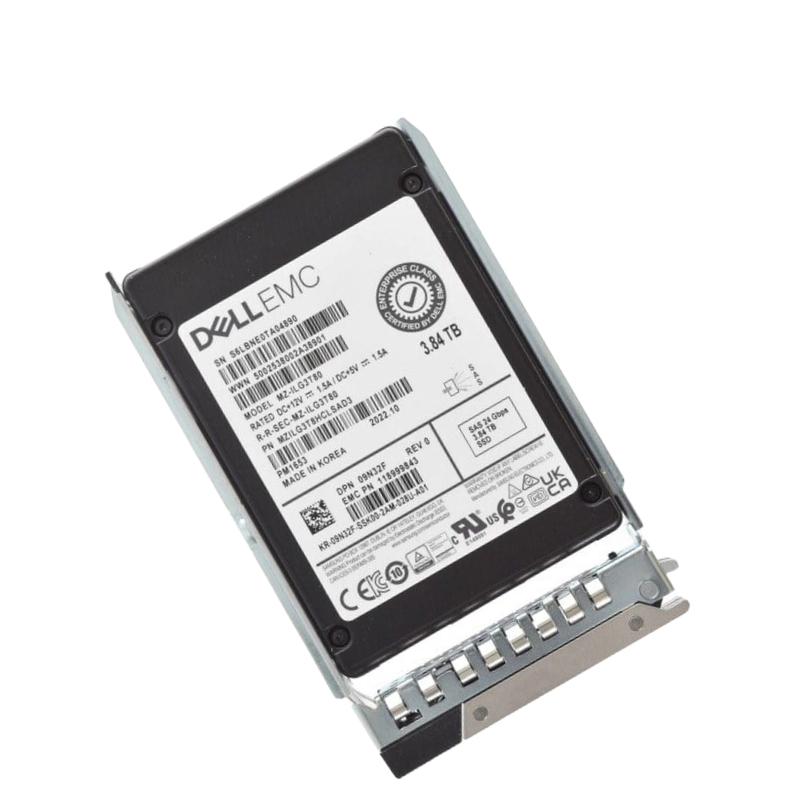


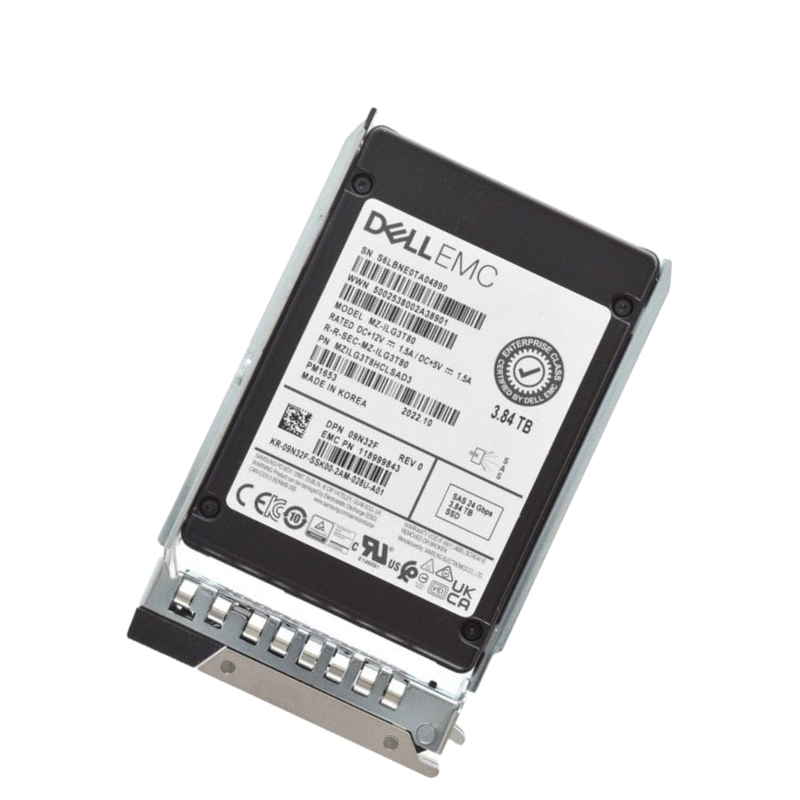
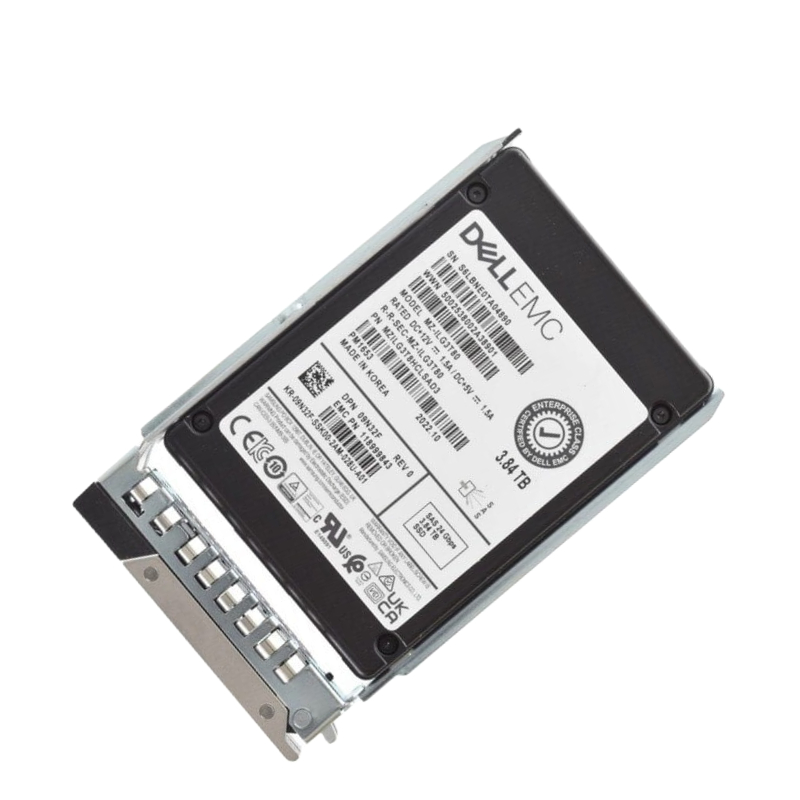
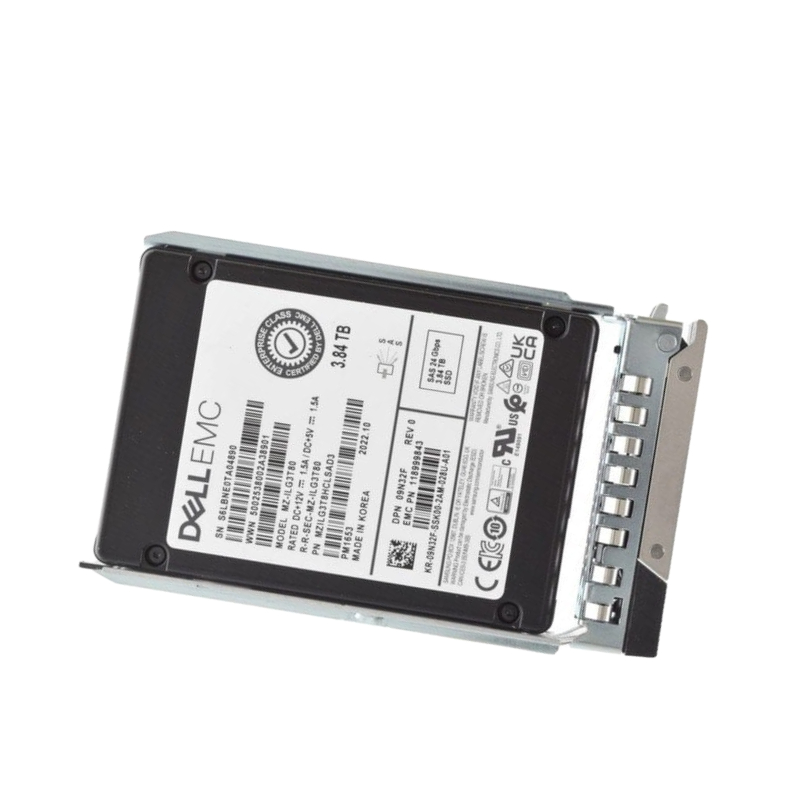
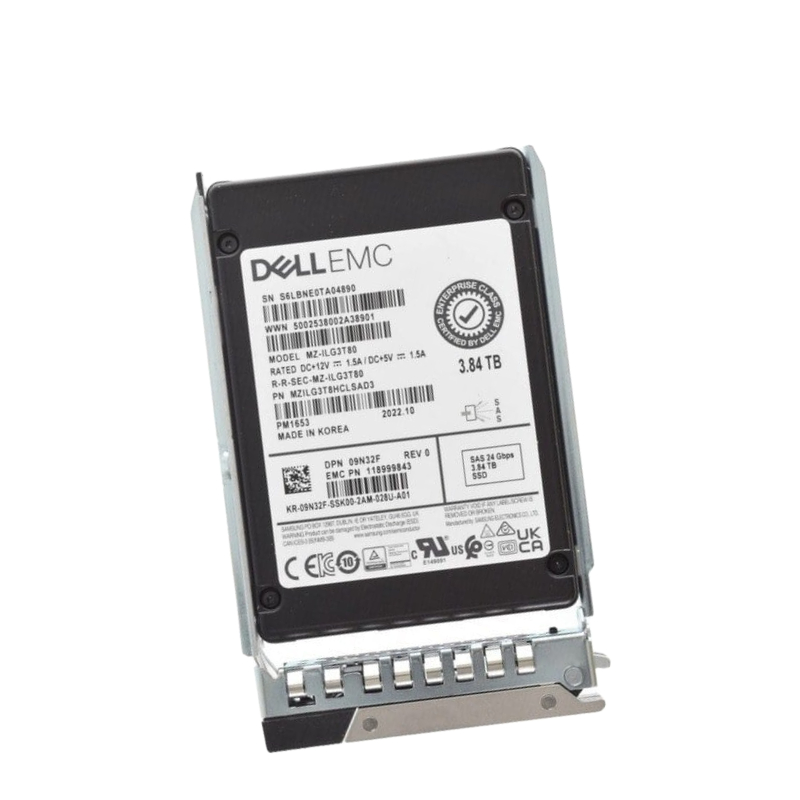
Dell 9N32F 3.84TB SAS-24GBPS Read-Intensive TLC 1Dwpd SFF Enterprise Class for 14G/15G/16G Poweredge Server Solid State Drive. New Sealed in Box (NIB) 1-Year Warranty
| SKU/MPN | Warranty | Price | Condition | You save |
|---|---|---|---|---|
| 9N32F | 1 Year Warranty | $4,275.00 | New Sealed in Box (NIB) | You save: $1,496.25 (26%) |
| 9N32F | 1 Year Warranty | $3,750.00 | Excellent Refurbished | You save: $1,312.50 (26%) |
This high-performance SSD is engineered to integrate seamlessly with a wide array of Dell PowerEdge and Powervault systems:
The above list highlights primary supported systems. Additional PowerEdge and Powervault configurations may also be compatible depending on firmware and controller specifications.
The Dell 9N32F 3.84TB SAS-24GBPS Read-Intensive TLC 1Dwpd SFF Enterprise Class for 14G/15G/16G PowerEdge Server Solid State Drive represents a focused segment of enterprise storage: high-density, read-optimized solid-state storage engineered for mission-critical workloads. This category emphasizes a 3.84TB formatted capacity in a small form factor (SFF, commonly 2.5"), leveraging SAS protocol at 24 Gbps to deliver consistent throughput and low latency. The “Read-Intensive” designation communicates workload targeting where sustained reads are predominant, and the TLC (Triple-Level Cell) NAND technology combined with a 1 drive write per day (1Dwpd) endurance rating indicates careful engineering to balance cost-efficiency, capacity density, and the endurance necessary for enterprise read-heavy applications. Compatibility with PowerEdge 14G, 15G, and 16G platforms ensures the drive fits a wide span of existing Dell server generations, simplifying lifecycle planning for data centers that maintain multi-generation server fleets.
Form factor and interface are two of the most critical selection criteria for storage administrators. The SFF 2.5-inch packaging of the Dell 9N32F fits dense server chassis and storage enclosures, enabling higher drive counts per rack unit and preserving valuable bay space for scale. The SAS-24Gbps interface in this category provides a point of compatibility between legacy SAS ecosystems and modern high-throughput server backplanes. By offering a dual-ported SAS path on most enterprise-class SAS drives in this family, systems gain redundancy and multipath I/O capability, which supports availability and failover strategies without compromising throughput. In heterogeneous datacenter environments where some systems still rely on SAS connectivity rather than NVMe, this SSD category simplifies integration and enables uniformity of management across blade, rackmount, and hybrid infrastructures.
Designed for read-optimized workloads, the Dell 9N32F family is tuned to deliver deterministic read latency, high sustained sequential and random read throughput, and consistent IOPS under production conditions. Workload types that benefit most include large-scale virtualization hosts serving primarily read-heavy VDI images, web and content delivery systems with frequent object retrievals, analytics query nodes that scan and read large datasets repeatedly, and database read-replica nodes that are optimized for fast transaction reads. The 1Dwpd endurance rating indicates the drive is not intended for write-intensive transactional logging or high-frequency update streams, but rather for environments where writes are comparatively limited or can be offloaded to higher-endurance tiers.
When selecting an SSD from this category, purchasers should evaluate expected latency under mixed load and peak concurrency rather than maximum synthetic numbers. Enterprises typically prioritize consistent sub-millisecond read latencies for user-facing applications and steady-state query responsiveness. The SAS-24Gbps link removes a common interface bottleneck when compared with lower-generation connections, allowing the drive to realize its internal NAND and controller performance. For read-dominant web caches, metadata stores, and content indexing services, these drives deliver a balance of capacity and performance that often reduces the need to tier large datasets into slower disk tiers, thereby simplifying storage architectures while lowering power consumption and rack density overhead.
Enterprise-class SSDs in this category typically incorporate a suite of reliability technologies. Error correction with advanced LDPC (Low-Density Parity-Check) algorithms protects data integrity at the NAND level; power-loss protection mechanisms guard against partial writes during unexpected outages; and on-drive telemetry with SMART attributes and health indicators supports predictive maintenance. Firmware is purpose-designed to maintain performance consistency over the drive lifetime, and features such as background garbage collection, wear-leveling, and thermal throttling are tuned for datacenter conditions. For IT teams, built-in self-monitoring and reporting help integrate the drive into existing monitoring systems so that preventive replacement can be scheduled long before end-of-life affects service levels.
Because the Dell 9N32F SSD category is intended for PowerEdge compatibility, the drives are often supported by vendor firmware updates, integration with server diagnostics, and warranty/service programs that align with server lifecycles. This simplifies asset tracking, firmware harmonization across drives, and support escalation when needed. Data centers benefit from vendor-validated compatibility matrices and from drive-level logs that can be accessed through iDRAC and similar out-of-band management tools. Lifecycle management in this category extends beyond mere failure replacement; it includes planned wear-out forecasting, secure decommissioning procedures, and validation steps to confirm compatibility with array controllers and HBA firmware levels across 14G through 16G generations.
Compatibility is central to the category identity. The Dell 9N32F 3.84TB SAS SSDs are validated for PowerEdge Gen 14, Gen 15, and Gen 16 servers, meaning the drives are physically and logically interoperable with the backplane, RAID controllers, and firmware ecosystems that power these server lines. For organizations that run mixed server generations, a consistent drive family that spans multiple PowerEdge releases reduces complexity in procurement, reduces cross-team training overhead, and minimizes the need for adapters or special backplanes. Compatibility validation typically includes drive firmware behavior under server firmware updates, hot-swap operations, RAID rebuild scenarios, and multipath I/O conditions, ensuring predictable behavior during normal operations and maintenance activities.
Enterprise storage designers must consider RAID and HBA compatibility when deploying SAS SSDs. Controllers that support SAS-3 interfaces and advanced RAID features will maximize the reliability and rebuild characteristics of 3.84TB drives. In many deployments, RAID rebuild times and array resiliency are central planning factors; larger-capacity SSDs reduce the number of spindles but increase individual rebuild bandwidth requirements. Selecting controllers and HBAs with firmware optimized for mixed-media arrays—SSDs and HDDs—ensures that rebuild operations, background scrubs, and parity recalculation do not introduce unacceptable performance degradation. The Dell 9N32F category is commonly used with Dell-certified RAID controllers that offer firmware optimizations for enterprise SSD behavior, including rebuild acceleration and background I/O prioritization to protect application-level SLAs during maintenance.
Security and data protection are often front-and-center for enterprise SSD deployments. Drives in this category may offer hardware encryption support, secure erase commands, and integration points for full-disk encryption schemes managed at the controller level. For regulated workloads, the ability to perform cryptographic erase as part of data destruction processes simplifies compliance with data privacy regulations and shorten deprovisioning windows. Audit-ready logs and SMART attribute reporting can help teams prove healthy drive usage and lifecycle events. When paired with server-level security features such as TPM and iDRAC logging, these drives fit into a comprehensive governance and compliance strategy that covers data retention, secure disposal, and incident forensics.
Maintaining firmware currency is a best practice; many enterprises establish controlled firmware update pipelines to ensure predictable rollouts. Firmware updates for drives in this category are often delivered through vendor-signed packages and are tested for compatibility with PowerEdge server firmware releases. In highly regulated production environments, controlled staging and rollback plans for drive firmware help avoid unexpected behavior. Trusted provisioning workflows, where drives are imaged or cryptographically initialized before deployment, reduce the risk of misconfiguration and help IT teams maintain a documented chain-of-custody for storage assets.
High-density SSD deployment changes rack thermal dynamics. The Dell 9N32F family, with its SFF packaging, allows more drives per chassis which increases both performance density and heat load. Storage architects must factor per-drive thermal envelopes and aggregate power draw into cooling designs and power distribution plans. Typical enterprise-class SSDs include thermal throttling and reporting that communicate temperature thresholds and dynamically adjust performance to prevent thermal runaway. For large arrays, grouping read-intensive SSDs with appropriate airflow and hot-aisle/cold-aisle design prevents hotspots and helps maintain sustained throughput. Power budgeting should also include peak draw during sustained writes or firmware maintenance tasks which sometimes spike power usage; these spikes should be considered when sizing UPS and PDU capacity so that redundancy is preserved during transient events.
Choosing a read-intensive TLC SSD like the Dell 9N32F 3.84TB depends on workload characteristics and performance SLAs. If an application primarily performs reads with occasional writes and the write volume falls within the 1Dwpd envelope, then read-intensive TLC is cost-effective. Conversely, write-heavy databases, high-frequency logging systems, or write-caching layers benefit from higher-endurance enterprise MLC or specially provisioned NVMe drives. Storage architects often design multi-tiered storage strategies where read-intensive drives hold large read-dominant datasets while higher-endurance drives serve write-heavy hot blocks, ensuring an optimal blend of cost, endurance, and performance across the estate.
There are multiple effective deployment patterns for drives in this category. One approach is to use these SSDs as primary read cache volumes in front of larger HDD arrays, accelerating read-heavy queries and reducing disk IO contention. Another approach is to implement these drives as the primary store for read-replica clusters or analytics shards where large sequential and random reads are frequent. Virtual desktop infrastructure (VDI) golden image stores also benefit from the combination of capacity and read performance, reducing login storms and improving user experience. In hyperconverged environments, these drives can serve as the read tier in two-tier storage pools, pairing with higher-endurance write tiers to balance cost and longevity.
Organizations across industries adopt read-optimized enterprise SAS SSDs for many purposes. In financial services, these drives often host read-intensive analytics caches and market data replicas. Media and entertainment companies use them to deliver high-volume content streams and to serve large media libraries with fast retrieval times. Enterprises running large-scale e-commerce sites leverage these SSDs for catalog indexes and search services where rapid response times directly affect conversion metrics. Healthcare institutions deploy read-optimized SSDs for imaging archives and PACS systems that require fast access to large files while balancing storage economics. Across these verticals, the balance of capacity, performance, and cost inherent to the Dell 9N32F category makes it a pragmatic choice for workloads dominated by reads.


 Contact Us
 Information
 Catalog
 Solid State Drives (SSD)
 Network Switches
 Hard Disk Drives
 HBA & Controllers
 PC & Servers
 PC & Server Memory
 CPU & Processors
 Network Routers
 Power Supplies
 Tape Drives & Libraries
 Network Devices
 Computer & Network Cables