
(7% discount is applied at checkout)
Cart is empty
Your go-to destination for cutting-edge server products
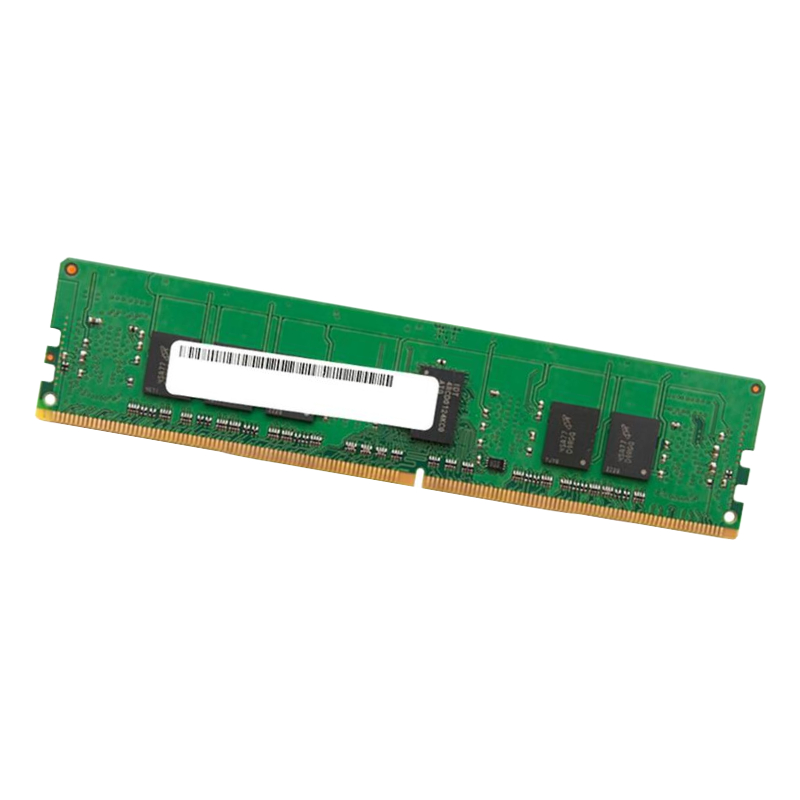
Dell AA783420 8GB DDR4-3200MT/S ECC Registered RDIMM Server Memory Module. New Sealed in Box (NIB)
The Dell AA783420 8GB 3200MHz PC4-25600 CL24 ECC Registered Single Rank X8 1.2V DDR4 SDRAM 288-Pin RDIMM is engineered for enterprise reliability and predictable performance in PowerEdge servers and compatible server platforms. This module’s 3200MHz data rate identifies it as part of the high-bandwidth DDR4 family optimized for modern multi-core processors and memory-intensive workloads.
The 8GB density, single rank organization and X8 chip configuration present an ideal balance between capacity, electrical loading and signal integrity for densely populated memory channels in 1U and 2U environments. Operating at 1.2 volts, the module supports DDR4 energy efficiency expectations while providing the timing characteristics typical of CL24 latency at its rated frequency, delivering deterministic latency behavior under ECC-enabled conditions.
Registered ECC memory differs from unbuffered DIMMs by inserting a register between the DRAM chips and the memory controller. This register reduces electrical loading on the memory controller and enables larger memory arrays and higher population counts without compromising signal quality. The ECC (Error Correcting Code) functionality detects and corrects single-bit memory errors in real time, which significantly reduces silent data corruption risk. In mission-critical server applications where data integrity and uptime are essential, ECC Registered modules like the AA783420 are a standard requirement. The Registered design also improves stability when pairing multiple DIMMs per channel, which is common in server configurations that aim to maximize total system memory for virtualization, in-memory databases, and high-performance computing workloads.
A single rank module organizes DRAM chips into one set of addressable memory banks. The X8 notation indicates each chip’s eight-bit data width, a common configuration for server-grade modules that balances cost and error-protection architecture while enabling compatibility with ECC logic which often expects specific bit-lane arrangements. Single rank modules typically impose less electrical load on the memory bus than dual or quad rank modules, which can benefit memory overclocking headroom and platform compatibility. For administrators who populate servers with multiple DIMMs per channel, single rank RDIMMs may allow higher overall module count before requiring BIOS-level adjustments to memory timings or frequency. Compatibility with Dell PowerEdge systems is ensured by design and testing protocols Dell applies to genuine modules, but independent platform validation remains advisable when mixing third-party parts or combining ranks and densities.
Measured in cycles rather than absolute time, CL24 at 3200MHz yields a specific nanosecond latency profile which is comparable with similar modules in the same frequency class. For server workloads that are bandwidth-sensitive—such as large dataset analytics, virtualization with high memory footprint per VM, and in-memory caches—the 3200MT/s capability brings notable benefits when the platform supports that frequency natively. Workloads with highly random access patterns remain sensitive to latency; while CL24 is not the lowest possible latency, the ECC and registered architecture ensure consistency and reliability that often outweigh microsecond-level latency differences in enterprise operations.
Operating at DDR4 standard 1.2 volts, this RDIMM reduces power draw relative to earlier generations while maintaining thermal stability in high-density server racks. Lower voltage reduces heat generation per module which is important when multiple DIMMs are placed adjacent on server motherboards and when chassis airflow is constrained. Reduced thermal stress also supports longer mean time between failures (MTBF). System administrators should still consider chassis cooling, airflow patterns and ambient data center temperatures to maintain optimal operation, because server-level densities and high CPU utilization can create hotspots that impact both processors and memory modules.
Dell AA783420 modules are qualified for specific PowerEdge families, but they are also compatible with a broader set of server platforms that accept DDR4 RDIMM 288-pin form factor and support ECC Registered modules. Compatibility depends on server BIOS memory training routines, chipset memory mapping and the supported memory speed table in the server firmware. On many platforms, mixing RDIMM modules of different speeds will force the array to the lowest supported common speed; likewise mixing single rank and multi-rank modules can limit the maximum achievable operating frequency. Administrators configuring memory should consult the server’s Qualified Vendor List (QVL) or the vendor’s memory configurator to ensure supported pairings and to avoid issues where the BIOS may restrict channel interleaving or reduce performance to maintain stability. Genuine Dell-branded modules, such as the AA783420, also often include server-specific SPD programming which helps the host firmware perform proper timing negotiation and voltage configuration during POST.
The AA783420 8GB RDIMM is well-suited to small-to-medium capacity server installations where reliability and ECC protection are paramount. It is ideal for entry-tier database servers, mail and file servers, small virtualization hosts, and compute nodes within larger clusters that require error-correcting memory. In hyperconverged infrastructures or multi-tenant virtualization environments where numerous virtual machines coexist on a single host, ECC and RDIMM stability reduce the chance of memory-induced errors which can ripple through multiple VMs.
Optimizing server memory performance requires attention to BIOS settings related to memory frequency, channel interleaving, and voltage margins. Many servers provide automatic settings that select the highest supported JEDEC standard frequency based on detected module SPD. For specific workloads, administrators may choose to configure memory to fixed frequencies to ensure deterministic behavior or to enable features like memory mirroring and sparing where supported by the platform. Enabling memory interleaving enhances throughput by distributing memory accesses across channels, which is particularly beneficial for multi-threaded server applications. However, performance tuning should always be validated with representative workload tests because conservative settings that favor stability may slightly lower peak throughput but yield higher long-term reliability, which is often preferred in enterprise operations.
In virtualization scenarios, capacity planning requires assessing per-VM memory overheads, host memory reservation policies and potential memory ballooning activity. An 8GB RDIMM module provides a straightforward building block for hosts that run multiple small-to-medium-sized VMs. When designing host configurations, consider the aggregate memory per socket and the memory overhead of the hypervisor, and leave headroom for peak demand. Memory oversubscription techniques can increase VM density, but they require more sophisticated monitoring and capacity planning. If planning for live migration or high availability, ensure that each host in the cluster has compatible memory capacity and performance characteristics to support VM redistribution without bottlenecks or unexpected downshifts in memory frequency.
Server-grade RDIMMs go through vendor validation cycles and burn-in testing that separate them from consumer-grade memory. The Dell AA783420 module adheres to these quality controls and is intended for long life cycles typical in data center deployments. Administrators should maintain an inventory of spare modules and follow an asset lifecycle policy that includes firmware updates, periodic diagnostic runs and replacement schedules tied to SMART metrics and environmental indicators. Physical inspection during maintenance windows for signs of corrosion, socket damage or bent pins can preempt installation problems.


 Contact Us
 Information
 Catalog
 Solid State Drives (SSD)
 Network Switches
 Hard Disk Drives
 HBA & Controllers
 PC & Servers
 PC & Server Memory
 CPU & Processors
 Network Routers
 Power Supplies
 Tape Drives & Libraries
 Network Devices
 Computer & Network Cables