
(7% discount is applied at checkout)
Cart is empty
Your go-to destination for cutting-edge server products
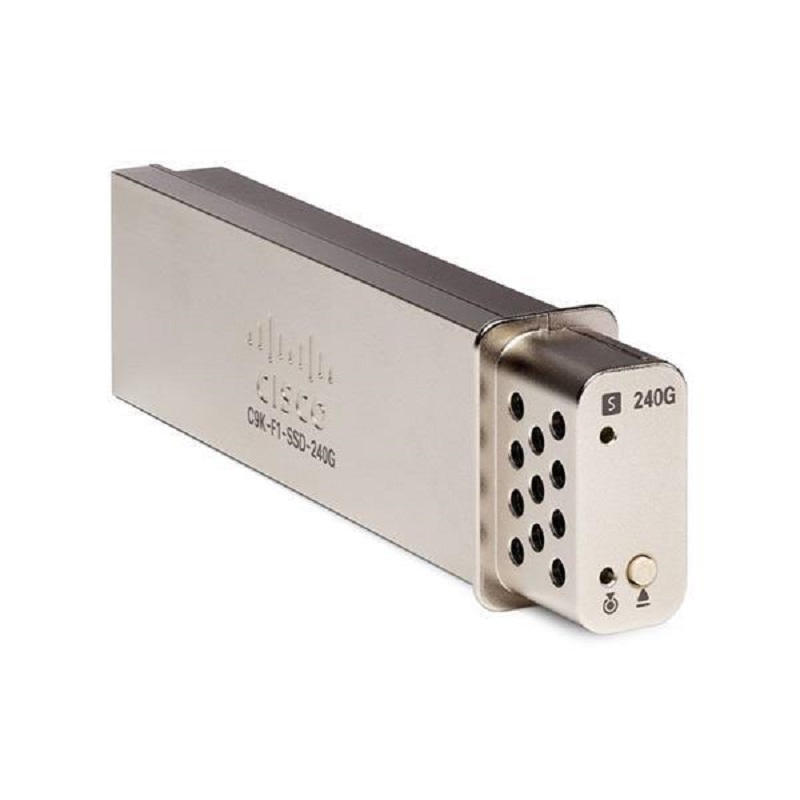
Cisco C9K-F1-SSD-240G 240GB Hot-Swap Internal SATA for Catalyst 9500 Series Solid State Drive. Excellent Refurbished with 1 year replacement warranty
Enhance your network infrastructure with the Cisco C9K-F1-SSD-240G, a high-performance 240GB internal SATA solid-state drive engineered for seamless integration with Catalyst 9500 Series switches.
This SSD is purpose-built for the Cisco Catalyst 9500 Series, ensuring optimal compatibility and performance. It integrates effortlessly into your existing network switch architecture, supporting high-throughput applications and virtualization workloads.
The Cisco C9K-F1-SSD-240G 240GB Hot-Swap Internal SATA Solid State Drive belongs to a class of high-reliability, high-performance internal storage modules designed specifically for Catalyst 9500 Series switches and similar enterprise-grade networking hardware. This category addresses the needs of network architects, systems administrators, and IT procurement teams who require a dependable onboard storage option for operating system images, logging, telemetry, configuration rollbacks, local packet buffering, and feature-rich modular services. Optimized for low-latency access patterns and sustained write endurance, these drives are engineered to integrate seamlessly with Cisco hardware and software ecosystems, providing an ideal balance between cost-effectiveness and lifecycle reliability for critical campus, data center, and branch deployments.
The defining technical attributes of the Cisco C9K-F1-SSD-240G model include a 240 gigabyte capacity formatted for internal use, SATA interface compliance to ensure broad compatibility and standardized signaling, and a hot-swap form factor enabling in-service replacement without powering down the host. The SSD utilizes solid-state NAND flash memory that delivers faster random read and write performance compared to mechanical drives, eliminating seek latency and greatly reducing I/O jitter. Enterprise-grade wear-leveling algorithms and power-loss protection features enhance data integrity under the demanding conditions typical of network appliances. Additionally, the drive’s firmware is often tuned for predictable performance with small-block metadata operations and frequent file system transactions characteristic of network OS workloads.
The SATA connection ensures interoperability with the Catalyst 9500 architecture while supporting standard SATA signaling speeds adequate for control-plane storage tasks, OS boot, crash dumps, and local buffering. The hot-swap capability is crucial for minimizing maintenance windows and enabling field replaceability by network operations personnel. Mechanically compatible bay design and keyed connectors prevent incorrect insertion and facilitate rapid extraction and replacement. For procurement teams, the form factor simplifies inventory logistics by aligning with established spare parts models and lifecycle procedures.
Performance in networking storage use-cases is measured not only in peak sequential throughput but, more importantly, in small-block random I/O throughput, consistent latency, and sustained write endurance. The Cisco C9K-F1-SSD-240G is optimized around these metrics, delivering low-latency access to configuration states and quick readbacks of system images. In practice, administrators will observe rapid boot cycles for network OS loads, snappier response when the device performs local logging or telemetry writes, and more predictable behavior during snapshots or image swaps. Because Catalyst 9500 switches often perform background tasks such as telemetry batching and local analytics, having a storage device that maintains stable latency under mixed workloads reduces the risk of transient control-plane slowdowns.
Enterprise SSDs are typically rated with endurance metrics expressed in drive writes per day (DWPD) or total terabytes written (TBW) across an expected warranty period. The endurance characteristics of a 240GB internal SSD targeted at network devices ensure that routine logging, OS updates, and local caching do not prematurely wear the media. In conjunction with predictable garbage collection and firmware-level protection schemes, the drive supports long service intervals and predictable replacement cycles. From an asset management perspective, tracking SMART attributes and firmware revisions is essential for proactive lifecycle planning; network operations teams can schedule replacements during routine maintenance intervals, relying on the hot-swap design to keep service disruption minimal.
Compatibility is a key selling point for platform-specific internal drives. The Cisco C9K-F1-SSD-240G is specified for Catalyst 9500 Series switches; it is validated to work with the switch’s storage management, partitioning scheme, and bootloader expectations. Integration with the switch’s operating system simplifies tasks such as OS image uploads, automatic recovery, and configuration snapshots. Using a validated internal SSD avoids interoperability pitfalls that can arise from generic consumer-grade drives whose behavior under certain corner-case storage commands might be unpredictable. For network professionals, sticking to parts validated by the platform vendor reduces support complexity and accelerates incident resolution.
Network deployments that benefit most from internal SSDs include enterprise campus cores, data center aggregation layers, and remote branch environments where local logging and image storage are needed. In a campus core, the Catalyst 9500 switch might host multiple virtual services and require rapid reloads during rolling upgrades; an internal 240GB SSD provides the space and performance to host multiple OS images for fast rollback. In data center aggregation roles, intensified telemetry and local packet capture episodes can be buffered to the SSD to avoid congesting management channels. For remote branches, the dependable internal storage reduces the need for external USB media for image storage and simplifies remote troubleshooting.
Proactive monitoring reduces the likelihood of surprise failures. Regular checks of S.M.A.R.T. parameters, monitoring of write amplification and spare capacity, and periodic firmware update reviews are all part of a strong maintenance approach. Logging and telemetry that records drive health over time can signal slow degradations before they impact operations. Maintenance windows offer opportunities to replace drives that are forecasted to reach endurance thresholds, enabling planned, low-risk swaps that leverage the hot-swap capability.
Within enterprise parts portfolios, choices typically vary by capacity, interface type, and vendor validation. Alternatives may include larger-capacity internal SSDs or different endurance profiles suited to write-intensive workloads. For organizations that require greater buffer space for telemetry or on-box analytics, higher-capacity models might be considered. Conversely, smaller-capacity options might exist for minimal storage needs. When evaluating alternatives, the most important considerations are platform validation, endurance rating, and whether the firmware has been tested against the specific host software versions used in production. Sticking with Cisco-validated part numbers reduces the risk associated with third-party firmware or unforeseen quirks in drive behavior.


 Contact Us
 Information
 Catalog
 Solid State Drives (SSD)
 Network Switches
 Hard Disk Drives
 HBA & Controllers
 PC & Servers
 PC & Server Memory
 CPU & Processors
 Network Routers
 Power Supplies
 Tape Drives & Libraries
 Network Devices
 Computer & Network Cables