
(7% discount is applied at checkout)
Cart is empty
Your go-to destination for cutting-edge server products
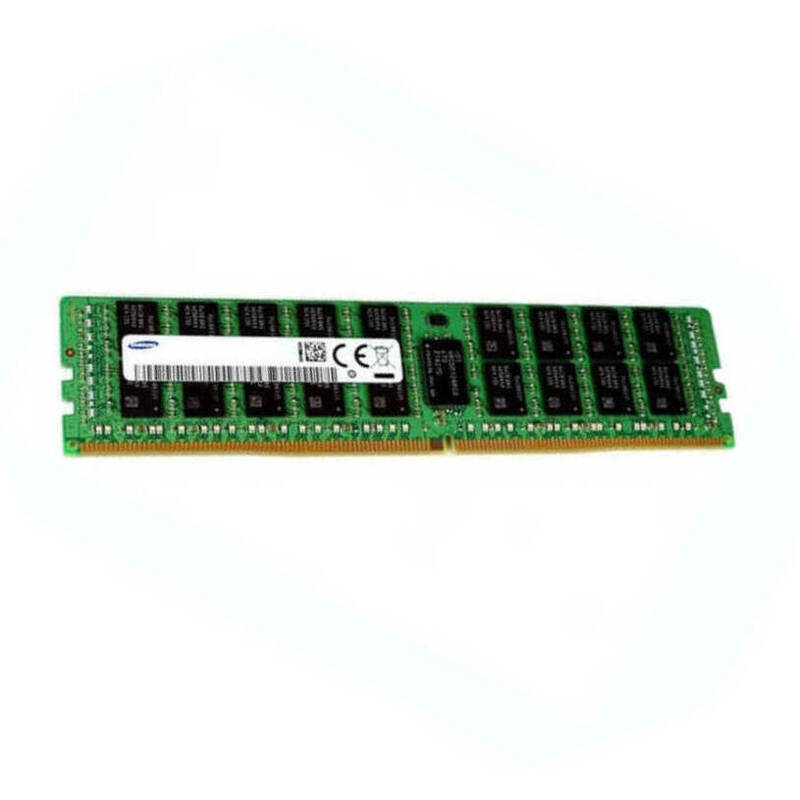
Samsung M393A8G40AB2-CWEQB 64GB PC4-25600 DDR4-3200MHz 288-Pin 1.2V Memory Module . New (System) Pull with 1 year replacement warranty
| SKU/MPN | Warranty | Price | Condition | You save |
|---|---|---|---|---|
| M393A8G40AB2-CWEQB | 1 Year Warranty | $768.00 | New (System) Pull | You save: $268.80 (26%) |
| M393A8G40AB2-CWEQB | 1 Year Warranty | $1,056.00 | New Sealed in Box (NIB) | You save: $369.60 (26%) |
The Samsung M393A8G40AB2-CWEQB is a high-performance 64GB DDR4 SDRAM memory module designed to meet the demanding needs of modern computing systems. With superior reliability and speed, this module ensures that your system operates at its best, offering efficient data processing and optimal performance. This memory module is ideal for use in servers, workstations, and other high-end applications where stability and speed are paramount.
The Samsung M393A8G40AB2-CWEQB represents a pinnacle of DDR4 server memory engineering, designed explicitly for demanding enterprise, data center, and high-performance computing (HPC) environments. This 64GB registered ECC RDIMM module is built to deliver exceptional reliability, substantial memory density, and robust performance for critical server workloads. Engineered with Samsung's advanced semiconductor technology, this module ensures data integrity and system stability under continuous operation, making it an ideal choice for server virtualization, in-memory databases, large-scale cloud infrastructure, and intensive computational tasks.
This memory module is configured as a single 64GB (Gigabyte) stick, operating at a data transfer rate of 3200 Megatransfers per second (MT/s), commonly marketed as 3200Mbps. The part number M393A8G40AB2-CWEQB follows Samsung's precise nomenclature, indicating its form factor (M3 for RDIMM), data width (8 for x4), and specific revision. The module adheres to the PC4-25600 standard, which denotes the peak bandwidth of 25600 MB/s (calculated as 3200 MT/s * 8 bytes). This high bandwidth is crucial for reducing data bottlenecks in multi-processor systems.
This module offers a substantial 64-gigabyte capacity in a single module. This high-density design is essential for maximizing total system memory without consuming excessive physical DIMM slots. In a typical dual-processor server with 12 or 16 slots per CPU, using modules of this density can enable system configurations reaching 768GB or 1TB per socket and beyond, facilitating immense in-memory workloads.
The "Dual Rank" configuration means the 64GB capacity is organized into two independent sets of DRAM chips that the memory controller can address separately. While not as performance-optimized for sheer bandwidth as a single-rank module in some scenarios, dual-rank design offers an excellent balance of capacity, manufacturability, and performance. It improves memory interleaving and can provide better overall throughput than a single-rank module in many server applications.
The module operates at a data rate of 3200 Megatransfers per second (MT/s), commonly referred to as 3200 Mbps. This translates to a peak theoretical bandwidth of 25,600 MB/s per module, calculated as (3200 MT/s * 64-bit data bus) / 8 bits per byte. The industry nomenclature for this is PC4-25600. This high-speed interface accelerates data movement between the CPU and memory, reducing bottlenecks in memory-intensive applications.
The module operates at a low voltage of 1.2V, balancing power efficiency with performance. Its timing latency is rated at CL22 (CAS Latency 22), a standard for high-density, high-speed server modules where stability and capacity often take precedence over ultra-tight timings. The "Dual Rank" architecture means the memory chips are organized into two independent sets that the memory controller can address alternately, improving performance over a single-rank design at the same density by optimizing signal loading and allowing for more efficient access cycles.
The integration of Error-Correcting Code (ECC) and a Registered (Buffered) design is the cornerstone of this module's server-grade pedigree.
ECC technology is non-negotiable for mission-critical systems. It enables the module to detect and correct single-bit memory errors automatically and detect multi-bit errors. This proactive correction prevents data corruption, silent data errors, and potential system crashes that can result from cosmic rays, electrical interference, or cell degradation. For databases, financial transactions, and scientific computing, ECC is essential for ensuring data accuracy and long-term system uptime.
The "Registered" in RDIMM indicates the presence of a register (or buffer) on the module itself, situated between the memory controller and the DRAM chips. This register buffers the command and address signals, reducing the electrical load on the memory controller. This allows a server system to support a much greater number of memory modules per channel (typically 2-3 per channel for RDIMMs vs. 1-2 for unbuffered) without signal degradation. This is absolutely vital for populating large memory capacities across multiple CPUs, enabling servers to scale to terabytes of RAM reliably.
The "Dual Rank" and "x4" data width specifications are critical for understanding module compatibility and performance characteristics.
A dual-rank module effectively behaves like two logical memory modules soldered onto a single physical stick. The memory controller can switch between these two ranks, hiding precharge and activation delays and thus improving overall memory efficiency. Compared to a single-rank 64GB module (which would be very difficult and expensive to produce), a dual-rank design offers better performance under many server workloads and is more feasible to manufacture with current DRAM chip densities.
The "x4" refers to the organization of the individual DRAM chips on the module. Each chip has a 4-bit wide data interface. A x4-based RDIMM is essential for supporting advanced RAS (Reliability, Availability, Serviceability) features like SDDC (Single Device Data Correction), also known as Chipkill. SDDC can survive the complete failure of an entire DRAM chip or a full 4-bit lane. This is a higher level of protection than standard ECC, which corrects single-bit errors. Server platforms that require this level of fault tolerance specifically mandate x4-based LRDIMMs or RDIMMs.
The module utilizes the standard 288-pin RDIMM form factor, designed for DDR4 server motherboards. The physical layout and notch position are specific to DDR4 and prevent insertion into incompatible DDR3 or DDR5 slots. It is paramount to verify motherboard and system compatibility through the vendor's qualified vendor list (QVL), as support depends on the CPU's memory controller and the system's firmware. This module is intended for dual- or multi-socket servers from manufacturers like Dell (PowerEdge), HPE (ProLiant), Lenovo (ThinkSystem), Cisco (UCS), and Supermicro, among others.
Operating at the JEDEC-standard 1.2V, this module aligns with DDR4's improved power efficiency over DDR3 (1.5V). However, high-density modules in aggregate can still generate significant heat in densely packed servers. Proper system airflow is required to maintain optimal operating temperatures. Many servers incorporate temperature sensors (TS-on-DIMM) and advanced thermal management to throttle performance if necessary to protect the hardware, though this module itself does not include a temperature sensor.
In virtualized environments using VMware vSphere, Microsoft Hyper-V, or KVM, high memory density is paramount. A single 64GB module allows for greater consolidation ratios—hosting more virtual machines (VMs) per physical server. This reduces hardware footprint, power consumption. For cloud service providers, such modules enable the creation of high-memory instance types for memory-intensive applications.
Technologies like SAP HANA, Oracle Database In-Memory, and various real-time analytics platforms rely on storing vast datasets in RAM for lightning-fast processing. The 64GB capacity per module allows systems to reach the terabytes of memory required for these workloads efficiently. The ECC and Registered features ensure the integrity of the valuable data held in memory during computation.
Scientific simulations, financial modeling, genomic sequencing, and 3D rendering farms require not only powerful CPUs/GPUs but also large, fast, and stable memory subsystems. The 3200MT/s bandwidth helps feed data quickly to processors, while the high density allows complex models and datasets to be loaded entirely into RAM, drastically accelerating compute times compared to disk-swapping.


 Contact Us
 Information
 Catalog
 Solid State Drives (SSD)
 Network Switches
 Hard Disk Drives
 HBA & Controllers
 PC & Servers
 PC & Server Memory
 CPU & Processors
 Network Routers
 Power Supplies
 Tape Drives & Libraries
 Network Devices
 Computer & Network Cables