
(7% discount is applied at checkout)
Cart is empty
Your go-to destination for cutting-edge server products
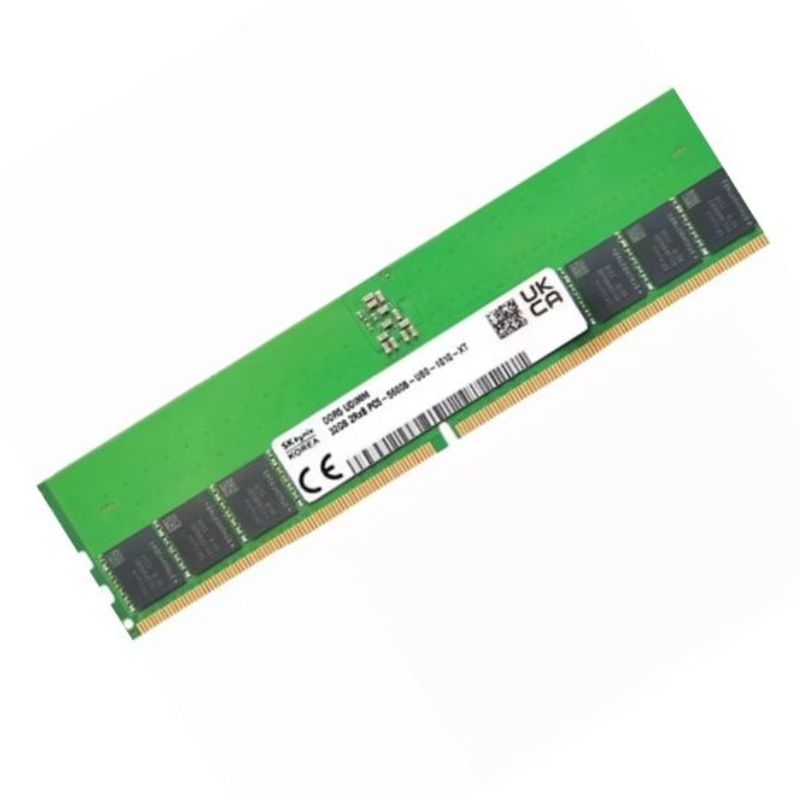
Hynix HMCG88AGBRA190N 32GB (1x32gb) 5600MHz Pc5-44800 Dual Rank X8 Ecc Registered 1.1v Cl46 Ddr5 Sdram 288-pin Rdimm Memory Module For Server. New (System) Pull with 1 year replacement warranty
The Hynix HMCG88AGBRA190N 32GB (1×32GB) DDR5-5600MHz PC5-44800 Dual Rank x8 ECC Registered 1.1V RDIMM module is engineered for high-performance servers, providing exceptional speed, reliability, and data protection for demanding enterprise workloads.
This high-efficiency DDR5 memory module is verified to operate smoothly with multiple Dell PowerEdge platforms.
The transition from DDR4 to DDR5 is a generational leap, and the Hynix HMCG88AGBRA190N is at the forefront. DDR5 architecture is fundamentally redesigned to address the bandwidth bottlenecks of previous generations, introducing key innovations that redefine server performance ceilings.
DDR5 memory doubles the burst length and prefetch size compared to DDR4, enabling significantly higher data transfer rates per clock cycle. The module's speed of 5600MT/s (Mega Transfers per second), marketed as 5600MHz, is a testament to this. This is achieved through a more robust and efficient signaling technology, allowing for faster operations without a proportional increase in power consumption.
A critical DDR5 innovation is the relocation of the power management from the motherboard to the memory module itself. Each HMCG88AGBRA190N module incorporates an onboard PMIC. This allows for more granular and stable voltage regulation (at 1.1V, lower than DDR4's typical 1.2V), improving signal integrity, power efficiency, and enabling better over-current protection. This distributed power design is crucial for server racks where power delivery and thermal management are paramount.
While a DDR4 DIMM operates as a single 72-bit channel (64 data + 8 ECC), a DDR5 RDIMM like this Hynix module internally splits into two independent 40-bit sub-channels (32 data + 8 ECC each). This effectively doubles the bank groups and improves memory access concurrency, allowing the memory controller to handle two simultaneous 32-byte data accesses per channel. This dramatically reduces latency contention and increases overall efficiency for multi-threaded server workloads.
Each segment of the part number and specification sheet for the HMCG88AGBRA190N tells a story about its capability and intended application. Understanding these details is key to proper system integration and performance tuning.
This 32GB capacity per module offers an optimal balance for modern server configurations, allowing for high-density memory installations (e.g., 512GB across 16 slots) without overwhelming the memory controller. The "Dual Rank" designation indicates the memory chips are organized into two logical ranks on the module. Dual Rank provides a performance advantage over Single Rank by offering more bank interleaving, leading to better parallelism and higher sustained bandwidth, which is ideal for database and virtualization servers.
The "x8" refers to the physical organization of the DRAM chips—each chip has an 8-bit wide data interface. x8-based modules are the standard for server-grade ECC memory. This configuration, combined with the module's ECC capability, uses standard 8Gb or 16Gb DDR5 chips to construct the full 72-bit width (64 data + 8 ECC) of the channel. This organization is preferred for its optimal balance of reliability, manufacturability, and compatibility with server memory controllers.
These three figures are intrinsically linked and define the speed and timing of the module.
The module operates at a data rate of 5600 Megatransfers per second (MT/s), commonly referred to as 5600MHz. The industry standard designation for this speed is PC5-44800. The "PC5" denotes DDR5, and the "44800" represents the peak theoretical bandwidth in megabytes per second (MB/s) for a single module. This is calculated as: 5600 MT/s * 8 bytes (64-bit) = 44,800 MB/s. This massive bandwidth is essential for data-intensive applications like in-memory analytics, AI model inference, and high-frequency trading platforms.
CAS Latency (CL) is the number of clock cycles between the memory controller issuing a read command and the first piece of data being available. A CL46 rating at 5600MT/s represents a balanced engineering trade-off. While the absolute latency in nanoseconds (ns) is a more useful cross-generation comparison, DDR5's vastly higher clock speeds mean that even with a higher CL number, the actual time delay can be competitive or better. The formula is: (CL / Speed in MHz) * 2000 = latency in ns. For this module: (46 / 5600) * 2000 ≈ 16.43 nanoseconds. This is optimized for high-throughput server workloads where bandwidth is often more critical than absolute lowest latency.
This triad of features is what categorically separates server memory from consumer desktop memory. They are non-negotiable for any system where data accuracy and stability are critical.
ECC is a mandatory feature for servers. The Hynix HMCG88AGBRA190N includes an extra 8 bits per 64-bit word (hence the 288-pin design vs. 288-pin for non-ECC, which uses the extra pins for other functions) to store an error-correcting code. This allows the memory module to detect and automatically correct single-bit data corruption (soft errors) on the fly. It can also detect, but not correct, multi-bit errors. This hardware-level correction prevents silent data corruption that could lead to application crashes, corrupted calculations, or database integrity issues, ensuring data fidelity across billions of operations.
The "Registered" in its title (often abbreviated as RDIMM) is crucial. A Registered DIMM includes a register (or buffer) on the module for the address and command lines from the memory controller. This buffer reduces the electrical load on the controller, allowing it to drive more memory modules stably. This enables servers to populate all memory slots with high-capacity DIMMs (like 32GB modules) without risking signal degradation. The trade-off is an additional clock cycle of latency for the buffering, but the gain in system capacity and stability is indispensable for scalable server architectures.
The physical interface is a 288-pin edge connector, which is the standard for DDR5. The pinout is different from DDR4's 288-pin design to prevent accidental insertion into an incompatible slot. The connector and PCB are designed for sustained operation in 24/7 environments, with gold-plated contacts for reliable connections over years of service.
Operating at a nominal voltage of 1.1V, DDR5 is more power-efficient than DDR4 (typically 1.2V). This reduction, combined with the efficiency of the onboard PMIC, leads to lower power consumption per gigabyte transferred—a critical factor in large-scale data centers where operational expenditure (OPEX) on power and cooling is a major concern. The module is also designed with enterprise thermal sensors and a standard server heatsink/spreader to manage heat output under constant load, ensuring consistent performance and longevity.
The Hynix HMCG88AGBRA190N is not a general-purpose component; it is engineered for specific, demanding workloads where its features provide tangible ROI.
Hypervisors like VMware vSphere, Microsoft Hyper-V, and KVM require large pools of reliable, high-bandwidth memory to host numerous virtual machines (VMs). The 32GB capacity and ECC protection ensure VM isolation and data integrity, while the high bandwidth prevents memory bottlenecks as VMs compete for I/O. Registered design allows for maximum memory population per host, increasing VM density and consolidation ratios.
Enterprise databases (Oracle, SQL Server, SAP HANA) and in-memory data platforms thrive on fast, error-free memory. The dual-rank, dual sub-channel design of this module provides the sustained bandwidth needed for rapid query processing and transaction throughput. ECC is absolutely critical here, as a single uncorrected memory error could corrupt an entire database index or transaction log.
Clusters used for computational fluid dynamics, genomic sequencing, and financial modeling process massive datasets. The PC5-44800 bandwidth accelerates the movement of data between the CPU and memory, reducing compute cycle wait times. The scalability afforded by the Registered (RDIMM) design is essential for building nodes with terabytes of coherent memory.


 Contact Us
 Information
 Catalog
 Solid State Drives (SSD)
 Network Switches
 Hard Disk Drives
 HBA & Controllers
 PC & Servers
 PC & Server Memory
 CPU & Processors
 Network Routers
 Power Supplies
 Tape Drives & Libraries
 Network Devices
 Computer & Network Cables