
(7% discount is applied at checkout)
Cart is empty
Your go-to destination for cutting-edge server products
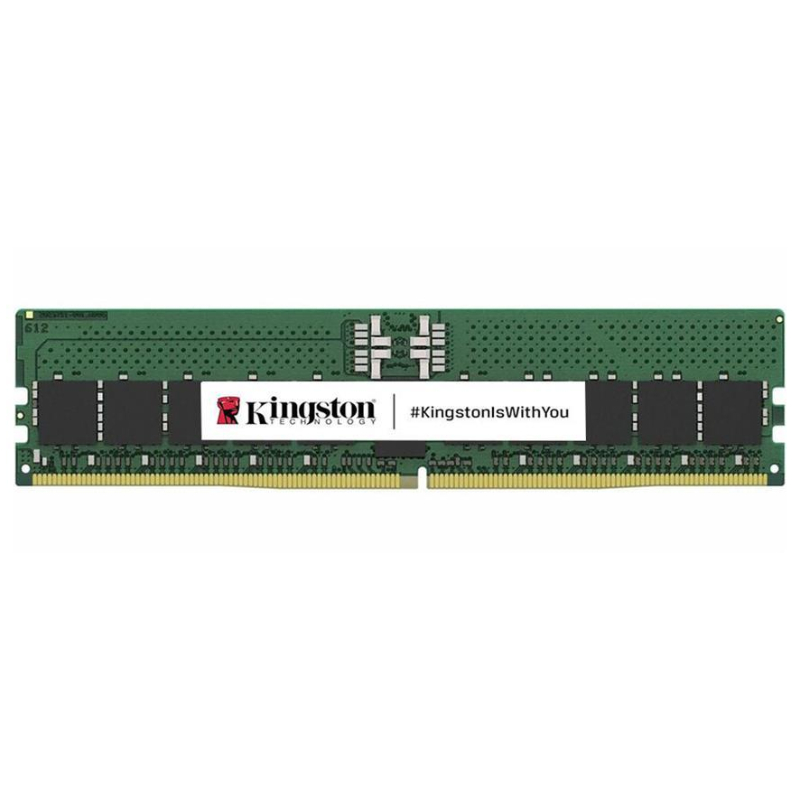
Kingston KSM56R46BD8-32MD 32GB DDR5-5600MHz PC5-44800 ECC Registered RDIMM CL46 2Rx8 1.1V 288-Pin Memory Module. Factory-Sealed New in Original Box (FSB) with 3 Years Warranty
The Kingston KSM56R46BD8-32MD is defined by a precise set of technical parameters that determine its compatibility and performance envelope. At its core, this module operates at a data rate of 5600 Megatransfers per second (MT/s), which is often marketed as DDR5-5600.
In the realm of enterprise computing, data integrity, system stability, and performance scalability are non-negotiable. The Kingston KSM56R46BD8-32MD represents a cornerstone component for modern server platforms, embodying the significant architectural leap of DDR5 technology. This 32GB DDR5-5600MHz ECC Registered RDIMM is engineered for next-generation servers, offering enhanced bandwidth, improved power efficiency, and robust error correction crucial for data centers, cloud infrastructure, high-performance computing (HPC), and mission-critical applications.
The Kingston KSM56R46BD8-32MD is defined by a precise set of technical parameters that determine its compatibility and performance profile within a server ecosystem.
This module features a substantial 32 gigabytes (GB) of memory capacity. This high-density design allows system builders and data center operators to maximize total system memory within the physical slot constraints of a server motherboard. For example, a dual-processor server with 16 memory slots per CPU can achieve a terabyte of RAM or more using these modules, enabling the hosting of massive in-memory databases and reducing reliance on slower storage-based caching.
The module operates at a data rate of 5600 million transfers per second (MT/s), designated as DDR5-5600. This translates to a peak transfer rate of 44800 megabytes per second per module, hence the industry standard designation PC5-44800. This higher speed, compared to common DDR4-3200 modules, significantly increases the available memory bandwidth, alleviating potential bottlenecks for data-intensive applications and multi-core processors.
The module’s latency is specified by the CAS Latency (CL) value of 46 cycles at its rated speed of 5600 MT/s. While the CL number is higher than typical DDR4 modules, it is essential to understand that latency in nanoseconds is a more accurate measure due to the vastly increased clock speeds of DDR5. The combination of high data rate and optimized timings ensures responsive system performance under load.
The Kingston module operates at a low voltage of 1.1 volts (V). This represents an improvement in power efficiency over DDR4's standard 1.2V, contributing to reduced power consumption and heat generation at the rack and data center level. Lower thermals enhance long-term reliability and stability.
The module conforms to the 288-pin Dual In-Line Memory Module (DIMM) form factor standard for DDR5. The physical layout and notch keying are specific to DDR5, preventing accidental insertion into incompatible DDR4 slots. The RDIMM design includes additional hardware components that are crucial for its function in server environments.
DDR5 is not merely an incremental speed boost over DDR4; it introduces architectural changes that fundamentally benefit server workloads.
Each DDR5 module incorporates two independent 32-bit data subchannels (with ECC, this becomes 40-bit per subchannel). This effectively doubles the burst length and improves memory controller efficiency compared to DDR4's single 64-bit channel. For servers, this means better concurrency and reduced latency for simultaneous memory access patterns common in multi-threaded applications.
A key innovation of DDR5 is the migration of the power management integrated circuit (PMIC) from the motherboard to the memory module itself. The Kingston KSM56R46BD8-32MD includes its own PMIC. This provides superior voltage regulation, reduces signal noise, improves power integrity, and allows for more granular power monitoring and control—a vital feature for data center infrastructure management (DCIM) and optimizing power usage effectiveness (PUE).
DDR5 memory chips incorporate on-die ECC to correct bit errors within the DRAM chip itself before data is sent to the system. This internal error scrubbing enhances data reliability at the most fundamental level, working in tandem with the module-level ECC to provide a multi-layered defense against soft errors and corruption.
The "ECC Registered" in the module's description points to its two most important server-grade features, which are essential for mission-critical system stability.
ECC is a non-negotiable requirement for servers and workstations handling sensitive data or requiring continuous uptime. The Kingston KSM56R46BD8-32MD includes extra memory bits to store an error-correcting code. As data is written to memory, a code is calculated and stored. When the data is read, the code is recalculated and compared. The ECC logic can automatically detect and correct single-bit errors (Single Error Correction, or SEC) and detect (but not correct) multi-bit errors (Double Error Detection, or DED). This hardware-level protection prevents silent data corruption, system crashes, and application faults caused by cosmic rays, electrical interference, or other factors that can flip memory bits.
The "Registered" designation means the module includes a register (or buffer) for the address and command signals sent from the server's memory controller. This register, located on the module, buffers and re-drives these signals before they reach the individual memory chips. This reduces the electrical load on the memory controller, allowing it to support a greater number of memory modules per channel while maintaining signal integrity and system stability. RDIMMs are the standard for high-capacity, multi-DIMM server configurations, offering superior reliability and scalability compared to unbuffered (UDIMM) memory.
It is important to distinguish this RDIMM from Load-Reduced DIMMs (LRDIMMs) and Unbuffered DIMMs (UDIMMs). LRDIMMs buffer the data lines as well, enabling even higher capacities at the cost of slightly higher latency. UDIMMs have no buffer, placing a direct electrical load on the controller and are typically used in consumer desktops and low-end workstations. The Kingston KSM56R46BD8-32MD RDIMM strikes the optimal balance of performance, capacity, and cost for the vast majority of enterprise server applications.
The "2Rx8" notation describes the internal organization of the memory chips on the module.
A "rank" is a set of memory chips that work together to fill the data width of the memory channel. A 2R module is dual-rank, meaning it has two independent sets of chips that the memory controller can address separately. This allows for interleaving, where the controller can switch between ranks to access data without waiting for one rank to complete its cycle, improving overall throughput and efficiency compared to a single-rank (1R) module of the same capacity.
The "x8" refers to the organization of the individual DRAM chips. Each chip has an 8-bit wide data interface. To form a 72-bit wide RDIMM (64 data bits + 8 ECC bits), the module uses multiple chips in parallel. A 2Rx8 32GB module like the Kingston KSM56R46BD8-32MD will utilize a specific arrangement of high-density DRAM chips to achieve its total capacity, rank count, and data width. This organization is optimized for yield, performance, and compatibility with server memory controllers.
The Kingston KSM56R46BD8-32MD is purpose-built for specific server platforms and demanding workloads.
This memory module is validated and qualified for use in servers based on the latest Intel and AMD enterprise platforms. This includes servers with Intel's fourth-generation Xeon Scalable processors (code-named Sapphire Rapids) and the accompanying Intel C741 chipset, as well as systems powered by AMD's EPYC 9004-series processors (code-named Genoa) with the SP5 socket. Always consult your server manufacturer's qualified vendor list (QVL) to ensure specific model compatibility.
The combination of high bandwidth, large capacity, and unwavering reliability makes this module ideal for numerous enterprise and hyperscale applications. Virtualized environments running VMware, Hyper-V, or KVM benefit from the high density and ECC protection to host more virtual machines safely. In-memory databases like SAP HANA, Oracle Exadata, and Redis require the speed and capacity that 32GB DDR5 RDIMMs provide. Other key use cases include high-performance computing (HPC) clusters, big data analytics platforms (Hadoop, Spark), AI/ML training data stores, and demanding financial modeling and simulation applications.


 Contact Us
 Information
 Catalog
 Solid State Drives (SSD)
 Network Switches
 Hard Disk Drives
 HBA & Controllers
 PC & Servers
 PC & Server Memory
 CPU & Processors
 Network Routers
 Power Supplies
 Tape Drives & Libraries
 Network Devices
 Computer & Network Cables