
(7% discount is applied at checkout)
Cart is empty
Your go-to destination for cutting-edge server products
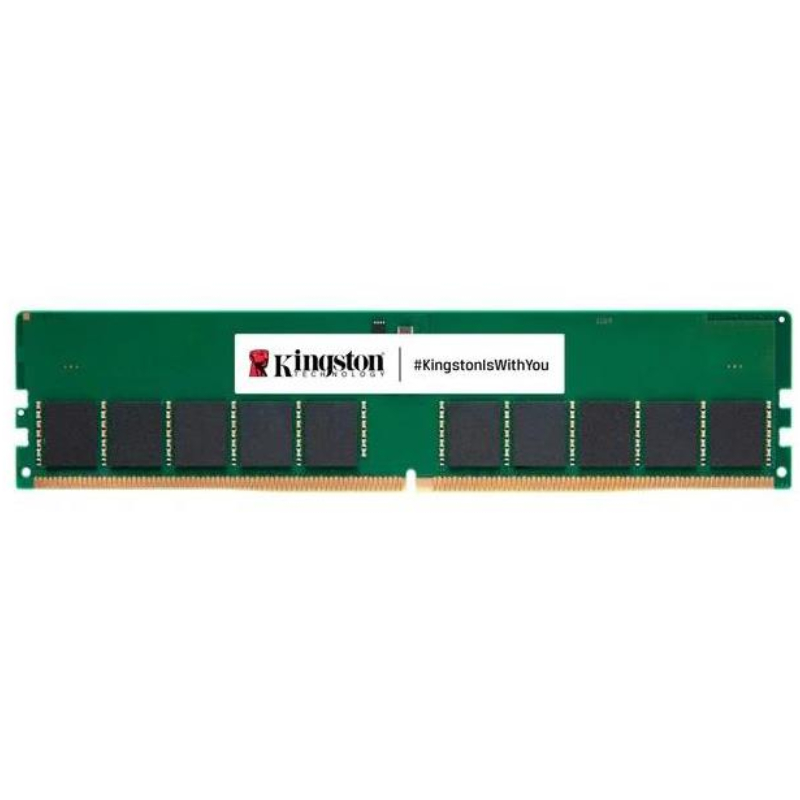
Kingston KSM56R46BD8PMI-32MDI 32GB DDR5-5600MHz PC5-44800 ECC Registered RDIMM CL46 2Rx8 1.1V 288-Pin Memory Module. New Sealed in Box (NIB) with 3 Year Warranty
The Kingston KSM56R46BD8PMI-32MDI DDR5-5600 memory module employs the latest DDR5 SDRAM technology, delivering faster speeds and improved efficiency compared to its predecessors. Designed for high-performance computing, it ensures seamless multitasking and accelerated data processing.
The Kingston KSM56R46BD8PMI-32MDI 32GB DDR5-5600MHz Registered RDIMM represents a pivotal advancement in server memory technology, designed to deliver the enhanced bandwidth, improved power efficiency, and unwavering reliability required by modern data centers, cloud infrastructure, and high-performance computing environments. This module is not merely an upgrade from DDR4; it is a fundamental building block for next-generation server platforms, offering a significant leap in data throughput and system responsiveness while maintaining the robust error correction and signal integrity that enterprise workloads demand.
At its core, this module is defined by a meticulously engineered set of specifications that dictate its performance profile and compatibility. Operating at a data rate of 5600 million transfers per second (MT/s), designated as PC5-44800, it provides a substantial increase in peak bandwidth over previous generations. This is achieved while operating at a reduced voltage of 1.1V, contributing to lower overall power consumption and thermal output at the rack level—a critical consideration for large-scale deployments. The module's timing configuration is specified as CL46, a latency parameter optimized for the high-speed, burst-oriented nature of DDR5 architecture in server applications, where overall bandwidth and stability often take precedence over absolute lowest latency.
The 32GB capacity, organized in a 2Rank by 8-bit (2Rx8) configuration, offers an ideal balance for many dual- and multi-socket server platforms. This density allows for substantial total memory capacity per system without overpopulating memory channels, which can impact signal quality. The 2R (dual-rank) design enables more efficient interleaving of memory accesses, often yielding better performance than single-rank modules in server workloads by allowing the memory controller to switch between ranks with minimal delay, keeping the data bus more actively utilized.
The "Registered" component in RDIMM is crucial for enterprise integrity. This module includes a register (or buffer) on the DIMM for address and command signals (but not for data). This buffer reduces the electrical load on the server's memory controller by presenting only one load per rank, rather than one load per DRAM chip. This allows for the support of a much greater number of memory modules per channel (commonly two RDIMMs vs. one UDIMM) and enables higher capacities and more reliable operation at high speeds, which is non-negotiable in mission-critical environments where data corruption is unacceptable.
Error-Correcting Code (ECC) is an essential feature of this Kingston module. It goes beyond simple parity checking. ECC can detect and correct single-bit errors on-the-fly without interrupting system operation and can detect (though not correct) multi-bit errors. This hardware-level data protection is vital for preventing silent data corruption, ensuring computational accuracy in financial modeling, scientific simulations, database transactions, and virtualized infrastructure, where even a single bit-flip can have cascading consequences.
The shift to DDR5 architecture introduces several key innovations that the KSM56R46BD8PMI-32MDI leverages to benefit server performance and management.
A defining feature of DDR5 is the migration of power management from the motherboard to the memory module itself. Each Kingston DDR5 RDIMM incorporates a PMIC. This allows for more granular and stable power delivery to the onboard DRAM, improving signal integrity and noise margin at high speeds. It also enhances power efficiency by optimizing voltage regulation specifically for the module's components, a significant upgrade from the centralized voltage regulation used in DDR4 systems.
While a DDR4 DIMM featured a single 72-bit channel (64 data + 8 ECC), each DDR5 DIMM is architected with two independent 40-bit subchannels (32 data + 8 ECC each). This Kingston module utilizes this design to increase effective memory access concurrency. The memory controller can issue commands to each subchannel independently, reducing bottlenecks and improving overall efficiency for real-world, often non-sequential, memory access patterns prevalent in server applications.
Beyond the standard module-level ECC, DDR5 DRAM chips themselves often include On-Die ECC. This is a secondary, internal error-correction mechanism that handles bit errors within the DRAM chip before data is sent to the module-level ECC. This two-tiered approach dramatically improves chip yield and longevity, further increasing the overall reliability and data integrity of the Kingston KSM56R46BD8PMI-32MDI module.
This memory module is specifically engineered for servers and workstations based on modern Intel Xeon Scalable Processors (code-named Sapphire Rapids, Emerald Rapids, and later) and compatible AMD EPYC platforms that support DDR5 Registered memory. It is imperative to consult the system or motherboard manufacturer's Qualified Vendor List (QVL) to ensure validated compatibility, as mixing modules with different specifications (speed, timing, rank) can lead to system instability or operation at reduced performance.
The Kingston KSM56R46BD8PMI-32MDI is suited for a wide array of demanding enterprise applications. Its blend of high bandwidth, large capacity, and robust ECC protection makes it an excellent choice for:
Platforms such as SAP HANA, Oracle Database In-Memory, and Redis thrive on fast, high-capacity memory. The 5600MT/s bandwidth accelerates data access, while ECC ensures the integrity of critical business data residing entirely in RAM.
Scientific simulations, financial analytics, and machine learning training workloads are intensely memory-bandwidth sensitive. The architectural improvements of DDR5 in this module provide the necessary data throughput to feed multiple CPU cores efficiently, reducing time-to-solution.
For cloud service providers and storage arrays managing vast amounts of metadata and cache, reliable, high-density memory is essential for maintaining consistent I/O performance and service availability.
The module adheres to the standard 288-pin DIMM form factor, but it is keyed differently from DDR4 modules to prevent accidental insertion into an incompatible slot. The "MDI" suffix in the part number often indicates a specific thermal profile or assembly characteristic aligned with Kingston's manufacturing and quality control processes. While not featuring an attached heatsink—common for enterprise RDIMMs which rely on robust system airflow for cooling—the components are selected and tested for extended operation within strict thermal parameters typical of server chassis with directed cooling solutions.
Kingston subjects its server memory modules to a rigorous testing regimen that surpasses industry standards. Each module undergoes extensive testing at the component and assembly level. This includes electrical testing, full-speed functional testing under varying thermal conditions, and compatibility testing on target platforms.


 Contact Us
 Information
 Catalog
 Solid State Drives (SSD)
 Network Switches
 Hard Disk Drives
 HBA & Controllers
 PC & Servers
 PC & Server Memory
 CPU & Processors
 Network Routers
 Power Supplies
 Tape Drives & Libraries
 Network Devices
 Computer & Network Cables