
(7% discount is applied at checkout)
Cart is empty
Your go-to destination for cutting-edge server products
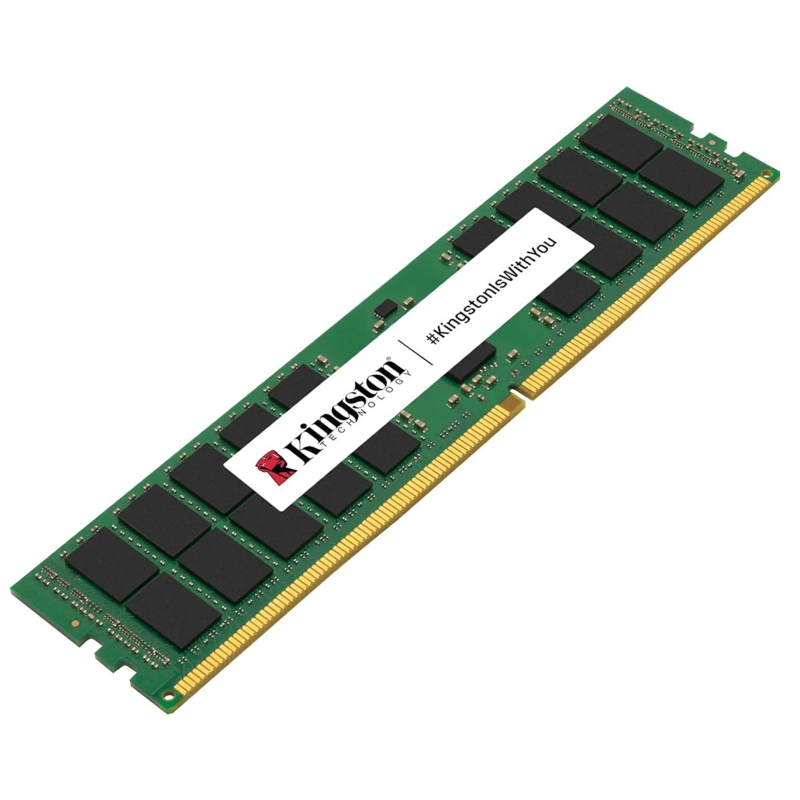
Kingston KTD-PE548D4-64G 64GB PC5-38400 DDR5-4800Mhz ECC Registered CL40 288-Pin DIMM 1.1V Dual Rank Memory Module. New Sealed in Box (NIB) with 3 Years Warranty - Call.
The Kingston KTD-PE548D4-64G is a high-capacity enterprise-grade memory module engineered for servers and professional workstations that demand stability, efficiency, and consistent performance. Built on advanced DDR5 technology, this 64GB RDIMM delivers faster data throughput, improved power efficiency, and enhanced reliability compared to previous-generation memory solutions.
The Kingston KTD-PE548D4-64G 64GB PC5-38400 DDR5-4800MHz ECC Registered memory module belongs to a specialized category of enterprise-class server and workstation RAM designed for reliability, scalability, and long-term operational stability. This category focuses on high-capacity DDR5 RDIMM modules that meet the stringent demands of data centers, virtualization platforms, cloud infrastructures, AI workloads, and mission-critical enterprise systems. DDR5 technology represents a generational leap in memory architecture, delivering higher bandwidth, improved power efficiency, and enhanced error correction capabilities compared to DDR4.DDR5 ECC Registered DIMMs are purpose-built for server motherboards.
The 64GB capacity places the Kingston KTD-PE548D4-64G within a high-density memory category designed for advanced enterprise workloads. High-capacity DDR5 RDIMMs enable servers to handle large datasets, in-memory databases, and complex analytics without excessive reliance on slower storage tiers.This capacity is ideal for modern applications such as virtualization, container orchestration, AI model training, and real-time data processing. By reducing memory bottlenecks, high-capacity modules improve overall system responsiveness and efficiency.
DDR5 Memory
DDR5 memory modules introduce fundamental architectural enhancements that define this category. Compared to previous generations, DDR5 operates with doubled bank groups, increased burst length, and optimized channel efficiency. PC5-38400 memory provides a theoretical bandwidth of up to 38.4GB/s per module, enabling faster data movement across CPUs, accelerators, and storage subsystems. This level of throughput is essential for modern enterprise applications that process large datasets in real time.The DDR5 standard also integrates on-die ECC for internal data integrity, complementing the external ECC functionality of registered modules. Together, these features significantly reduce the risk of data corruption, making DDR5 ECC RDIMMs a foundational component in environments where accuracy and stability are paramount.
Operating at 4800MHz, PC5-38400 memory strikes an optimal balance between performance and compatibility for current-generation server processors. Many enterprise CPUs are optimized for DDR5-4800, ensuring stable operation while delivering substantial performance gains over DDR4-3200. This frequency enables faster memory access, reduced latency in data-intensive tasks, and improved throughput for multi-threaded applications.Within this category, DDR5-4800 RDIMMs are commonly deployed in virtualization clusters, database servers, and enterprise application platforms where predictable memory performance directly impacts overall system efficiency. The CL40 latency specification aligns with DDR5 standards, ensuring consistent timing behavior under load.
Dual rank memory modules, such as the Kingston KTD-PE548D4-64G, offer enhanced performance characteristics by allowing the memory controller to interleave access between ranks. This improves utilization of the memory bus and can lead to higher effective bandwidth in real-world workloads. Dual rank RDIMMs are particularly advantageous in multi-socket server environments where memory access patterns are complex and highly parallelized.The dual rank design also supports higher memory densities per slot, enabling system architects to maximize total system memory without sacrificing stability. This is especially valuable in dense rack-mounted servers and blade systems where physical space and slot availability are limited.
The Kingston KTD-PE548D4-64G utilizes Registered ECC (Error-Correcting Code) technology to ensure superior data accuracy and system stability. ECC memory automatically detects and corrects data errors, reducing the risk of system crashes, corrupted files, and unexpected downtime.
Registered DIMM technology enhances signal integrity by isolating the memory controller from the electrical load of multiple DRAM chips. This allows systems to scale memory capacity without compromising stability. As server platforms evolve to support higher core counts and increased memory channels, RDIMMs remain the preferred choice for scalable architectures.This scalability is particularly relevant for virtualization hosts and hyper-converged infrastructure, where memory capacity directly influences the number of virtual machines and workloads a system can support.
This Kingston DDR5 ECC Registered memory module features a standard 288-pin DIMM form factor, ensuring compatibility with a wide range of DDR5-enabled server and workstation motherboards. It is engineered to meet strict industry standards for quality and reliability.
DDR5 memory introduces improved power efficiency through reduced operating voltage and advanced power management features. Operating at 1.1V, DDR5 RDIMMs consume less power than previous DDR4 modules, contributing to lower overall system energy consumption and reduced heat output.Power efficiency is a critical consideration in data centers, where energy costs and thermal management directly impact operational expenses. This category supports greener IT initiatives while maintaining high performance and reliability.
The 288-pin DIMM form factor is standard for DDR5 memory modules, ensuring compatibility with modern server and workstation motherboards. This standardized design simplifies system integration and upgrades, allowing IT teams to deploy DDR5 memory with confidence.ECC Registered DDR5 DIMMs are supported by enterprise-grade chipsets and processors from leading manufacturers. The Kingston KTD-PE548D4-64G is validated for specific server platforms, reducing compatibility risks and deployment challenges.
CAS latency (CL40) is a standard timing specification for DDR5-4800 memory modules. While numerical latency values are higher than DDR4, the increased clock speed and bandwidth of DDR5 result in comparable or improved real-world performance.This category prioritizes stability and consistency over aggressive latency tuning, aligning with enterprise requirements for predictable performance and reliability.
Enterprise memory categories prioritize reliability and compatibility over marginal performance gains. The Kingston KTD-PE548D4-64G exemplifies this balance, offering high bandwidth, ample capacity, and robust error correction without compromising stability.This approach ensures consistent performance across diverse workloads and operating conditions.


 Contact Us
 Information
 Catalog
 Solid State Drives (SSD)
 Network Switches
 Hard Disk Drives
 HBA & Controllers
 PC & Servers
 PC & Server Memory
 CPU & Processors
 Network Routers
 Power Supplies
 Tape Drives & Libraries
 Network Devices
 Computer & Network Cables