
(7% discount is applied at checkout)
Cart is empty
Your go-to destination for cutting-edge server products
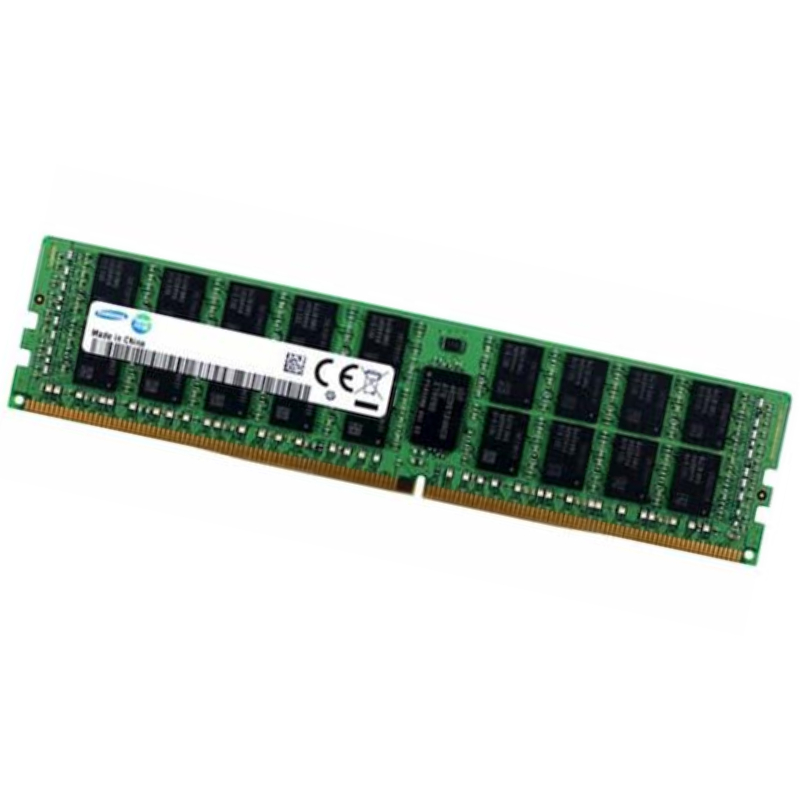
Samsung M321R4GA0PB2-CCP 32GB PC5-51200 DDR5-6400MHz ECC Registered CL 288-Pin DIMM 1.1V Single Rank Memory. New Sealed in Box (NIB) with 3 Years Warranty
This is precisely the domain of server-grade memory modules like the Samsung M321R4GA0PB2-CCP. As a 32GB DDR5-6400MHz ECC Registered (RDIMM), it represents the evolution of server memory technology, engineered for next-generation platforms requiring high bandwidth, massive capacities, and stringent data integrity.
In the realm of enterprise computing, data center reliability, and high-performance workstations, server-grade memory stands as a critical pillar of system stability and throughput. The category of ECC Registered DDR5 memory represents the pinnacle of this technology, designed for servers, advanced workstations, and storage systems where error-free operation and high capacity are non-negotiable. The Samsung M321R4GA0PB2-CCP 32GB module is a quintessential example within this category, engineered to deliver robust performance, exceptional signal integrity, and uncompromising data integrity for mission-critical applications.
The transition from DDR4 to DDR5 memory architecture marks a significant leap in computing capabilities. This category is defined by several fundamental advancements that Samsung's modules fully leverage. The core voltage has been reduced to 1.1V, enhancing power efficiency—a crucial factor for dense server deployments where heat and power draw are primary concerns. More importantly, DDR5 introduces a radical shift in the memory subsystem's architecture by decentralizing the power management integrated circuit (PMIC) from the motherboard to the memory module itself. This allows for more refined voltage regulation and improved signal quality, which is paramount for stability at high data rates like 6400MT/s.
The DDR5 standard bifurcates each DIMM into two independent 32-bit addressable channels (with ECC). While a single DDR4 DIMM offered one 72-bit channel (64 data bits + 8 ECC bits), a DDR5 DIMM like the Samsung M321R4GA0PB2-CCP provides two independent 40-bit sub-channels (32 data bits + 8 ECC bits each). This dual sub-channel architecture effectively doubles the burst length and increases concurrency, reducing latency for memory access patterns common in server workloads such as virtualization, in-memory databases, and scientific computing.
For system administrators and datacenter architects, this architectural shift means that even a single memory module can handle more simultaneous memory requests more efficiently. When populating a server with multiple modules, the increase in aggregate memory bandwidth is substantial, directly accelerating data-intensive tasks and improving overall system responsiveness under heavy multi-user or multi-application loads.
Understanding Samsung's part numbering convention is key to grasping the specifications and placement of this module within the broader memory ecosystem. The model number "M321R4GA0PB2-CCP" is not arbitrary; it is a detailed blueprint of the module's capabilities.
The "M3" prefix indicates a DDR5 memory product. The following "21" denotes the product family and generation. The "R" is crucial—it designates that this is an ECC Registered (RDIMM) module. The "4G" signifies a 4Gb DRAM die density. The "A0" refers to the specific component revision and organization. The "PB2" segment often relates to the module's rank, speed, and voltage configuration—in this case, pointing to its 1.1V operation and 6400MT/s speed grade. Finally, the "CCP" suffix is a family and internal product code for Samsung.
This module offers a 32GB capacity, a versatile size for balancing density and performance. The "Single Rank" designation means all memory chips on the module are accessed simultaneously as one group (or rank). Compared to dual-rank modules, single-rank modules can sometimes allow for higher operating speeds or lower latencies at the same speed because the electrical load on the memory controller is reduced. This makes the Samsung M321R4GA0PB2-CCP an excellent choice for systems where maximizing clock speed is a priority, or for populating many channels without overburdening the server's memory controller.
This memory category is defined by specific technologies that ensure data integrity and system stability beyond what consumer-grade memory provides.
ECC is the cornerstone of server memory reliability. It is a hardware-based technology that detects and corrects the most common kinds of data corruption in real-time. Single-bit errors (where one bit flips state) are corrected on-the-fly without any performance penalty or system interruption. Multi-bit errors (less common) are detected and reported to the system, which can then take preventative action. For databases, financial transactions, scientific research, and any scenario where data accuracy is paramount, ECC is not a luxury—it is an absolute requirement. The Samsung module implements this via the additional 8 ECC bits for every 64 bits of data.
The "Registered" aspect of this Samsung module is equally vital. An RDIMM incorporates a register (or buffer) on the module itself, placed between the memory controller and the DRAM chips. This register buffers the command and address signals, reducing the electrical load on the server's memory controller. This allows a system to support a significantly greater number of memory modules per channel (often 2-3x more than Unbuffered DIMMs) without degrading signal integrity. This is essential for building servers with very high total memory capacities—think 1TB, 2TB, or more—which are standard in virtualization hosts and in-memory computing appliances.
The synergy of ECC and Registered buffering creates an environment of exceptional stability. The RDIMM design ensures clean, stable signals to all memory chips across large, fully-populated systems, while ECC continuously scrubs the data for errors. This combination minimizes the risk of silent data corruption, system crashes, and downtime, directly contributing to higher server availability and data integrity.
The Samsung M321R4GA0PB2-CCP operates at a data rate of 6400 Megatransfers per second (MT/s), marketed under the industry-standard label of DDR5-6400. This speed is a key determinant of available memory bandwidth.
The "PC5-51200" designation is the module's bandwidth classification. It is calculated as (6400 MT/s * 8 bytes per transfer) = 51,200 MB/s (or ~51.2 GB/s) of theoretical peak bandwidth per module. Given its dual sub-channel architecture, this bandwidth is more accessible than in previous generations. The CAS Latency (CL) is specified as CL (not explicitly stated in the part number, but typical for this speed grade). Latency timings are a series of numbers (e.g., CL-) that represent the number of clock cycles between various memory operations. While slightly higher absolute cycle counts than DDR4, the significantly faster clock speed of DDR5 results in lower actual time-based latency (nanoseconds), improving overall responsiveness.
Operating at a nominal voltage of 1.1V, this DDR5 module is more power-efficient than its DDR4 predecessors (typically 1.2V). The on-module PMIC further optimizes power delivery, reducing waste and improving efficiency. Over thousands of modules in a large data center, this reduction in power consumption translates directly into lower operational costs (OPEX) and a reduced thermal load for cooling systems to manage.
The module uses a 288-pin Dual In-Line Memory Module (DIMM) interface. It is physically and electrically incompatible with DDR4's 288-pin design (the key notch is in a different position). This DIMM is specifically designed for servers and workstations supporting the DDR5 ECC Registered standard. System compatibility must be verified with the motherboard or server chassis manufacturer's qualified vendor list (QVL) to ensure tested and validated operation.
Memory modules of this category are not designed for standard desktop PCs. Their value is unlocked in specific, demanding computing environments.
In virtualized environments (using VMware, Hyper-V, KVM, etc.), physical memory is the most critical and often the first exhausted resource. High-density, reliable RDIMMs like the 32GB Samsung module allow for the consolidation of more virtual machines (VMs) onto a single physical host. The ECC protection ensures the stability of all resident VMs, preventing a single bit error from crashing a critical business application.
HPC clusters used for computational fluid dynamics, genomic sequencing, and financial modeling require immense, fast, and error-free memory subsystems. The high bandwidth of DDR5-6400 accelerates data movement between the CPU and memory, a common bottleneck. ECC guarantees the mathematical accuracy of billions of calculations, which is non-negotiable for research validity.
Platforms like SAP HANA, Oracle Exadata, and other in-memory databases store active datasets entirely in RAM. The speed of the memory directly defines transaction throughput and query performance. The capacity and reliability of Samsung's ECC RDIMMs make them foundational building blocks for these high-stakes, real-time analytical and transactional systems where downtime or data corruption has immediate financial consequences.
Large-scale cloud providers and networked storage solutions (NAS/SAN appliances) rely on server-grade memory for cache and operating memory. Fast, high-capacity ECC memory improves read/write cache performance for storage arrays and supports the control plane operations of hyper-scale cloud infrastructure, where reliability at scale is the primary design goal.


 Contact Us
 Information
 Catalog
 Solid State Drives (SSD)
 Network Switches
 Hard Disk Drives
 HBA & Controllers
 PC & Servers
 PC & Server Memory
 CPU & Processors
 Network Routers
 Power Supplies
 Tape Drives & Libraries
 Network Devices
 Computer & Network Cables