
(7% discount is applied at checkout)
Cart is empty
Your go-to destination for cutting-edge server products
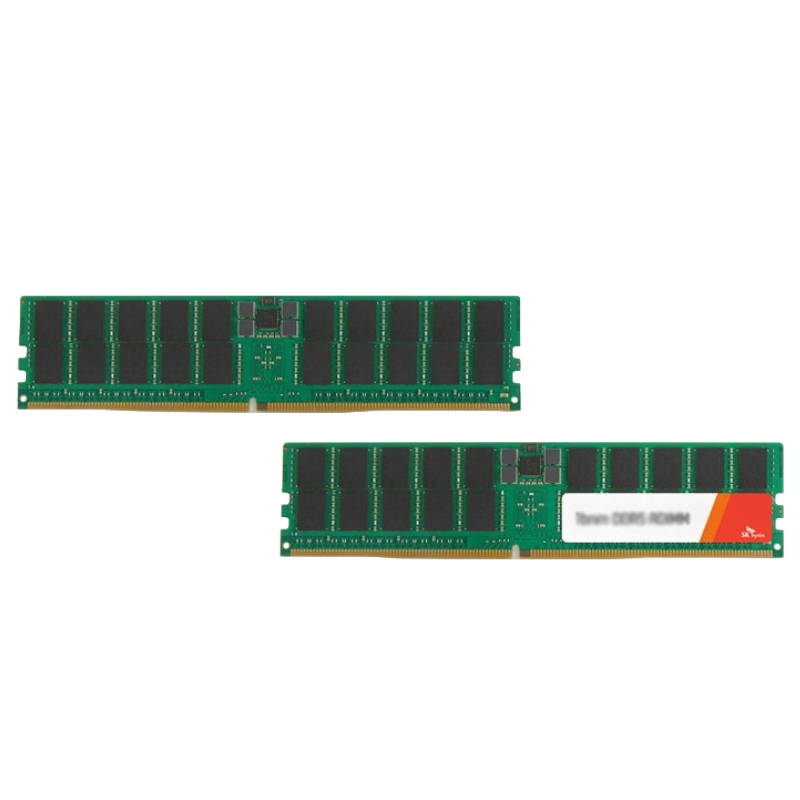
Hynix HMCT04AGERA199N 128GB PC5-44800 DDR5-5600MHz ECC Registered CL46 288-Pin RDIMM 1.1V Dual Rank Memory Module. New (System) Pull with 1 year replacement warranty
| SKU/MPN | Warranty | Price | Condition | You save |
|---|---|---|---|---|
| HMCT04AGERA199N | 1 Year Warranty | $6,240.00 | New Sealed in Box (NIB) | You save: $2,184.00 (26%) |
| HMCT04AGERA199N | 1 Year Warranty | $5,280.00 | New (System) Pull | You save: $1,848.00 (26%) |
DDR5 memory represents a generational shift from DDR4, offering increased base frequencies, higher per-module capacities, and improved power management. Modules such as the Hynix 128GB DDR5-5600 dual rank option reflect this evolution by enabling systems to scale memory footprints without sacrificing bandwidth or signal integrity. This category serves IT professionals, system integrators, cloud infrastructure providers, and enterprise architects who prioritize compatibility with next-generation platforms and long-term deployment stability.
The HMCT04AGERA199N Hynix 128GB PC5-44800 DDR5-5600MHz Dual Rank Memory belongs to a specialized category of high-capacity DDR5 memory modules designed to meet the demanding requirements of modern server, data center, and professional workstation environments. This category focuses on stability, scalability, bandwidth efficiency, and long-term reliability rather than consumer-oriented aesthetics or overclocking features. Memory solutions in this segment are engineered to support multi-core processors, dense virtualization, large in-memory datasets, and mission-critical workloads that depend on predictable performance under sustained load.
High-capacity modules are a defining feature of this category. A 128GB DDR5 memory module allows system builders to achieve substantial total memory capacity using fewer DIMM slots, which can be critical in dense server configurations. This enables more efficient use of motherboard layouts and supports higher memory per CPU ratios, especially in dual-socket and multi-socket systems where memory channels are shared across multiple cores.
The ability to deploy 128GB per module reduces the need for populating all available slots, which can improve airflow, simplify system upgrades, and reduce overall power draw per gigabyte. This category is particularly relevant for virtualization platforms, large-scale databases, analytics engines, and in-memory caching systems where memory footprint directly impacts performance and scalability.
Dual rank memory modules are engineered with two logical sets of memory ranks on a single DIMM. This design allows memory controllers to interleave access between ranks, improving overall data throughput and utilization efficiency. In server-class environments, dual rank configurations often provide better real-world performance than single rank alternatives, especially under multi-threaded workloads.
Within this category, dual rank DDR5 modules such as the Hynix HMCT04AGERA199N are optimized for balanced performance and compatibility. They support stable operation at high frequencies while maintaining the electrical characteristics required by modern CPUs. This makes them suitable for platforms that benefit from rank interleaving, including virtualization hosts and enterprise application servers.
PC5-44800 denotes a theoretical peak bandwidth of 44.8GB/s per module, a substantial increase over DDR4 standards. This elevated bandwidth is essential for feeding data-hungry processors with dozens of cores and simultaneous threads. In this category, memory bandwidth is a key performance determinant, particularly for workloads such as scientific simulations, AI model inference, video rendering, and high-frequency transaction processing.
DDR5-5600MHz memory enables faster data transfer rates while maintaining signal integrity through improved channel architecture and on-module power management. Systems equipped with modules in this category benefit from reduced latency bottlenecks when accessing large datasets, leading to more consistent application responsiveness and throughput under load.
One of the defining characteristics of DDR5 memory is the relocation of power management circuitry from the motherboard to the memory module itself. This category leverages on-module power management integrated circuits to deliver more precise voltage regulation. As a result, DDR5-5600 modules can operate at higher speeds with improved power efficiency compared to previous generations.
For data centers and enterprise environments, power efficiency is a critical consideration. Memory modules in this category are designed to minimize wasted energy while maintaining stable performance. This contributes to lower operational costs, reduced thermal output, and improved system reliability over extended deployment periods.
Hynix is recognized globally for its semiconductor manufacturing expertise, particularly in memory technologies. Modules within this category are built using high-quality DRAM chips that undergo rigorous testing and validation. The focus on component consistency ensures predictable behavior across large deployments, which is essential for enterprise-scale installations.
The HMCT04AGERA199N module reflects the broader category’s emphasis on reliability. Memory used in servers and professional workstations must withstand continuous operation, thermal cycling, and sustained data access patterns. Hynix-designed modules are validated to meet these expectations, making them suitable for environments where downtime is not acceptable.
Memory modules in this category are subjected to extensive quality control procedures, including functional testing, stress testing, and compatibility validation across supported platforms. These processes help ensure that each module meets specification requirements for speed, capacity, and stability. This is particularly important for high-capacity DDR5 modules, where signal integrity and thermal performance are more challenging to manage.
System integrators and IT administrators rely on this category because validated memory reduces the risk of deployment issues, data corruption, or system instability. By choosing modules that adhere to strict manufacturing and validation standards, organizations can deploy infrastructure with greater confidence.
The DDR5 memory category is designed to align with the latest CPU architectures that support DDR5 memory standards. This includes modern server and workstation processors that feature increased core counts, expanded memory channels, and enhanced memory controllers. Modules such as the Hynix 128GB DDR5-5600 dual rank option are engineered to operate within these specifications.
Compatibility extends beyond raw electrical support to include firmware and BIOS recognition, proper SPD programming, and adherence to JEDEC standards. This ensures that memory modules in this category can be deployed seamlessly in supported systems without extensive manual tuning or configuration.
Enterprise and professional environments often require systems to remain in service for many years. Memory modules in this category are designed with long-term platform support in mind. Manufacturers focus on maintaining consistent specifications and availability, allowing organizations to expand or replace memory without introducing compatibility concerns.
This approach supports lifecycle management strategies where systems are upgraded incrementally rather than replaced entirely. By selecting DDR5 memory from a stable category, IT teams can plan for future capacity expansions while maintaining homogeneous system configurations.
Virtualization platforms benefit significantly from high-capacity, high-bandwidth memory. The ability to allocate large amounts of RAM to multiple virtual machines directly impacts consolidation ratios and performance isolation. Modules like the Hynix 128GB DDR5-5600 dual rank memory are well-suited for this category, enabling hosts to support more workloads simultaneously.
Cloud infrastructure providers also rely on this category to deliver consistent performance across shared environments. High-density memory reduces the physical footprint of servers while supporting diverse workloads, from web services to containerized applications and database clusters.
Data analytics platforms and in-memory computing frameworks depend on fast access to large datasets. Memory-intensive operations such as real-time analytics, graph processing, and machine learning inference benefit from the bandwidth and capacity provided by DDR5-5600 modules. This category supports these use cases by minimizing data transfer bottlenecks and enabling large working sets to reside entirely in memory.
Organizations deploying analytics solutions can leverage this category to improve query performance, reduce processing latency, and support more complex analytical models. The combination of high capacity and high speed makes these modules a foundational component of modern data-driven architectures.
Beyond traditional servers, this memory category is also relevant for high-end professional workstations used in engineering, simulation, and content creation. Applications such as CAD, 3D rendering, video production, and scientific modeling often require large memory pools to handle complex projects efficiently.
By utilizing 128GB DDR5 modules, workstation users can maintain responsive performance even when working with large files or running multiple demanding applications concurrently. The reliability and stability characteristics of this category make it suitable for professional environments where productivity and data integrity are paramount.
Many memory modules in this category are designed to support error correction capabilities when paired with compatible platforms. Error correction mechanisms help detect and correct memory errors that can occur due to electrical interference, cosmic radiation, or component aging. This is especially important in environments where data accuracy is critical.
By selecting memory from this category and deploying it in systems that support error correction, organizations can enhance system reliability and reduce the risk of data corruption. This contributes to overall system uptime and trustworthiness, particularly in enterprise and research settings.
Memory modules in this category are engineered to maintain stability under continuous, high-load conditions. Unlike consumer-grade memory, which may prioritize peak performance for short durations, enterprise-focused DDR5 modules are validated for sustained operation. This includes long-running workloads, high utilization rates, and elevated thermal conditions.
This focus on stability ensures that systems equipped with such memory can operate reliably around the clock. For businesses and institutions that depend on continuous service availability, this characteristic is a critical factor in hardware selection.
High-capacity DDR5 modules generate more heat than lower-density alternatives due to increased component count and operating frequencies. This category addresses thermal challenges through careful component layout, optimized PCB design, and compatibility with standard server airflow patterns.
System integrators must consider memory cooling as part of overall system design. Modules such as the Hynix 128GB DDR5-5600 dual rank memory are intended to operate within specified thermal envelopes when deployed in properly designed enclosures with adequate airflow.
Memory modules in this category are designed to conform to industry-standard DIMM form factors and mechanical specifications. This ensures compatibility with a wide range of server and workstation chassis. Proper mechanical fit and electrical alignment are essential for maintaining signal integrity and preventing physical stress on components.
By adhering to standardized designs, this category enables straightforward integration into existing infrastructure. This simplifies deployment, maintenance, and future upgrades, supporting efficient IT operations across diverse environments.
Organizations deploying memory at scale require consistency across batches and production runs. This category emphasizes standardized specifications and controlled manufacturing processes to deliver predictable performance characteristics. Consistency reduces the complexity of managing large inventories and ensures uniform behavior across systems.
For procurement teams, this translates into simplified sourcing and reduced risk. Selecting memory modules from a well-defined category allows organizations to standardize on specific configurations, streamlining deployment and support processes.


 Contact Us
 Information
 Catalog
 Solid State Drives (SSD)
 Network Switches
 Hard Disk Drives
 HBA & Controllers
 PC & Servers
 PC & Server Memory
 CPU & Processors
 Network Routers
 Power Supplies
 Tape Drives & Libraries
 Network Devices
 Computer & Network Cables